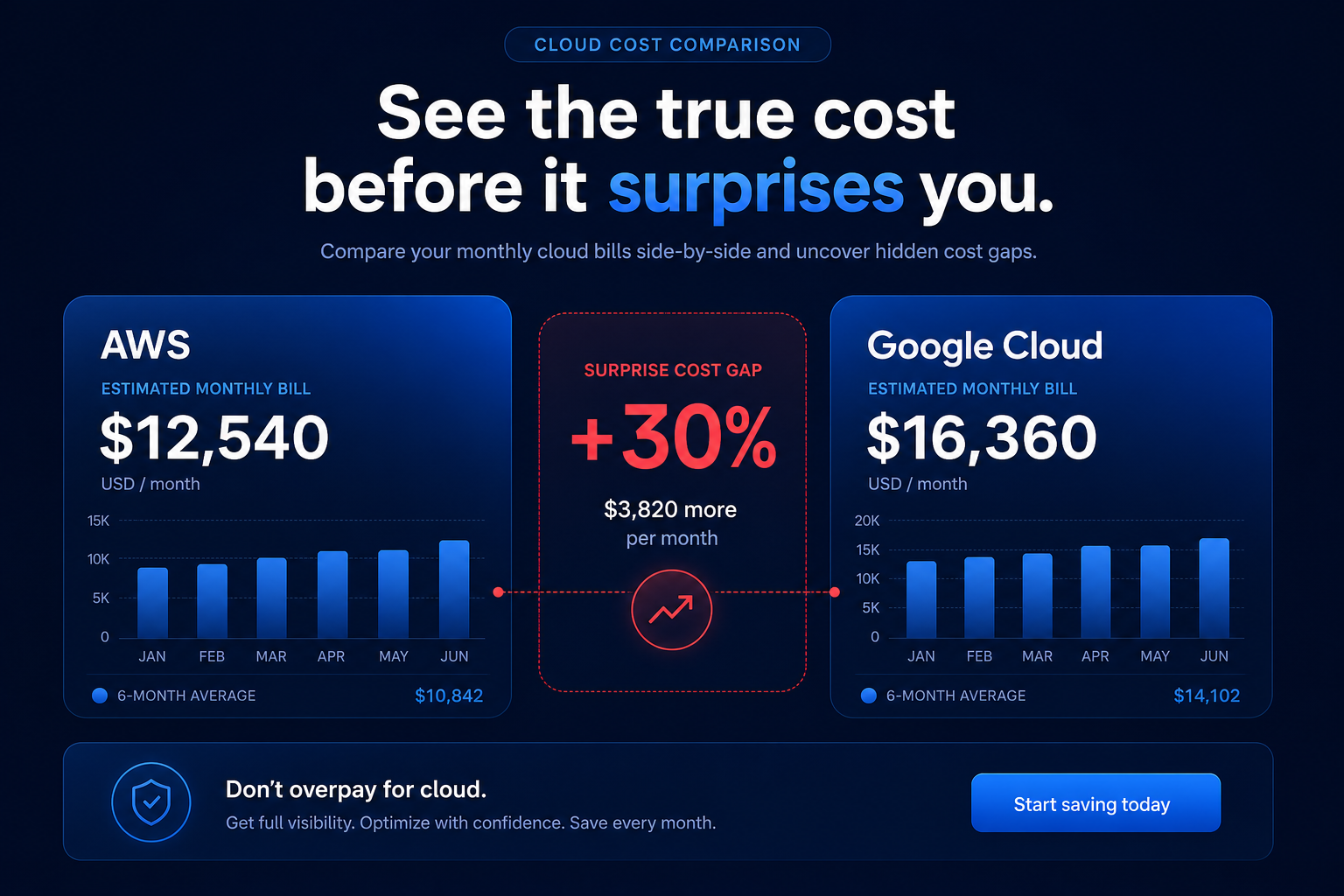
Most businesses choose a cloud provider based on brand recognition, only to realize their monthly bill is 30% higher than projected. While Google Cloud often markets itself as the price leader, the reality of cloud billing depends entirely on architectural choices and AWS rate optimization strategies.
Compute pricing: EC2 vs. Compute Engine
Compute costs represent the largest portion of most cloud bills. AWS and Google Cloud (GCP) approach compute pricing through fundamentally different philosophies. AWS uses a mix of On-Demand, Spot Instances, and Savings Plans, while GCP relies on Committed Use Discounts (CUDs) and Sustained Use Discounts (SUDs).
For general-purpose workloads, On-Demand pricing is competitive. A standard 2-CPU Linux instance on AWS costs approximately $0.100 per hour, compared to $0.107 per hour on Google Cloud. However, the gap can widen for compute-optimized workloads, where GCP instances sometimes offer lower rates before any commitments are applied.
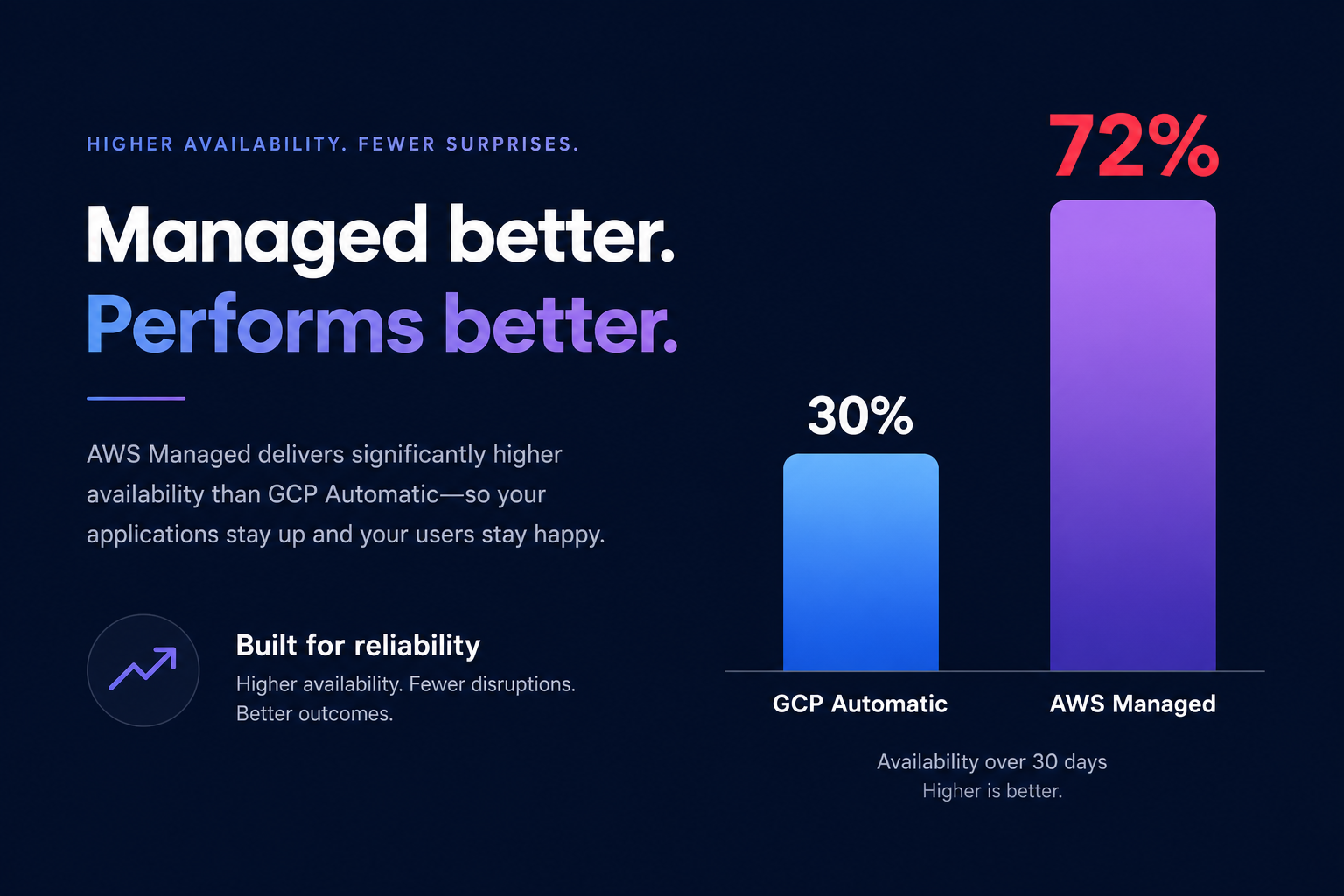
The real differentiator lies in how these providers reward usage patterns. GCP’s Sustained Use Discounts are automatic, providing up to a 30% net discount for VMs that run for an entire month without requiring manual setup. Conversely, AWS offers deeper maximum discounts – up to 72% via Compute Savings Plans – but these require active management. To bridge this gap, Hykell automates the selection and management of these instruments, ensuring you hit that 72% ceiling without the engineering overhead.
Storage costs and lifecycle management
Storage pricing appears straightforward, but request fees and data retrieval costs often hide the true expense. For standard object storage, Google Cloud lists regional storage at $0.020 per GB per month, while Amazon S3 Standard pricing begins at $0.023 per GB.
While GCP has a slight edge in raw per-GB pricing, AWS provides a more mature ecosystem for cost-effective object storage. S3 Intelligent-Tiering automatically moves data between access tiers, which often results in lower effective costs than GCP for unpredictable access patterns. Furthermore, for block storage, EBS optimization is critical for performance-heavy applications. AWS gp3 volumes offer decoupled performance and capacity, allowing you to pay only for the IOPS you actually use, whereas GCP’s persistent disks often require scaling capacity just to increase throughput.
For businesses operating across both platforms, understanding GCP cloud storage optimization is vital for specific use cases. However, for high-scale AWS users, focusing on S3 lifecycle policies and automated EBS tuning usually yields the highest return on investment.
Networking and the egress trap
Networking is the most frequent source of “bill shock.” Both providers offer free inbound data transfer, but outbound transfer (egress) to the internet is where costs balloon.
AWS typically charges starting at $0.09 per GB for the first 10 TB of egress. GCP’s pricing is more tiered; its Premium Tier starts at $0.12 per GiB, while its Standard Tier using the public internet is significantly cheaper at $0.02 per GiB.
Load balancing also presents a cost variance:
- AWS Application Load Balancers (ALB) charge $0.0225 per hour plus LCU-hour fees.
- GCP’s global external Application Load Balancers charge $0.025 per hour for the first five forwarding rules.
- AWS users often face costs from cross-Availability Zone (AZ) data transfer, billed at $0.01 per GB in each direction.
Hykell’s observability platform tracks these inter-zone costs in real time, identifying architectural inefficiencies that generic billing tools miss.
Commitment models: Savings Plans vs. CUDs
The choice between AWS Savings Plans vs. GCP CUDs is a choice between flexibility and simplicity. AWS Savings Plans cover a wide range of services, including EC2, Fargate, and Lambda, making them ideal for modern, containerized architectures. GCP’s resource-based CUDs can be more restrictive, often tying you to specific machine types in exchange for a commitment.
If you are running a startup, the AWS vs GCP startup comparison often favors AWS due to credit programs like AWS Activate. As you scale, the ability to leverage AWS ARM vs. x86 pricing becomes a major competitive advantage. Migrating to Graviton instances can reduce your compute costs by up to 40% with better price-performance than standard x86 chips. Hykell specializes in accelerating Graviton gains, providing the automated lifecycle management needed to move workloads without disrupting operations.
Determining the most cost-effective provider is not just about looking at a static price list; it is about how much of the maximum available discount you actually capture. While Google Cloud’s automatic discounts are convenient, they often leave money on the table compared to a fully optimized AWS environment. Hykell removes the manual burden of this optimization, delivering up to 40% savings on AWS through automated rate management and resource rightsizing.
To see exactly how much you could be saving on your current infrastructure, use the Hykell cloud cost calculator for a detailed breakdown of your potential ROI.