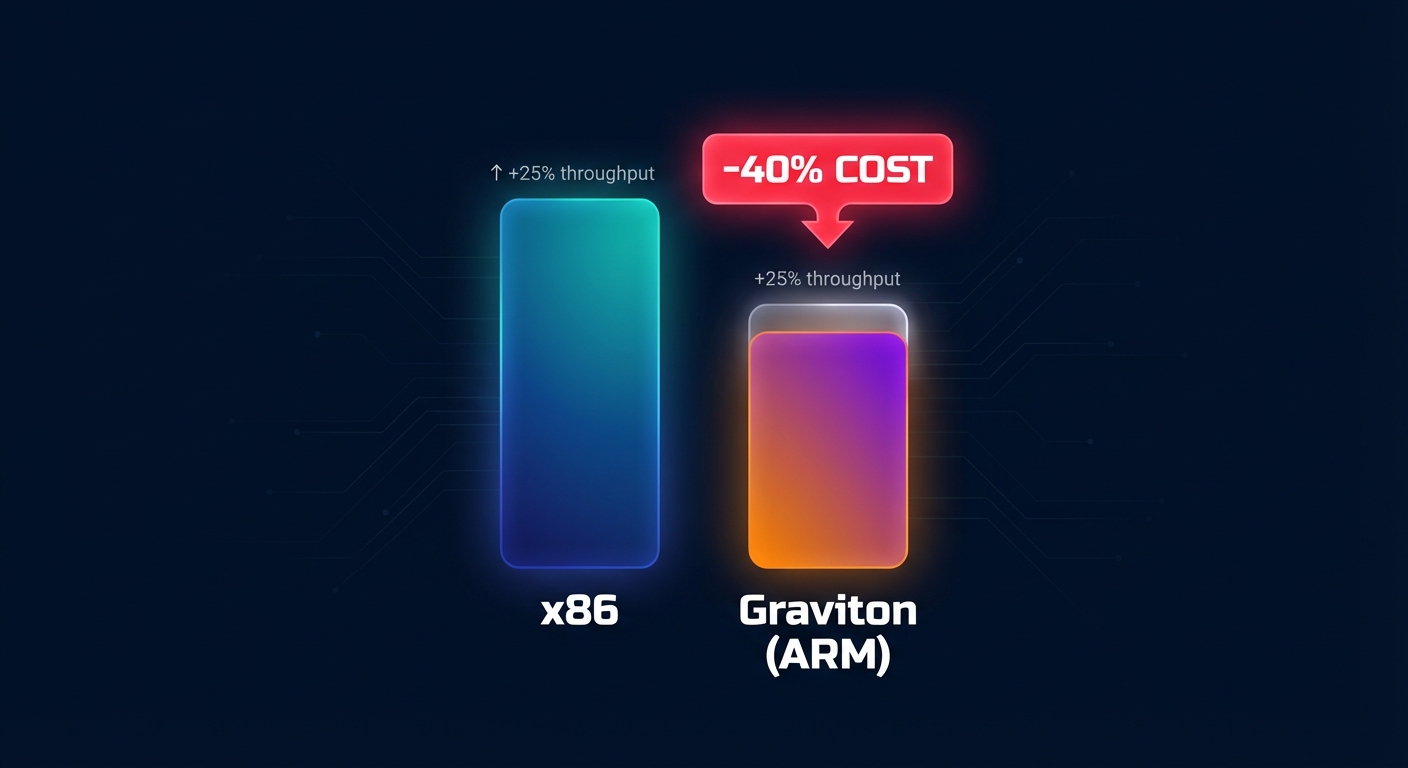
Can you slash compute costs by 40% simply by switching processor architectures? AWS Graviton instances often deliver significantly better price-performance than their Intel counterparts, making them a cornerstone for modern FinOps strategies.
For FinOps teams and engineering leaders, the decision between architectures is about more than just hourly rates. While AWS Graviton (ARM64) instances typically cost 20% less per hour than Intel (x86) equivalents, the true value lies in how much work they perform per dollar. Research indicates that performance benchmarking for AWS Graviton instances reveals a consistent 25% to 40% improvement in computational efficiency for most cloud-native workloads.
The vCPU secret: Why ARM scales differently
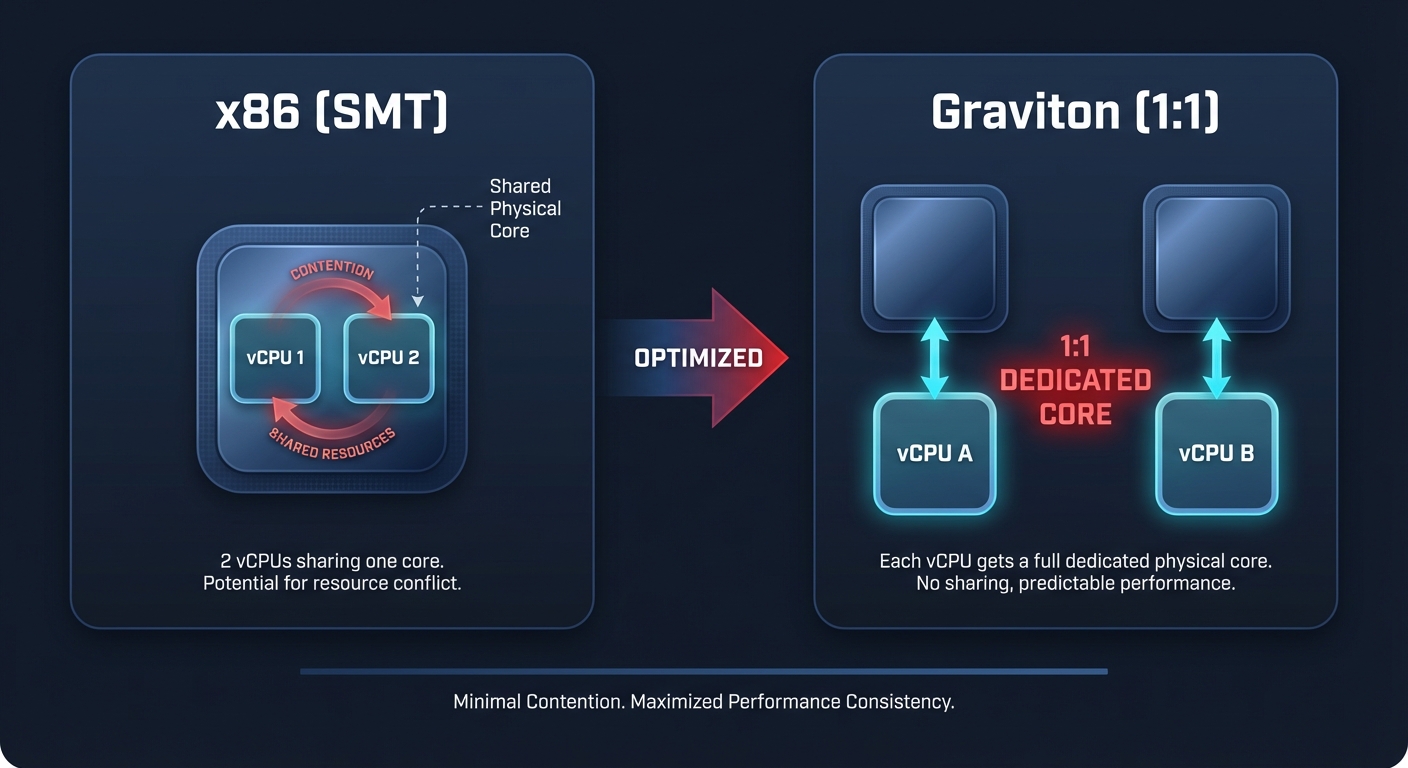
To understand the cost gap, you must look at the underlying silicon. Traditional x86 processors from Intel and AMD use Simultaneous Multithreading (SMT), often called Hyperthreading. In this model, one physical core is split into two virtual CPUs (vCPUs), which can lead to resource contention. This architecture often results in “noisy neighbor” effects where two threads compete for the same execution resources.
By optimizing EC2 workloads with Graviton instances, you benefit from a 1:1 vCPU-to-physical-core mapping. Every vCPU you pay for is a dedicated physical core with its own cache. For multi-threaded applications like microservices or web servers, this provides more consistent performance. Furthermore, Graviton3 and Graviton4 deliver massive boosts in memory bandwidth compared to Intel Xeon instances, allowing data-heavy applications to process information faster.
Benchmarking the performance gap
When comparing the cost between Graviton and Intel instances, benchmarks favor ARM for modern tasks. Recent performance tests show that Graviton4-based EC2 instances can deliver up to 40% lower total cost of ownership compared to Intel Xeon 5th Gen instances. The efficiency gains are even more pronounced in specialized fields:
- For machine learning, Graviton4 achieves 53% faster XGBoost training times than AMD and 34% faster than Intel.
- In generative AI testing, Llama 3.1 8B model inference showed Graviton4 delivering 168% higher token throughput than AMD EPYC.
- General compute tasks like data compression see consistent boosts, with Graviton4 outperforming Intel Sapphire Rapids in 7-Zip benchmarks.
These efficiencies translate directly to the bottom line. A compute-heavy workload that costs $182,000 annually on Intel can often run for just $91,000 on Graviton when factoring in both the lower hourly rates and the increased performance per core.
AWS Lambda: Graviton vs. x86
For serverless deployments, the choice is even clearer. AWS Lambda functions powered by Graviton2 or Graviton3 are priced roughly 20% lower than x86 equivalents. According to Serverless Land, you can see up to 34% better price-performance by making the switch to ARM.
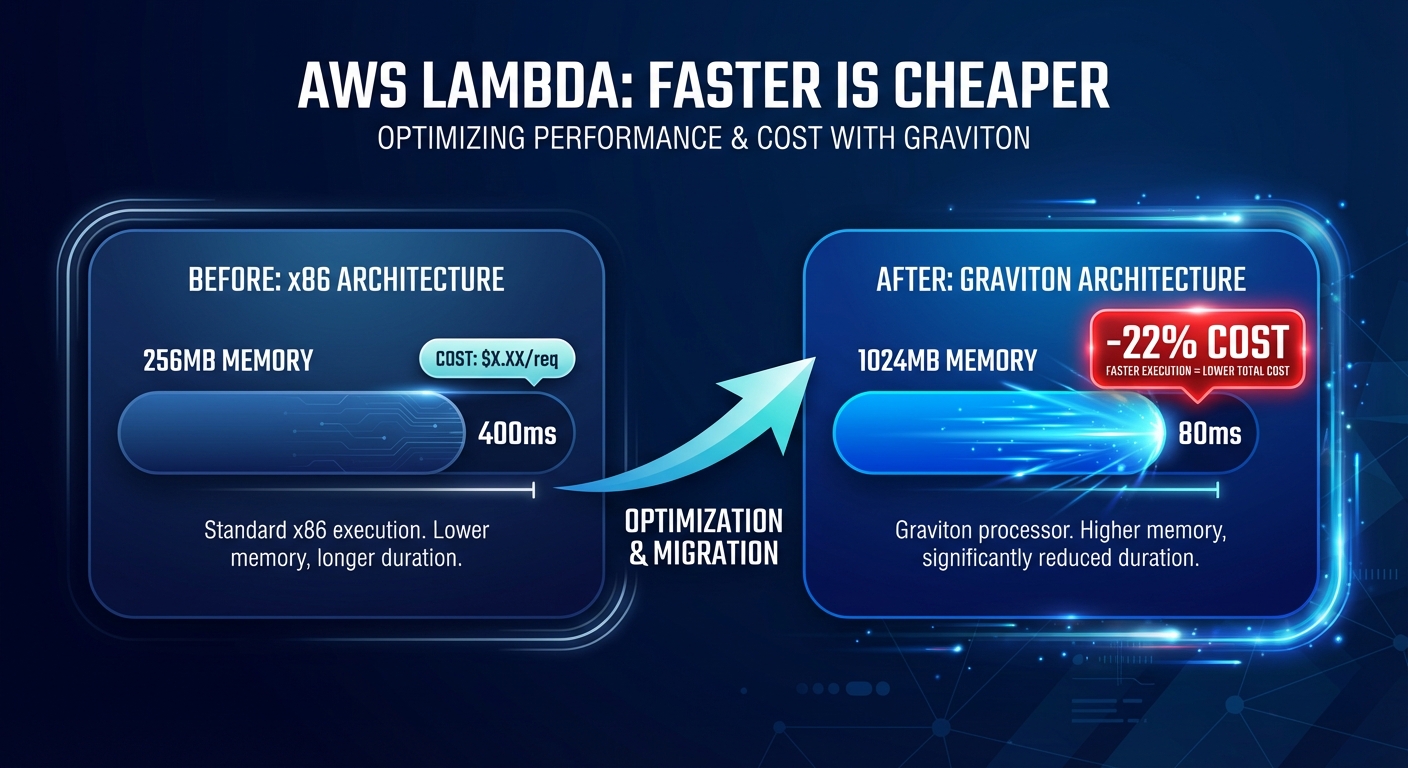
Because Lambda scales CPU power linearly with memory, many AWS Lambda cost reduction techniques involve moving to ARM to capture structural savings. For example, an order processing function might run for 400ms on a 256MB x86 Lambda. By switching to a 1024MB Graviton Lambda, you might reduce the duration to just 80ms. Even though you allocated more memory, the speed boost combined with lower ARM pricing results in a 22% total cost reduction per invocation.
When x86 still makes financial sense
Despite the high performance-to-dollar ratio, Graviton is not a universal replacement. You should generally stick with x86 architecture if your environment requires Windows Server, as Graviton is currently a Linux-only playground.
Legacy binaries also present a hurdle. If your application relies on proprietary x86-only binaries or specialized Intel instruction sets like AVX-512 that haven’t been ported to ARM, the effort of emulation often negates any potential savings. In these cases, an EC2 instance type selection guide might suggest AMD instances, which are typically 10% cheaper than Intel while maintaining x86 compatibility.
Accelerate your transition with Hykell
The biggest barrier to Graviton adoption is the engineering effort required to identify compatible workloads and benchmark them accurately. Manually migrating applications can take months of trial and error as you audit dependencies and rebuild container images.
Hykell removes this guesswork through our specialized migration acceleration program. Our platform analyzes your environment to identify low-risk, high-reward migration candidates – like stateless web tiers and containerized microservices – on autopilot. We help you layer Graviton’s architectural savings on top of AWS rate optimization to ensure your Savings Plans and Reserved Instances are always working at maximum efficiency.
Most Hykell clients see a 40% reduction in their total AWS bill without their engineers having to manually right-size a single instance. If you are ready to see how much you could save by making the switch, try our savings calculator. We only take a slice of what we save you – if you don’t save, you don’t pay.