Are you overpaying for compute simply because you are stuck on x86 architecture? For most engineering teams, switching from Intel to Graviton is the most direct path to reduce cloud expenses by up to 40% while actually increasing application throughput and performance.
Understanding the 1:1 architectural advantage
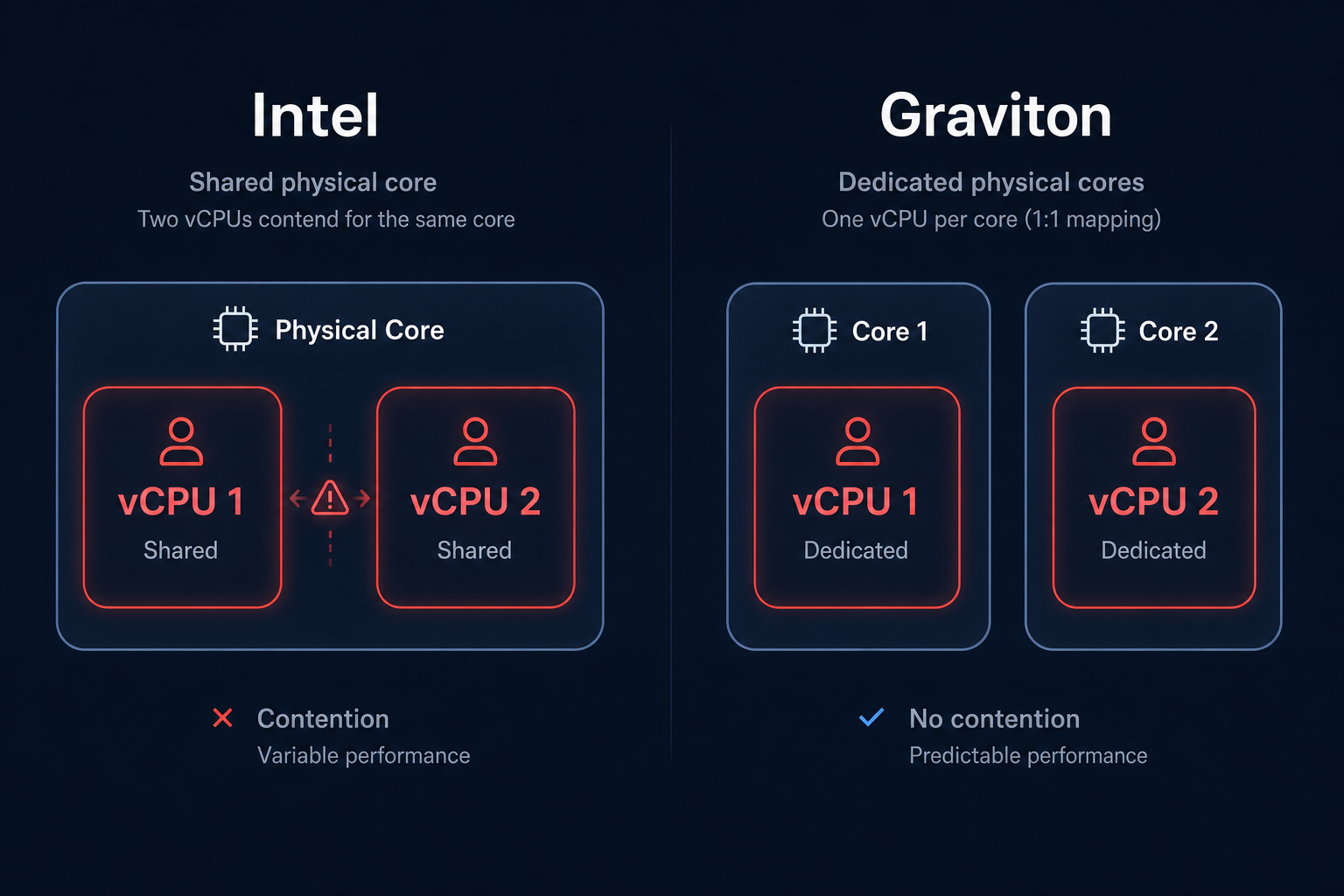
The core performance difference between Graviton and Intel lies in the mapping of virtual CPUs (vCPUs) to physical hardware. Intel Xeon processors traditionally utilize hyperthreading, where a single physical core is split into two logical vCPUs. While effective for general multitasking, this often leads to resource contention under heavy load as two threads compete for the same execution units.
AWS Prescriptive Guidance highlights that Graviton instances map one vCPU to one dedicated physical core. This architectural shift provides more predictable performance for multi-threaded workloads, ensuring your application doesn’t suffer from “noisy neighbor” effects at the hardware level. This is a primary reason why optimizing EC2 workloads with Graviton instances often results in higher throughput even when clock speeds appear lower on paper.
Benchmarking performance: Graviton4 vs Intel Xeon
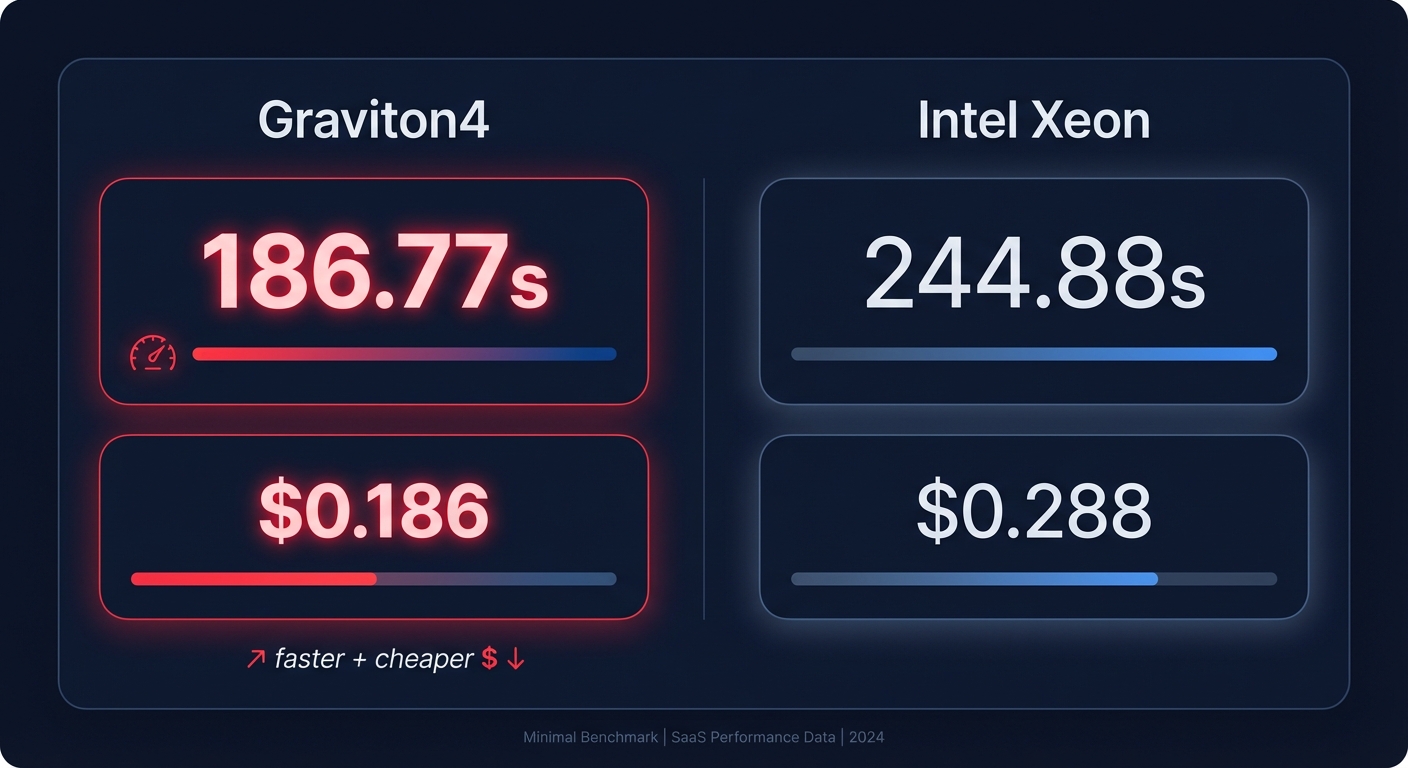
Recent benchmarks indicate that the performance gap is widening in favor of ARM-based silicon. In heavy compilation tasks like Gem5, Graviton4 completed workloads in roughly 187 seconds at a cost of $0.186 per run. In contrast, the Intel Xeon 8488C required 245 seconds and cost approximately $0.288 per run. This represents a massive gain in both speed and cost efficiency for DevOps teams.
Detailed cloud performance benchmarking also reveals significant leads in memory-intensive environments. For instance, the r8g.2xlarge (Graviton4) achieved a SPECint2017_base score of 48.2, outperforming the r7i.2xlarge (Intel Xeon 5th Gen), which scored 40.8. Furthermore, PostgreSQL 16 performance on Graviton4 demonstrates up to 29% lower latency compared to Graviton2, making it an ideal choice for high-traffic database clusters. While Intel maintains a lead in specific single-threaded cryptographic tasks, Graviton’s use of DDR5-5600 memory offers superior bandwidth for real-time analytics and in-memory databases.
The pricing mechanics of migration
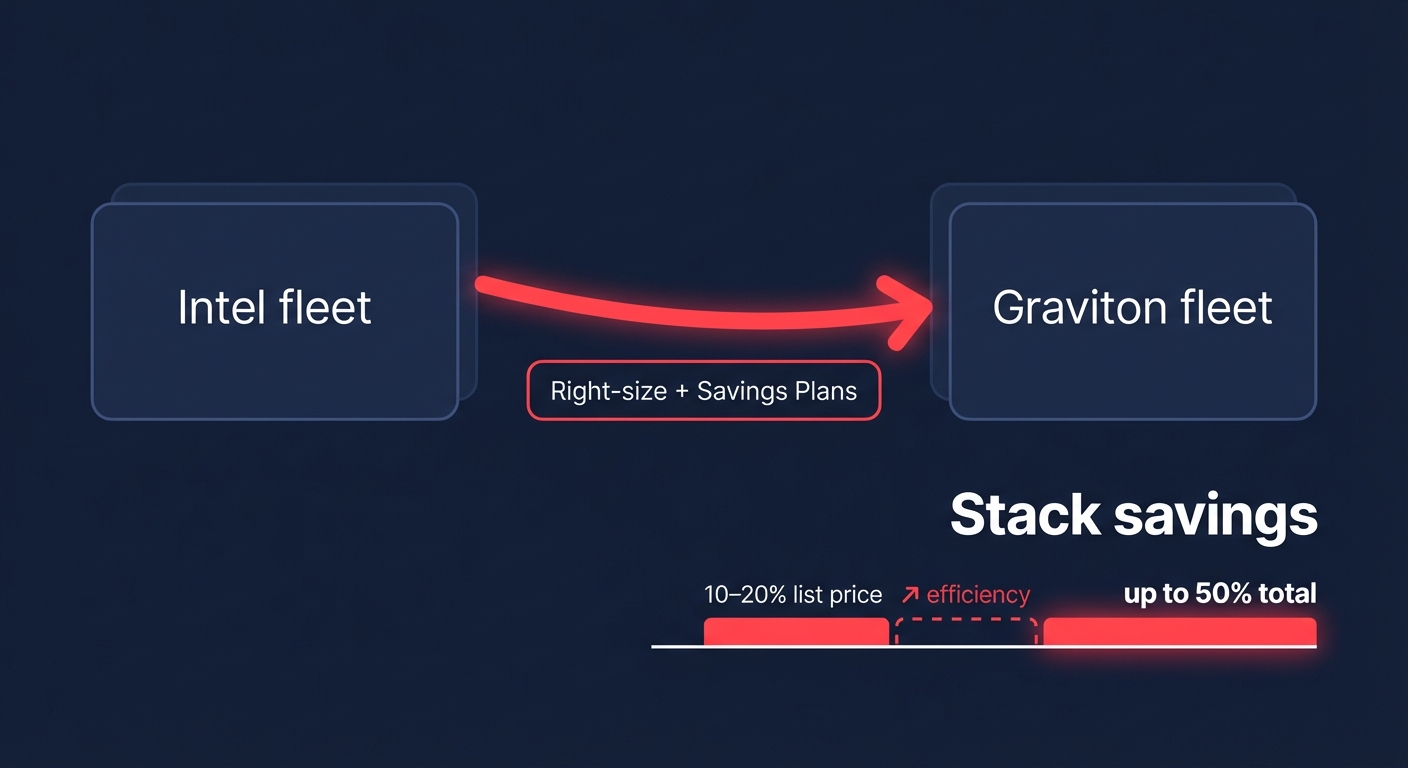
When evaluating AWS ARM vs x86 pricing, the on-demand list price for Graviton is typically 10–20% lower than comparable Intel instances. However, the true ROI comes from price-performance improvements. Because Graviton delivers more work per vCPU for modern workloads, you can often right-size your fleet, moving from a larger Intel instance to a smaller Graviton instance without sacrificing response times.
These savings stack with other financial strategies. By layering Graviton’s lower base cost with AWS rate optimization – such as Savings Plans or Reserved Instances – organizations frequently see total compute bill reductions exceeding 50%. This combined approach of architectural efficiency and automated commitment management is the most effective way to maximize your cloud budget.
When to migrate and when to stay on Intel
Migration is highly effective for modern, cloud-native applications, but it is not a universal solution. You should prioritize workloads that use interpreted languages like Python, Java, Node.js, or Go, as these runtimes have mature ARM64 support and typically require zero code changes.
However, certain constraints may necessitate staying on x86 architecture:
- Windows Server is currently not supported on Graviton instances.
- Applications relying on proprietary x86 binaries or specialized Intel instruction sets lack ARM64 versions.
- Strictly single-threaded workloads may still see a slight performance edge on high-clock Intel Xeon processors.
For the majority of Linux-based microservices and CI/CD pipelines, the compatibility of software with AWS Graviton is high enough that the migration pays for itself within weeks. Following best practices for Graviton instances, such as using ARM-optimized compilers and updated Amazon Machine Images (AMIs), ensures you capture the full 40% performance-per-dollar advantage.
Maximizing your compute ROI with Hykell
A successful transition to Graviton requires more than a simple instance swap; it requires a data-driven strategy to avoid leaving savings on the table. Many teams capture the initial 20% savings from the architecture switch but miss the additional 20% available through proper right-sizing and commitment rebalancing.
Hykell removes the manual burden of this transition by providing automated cloud cost optimization. We perform side-by-side cost comparison between Graviton and Intel instances to identify which workloads will benefit most from ARM64. Our platform manages your rate optimization on autopilot, ensuring your Savings Plans align perfectly with your new architecture.
You can visualize the potential impact on your infrastructure with our cost savings calculator. Through Hykell’s observability dashboard, you gain real-time visibility into your effective savings rate and performance metrics. Because Hykell only takes a slice of what you actually save, there is zero risk to your engineering budget.
Ready to stop overpaying for x86 compute? Start your audit with Hykell today and reduce your AWS bill by up to 40% without the manual engineering overhead.