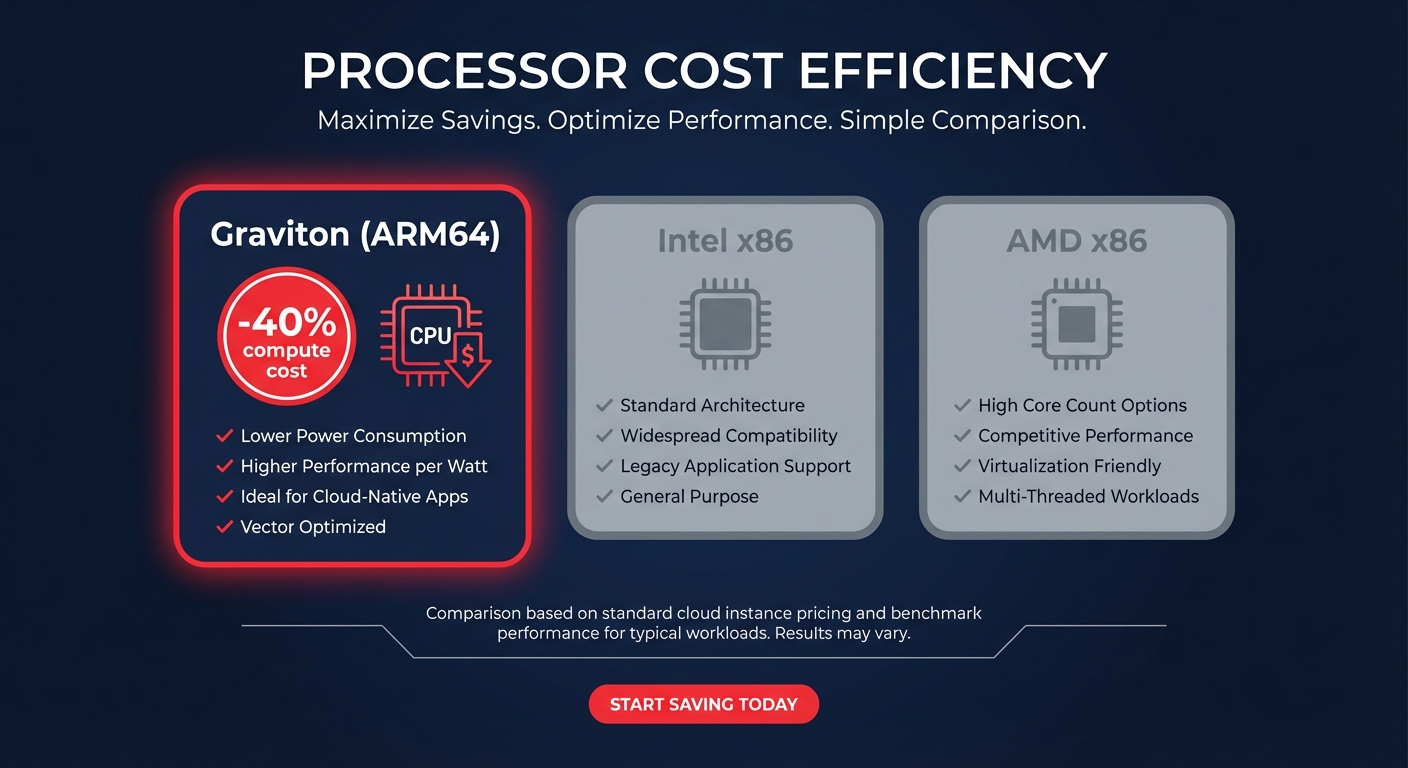
Is your AWS bill climbing while performance plateaus? Switching from Intel or AMD to AWS Graviton isn’t just a technical preference – it’s a financial move that can slash your compute spend by 40% while maintaining or even increasing application speed.
Engineering leaders often stick with Intel (x86) because it is familiar, but staying in your comfort zone is expensive. As cloud-native architectures evolve, the performance-to-price gap between Amazon’s custom silicon and traditional processors has become too wide to ignore.
The architectural showdown: ARM vs x86
The primary difference lies in how these processors handle tasks. Intel and AMD use the x86 architecture, which relies on Simultaneous Multithreading (SMT) or hyperthreading. This presents two virtual cores (vCPUs) for every one physical core. While this is effective for certain operations, it can lead to resource contention that degrades performance under heavy load.
In contrast, AWS Graviton instances are built on the ARM64 architecture. In a Graviton-powered environment, one vCPU maps directly to one physical core. This design provides more consistent performance for multi-threaded workloads because there is no contention for core resources between threads. This ensures that your applications run more predictably when traffic spikes, though you may encounter multi-architecture support challenges with Graviton if you are managing a hybrid environment.
Performance benchmarks: Graviton vs Intel vs AMD
When you evaluate these processor families, you will find that the best chip depends entirely on your specific workload. Graviton2 and Graviton3 instances currently serve as the price-performance leaders, offering 40% better price-performance than Intel C5 instances and 23% better than AMD C5a instances when CPU resources are fully utilized. You can find more detail in our report on performance benchmarking for AWS Graviton instances.
The gains are even more pronounced in the newest generations. Graviton4 is approximately 30% faster than its predecessor, with some customer benchmarks showing real-world performance increases of up to 45% for large Java applications. However, Intel and AMD still hold distinct advantages in certain niches. For single-threaded speed, x86 instances can offer up to 14% better price-performance than older Graviton generations. Intel also demonstrates a significant advantage in MySQL read throughput on larger instances with 48 to 64 vCPUs.
The cost-efficiency breakeven point
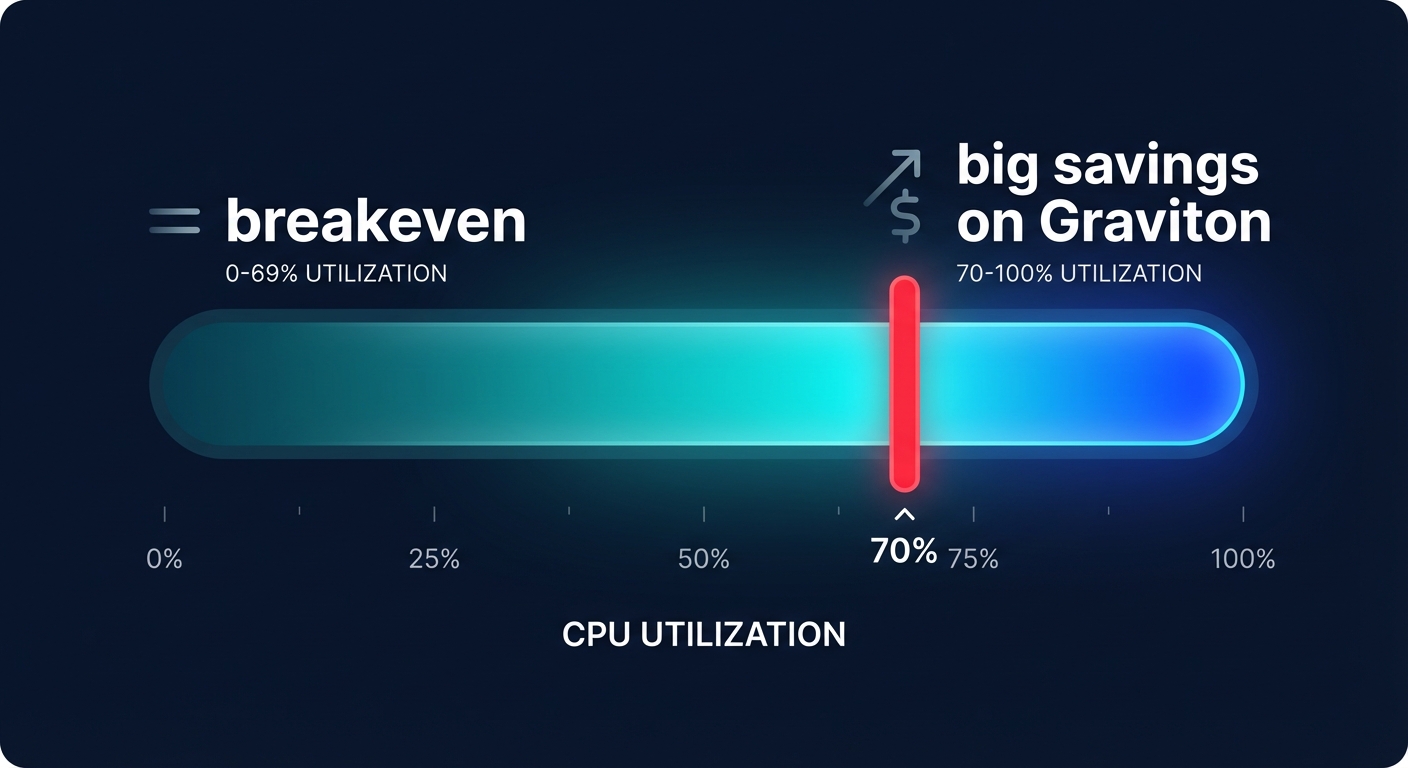
On a raw hourly basis, Graviton instances typically cost 18% to 20% less than equivalent Intel instances. The real financial impact, however, is dictated by how hard you push your hardware. For a deep dive into the numbers, review our guide on AWS ARM vs x86 pricing. Research indicates the breakeven point for Graviton is approximately 70% CPU utilization. Benefits become significantly more apparent above this threshold, making Graviton the clear winner for steady-state, high-demand applications like microservices and data processing.
If you are not yet ready to migrate to Graviton instances, AMD serves as an excellent middle ground. AMD instances are typically priced 5–10% cheaper than Intel while maintaining full x86 compatibility. This makes them a perfect low-effort optimization step for teams that need immediate savings without the architectural shift to ARM.
Choosing the right family for your workload
To maximize efficiency, you must map your applications to the correct EC2 instance type selection guide for cost efficiency.
Databases (RDS and Aurora)
For MySQL, PostgreSQL, and MariaDB, migrating to Graviton is often the most impactful move you can make. Graviton3 delivers up to 30% lower compute costs for RDS compared to older x86 generations. While massive, read-heavy MySQL clusters might benefit from Intel’s throughput edge, the vast majority of standard relational database workloads will see immediate cost reductions. Following best practices for Graviton instances like proper instance sizing can further compound these savings.
Containers and Kubernetes
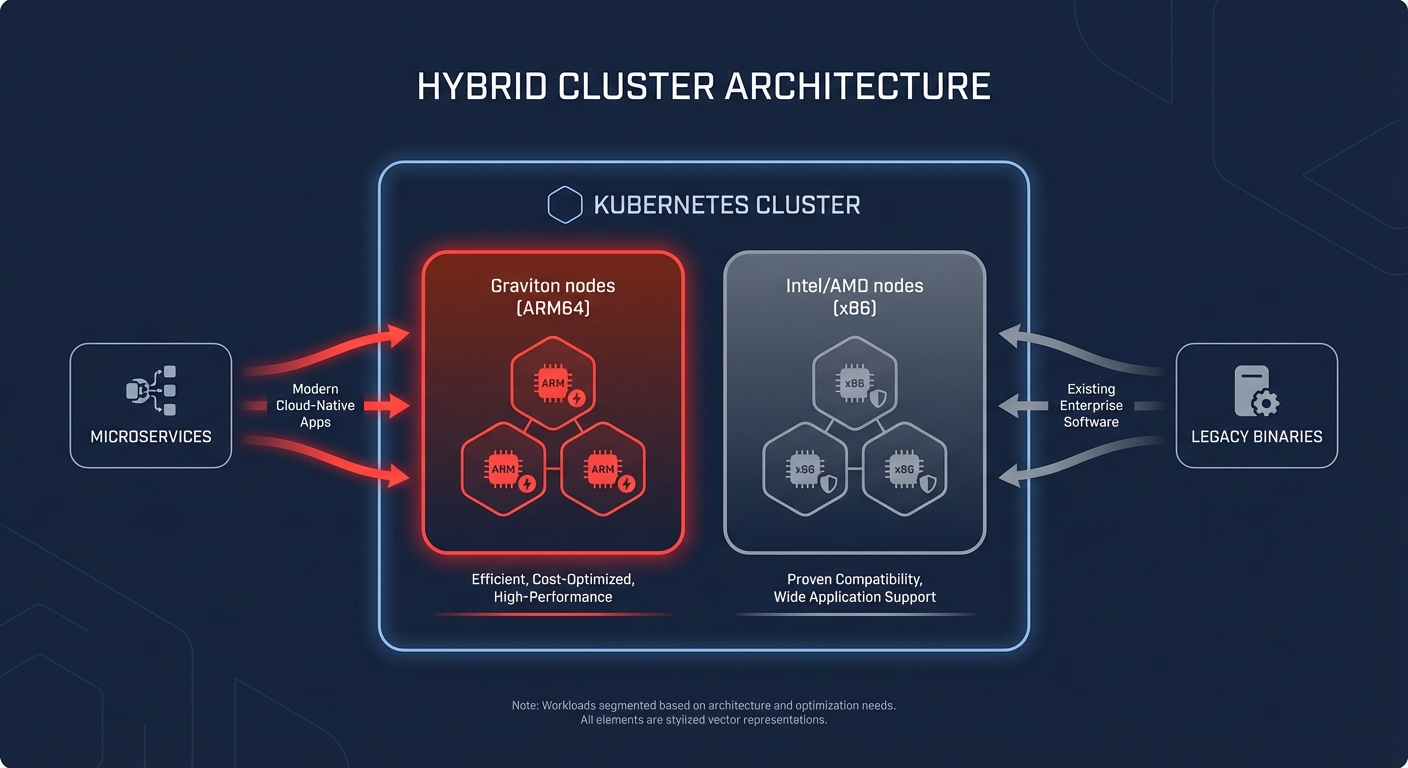
Kubernetes environments are perfect candidates for Graviton adoption because EKS supports mixed-architecture clusters. This capability allows you to automate your EKS optimization by shifting modern, containerized microservices to Graviton while keeping legacy binaries on Intel nodes. This hybrid approach ensures you capture savings where possible without risking the stability of older codebases.
General compute
For web servers and application tiers running on Linux, Graviton provides faster API response times even under moderate traffic. If your tech stack is built on modern interpreted languages like Java, Python, Node.js, or Go, the migration effort is usually minimal. You can check the compatibility of software with AWS Graviton to confirm that your specific runtime version supports ARM64.
Where x86 still wins
Despite the momentum behind Graviton, Intel and AMD remain necessary for specific scenarios where ARM is not yet a viable substitute. Windows Server workloads and proprietary x86-only binaries are not supported on Graviton, meaning legacy Windows-based applications must remain on traditional processors.
Additionally, if your application relies on specialized Intel instruction sets or older libraries that haven’t been recompiled for ARM64, the refactoring cost may outweigh the immediate compute savings. In these cases, staying on Intel or moving to AMD is the safer path until the application can be modernized.
Maximize your Graviton gains with Hykell
Choosing the right instance type is only half the battle. To truly maximize efficiency, you must layer these architectural choices with a sophisticated AWS rate optimization strategy. Hykell helps you accelerate your Graviton gains by identifying exactly which workloads are ready for migration and which should remain on x86 for peak performance.
Our platform does more than just generate reports; it automates the heavy lifting. We stack Graviton’s native 20–40% price-performance advantage on top of optimized Savings Plans and Reserved Instances, ensuring you never pay for idle capacity. With Hykell, you can achieve a total AWS cost reduction of up to 40% on autopilot.
We operate on a success-based model where we only take a slice of what you save. If we don’t find savings, you don’t pay. You can use our calculator to see your potential for infrastructure savings today. Ready to see how much your Intel-heavy infrastructure is costing you? Book a free cost audit with Hykell and start your transition to high-performance, low-cost compute.