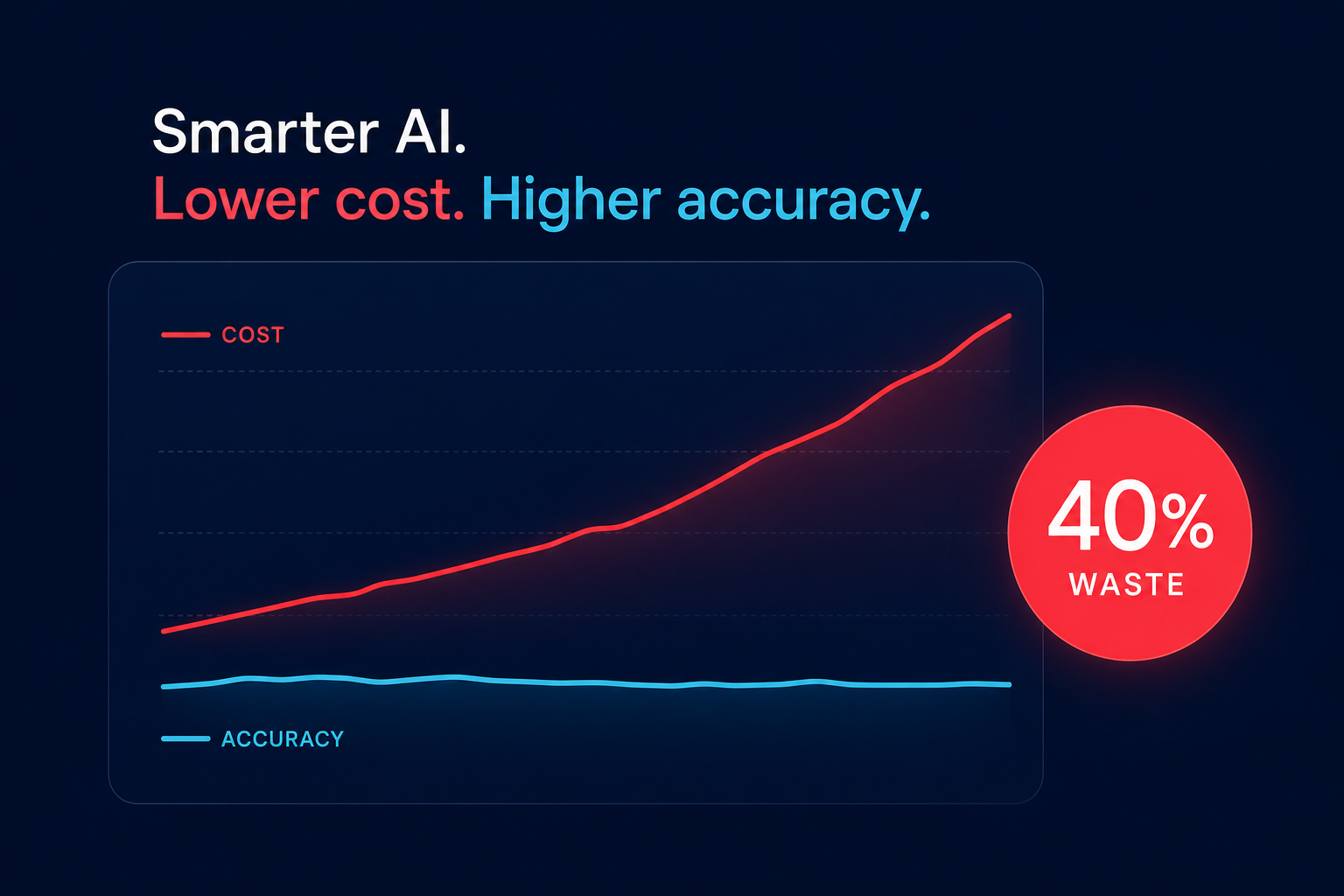
Are your SageMaker bills growing faster than your model accuracy? Many teams waste up to 40% of their machine learning budget on idle capacity and over-provisioned instances. You can reclaim these funds by systematically optimizing your training, inference, and storage strategies.
Machine learning is inherently resource-intensive, but a significant portion of SageMaker spend is often wasted on idle endpoints and unoptimized data pipelines. By applying a systematic approach to cloud resource right-sizing, you can eliminate this waste without sacrificing the performance of your production models.
Optimizing the training phase
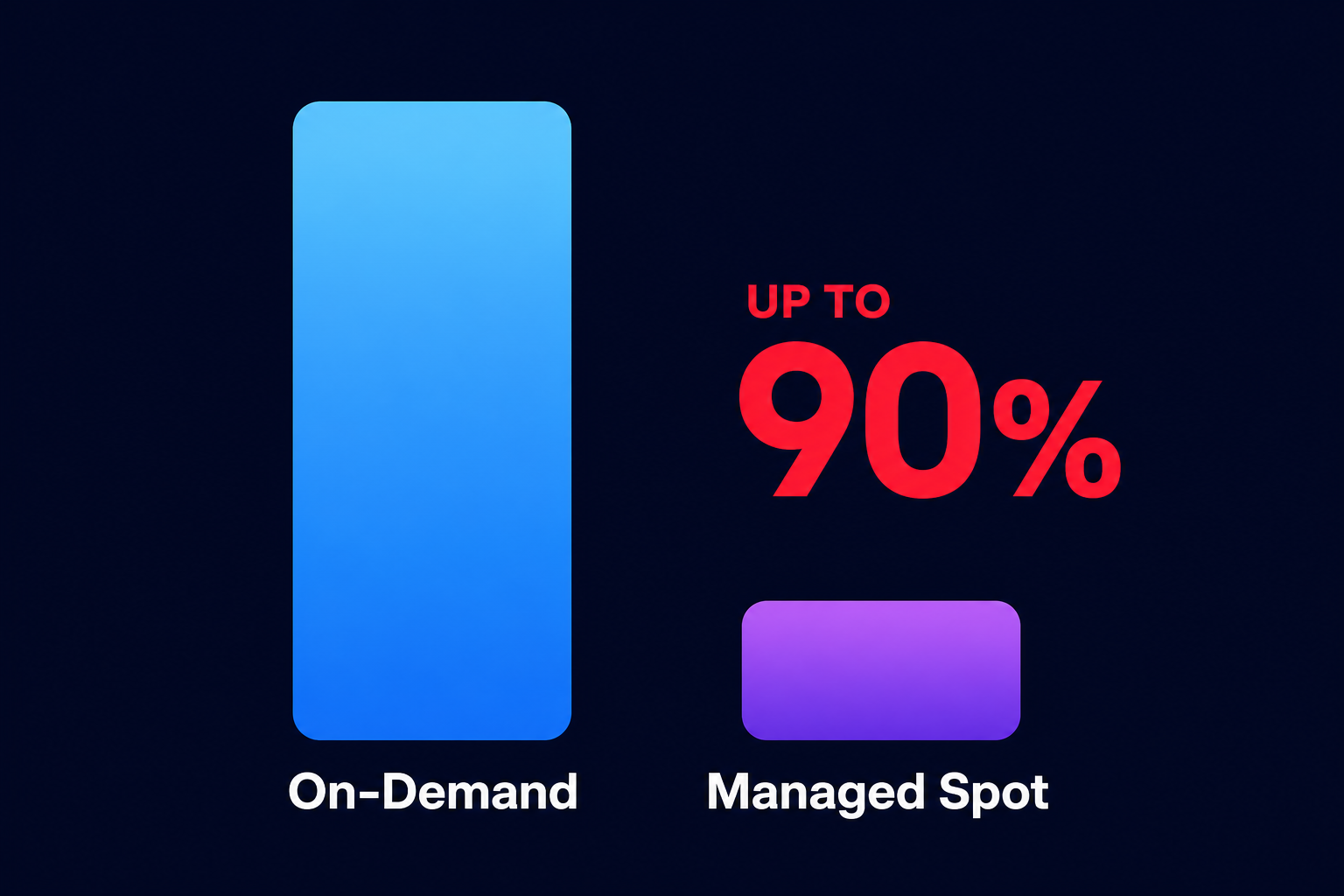
The training phase is often the most visible cost driver, but it also offers the most immediate opportunities for savings. You can reduce training costs by up to 90% by switching from On-Demand instances to Amazon SageMaker Managed Spot Training. This feature utilizes spare AWS capacity; while it is subject to interruptions, SageMaker handles checkpointing and resumes training automatically, making it ideal for long-running deep learning jobs.
Beyond spot instances, you must ensure your infrastructure matches your workload. Using Amazon CloudWatch metrics to detect bottlenecks is essential for maintaining a lean environment. For example, if your CPU utilization is consistently low during training, you are likely over-provisioned and should downsize your instance family.
Advanced training accelerators
For teams running large-scale deep learning models, adopting purpose-built hardware can lead to massive efficiency gains. Using AWS Trainium-based Trn1 instances can offer up to 50% cost-to-train savings compared to comparable GPU-based instances.
To further compress training time, you should implement mixed precision training and use the SageMaker Training Compiler. These techniques reduce memory usage and accelerate execution with minimal impact on model accuracy. For workloads with predictable, consistent usage, applying AWS rate optimization through SageMaker AI Savings Plans can provide up to a 64% discount in exchange for a one- or three-year commitment.
Scaling inference efficiently
Inference often accounts for the majority of long-term SageMaker costs because endpoints typically run 24/7. To optimize this, you must match your deployment strategy to your specific traffic patterns.
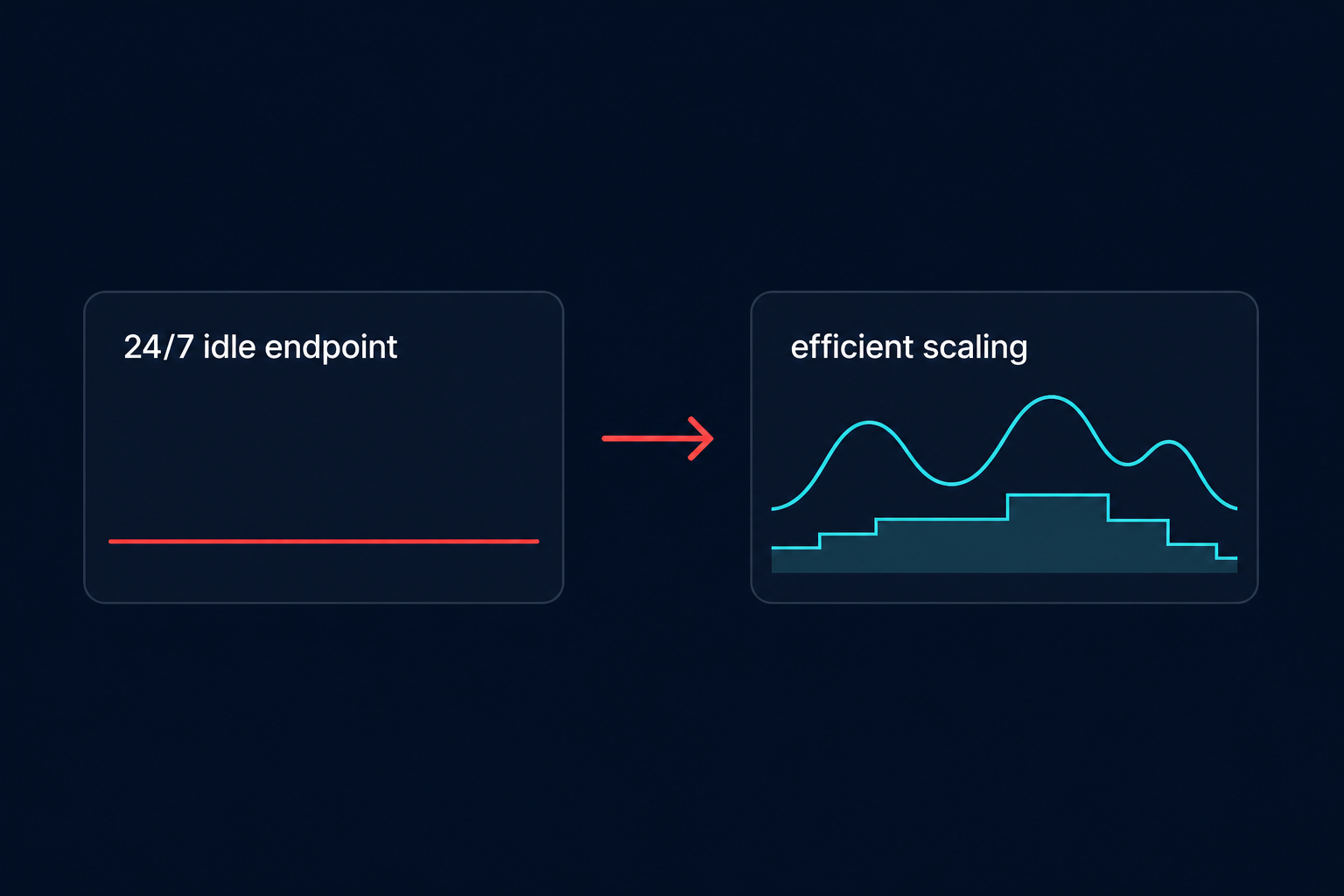
- Serverless Inference is ideal for spiky or infrequent traffic, ensuring you only pay for the duration of the request rather than idle uptime.
- Asynchronous Inference works best for large payloads or long processing times. It allows you to scale down to zero when there is no traffic, eliminating idle costs entirely.
- Multi-Model Endpoints (MME) allow multiple models to share a single instance, which is perfect for models with similar resource requirements. Salesforce Engineering reported that using inference components on large GPU instances reduced AI costs by up to 8x.
For high-throughput production workloads, migrating to AWS Graviton can provide up to 40% better price-performance for inference. You should also leverage the SageMaker Inference Recommender to benchmark your model across different instance types, ensuring you aren’t paying for more compute than your latency requirements demand.
Managing storage and data expenses
Storage costs are frequently overlooked until they become a significant portion of the monthly bill. You can significantly lower these expenses by implementing S3 lifecycle policies to move older training datasets and model artifacts to lower-cost tiers like Glacier Instant Retrieval. Auditing your cloud storage expenses regularly ensures you aren’t paying for “zombie” data that is no longer needed.
Data transfer is another hidden cost that can balloon quickly. Always keep your SageMaker compute resources and S3 buckets in the same AWS Region to avoid inter-region data transfer fees. Additionally, compressing your datasets before storage reduces both the S3 footprint and the time required for training jobs to ingest the data.
If you use the SageMaker Feature Store, be wary of over-provisioning throughput. You are charged for provisioned read/write capacity regardless of actual usage, so right-sizing these settings is critical for maintaining a cost-effective feature pipeline.
Automating cost governance
Maintaining these optimizations manually is nearly impossible as your machine learning environment grows. Effective management requires sophisticated machine learning for cloud cost optimization to anticipate usage spikes and adjust resources dynamically. Integrating cloud observability dashboards allows your DevOps and FinOps teams to track real-time spend and identify anomalies before they result in massive overages.
At Hykell, we believe that you shouldn’t have to choose between machine learning innovation and fiscal responsibility. Our platform provides fully automated AWS cost optimization, performing continuous workload rightsizing and commitment management on your behalf. We identify inefficiencies across your SageMaker, EC2, and EBS resources to help you achieve up to 40% savings on autopilot.
Because we operate on a performance-based model, you only pay a slice of the actual savings we generate. If you don’t save, you don’t pay.
Ready to see how much you could be saving on your SageMaker environment? Calculate your potential savings or contact the Hykell team for a detailed cost audit today.