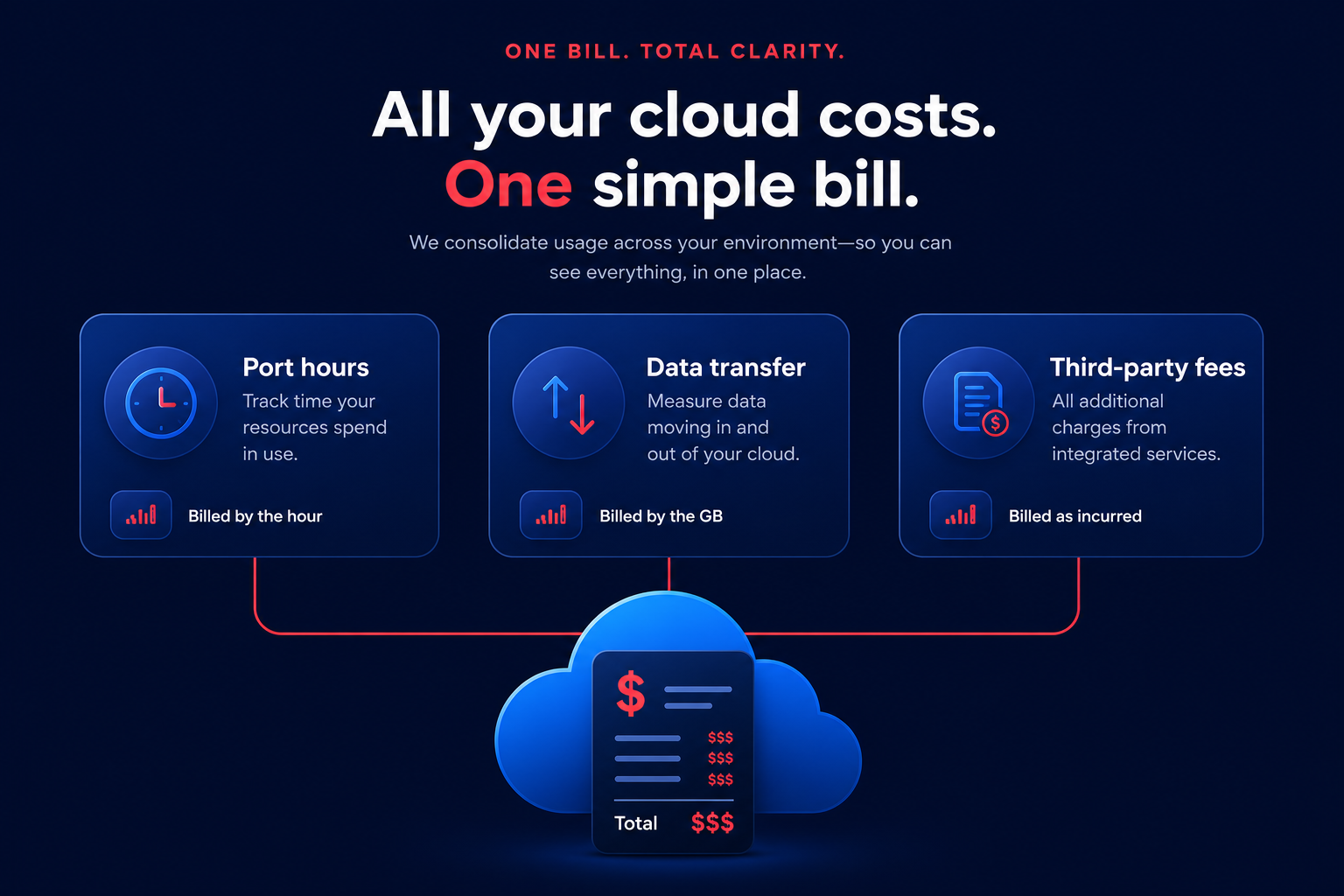
Is your dedicated line to the cloud costing more than the workloads it supports? AWS Direct Connect promises consistent performance, but its multi-layered billing structure can turn a performance win into a budgetary nightmare. Understanding port hours, data transfer, and third-party fees is essential for accurate infrastructure planning.
Setting up a Direct Connect (DX) architecture requires a clear understanding of three primary cost levers: port hours, data transfer fees, and often-overlooked third-party expenses. While moving data over a dedicated line is generally cheaper than using the public internet, the upfront and fixed costs can be substantial for low-volume users. At Hykell, we frequently observe organizations overprovisioning these connections, leading to wasted spend that could be better allocated to AWS rate optimization strategies.
Core components of port-hour and capacity costs
AWS Direct Connect pricing for connections to Regions or Local Zones is primarily based on capacity and port hours. Port hours measure the time a port is provisioned for your use, regardless of whether data is actually flowing. You are charged for these hours even during idle periods, making capacity planning a critical financial exercise.
The price you pay per hour depends heavily on your choice between dedicated and hosted connections. Dedicated connections are physical Ethernet ports associated solely with your account. Outside of Japan, rates for these ports start at $0.30 per hour for 1 Gbps and scale significantly to $2.25 for 10 Gbps, $22.50 for 100 Gbps, and $85.00 for 400 Gbps.
Hosted connections are provisioned by AWS Direct Connect Partners and offer more granular bandwidth options. This is often a more cost-effective entry point for mid-sized enterprises, as you can provision speeds as low as 50 Mbps at approximately $0.03 per hour or 500 Mbps at $0.20 per hour. While these hourly costs appear nominal, they represent fixed monthly overheads that persist 24/7.
Managing data transfer and egress variables
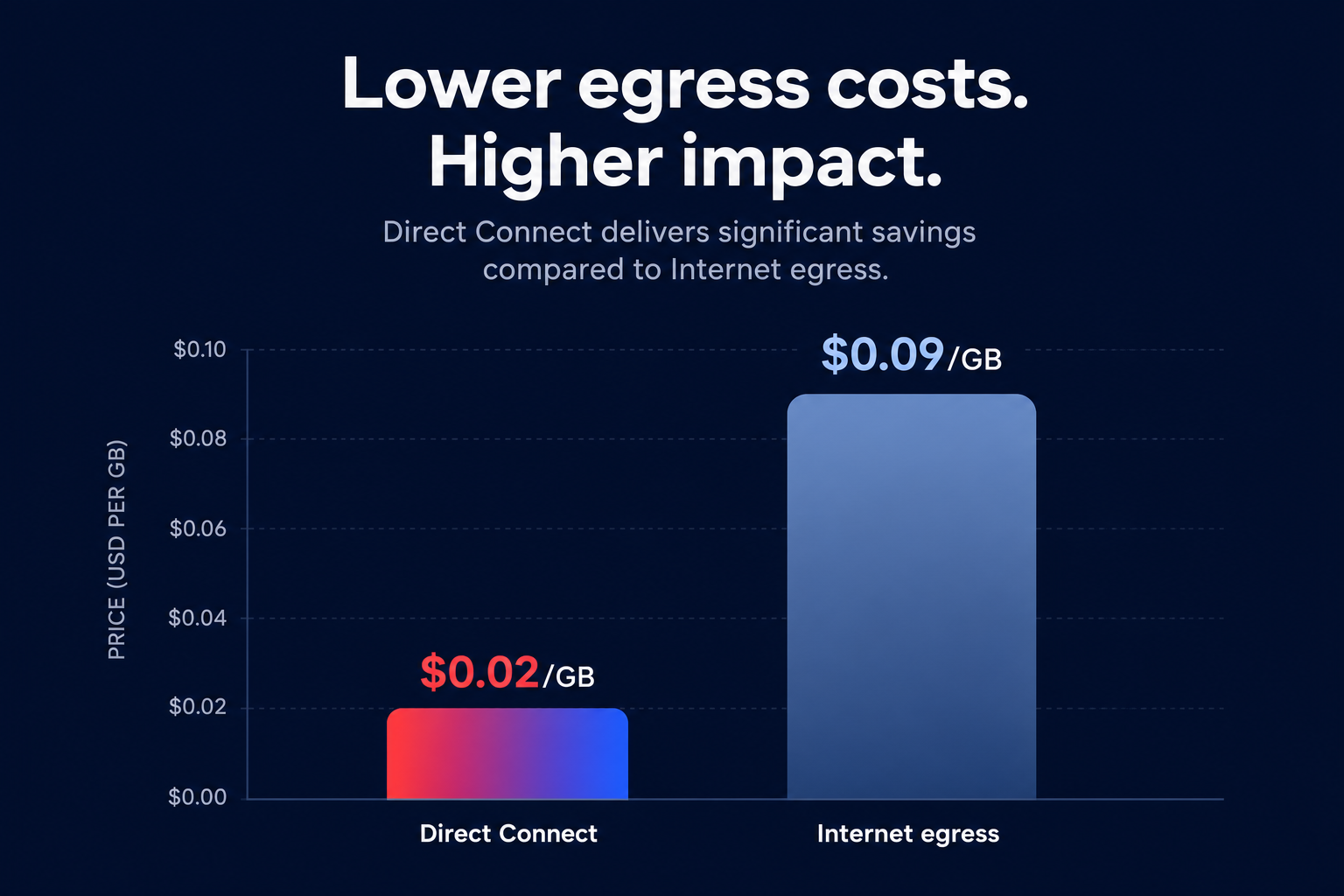
While data transfer into AWS over Direct Connect is free, the cost of pulling data out of AWS is where most architectural decisions are made. The Direct Connect data transfer rate is significantly lower than standard internet egress fees, which is the primary financial driver for adopting the service.
For example, egress from US regions via a Direct Connect location is often billed at approximately $0.02 per GB. This is a sharp reduction from the $0.09 per GB typically charged for standard internet-bound traffic. To see how these egress fees compare to other networking components in your architecture, you can explore our comprehensive breakdown of AWS data transfer costs.
Hidden architectural expenses and third-party fees
The sticker price of a port does not tell the whole story. Several variables can inflate your monthly invoice, particularly when you move beyond a simple point-to-point connection. Architects must account for these additional layers to avoid “bill shock” at the end of the month.
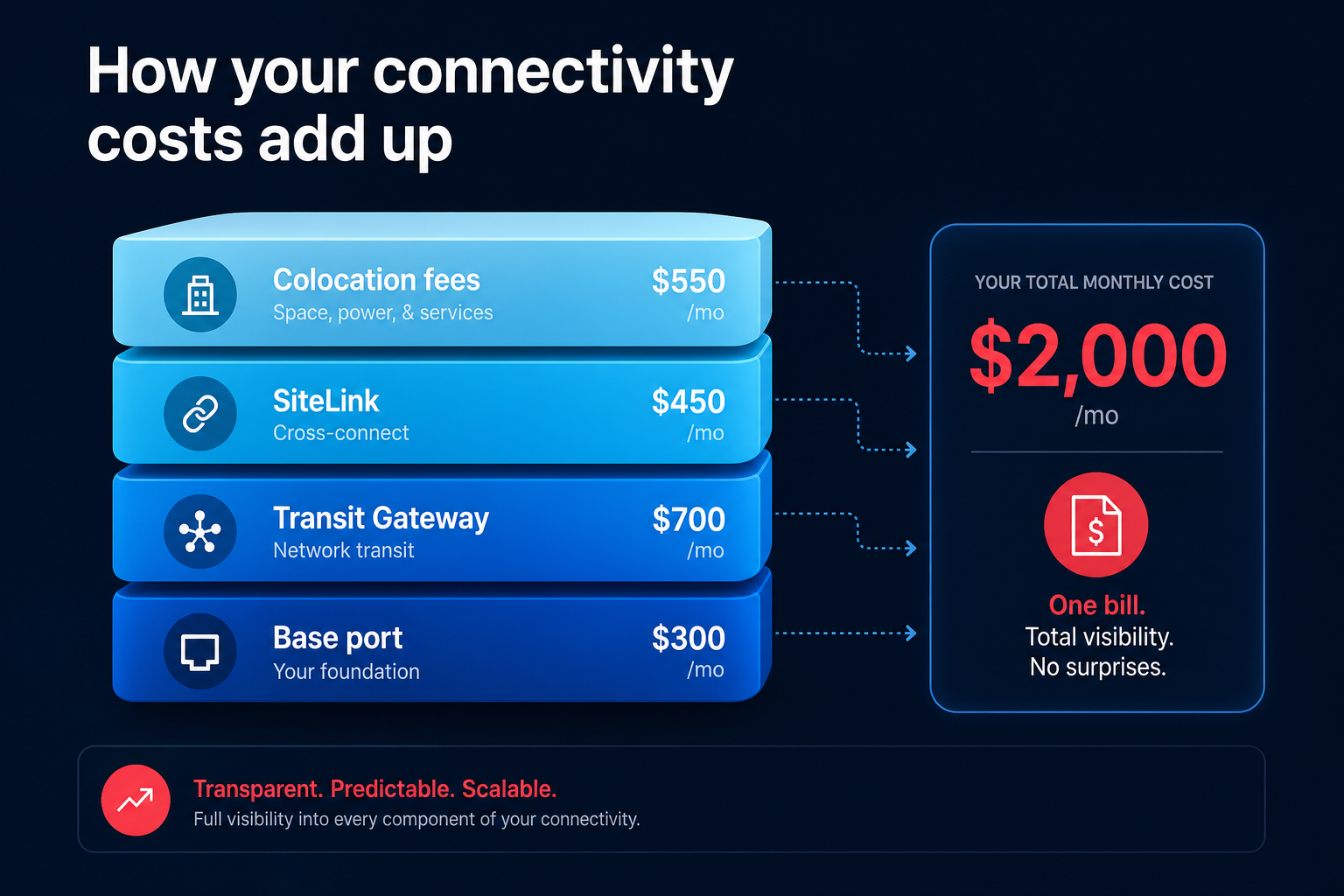
- AWS Transit Gateway processing: If you route Direct Connect traffic through an AWS Transit Gateway to simplify VPC management, AWS adds a data processing charge on top of your Direct Connect fees. This can effectively double your egress costs if the traffic volume is high.
- SiteLink fees: For organizations using Direct Connect to link two on-premises data centers, SiteLink adds a fixed $0.50 per hour charge for each Virtual Interface (VIF) enabled with the feature, in addition to standard data transfer fees.
- Colocation and cross-connects: AWS does not bill you for the physical fiber jump from your equipment to theirs in a colocation facility. These cross-connect fees are billed by the facility provider and can range from a few hundred to over a thousand dollars per month.
When designing for AWS high availability on a budget, you must decide if the redundancy of a second Direct Connect port is worth the 100% increase in fixed port-hour costs, or if a VPN backup serves as a more fiscally responsible failover mechanism.
Balancing performance and budget in network design
One common misconception is that using Link Aggregation Groups (LAG) provides a volume discount. While LAG allows you to treat multiple dedicated connections as a single logical unit, it does not change the unit pricing. You are still billed for each individual port hour within the group.
For those looking to optimize their entire cloud footprint, networking is just one piece of the puzzle. While Direct Connect reduces your per-GB egress rate, significant waste often remains in how you manage your internal traffic. Integrating your networking strategy with AWS VPC endpoint cost savings can further strip away unnecessary NAT Gateway processing fees, which are often the true “hidden tax” on cloud data movement.
Hykell helps you navigate these complexities by providing automated cloud cost optimization that looks beyond simple line items. We dive deep into your infrastructure to uncover efficiencies, ensuring you only pay for what you actually use. Our platform automatically optimizes your AWS rate strategies to achieve effective savings rates of 50% or higher without requiring manual engineering effort.
If you are unsure whether your current Direct Connect setup is the most cost-effective choice for your traffic volume, use our cloud cost calculator to see where you could be saving up to 40% on your total AWS bill. We operate on a pay-from-savings model, meaning we only succeed when your infrastructure becomes more efficient. Contact Hykell today to start your audit and take the guesswork out of your cloud infrastructure planning.