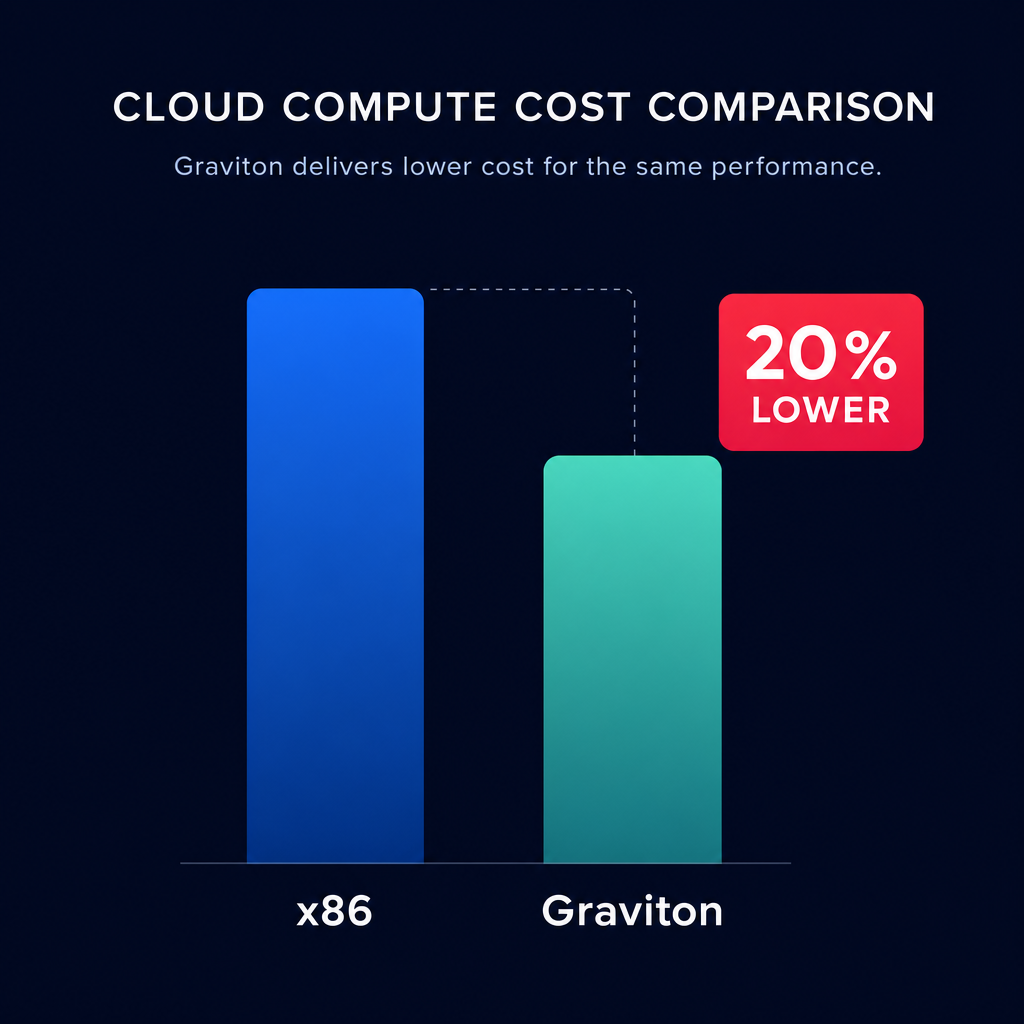
Are you still paying the “x86 tax” on your AWS bill? Switching to AWS Graviton can instantly reduce your compute costs by 20%, but the real magic happens when you align the right instance family with your specific workload architecture to unlock deeper savings.
How the AWS Graviton billing model works
AWS Graviton instances follow the same fundamental billing structure as traditional x86 instances but at a significantly lower price point. For instance, Amazon EC2 usage is billed in one-second increments with a 60-second minimum, and you only incur charges while the instance is in a “running” state.
The core advantage lies in the baseline unit price. On average, Graviton-based instances are priced roughly 20% lower than comparable Intel or AMD instances. When you combine this lower entry cost with strategic AWS arm vs x86 pricing analysis, the total cost of ownership (TCO) for your infrastructure drops significantly.
Discount stacking on Graviton
You do not have to choose between architectural savings and commitment-based discounts. Graviton instances are fully compatible with existing AWS pricing models, allowing you to stack savings for maximum impact:
- Compute Savings Plans: These provide up to 72% savings and automatically apply across different instance families, regions, and even between x86 and ARM architectures.
- Reserved Instances (RIs): You can commit to specific Graviton types for one or three years to lock in the lowest possible rates for predictable workloads.
- Spot Instances: For fault-tolerant or stateless workloads, Spot instances on Graviton can offer up to 90% off standard on-demand prices.
Architectural efficiency: why you pay less for more
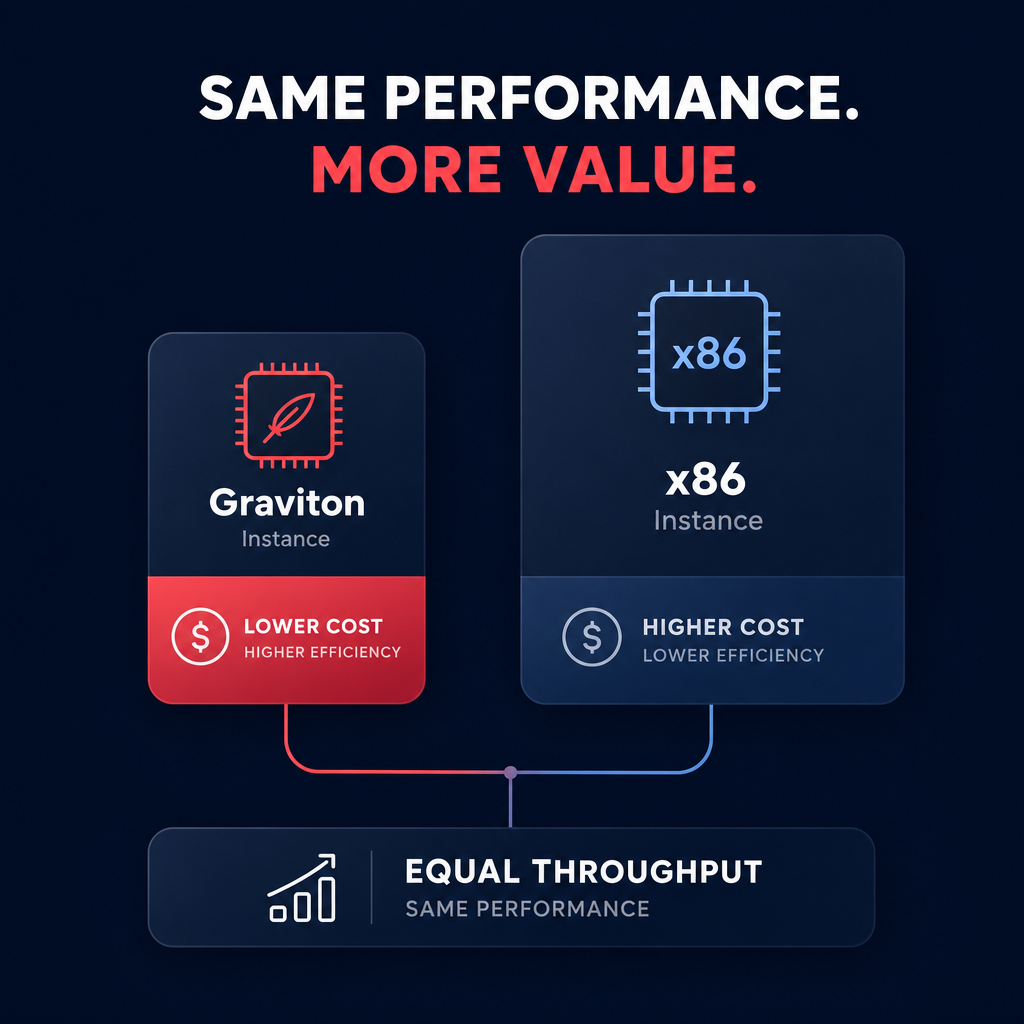
The billing model becomes even more attractive when you consider performance per dollar. Unlike x86 processors that typically use hyperthreading to present two virtual cores (vCPUs) per physical core, Graviton maps one vCPU to one physical core.
This 1:1 mapping ensures that every vCPU you pay for has dedicated compute resources, which often allows you to use a smaller Graviton instance to achieve the same throughput as a larger x86 instance. When you right-size your AWS EC2 fleet before migrating, you avoid the common pitfall of locking in discounts on oversized capacity, which Hykell frequently identifies as a primary source of cloud waste.
Choosing the right Graviton family for your workload
Selecting the wrong instance family can lead to over-provisioning or performance bottlenecks that erode your savings. AWS has specialized the Graviton lineup to match specific resource demands across different applications.
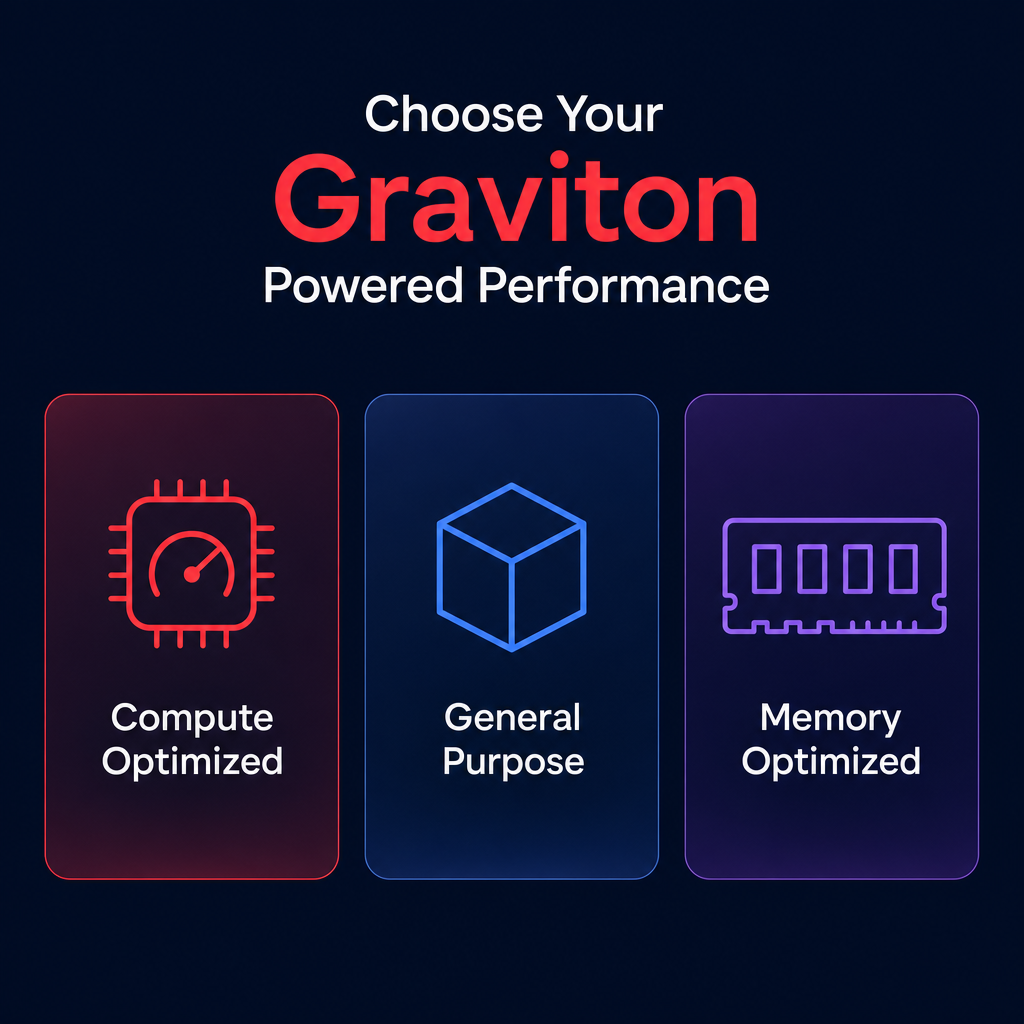
Compute-optimized (C7g, C8g)
These instances are ideal for CPU-bound tasks such as high-performance computing (HPC), video encoding, and gaming servers. They provide the highest performance-to-cost ratio for raw compute power. According to performance benchmarking for AWS Graviton, C7g instances offer roughly 25% better computational performance than previous generations, making them a top choice for compute-heavy fleets.
General purpose (M7g, T4g)
The M-series is the “workhorse” family, balanced for application servers, mid-size data stores, and caching fleets. For smaller workloads, microservices, or development environments, T4g burstable instances provide a low-cost entry point with the ability to handle temporary traffic spikes without requiring a move to a more expensive instance tier.
Memory-optimized (R7g)
If you are running in-memory databases like Redis or large-scale data analytics, the R-series is designed specifically for memory-intensive tasks. Choosing an R7g instance can provide 50% faster memory access compared to older generations. This allows you to process significantly more data per hour without increasing your total hourly spend.
Tuning Graviton for specific applications
Simply switching the instance type is a vital first step, but tuning your software environment ensures you are maximizing your return on investment.
Python and Node.js microservices
Interpreted languages are generally “Graviton-ready” because runtimes like Python 3.8+ or Node.js 14+ handle the underlying architecture differences for you. For web applications on Graviton, you can often see immediate response time improvements and reduced latency simply by upgrading to the latest ARM-optimized runtimes.
ETL and data processing
For data-heavy jobs, such as those using AWS Glue for ETL, migrating to Graviton-based workers can significantly reduce job duration. Since many serverless ETL services bill based on execution time, faster processing directly translates to a smaller monthly bill.
Containerized workloads
Containers offer the easiest path to Graviton adoption. By using multi-architecture Docker images, you can implement a mixed-instance policy in your Auto Scaling Groups. This allows your cluster to favor lower-cost Graviton nodes while maintaining x86 nodes as a fallback, ensuring high availability during the transition.
Optimizing Graviton gains with Hykell
Migrating to Graviton offers a theoretical 40% saving, but achieving those results in a production environment requires constant monitoring and adjustment. Many organizations struggle to realize these gains because they commit to Savings Plans before conducting an EC2 instance type selection guide review, effectively locking in inefficient spending.
Hykell’s Accelerate Your Graviton Gains program automates the technical heavy lifting. We perform a comprehensive workload compatibility assessment and use AI-powered AWS rate optimization to blend Savings Plans and Reserved Instances around your new ARM-based infrastructure. This approach ensures you never pay for unused capacity while migrating to more efficient hardware.
By layering architectural savings with automated commitment management, Hykell helps you reduce compute spend by up to 40% without requiring ongoing manual engineering effort.
Ready to see how much you could save by switching to Graviton? Use the Hykell savings calculator to analyze your current environment and uncover hidden efficiency.