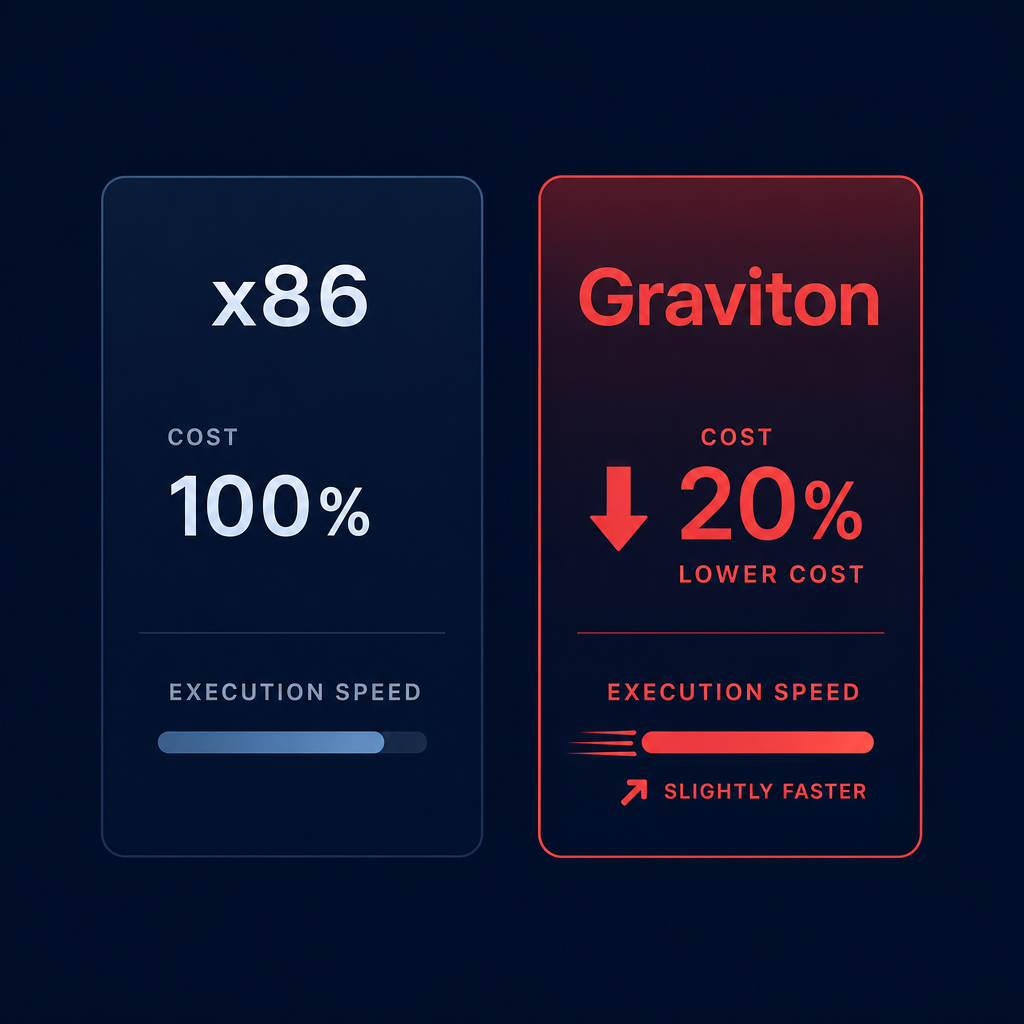
Are you paying a premium for serverless compute just by sticking to the default settings? Most AWS Lambda functions run on x86 processors by default, but switching to Graviton can instantly reduce your compute expenses by 20% while frequently boosting execution speed.
The price-performance case for Graviton on Lambda
AWS Lambda functions powered by AWS Graviton2 processors are designed to deliver up to 19% better performance at a 20% lower cost than their x86 counterparts. When you factor in the efficiency of the Arm64 architecture, many organizations realize an overall price-performance improvement of up to 34%.
The primary driver of these savings is the lower price per GB-second of execution. While an x86 function in a region like us-east-1 costs approximately $0.0000166667 per GB-second, a Graviton-based function costs roughly $0.0000133336. Over millions of monthly invocations, this AWS arm vs x86 pricing difference creates a significant impact on your bottom line without requiring a reduction in workload volume or throughput.
Benchmarking performance and compatibility
Before shifting your entire serverless architecture, you must understand where Graviton excels. CPU-bound workloads, such as data transformation, encryption, and image processing, typically see the most significant performance gains. Because Graviton cores are physical cores rather than hyperthreaded virtual cores, they offer more consistent performance for multi-threaded tasks. You can explore more technical data in our guide on performance benchmarking for AWS Graviton instances to see how these architectures differ under load.
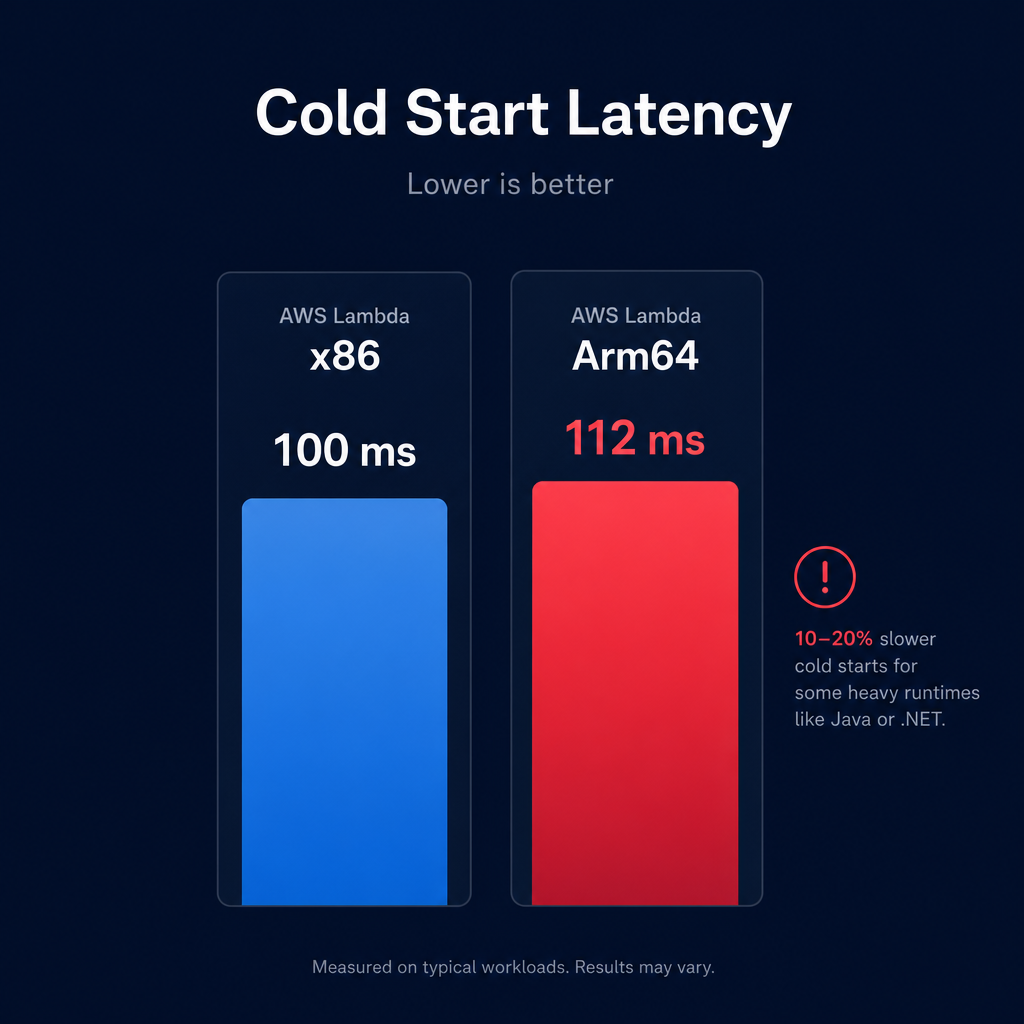
Performance is not universally superior in every metric, however. For instance, AWS research on Java 21 indicates that Arm64 cold starts can sometimes be 10% to 20% slower than x86_64 at various percentiles. If your application is highly sensitive to cold-start latency and uses heavy runtimes like Java or .NET, you should conduct specific benchmarks to ensure the cost savings do not compromise your user experience.
Implementation steps for a smooth migration
Migrating your serverless functions to Graviton involves more than just toggling a radio button in the AWS Console. To ensure reliability and maintain service levels, you should follow a structured migration methodology:
- Inventory Dependencies: Verify that all libraries, packages, and Lambda layers support the arm64 architecture. Most modern runtimes like Python, Node.js, and Go have native support, but compiled binaries or specialized third-party monitoring tools must be checked for software compatibility.
- Update CI/CD Pipelines: Your build environment must be capable of producing arm64 artifacts. If you use Docker-based Lambdas, you will need to update your build scripts to target the linux/arm64 platform specifically.
- Bootstrap and Test: Deploy the function to a staging environment first. Use tools like the AWS Compute Optimizer to identify if the new architecture suggests a different memory configuration based on historical usage.
- Phased Rollout: Use Lambda Aliases and weighted routing to split traffic between the old x86 version and the new Graviton version. Start with 5–10% of traffic and monitor CloudWatch for increased error rates or unexpected latency spikes.
Rightsizing memory for compounding savings
Architecture is only one half of the cost equation; memory allocation is the other. In AWS Lambda, CPU power scales linearly with memory. Increasing your memory allocation can actually lower your total bill if the reduction in execution duration offsets the higher price per GB-second.
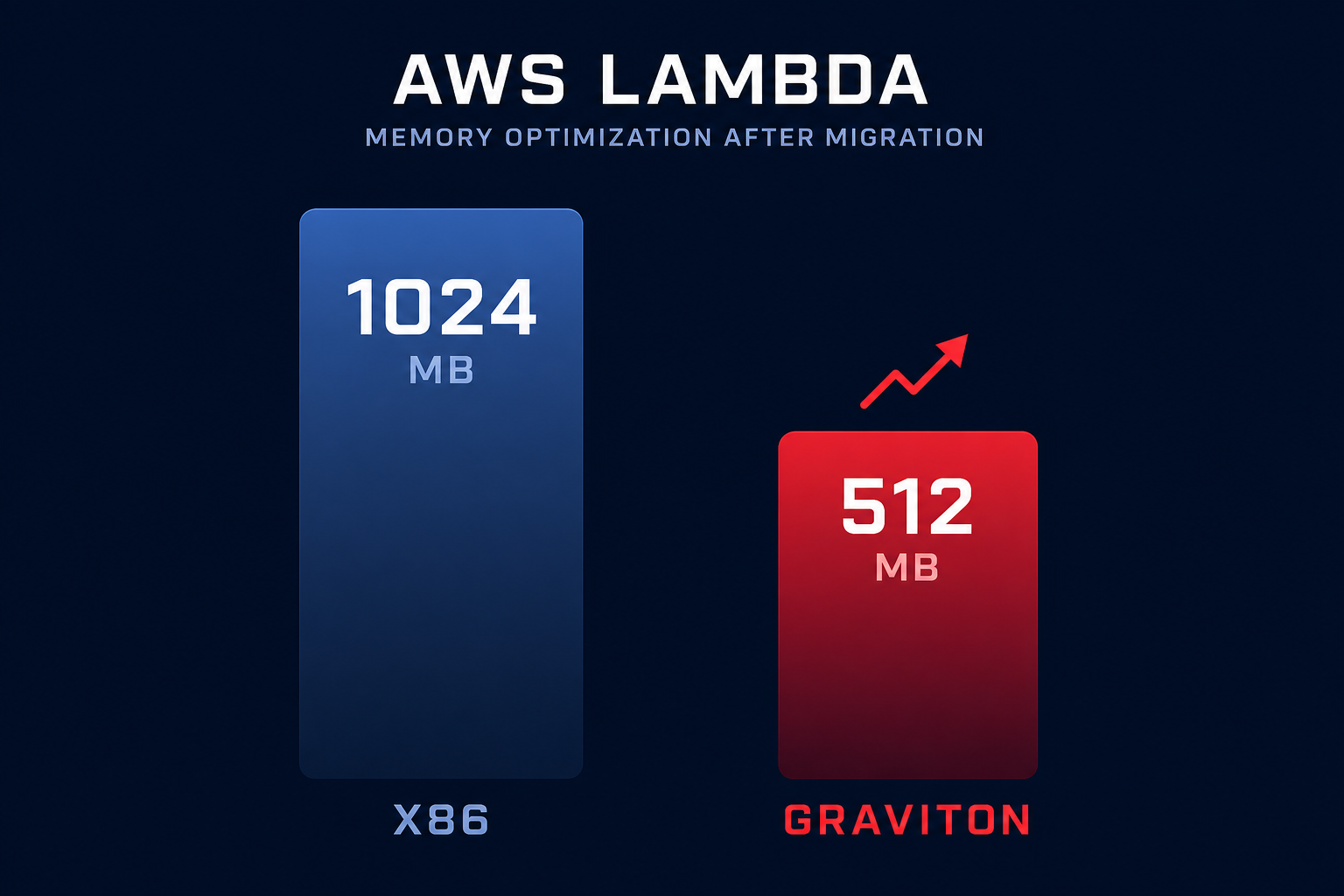
When you migrate to Graviton, the “sweet spot” for memory often shifts. A function that required 1024 MB on x86 to meet a latency target might only need 512 MB on Graviton, or vice versa, to achieve the best price-performance ratio. Implementing AWS Lambda memory optimization alongside your architecture migration is the fastest way to reach the 40% savings threshold that many Hykell clients achieve across their infrastructure.
Automating your serverless cost-efficiency
Manual benchmarking and migration planning can consume weeks of engineering time that your team could spend on core product features. Hykell bridges the gap between observability and action by using real-world performance data to automate AWS rate optimization. Our platform identifies the best candidates for Graviton migration and manages your Savings Plans to ensure you are always paying the lowest possible price for your compute resources.
By combining architectural shifts with automated commitment management, you can eliminate manual optimization tasks and keep your cloud environment lean. Hykell operates on a “no save, no pay” model, meaning we only take a slice of the actual savings we generate for your business.
To see exactly how much your business could save by optimizing your Lambda architecture and compute commitments, use the Hykell savings calculator for a detailed projection of your potential ROI.