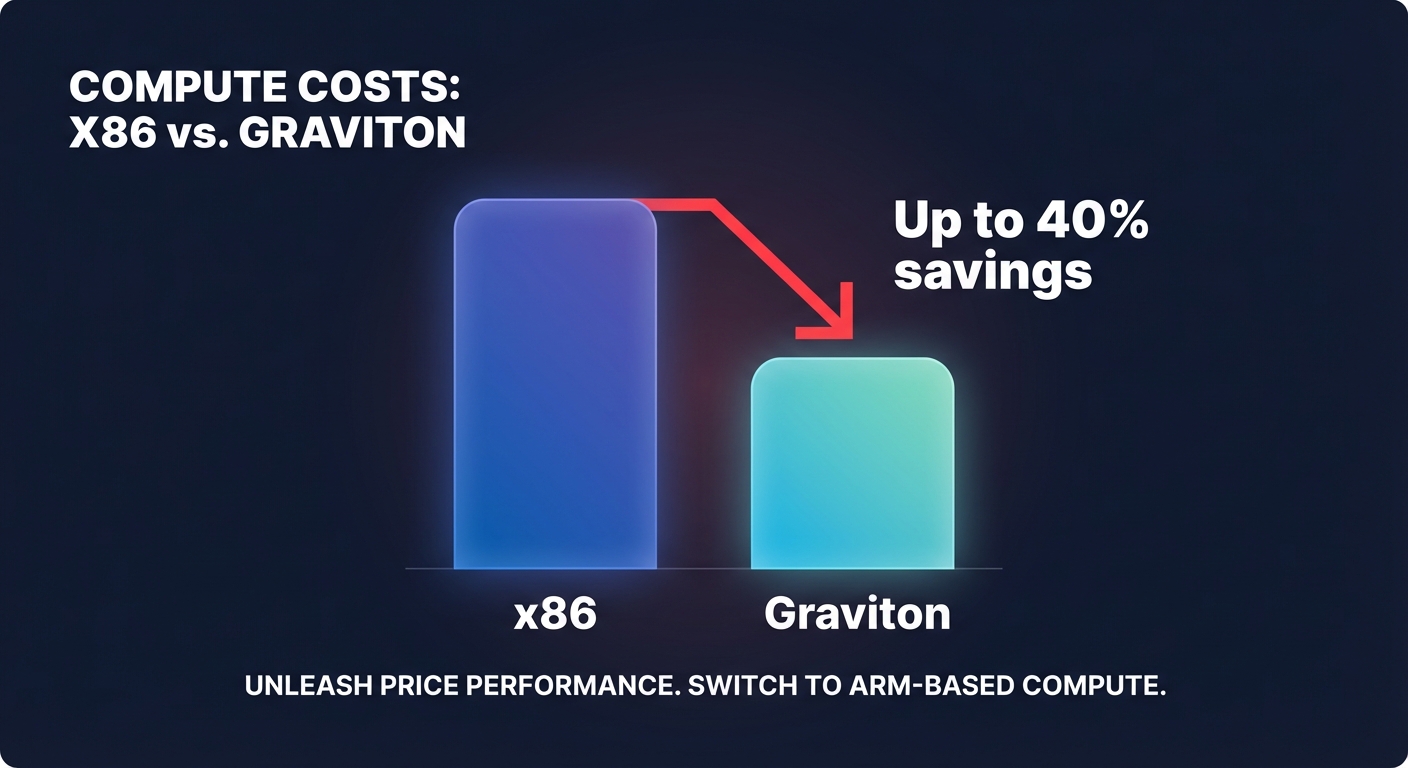
Are you still paying an “x86 tax” for your compute workloads? Moving to AWS Graviton can slice compute costs by 40% while boosting performance. This guide shows you how to model these gains accurately using AWS tools to build a bulletproof business case for migration.
Quantifying the shift from Intel or AMD to Arm-based architecture requires more than just looking at hourly rates. To build a solid financial projection, you need to combine forward-looking estimates with real-world usage data. Here is how you can use native AWS tools to quantify your potential gains and where Hykell fits in to accelerate your journey.
Modeling “before and after” scenarios with the AWS Pricing Calculator
The AWS Pricing Calculator serves as your primary tool for forward-looking “what-if” modeling. To begin, search for your current x86 instance type – such as an m6i.large – in your target region and set the utilization to 744 hours for 24/7 workloads. You can then toggle the architecture filter from x86_64 to Arm64 to reveal the corresponding Graviton families. By selecting an M7g or M8g instance, you will immediately see the 18–20% lower hourly costs typical of Arm architecture. Finally, layering your existing Savings Plans or Reserved Instances onto this estimate often demonstrates a total cost reduction of 50% or more compared to legacy Intel environments.
Utilizing the AWS Graviton Savings Dashboard for real-world data
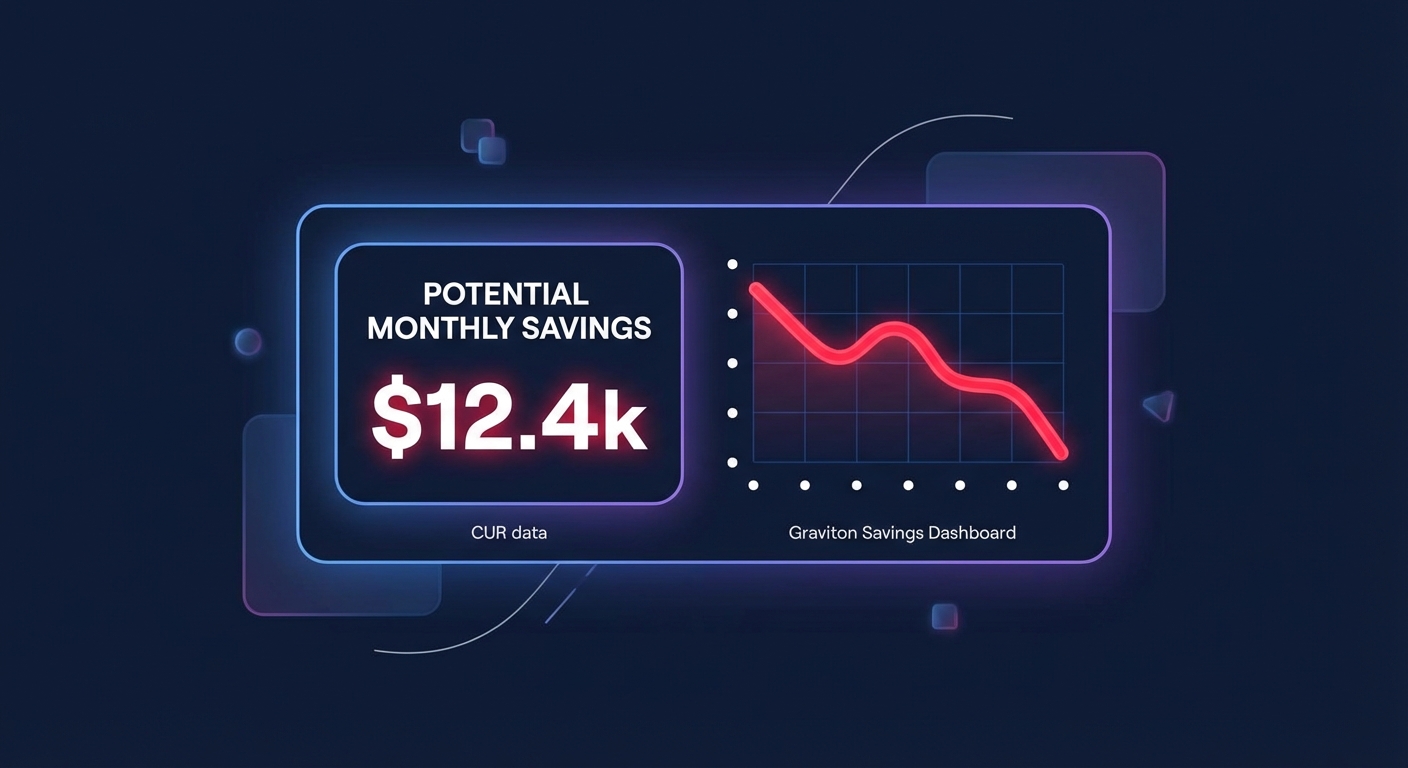
While the calculator provides projections, the AWS Graviton Savings Dashboard analyzes your actual historical spend. This dashboard, integrated within the Cloud Intelligence Dashboards framework, ingests your AWS Cost and Usage Reports (CUR) to identify workloads that are prime candidates for migration. It specifically highlights managed services like Amazon RDS, Aurora, ElastiCache, and Lambda, which represent “low-hanging fruit” because they require no code changes to realize immediate savings. This tool provides a clear “Potential Monthly Savings” metric that helps FinOps teams track migration ROI in real time.
Interpreting cost-performance tradeoffs in Arm architecture
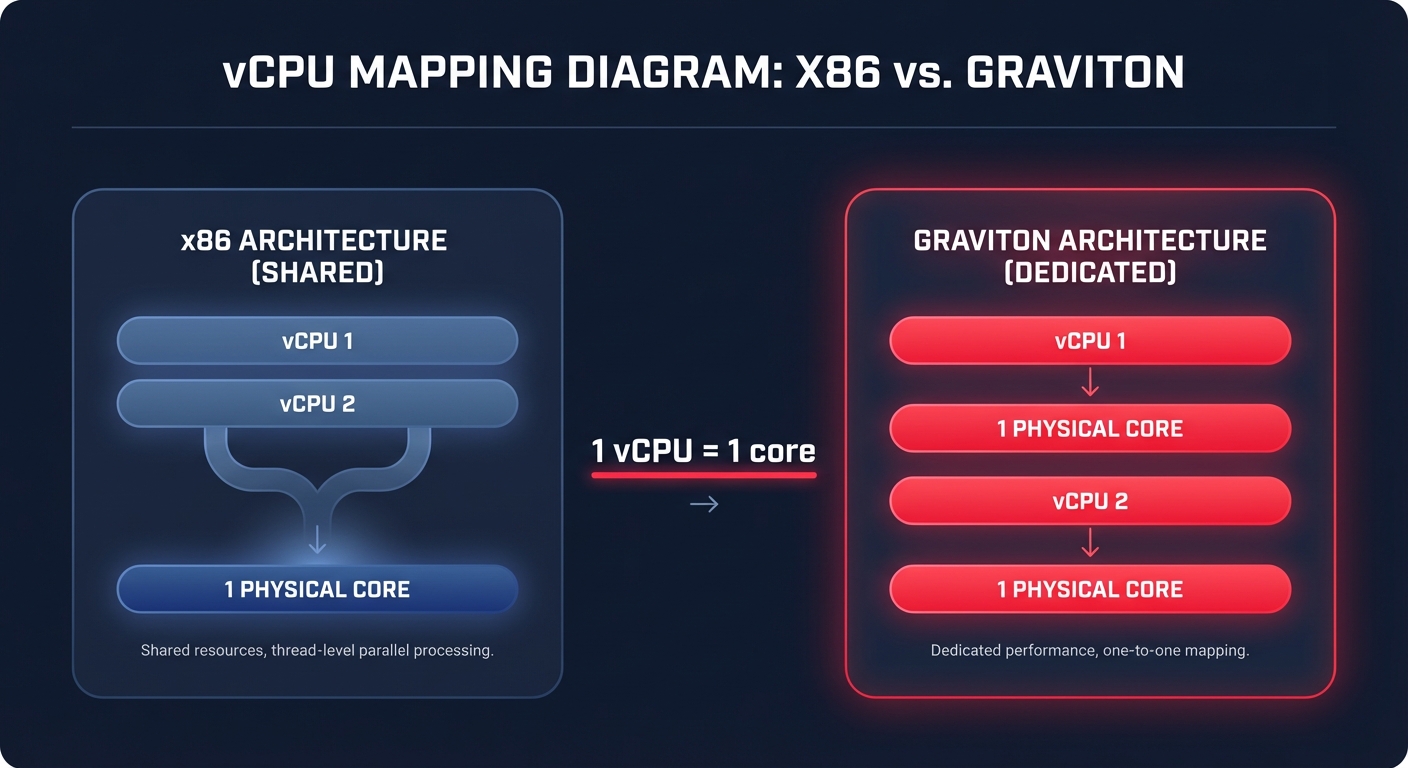
Interpreting the data requires a deep understanding of the cost-performance tradeoffs inherent in Arm architecture. Unlike x86 processors that rely on hyperthreading, Graviton maps one vCPU to one physical core, often providing significantly more “real” compute power per unit. For instance, C7g instances offer 25% better computational performance than C5 instances, which might allow you to downsize from a “large” to a “medium” instance while maintaining throughput. Furthermore, memory-intensive tasks benefit from the superior bandwidth of Graviton3 and Graviton4, frequently resulting in 20–30% throughput improvements for database workloads. However, you should always validate these gains with canary deployments, particularly for single-threaded applications where x86 might still maintain a slight edge.
Automating the realization of savings with Hykell
Identifying savings is only the first half of the equation; realizing them typically requires 9–12 weeks of engineering effort to migrate applications to Graviton instances safely. Hykell bridges this gap by providing an automated cost optimization platform that identifies Graviton-ready workloads on autopilot. Instead of your engineers manually updating infrastructure-as-code templates, Hykell accelerates the process to maximize your Graviton gains without the typical operational overhead. Our platform ensures your AWS rate optimization strategies align with your new architecture, allowing you to stack savings safely and effectively.
Moving to Graviton is one of the most impactful ways to reduce your cloud bill while improving application speed. By combining AWS’s native visibility with Hykell’s automation, you can eliminate the “x86 tax” and cut compute spend by up to 40%. Since we only take a slice of what you actually save, there is zero risk to your budget. Start your free AWS cost audit with Hykell today to see exactly how much your organization can save on Arm.