Did you know switching your database to a different processor could slash your AWS bill by 20% overnight without touching a single line of code? For many teams, migrating RDS workloads to Graviton is the single most effective way to optimize database spend.
Choosing the right architecture for your Amazon RDS instances often comes down to a battle between the established x86 giants, such as Intel and AMD, and AWS’s custom-built, ARM-based Graviton processors. While x86 has been the industry standard for decades, Graviton was designed specifically for cloud-native workloads, offering a performance-per-dollar ratio that is increasingly difficult for modern enterprises to ignore. To determine if the investment in migration is worth it, you must evaluate how these architectures handle the unique demands of database engines like MySQL, PostgreSQL, and MariaDB.
Architectural differences and performance reality
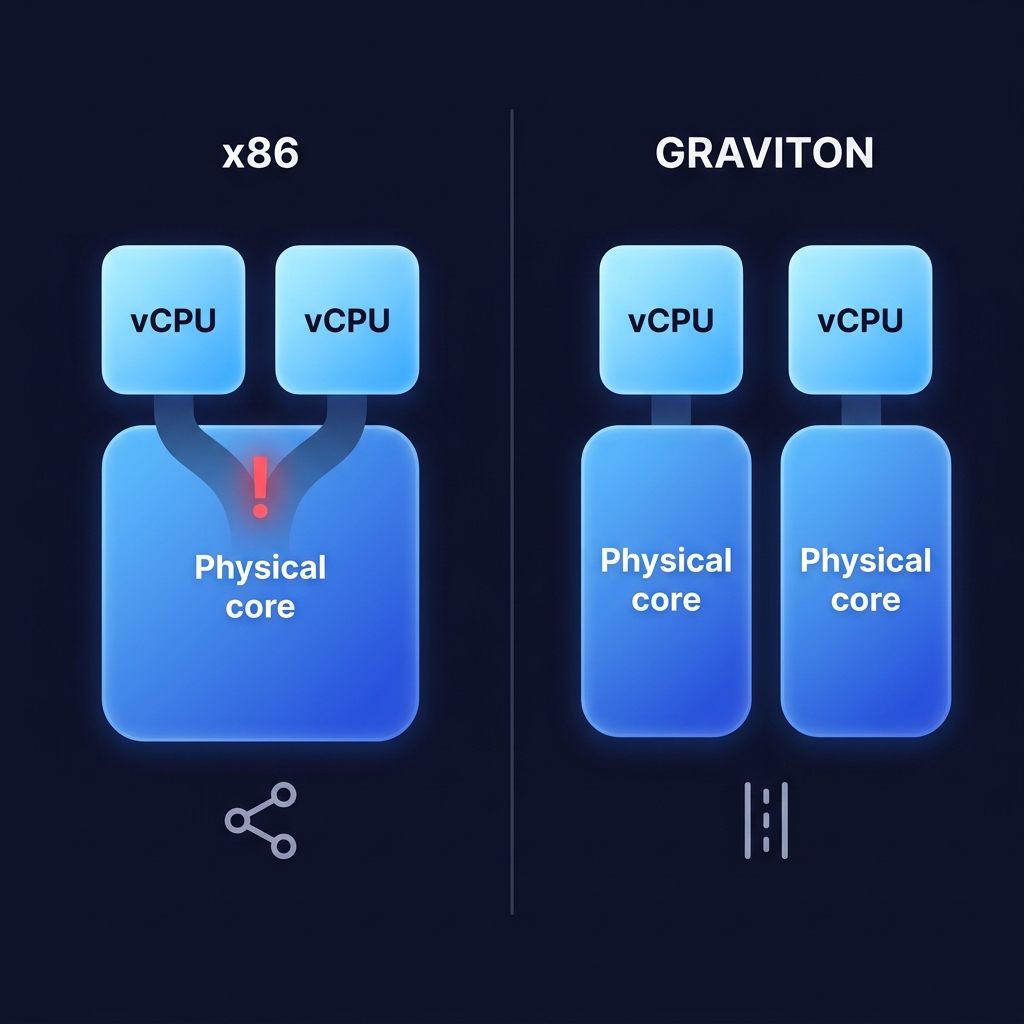
The most significant difference between these platforms lies in how they handle compute power. Standard x86 instances utilize hyperthreading, where a single physical core is split into two virtual CPUs (vCPUs), which can lead to resource contention. In contrast, Graviton maps one vCPU to one physical core, providing dedicated resources that eliminate the “noisy neighbor” issues often found within the processor itself. You can think of this as moving from a shared carpool lane to having your own private highway lane; the dedicated lanes of Graviton ensure consistent, predictable performance.
This 1:1 mapping is particularly beneficial for database workloads that require consistent latency and high throughput. According to AWS benchmarks, Graviton4 RDS instances deliver up to a 40% performance gain over Graviton3. For teams still running on older x86 hardware, the jump is even more dramatic. Graviton3 instances provide up to 30% better performance and 27% better price-performance for open-source engines like MySQL and PostgreSQL compared to their Graviton2 predecessors. However, performance isn’t universal across every use case. While performance benchmarking for AWS Graviton instances shows ARM leading in multi-threaded environments, Intel x86 instances often retain a slight edge in single-threaded tasks or massive, read-heavy MySQL clusters at very high vCPU counts.
The cost-efficiency breakdown
For most businesses, the primary driver for migration is the bottom line. Graviton instances are typically priced 20% lower per hour than comparable x86 instances in the same family. When you combine this lower hourly rate with the performance gains mentioned above, the cost comparison between Graviton and Intel often reveals a total price-performance improvement of 35% to 52% for RDS open-source engines.
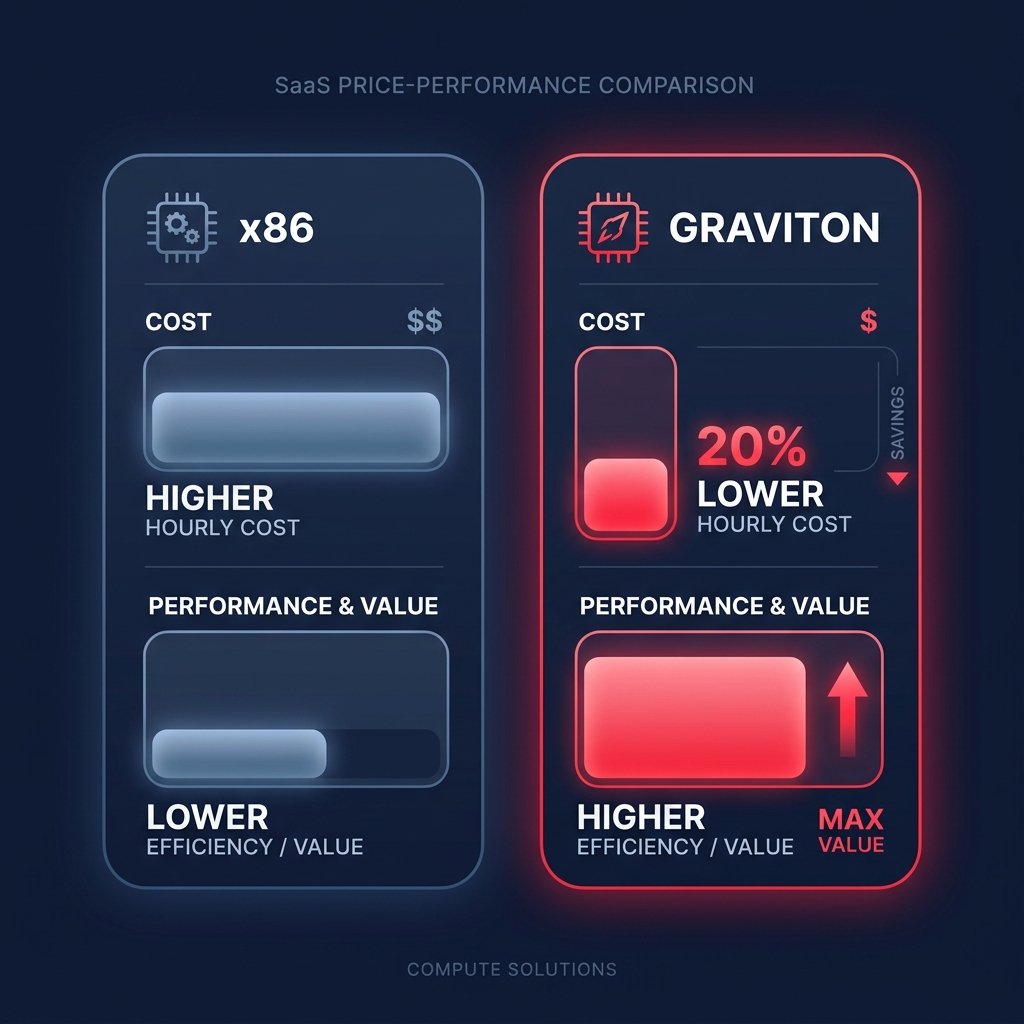
Real-world results validate these architectural advantages. For example, Zendesk achieved a 30% performance gain and 42% monthly savings after migrating to Graviton, while other enterprises have reported cutting database costs by up to 30%. Because these are managed services, you can realize these savings without the “engineering tax” typically associated with hardware migrations. You do not have to recompile your database engine because AWS handles the underlying ARM64 binaries for you. To see how these architectural savings could apply to your specific environment, utilizing a cost savings calculator can provide a clearer picture of your potential ROI.
When x86 remains the better choice
Despite the advantages of ARM, Graviton is not a universal solution for every database workload. There are several scenarios where staying on x86 – or at least delaying your migration – is the smarter move for your infrastructure.
- Proprietary engines such as Microsoft SQL Server or Oracle on RDS do not currently support Graviton, requiring these workloads to remain on x86 hardware.
- Legacy dependencies or databases that rely on specific x86-only extensions or third-party proprietary software may face software compatibility hurdles if the software hasn’t been ported to ARM64.
- Windows-based database environments are ineligible for migration because Graviton does not support Windows Server.
For these specific instances, you should focus on other methods of AWS rate optimization to lower costs, such as refining your Reserved Instance or Savings Plan strategy. Hykell can help you manage these commitments automatically to ensure you never pay for unused capacity.
Practical guidance for migration
If you are running MySQL, PostgreSQL, or MariaDB on RDS (including Aurora), the migration process is relatively straightforward and low-risk. You can modify the instance class during a standard maintenance window or utilize RDS read replica performance strategies to test the new architecture. By creating a Graviton-based read replica, you can benchmark performance against your x86 primary before committing to a full cutover.
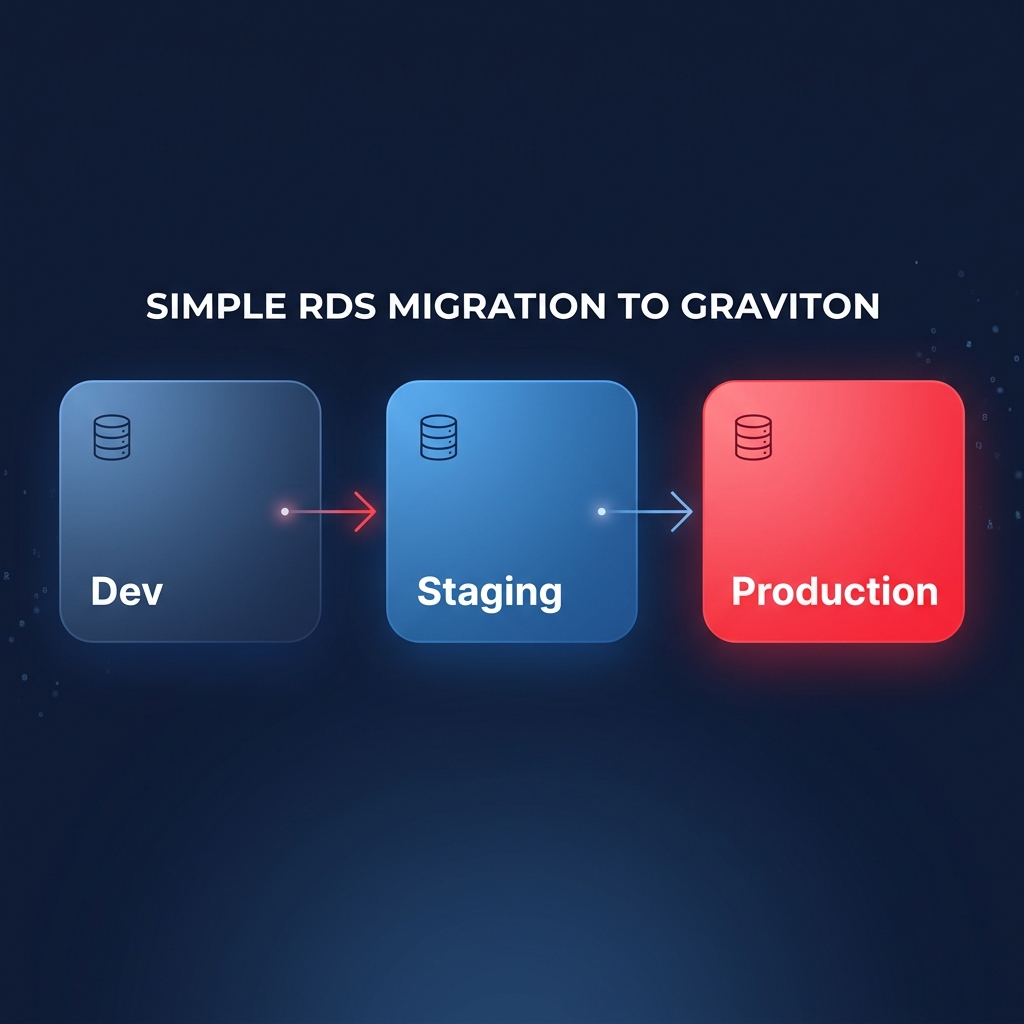
Effective migrating to Graviton instances involves a phased approach. You should start with development and staging environments to validate that your application-side drivers and queries behave as expected. Once validated, you can move to production with confidence, often achieving a “soft launch” by failing over from an x86 primary to a Graviton standby to minimize downtime.
Scaling your savings on autopilot
The decision to migrate is rarely just about the architecture; it is about maintaining a lean, high-performing infrastructure without constant manual intervention. While Graviton provides the foundation for 20% to 40% savings, full RDS cost optimization automation ensures those savings do not evaporate due to over-provisioning or idle resources.
Integrating these architectural shifts with advanced cloud observability allows you to track the exact impact of Graviton on your query latency and monthly spend. By following best practices for Graviton instances, such as right-sizing your instances to match ARM’s higher efficiency, you can ensure your database is not just cheaper, but faster.
Is the migration worth the investment? For any organization running open-source database engines on AWS, the answer is almost certainly yes. The combination of lower hourly rates and superior vCPU performance creates a value proposition that x86 can rarely match in a cloud-native context.
If you’re ready to see exactly how much your business could save by optimizing your database architecture and rate strategy, use the Hykell savings calculator to get a detailed breakdown of your potential 40% reduction in AWS spend.