Is your AWS bill scaling faster than your revenue? While the AWS Enterprise Discount Program (EDP) offers deep savings for high-volume users, signing the wrong contract can lock you into inflexible commitments and unexpected costs.
Understanding the mechanics of these agreements is essential for any business spending over $1 million annually on cloud infrastructure. Strategic AWS contract negotiation allows you to secure discounts that are often several percentage points higher than standard offers, but you must account for hidden obligations like mandatory support fees and rigid spend thresholds.
What is the AWS Enterprise Discount Program?
The AWS Enterprise Discount Program, often referred to as a Private Pricing Agreement (PPA), is a contractual commitment where an organization agrees to a specified level of spend over a one- to five-year term. In exchange, AWS provides tiered discounts across nearly all services and regions.
Unlike Savings Plans, which focus heavily on compute or database usage, an EDP provides a flat discount that applies to your entire AWS environment. This makes it a powerful tool for large enterprises with diversified service usage. However, because these are individual negotiations, the exact discount levels are not fixed and depend heavily on your historical spend and projected growth.
How the AWS EDP works
The program operates on a “net spend” basis. This means your commitment is tracked based on your final bill after other discounts, such as AWS Savings Plans or Reserved Instances, have been applied.
- Initial evaluation: AWS analyzes your usage history and future forecasts to set a minimum annual commitment.
- Tiered discounts: As your committed spend increases, the percentage discount typically scales higher.
- Marketplace integration: You can often use AWS Marketplace purchases to meet up to 25% of your annual commitment.
- Spend flexibility: As of May 2025, only SaaS products fully deployed on AWS infrastructure qualify for retiring EDP commitments through the Marketplace.
The hidden financial risks of EDP agreements
While the headline discount rate is attractive, there are hidden costs in AWS commitments that can erode your actual savings. One of the most significant requirements is mandatory enrollment in AWS Enterprise Support.
Enterprise Support costs approximately 3% of your monthly AWS usage for large accounts, with a minimum floor of $15,000 per month. If you do not factor this fee into your ROI calculations, your net savings may be significantly lower than anticipated.
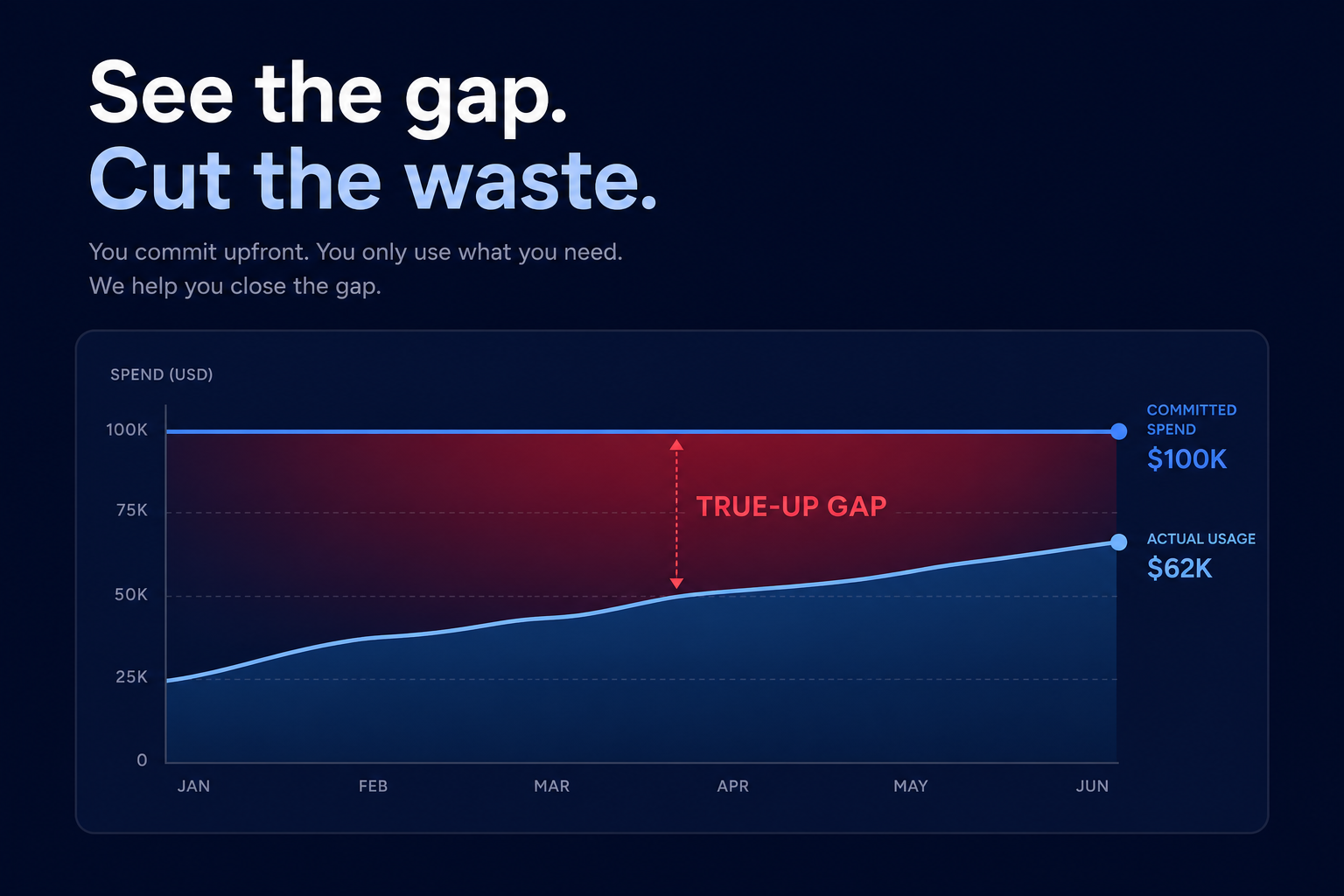
Shortfall risk is another critical factor. If your actual usage falls below your committed amount, you are still required to pay the full value. These “true-up” payments at the end of a term can create massive budgetary spikes. Because annual commitments generally cannot be reduced year-over-year, you must be certain that your architectural roadmap won’t lead to a significant spend decrease that leaves you paying for unused capacity.
AWS EDP vs. Savings Plans: Which is right for you?
Choosing between a broad EDP and a specific Savings Plan depends on your infrastructure’s stability and service mix.
- Service scope: EDPs offer discounts across the entire AWS portfolio, whereas Savings Plans are restricted to specific categories like compute or databases.
- Commitment type: EDPs require a total dollar-value commitment over a long term, while AWS Savings Plans require a fixed hourly spend ($/hour) for one or three years.
- Flexibility: Compute Savings Plans provide maximum flexibility across regions and instance families, making them ideal for rapidly evolving architectures.
- Stacking strategy: Most mature organizations stack these instruments, using Savings Plans to cover steady-state compute and an EDP to provide a baseline discount on everything else.
For a detailed breakdown of hourly commitment options, you can explore Compute and EC2 Instance Savings Plans pricing.
Maximize your AWS savings with Hykell
Navigating the complexities of Private Pricing Agreements and hourly commitments requires constant monitoring and precise forecasting. Hykell provides a fully automated AWS rate optimization platform that operates on autopilot to reduce your bill by up to 40%.
Hykell’s AI-driven approach manages a blended portfolio of Reserved Instances and Savings Plans to achieve an Effective Savings Rate (ESR) of 50–70% or higher. By automating the purchase and exchange of these instruments, we eliminate the financial risk of overcommitment while ensuring you never pay full on-demand rates for steady workloads.
- Zero engineering lift: Our platform integrates via secure, read-only IAM roles and requires no code changes or downtime.
- Performance-based pricing: We only charge a percentage of the actual savings we achieve. If you don’t save money, you don’t pay.
- Real-time adjustments: Our system identifies inefficiencies in EBS, Kubernetes orchestration, and data transfer that manual audits often miss.
Instead of locking yourself into a rigid multi-year contract based on guesswork, let Hykell’s automated intelligence optimize your spend in real-time.
Ready to see how much you could be saving? Use our cloud cost calculator to analyze your current usage and discover your optimization potential today.