Are you paying for “zombie” capacity in your Amazon EKS clusters? While Kubernetes offers unmatched agility, misconfigured node groups often lead businesses to overspend by 30–40% on their AWS bills. Optimizing your data plane builds a more resilient infrastructure that stops the waste immediately.
Mastering Spot instances in managed node groups
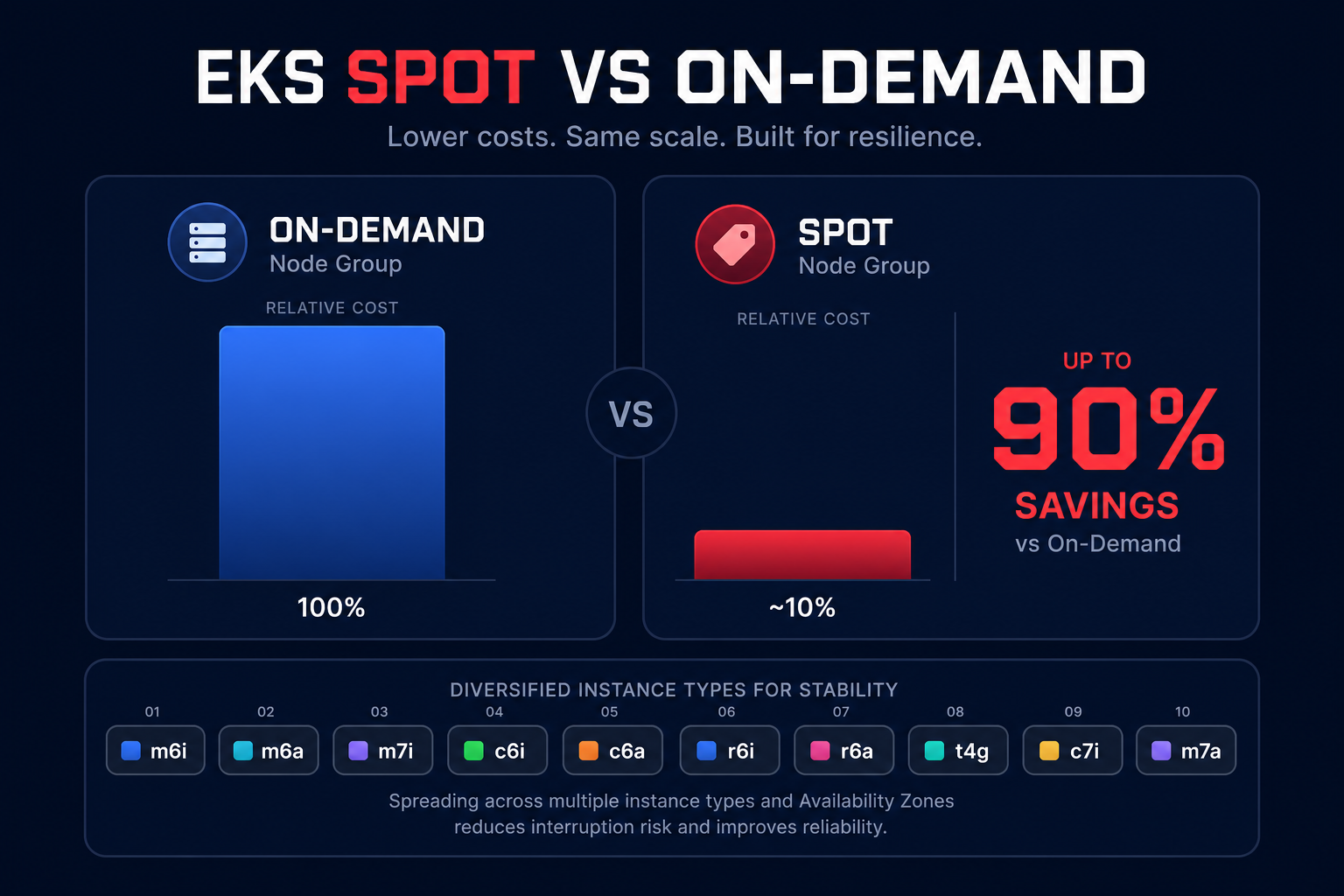
Amazon EKS managed node groups natively support EC2 Spot Instances, allowing you to run fault-tolerant workloads at up to a 90% discount compared to On-Demand pricing. When you set the capacity type to `SPOT`, AWS handles the lifecycle management of these instances, including tagging them with `eks.amazonaws.com/capacityType=SPOT` for easy workload targeting. However, the secret to stability lies in diversification. Hykell recommends flexibility across at least 10 instance types within a single node group to ensure that if one capacity pool becomes unavailable, your cluster can seamlessly shift to another.
To further bolster reliability, you should enable Capacity Rebalancing. This feature allows EKS to monitor AWS capacity forecasting and launch replacement nodes before an interruption occurs. By automating this process, you can maintain production-grade uptime even on interruptible hardware. Hykell further simplifies this by managing AWS rate optimization automatically, ensuring your mix of Spot and On-Demand instances achieves the highest possible Effective Savings Rate (ESR) without engineering effort.
Rightsizing pods to shrink the node footprint
Your EKS nodes only exist to house your pods, which means your node costs are a direct reflection of your pod resource requests. If your developers set safety buffer requests that are significantly higher than actual usage, your autoscaling logic will provision far more nodes than you actually need. Effective cloud resource rightsizing starts by analyzing historical usage data – specifically the 95th percentile (p95) of CPU and memory consumption – to set accurate floors and ceilings.
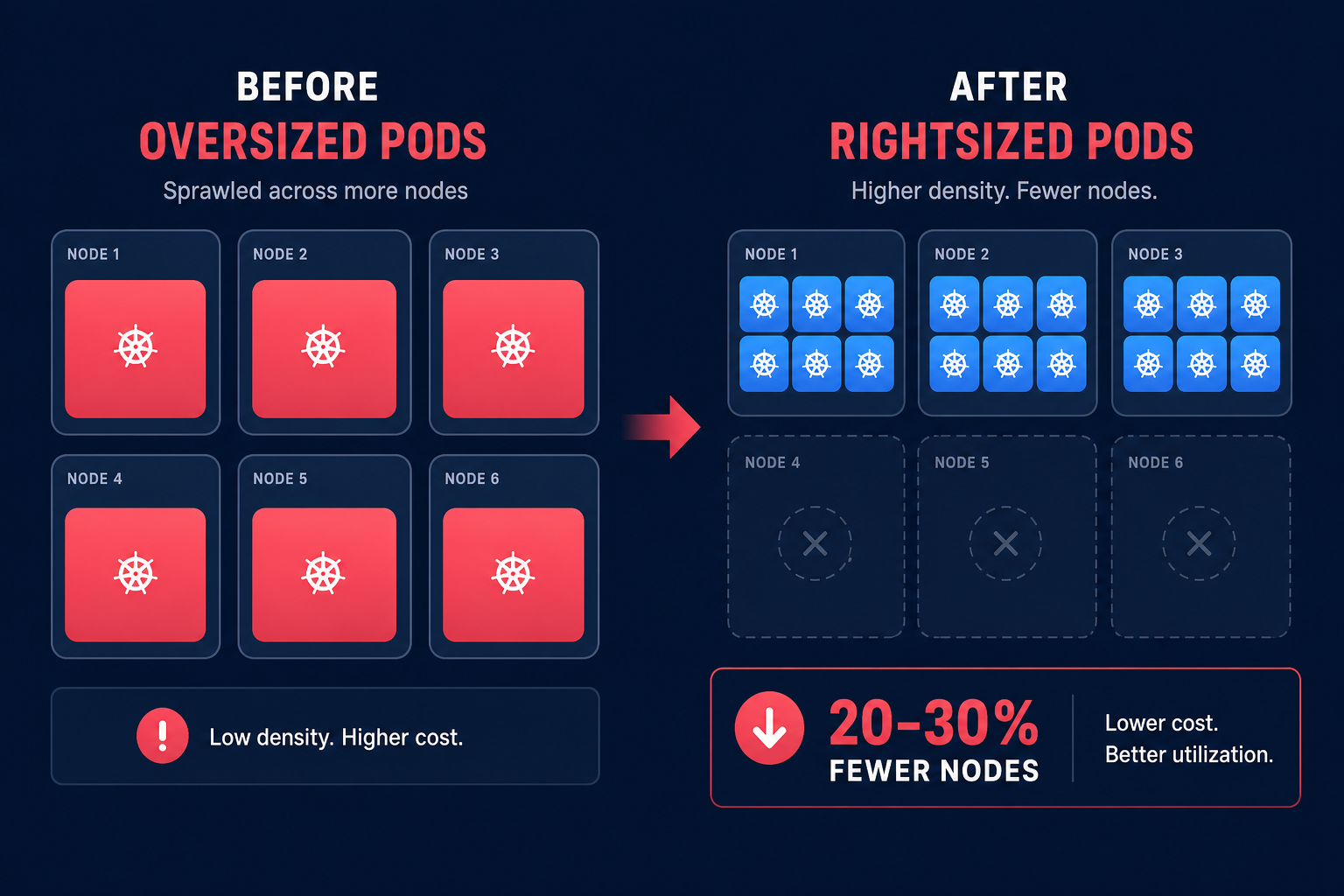
Setting accurate pod resource limits and requests allows for better bin-packing, the practice of fitting as many containers as possible onto a single node. When you improve your bin-packing efficiency, you can often reduce your total node count by 20–30% without impacting application performance. For businesses that find manual tuning too labor-intensive, Hykell provides automated Kubernetes cost optimization that adjusts these parameters on autopilot to prevent over-provisioning.
Modernizing with Graviton and efficient autoscaling
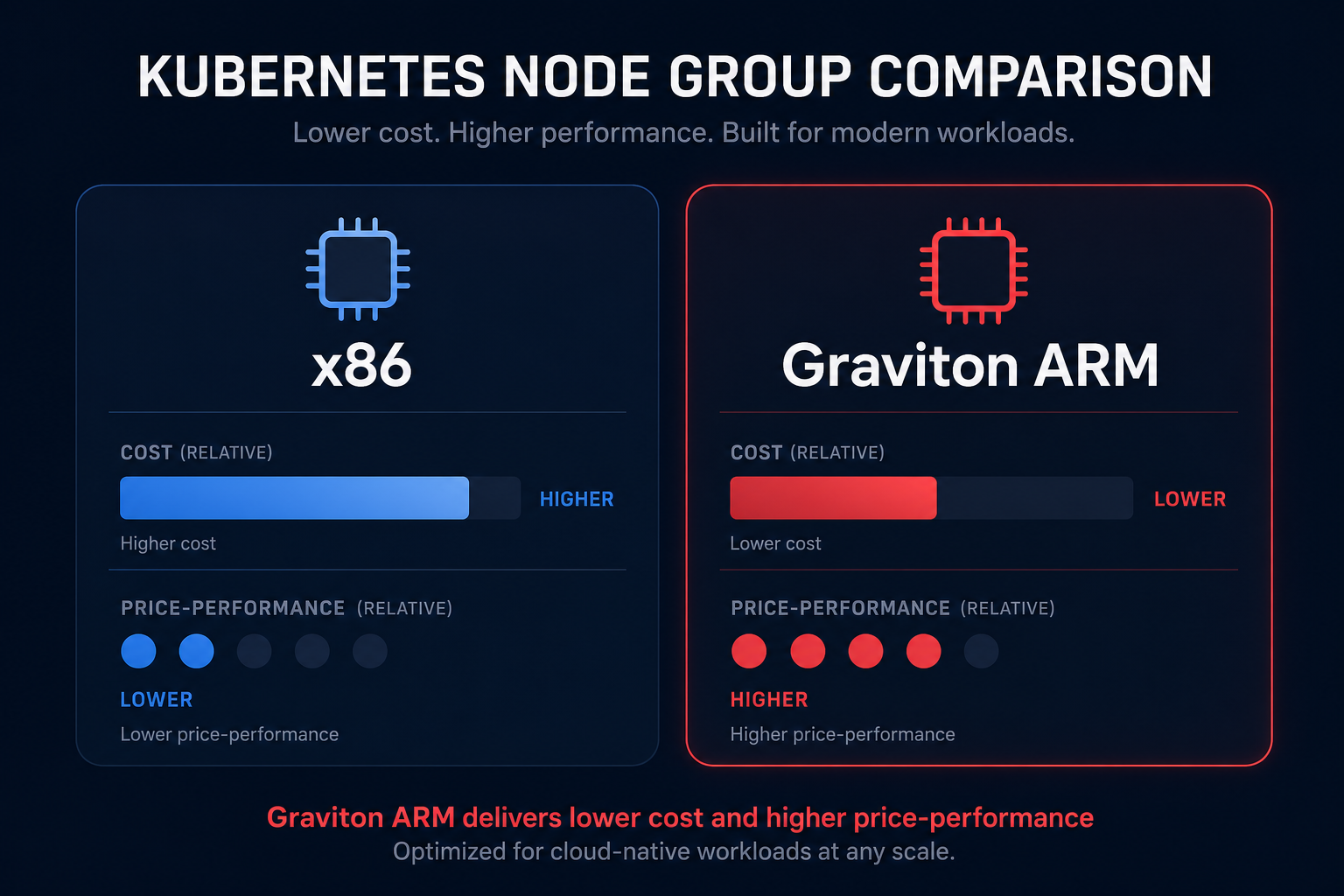
Migrating your node groups to AWS Graviton instances is one of the most effective ways to lower your EKS spend. These ARM-based processors offer up to 40% better price-performance than comparable x86 instances. Because many containerized applications are language-agnostic, such as those running on Java, Python, or Go, the migration often requires minimal architectural changes while delivering immediate savings.
Beyond hardware, the software you use to scale that hardware matters. While the standard Cluster Autoscaler is robust, many teams are moving toward Karpenter, an open-source high-performance Kubernetes provisioner. Karpenter evaluates the aggregate resource requirements of pending pods and chooses the most cost-effective instance type available in real-time. This dynamic selection ensures you are never paying for empty space on a large instance when a smaller one would suffice.
Visibility and the path to 40% savings
You cannot optimize what you cannot measure. Because AWS bills are often opaque at the Kubernetes level, implementing pod-level cost monitoring is essential for identifying which namespaces or teams are driving spend. By integrating real-time observability, you can spot underutilized clusters and orphaned resources before they balloon your monthly invoice.
The most successful cost management strategies for EKS follow a specific sequence:
- Rightsize your pods to define accurate resource requirements.
- Adopt Spot instances for flexible, fault-tolerant workloads.
- Modernize instance families by migrating to Graviton.
- Apply Savings Plans or Reserved Instances to the remaining stable baseline.
This layered approach ensures you are not committing to pay for waste over a one- or three-year term. Hykell takes the manual labor out of this cycle by deep-diving into your EKS infrastructure to uncover hidden savings and executing optimizations automatically. We typically reduce AWS costs by up to 40%, and because we only take a slice of what you save, you only pay for results.
Ready to see how much your EKS clusters could be saving? Use our cloud cost savings calculator to get an instant estimate of your optimization potential.