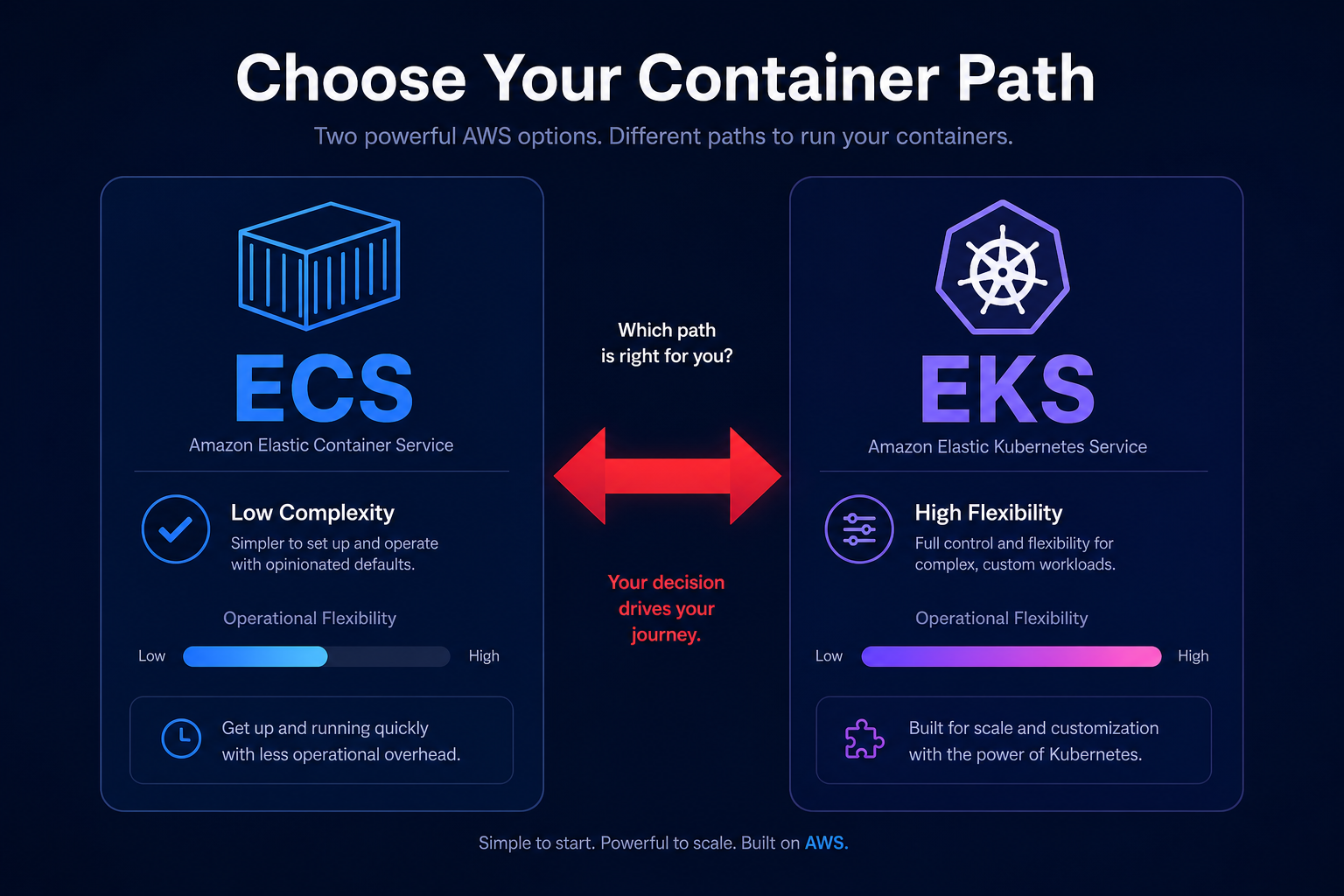
Are you paying for Kubernetes complexity you don’t actually need? Choosing between Amazon Elastic Container Service (ECS) and Amazon Elastic Kubernetes Service (EKS) isn’t just about technical preference – it’s a decision that dictates your operational overhead and your monthly AWS bill for years.
The architecture of simplicity versus flexibility
The fundamental difference between these two services lies in their orchestration DNA. Amazon ECS is an AWS-proprietary orchestrator designed to be the “easy button” for containers. It requires no separate control plane management and integrates natively with the AWS ecosystem, using simple constructs like task definitions to run your Docker containers. Because it is a native AWS solution, it feels like a natural extension of IAM, CloudWatch, and ELB.
Amazon EKS, conversely, is a managed Kubernetes service. While AWS handles the heavy lifting of the Kubernetes control plane availability, you are still interacting with the standard Kubernetes API. This makes EKS the better choice if your team requires multi-cloud portability or needs to leverage the massive ecosystem of Kubernetes-specific tools, such as Helm or Prometheus. However, this flexibility introduces a steeper learning curve; choosing between Amazon ECS and Kubernetes often highlights that Kubernetes has roughly 12 times more community-driven documentation and troubleshooting resources, reflecting its inherent complexity.
Management overhead and the DevOps burden
If your DevOps team is small, the operational “tax” of EKS might outweigh its benefits. In ECS, you do not need to worry about upgrades to the control plane or managing complex networking plugins. You define your service, and AWS handles the rest. This simplicity is particularly evident when using AWS Fargate cost optimization tips to run serverless containers, where you strip away the need to manage EC2 instances entirely.
EKS requires more consistent maintenance. Even as a managed service, you must manage Kubernetes versions, handle cluster add-ons, and configure granular RBAC. However, for organizations with deep Kubernetes expertise, this granularity is a significant asset. EKS allows for advanced scheduling techniques and the use of tools like Karpenter for optimizing EKS node groups, which automatically provisions the most cost-effective instance types based on pending pod requirements.
Comparing the real costs of orchestration
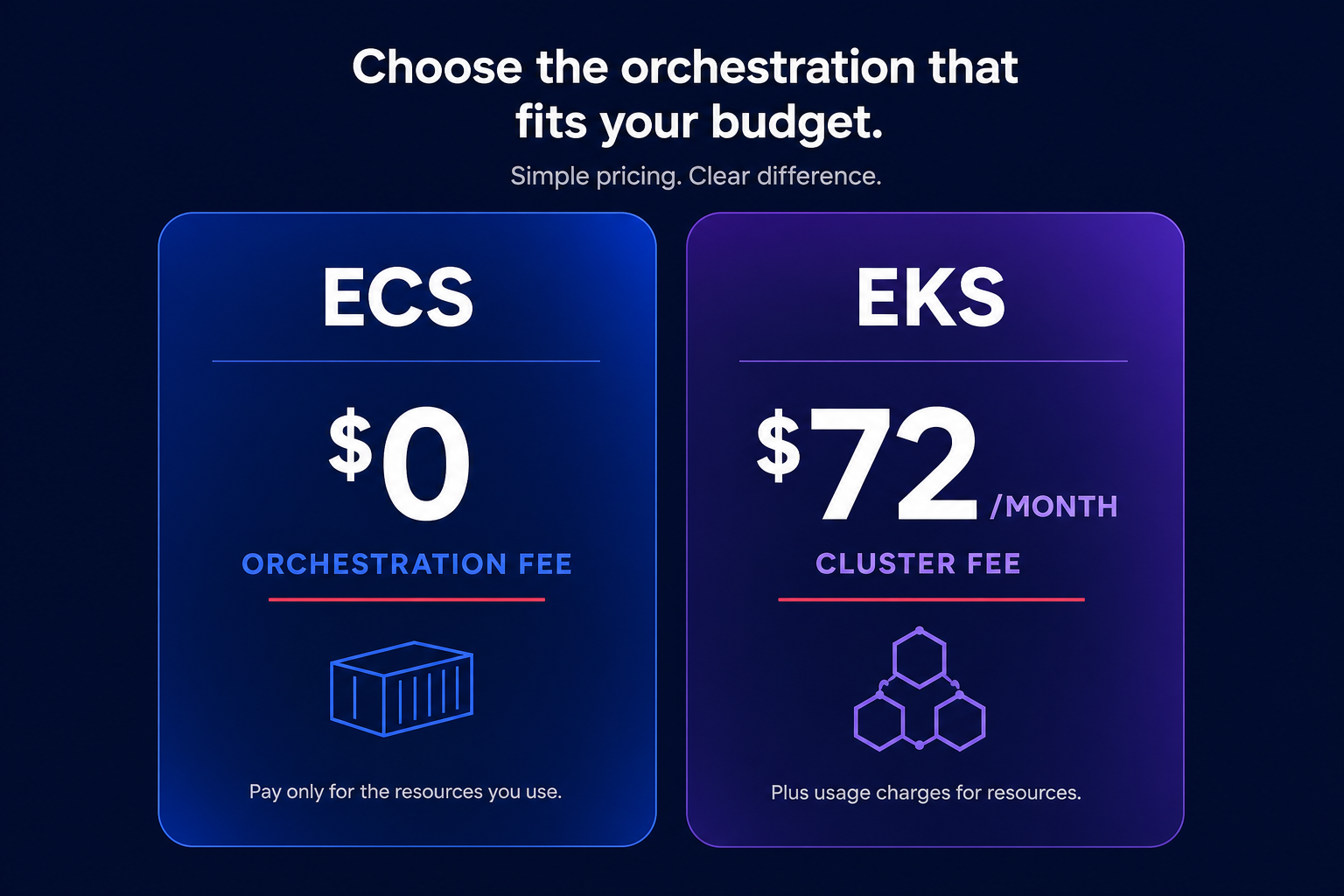
From a direct pricing standpoint, Amazon ECS is the more budget-friendly starting point. There is no additional charge for the orchestration itself; you only pay for the underlying EC2 instances or Fargate tasks. Amazon EKS, however, incurs a cluster charge of $0.10 per hour, which totals approximately $72 per month per cluster, according to official Amazon EKS pricing. While this is negligible for large production environments, it can add up quickly for organizations running dozens of small development or staging clusters.
The true cost differences often hide in the data plane. EKS clusters frequently suffer from “bin-packing” inefficiencies where nodes are underutilized due to poorly defined pod resource requests. Hykell helps teams bridge this gap by providing intelligent AWS rate optimization, ensuring that whether you choose ECS or EKS, you are leveraging the best mix of Savings Plans and Reserved Instances to lower your compute spend by up to 40%.
Scalability and ecosystem integration
Both services offer high scalability, but they approach it with different philosophies. ECS scales tasks quickly and integrates deeply with automatic cloud resource scaling policies that feel familiar to anyone who has used EC2 Auto Scaling Groups. It is a streamlined experience for stateless web applications and microservices that stay within the AWS ecosystem.
EKS is the power user’s choice for complex workloads, such as distributed machine learning or big data processing. It supports a wider array of specialized hardware and offers more sophisticated Kubernetes cost optimization strategies, such as using Horizontal Pod Autoscalers (HPA) in tandem with Cluster Autoscalers. If your long-term roadmap involves running the same application on-premises or on other cloud providers, the standardized Kubernetes API of EKS provides the only viable path for portability.
Maximizing performance with Graviton and Spot
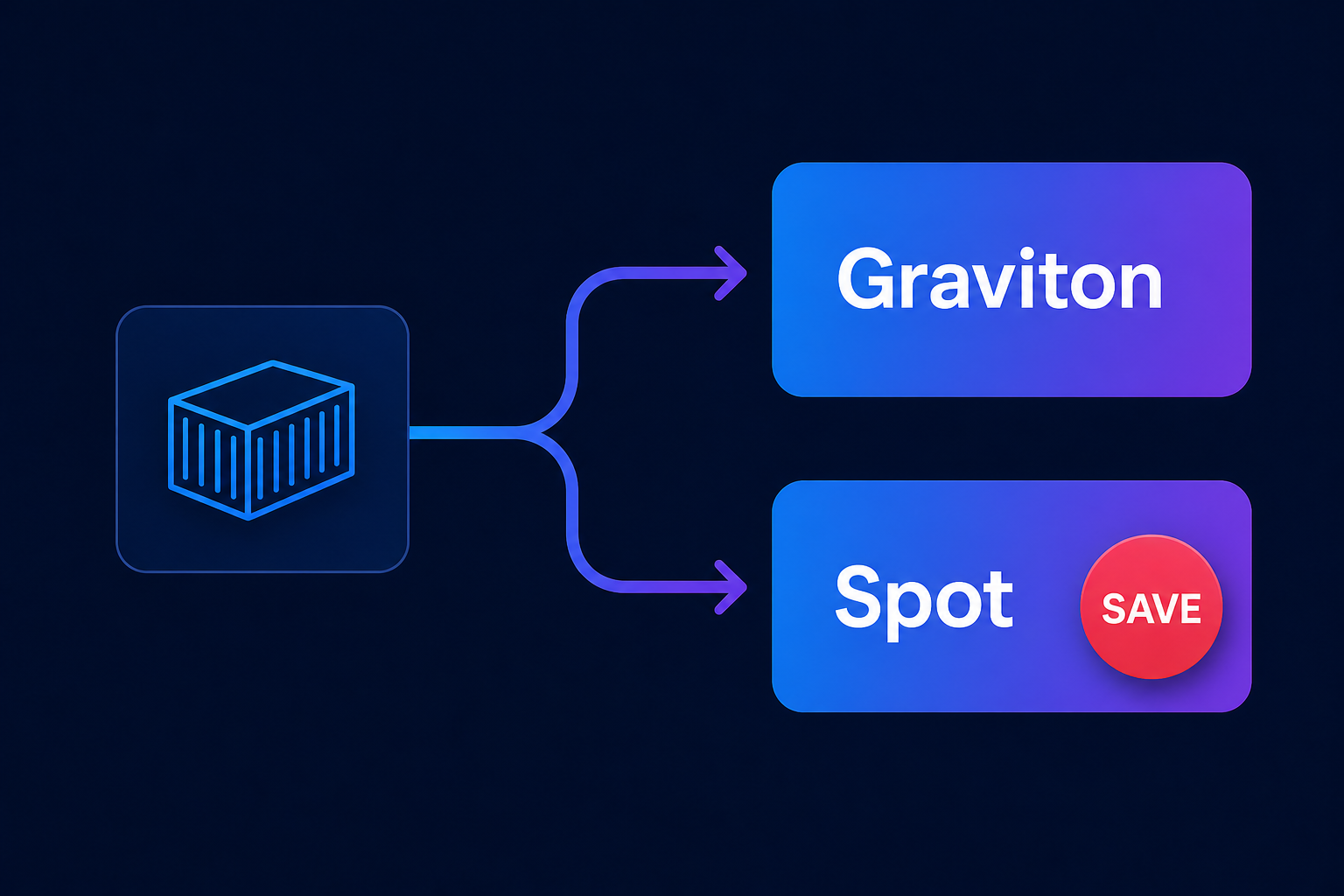
Regardless of which orchestrator you select, the most significant performance-per-dollar gains come from modernizing your compute. Migrating your ECS tasks or EKS nodes to AWS Graviton adoption can deliver up to 40% better price-performance compared to traditional x86 instances. Similarly, leveraging Spot Instances for fault-tolerant workloads can slash compute costs by up to 90%.
Hykell specializes in automating these transitions. The Hykell platform monitors your containerized workloads in real-time to identify cloud cost optimization solutions and implements configuration changes on autopilot. By removing the manual burden of infrastructure management, Hykell allows your DevOps team to focus on shipping code rather than chasing cloud waste.
The choice between ECS and EKS should ultimately be driven by your team’s existing skill set and your application’s need for Kubernetes-specific features. If you want a “set it and forget it” experience, choose ECS. If you need a platform-agnostic powerhouse, EKS is worth the additional operational investment. No matter which path you take, ensuring your underlying resources are optimized is the key to maintaining a healthy cloud budget.
To see exactly how much you could save on your container orchestration, use the Hykell cost savings calculator or contact our experts for a detailed infrastructure audit.