Why does your AWS bill feel like a moving target that your engineering and finance teams can’t seem to hit? While the cloud offers unparalleled agility, it often creates a “visibility gap” where technical decisions happen in milliseconds but financial reconciliation takes months.
Building a dedicated FinOps function is the only way to bridge this divide. According to Gartner, organizations that progress through FinOps maturity stages can boost AWS cost savings by 30-50% while improving forecasting accuracy by 40%. This guide explores how to structure your team, define roles, and scale from basic visibility to automated efficiency.
Choosing the right FinOps operating model
Before hiring, you must decide how the FinOps function will interact with the rest of your organization. The FinOps Foundation identifies three primary models that dictate how decisions are made and who carries the responsibility for cost spikes.
The centralized model is typically best for early AWS adopters or organizations requiring strict uniform policy enforcement. In this setup, a central team – often within Finance or IT – owns all cost control and vendor management. While this ensures standardization, it can create bottlenecks and disconnect the people spending the money from the responsibility of managing it. Conversely, a distributed model pushes accountability directly to the engineering squads. This is ideal for mature AWS environments where teams have high autonomy, though it risks fragmented reporting without central standards for AWS Organizations cost management across accounts.
Most successful enterprises eventually land on a federated model. This “hub-and-spoke” approach uses a central FinOps team to provide tooling, governance, and AWS rate optimization strategies, while individual engineering teams execute the actual resource adjustments. Roughly 60% of large organizations now use this model to balance scale with technical agility.
Core roles and responsibilities in a FinOps team
A functional FinOps team is a cross-functional squad that speaks both “code” and “capital.” Each role must understand how their specific actions influence the overall cloud economy.
Leadership and engineering roles
The FinOps Lead acts as the architect of the practice, aligning stakeholders and ensuring the organization moves toward a value-based spend model. They are responsible for establishing the role of tagging in cloud cost management to ensure every dollar spent is traceable.
Engineering and Operations teams own the technical execution of these strategies. They focus on rightsizing instances, managing storage lifecycles, and identifying idle resources. As the team matures, their role shifts from manually fixing leaks to building cost-aware architectures. Understanding the synergies between FinOps and DevOps is critical here, as cost metrics should eventually be integrated directly into your CI/CD pipelines.
Finance and procurement functions
Finance and Procurement handle the budgeting, forecasting, and contract negotiations. By using data from tools like AWS Cost Explorer, they ensure cloud spend stays within 10% of the forecast. Their focus remains on unit economics – measuring cloud cost against business outcomes, such as cost per customer or transaction. Finally, Executive Sponsors provide the necessary air cover to enforce accountability when cost-saving initiatives conflict with engineering delivery speed.
The FinOps maturity path: crawl, walk, run
You cannot build a high-performing FinOps team overnight. Most organizations follow a progression from “Crawl” to “Run” to ensure they do not over-engineer their processes too early.
- Crawl: The focus is entirely on visibility and “Informing.” The team establishes mandatory tagging, activates cost allocation tags, and implements AWS cost management best practices to answer the question of who is spending what.
- Walk: The team moves toward optimization and collaboration. Engineering and finance start holding regular “rituals” to review spend. You begin implementing FinOps automation with AWS Organizations, such as scheduled shutdowns for non-production environments.
- Run: The team achieves full operational integration. Automation becomes a requirement, and decisions regarding cloud FinOps tools are driven by their ability to provide real-time remediation. In this stage, every dollar spent on AWS is directly tied to a business value metric.
Aligning engineering and finance through KPIs
The biggest hurdle for a new FinOps team is the culture gap. Finance teams hate surprises, while engineering teams hate friction. To align them, the team must move away from “total spend” as the primary metric and focus on shared KPIs that reflect value.
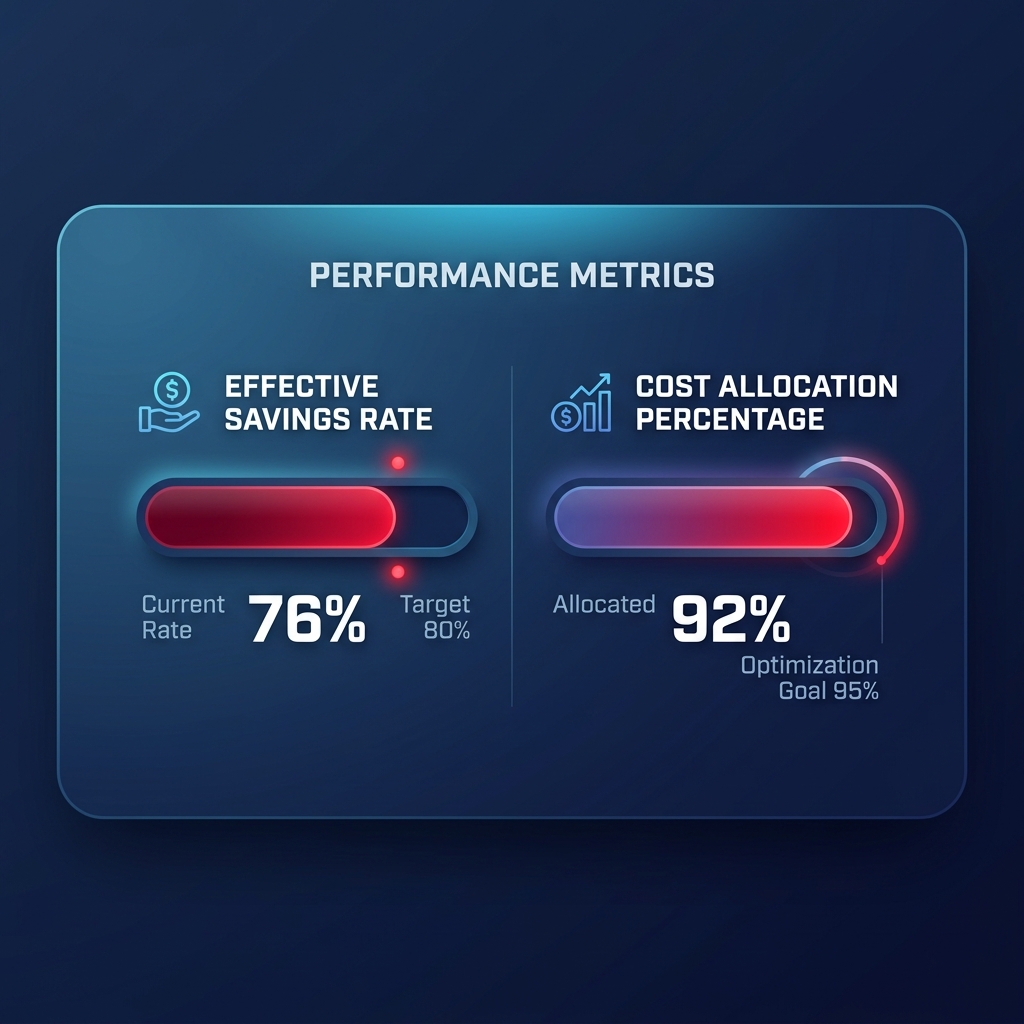
One of the most effective metrics is the Effective Savings Rate (ESR). This measures how much you are saving compared to On-Demand prices through a mix of Savings Plans, Reserved Instances, and Spot instances. Mature teams often target an ESR of 50–70% on compute workloads. Another vital metric is the Cost Allocation Percentage. If your team cannot attribute at least 85–90% of your AWS bill to a specific owner or project, your data is too noisy to be actionable. Using a cloud observability dashboard can help stakeholders visualize these metrics in real-time, tailored specifically to their leadership or technical roles.
Scaling your team with automated optimization
As your cloud footprint grows, the manual effort required to manage thousands of instances and fluctuating rates becomes unsustainable. A small FinOps team can quickly become overwhelmed by the sheer volume of rightsizing tickets and commitment renewals. This is where the transition from manual “Informing” to automated “Operating” becomes essential for long-term health.
High-growth companies are increasingly leveraging automation to handle the heavy lifting of rate optimization and resource cleanup. By automating the purchase and exchange of Convertible RIs and Savings Plans, teams can maintain high coverage without the risk of over-committing to the wrong instance types. This shift allows your specialized staff to focus on architecture and strategy rather than manual spreadsheet management.
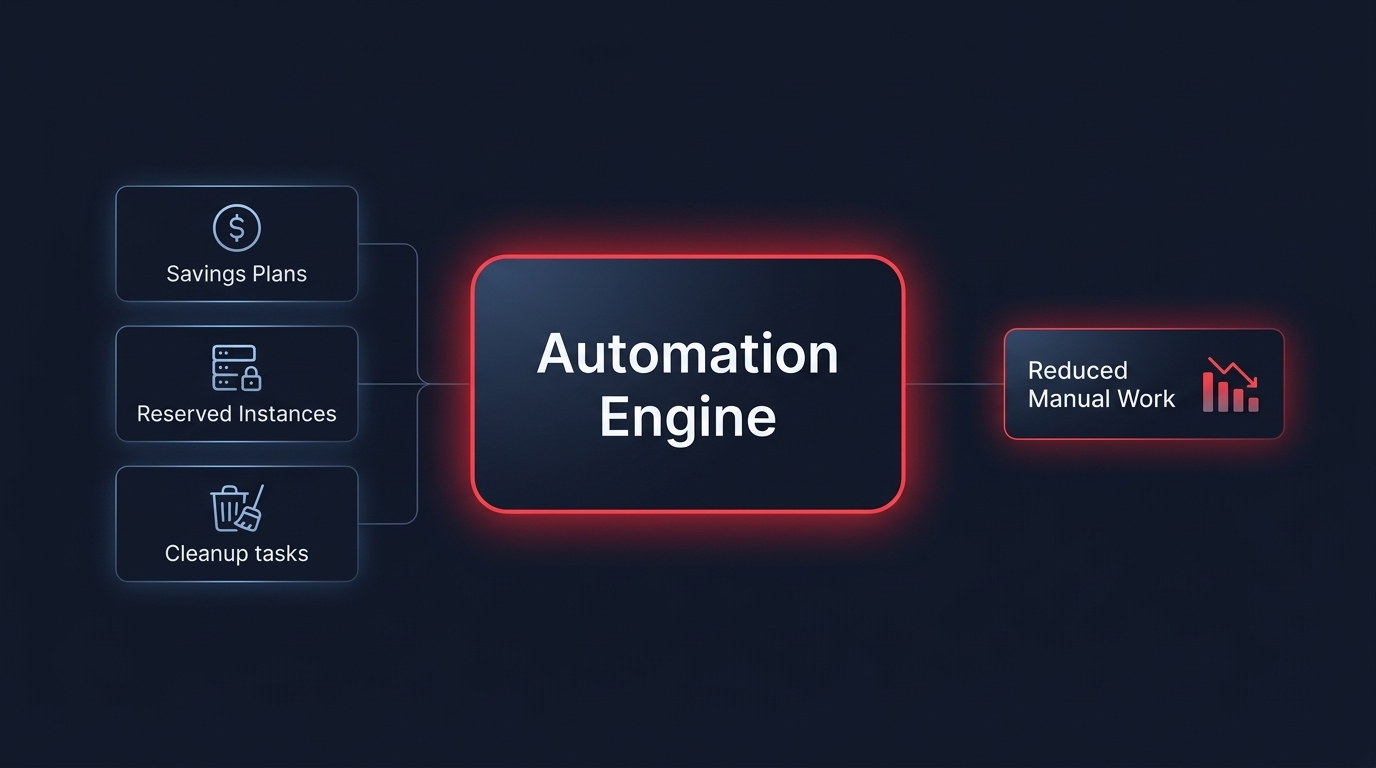
Hykell helps FinOps teams reach the “Run” phase faster by putting cloud cost optimization on autopilot. Our platform identifies hidden savings and executes optimizations automatically, typically reducing AWS costs by up to 40%. Because we only take a slice of what you actually save, there is no risk to your budget. To see how much your team could recover, run an automated cost audit with our calculator or contact our experts to discuss your FinOps roadmap.