Did you know the typical organization leaves 30% of its AWS spend on the table? For Fargate users, the “set it and forget it” nature of serverless often leads to over-provisioning that quietly drains your budget while resources sit idle.
Accelerate savings with AWS Graviton migration
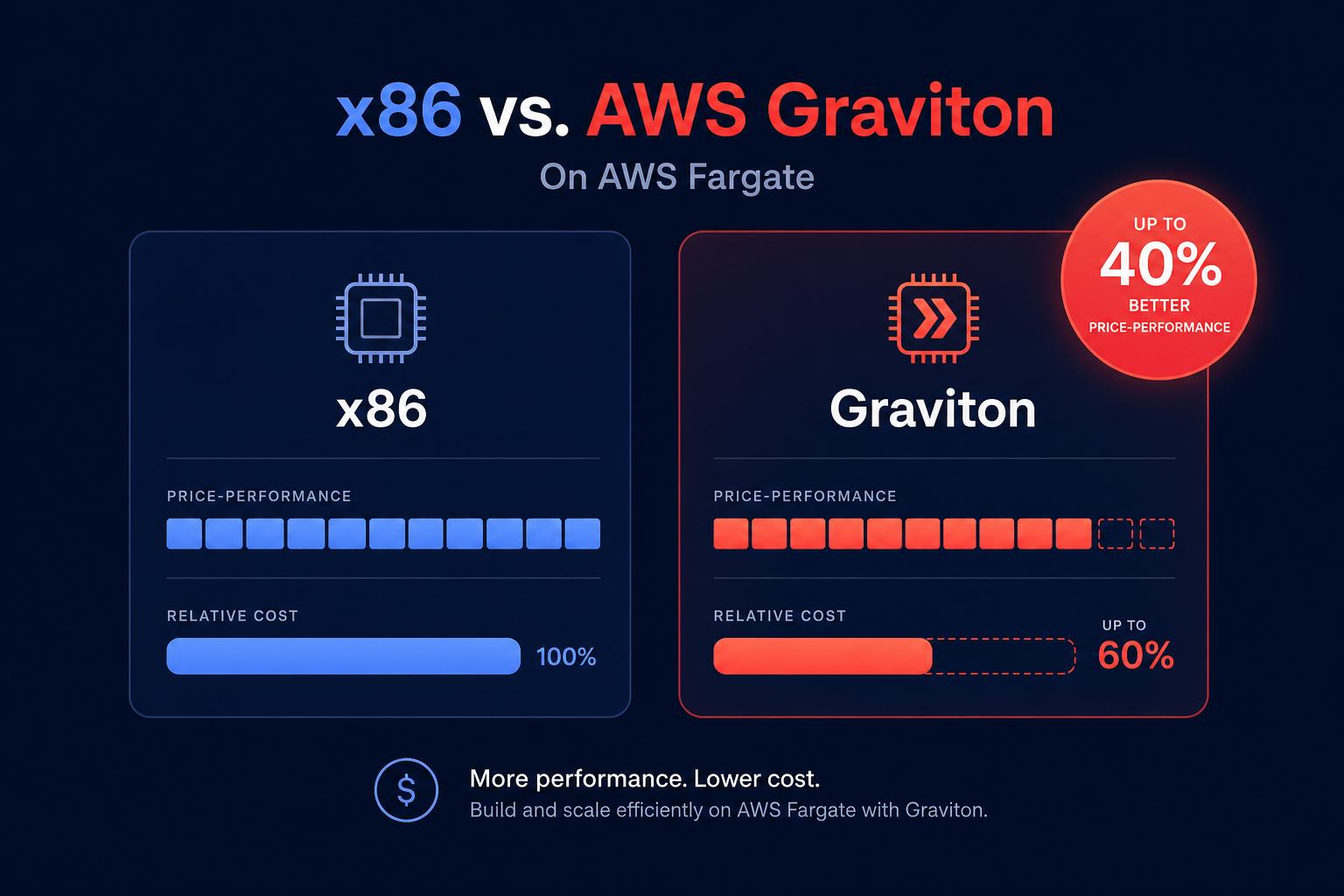
Moving your Fargate workloads from traditional x86 processors to AWS Graviton instances is one of the fastest ways to improve your performance-to-cost ratio. AWS Graviton2 and Graviton3 processors, based on the Arm64 architecture, deliver up to 40% better price-performance compared to x86-based instances. These processors consume up to 60% less energy, making the transition as beneficial for your sustainability goals as it is for your bottom line.
For Amazon ECS users, AWS supports Graviton-based Fargate tasks in all regions, allowing you to switch architecture simply by updating your task definition. On Amazon EKS, the impact of Graviton on Kubernetes workloads is equally significant. While multi-architecture challenges such as library compatibility exist, the 20% lower cost per vCPU makes the transition highly ROI-positive for stateless microservices. Hykell offers a Graviton migration acceleration program designed to help your team move faster with automated compatibility assessments and performance benchmarking.
Right-sizing Fargate tasks and Kubernetes pods
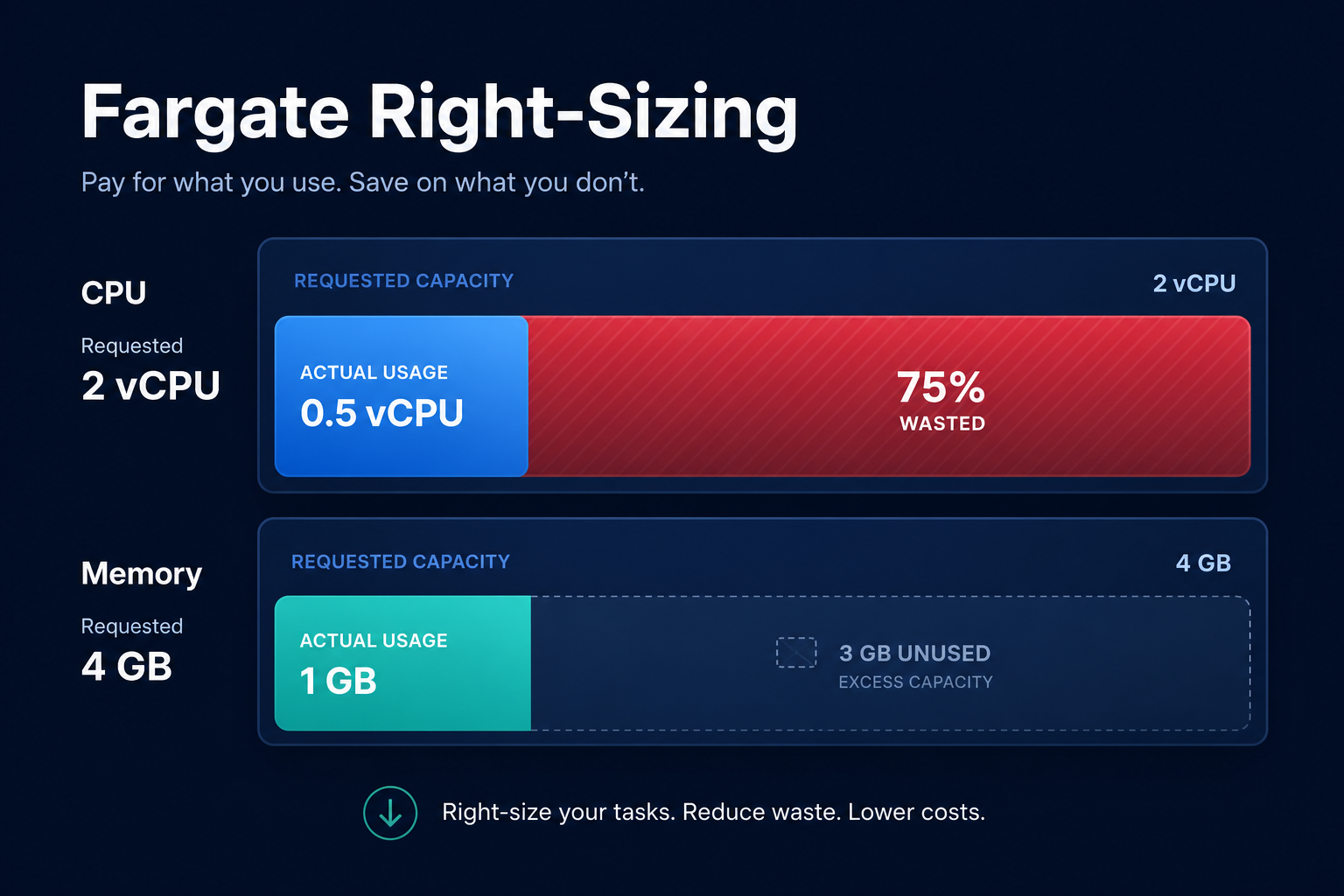
Fargate pricing is strictly based on the vCPU and memory resources you request, rounded to the nearest second with a one-minute minimum. If you provision 2 vCPU for a task that only ever peaks at 0.5 vCPU, you are effectively throwing away 75% of that task’s cost. Because you pay for what you request rather than what you use, accurate configuration is the only way to prevent waste.
Effective cloud resource right-sizing requires analyzing at least two weeks of historical utilization data. For ECS, you should aim for a p95 CPU utilization of roughly 60–70%. For EKS Fargate, the billing calculation is slightly more complex; AWS provisions capacity based on the sum of your container requests and adds an additional 256 MiB for Kubernetes components. This means your billed capacity is often higher than your raw pod spec suggests.
To avoid the “OOMKill” cycle while minimizing waste, you should follow Kubernetes pod resource limits best practices. Set your requests at the p95 of historical usage and use limits as a safety ceiling. Hykell can help you implement automated AWS right-sizing to match these resources to real-world demand on autopilot, often reducing compute costs by 40% without manual engineering effort.
Maximizing discounts with Fargate Spot and Savings Plans
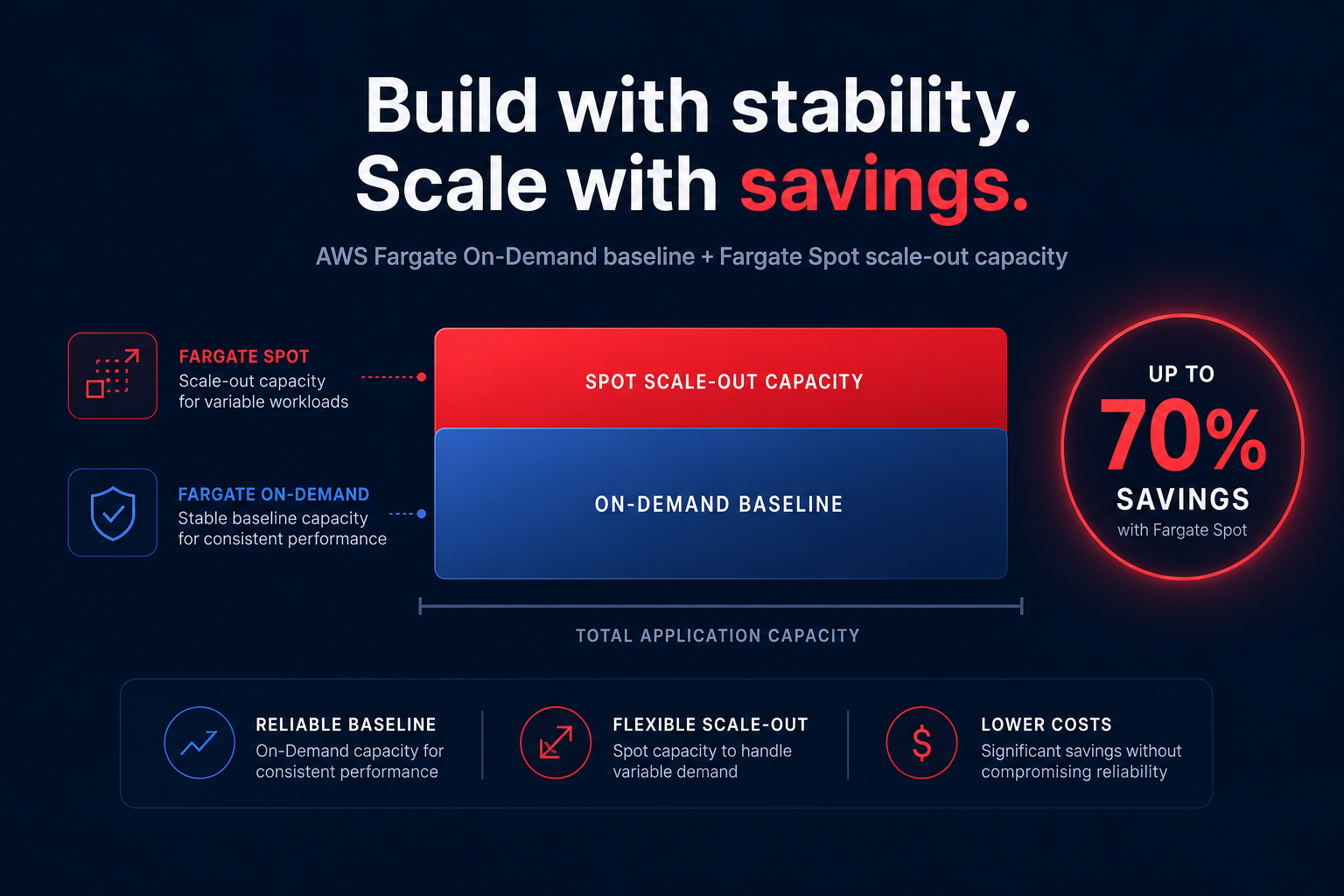
If your workloads are fault-tolerant – such as batch processing, development environments, or stateless web tiers – Fargate Spot is an essential tool. For Amazon ECS, Fargate Spot can provide up to 70% discounts compared to On-Demand pricing. You can use Capacity Providers to mix On-Demand for your baseline and Spot for your scale-out capacity, ensuring you maintain availability while slashing the cost of horizontal scaling.
For steady-state workloads on both ECS and EKS, Compute Savings Plans are your primary lever for long-term reduction. These plans offer significant discounts in exchange for a one- or three-year hourly spend commitment. However, managing these commitments manually often leads to “lock-in” or under-utilization when your architecture changes. Hykell’s AWS rate optimization service uses AI-driven commitment planning to manage a portfolio of Savings Plans and Reserved Instances for you, ensuring you hit the highest effective savings rate (ESR) without the risk of paying for unused capacity.
Automating the optimization lifecycle
Manual cost audits are outdated the moment they are finished. To maintain a lean Fargate footprint, you need continuous observability that allows you to drill down from a spend spike to the specific resource ID in seconds. While AWS native tools like Compute Optimizer provide recommendations, they do not implement the changes for you, leaving a gap between insight and savings.
By integrating automated cost-optimization strategies, you can move from reactive billing alerts to proactive savings. This includes scheduling non-production environments to scale to zero during off-hours and using intelligent node scaling to ensure container density remains high. Hykell provides a risk-free way to slash your AWS bill by up to 40% – we only take a slice of what you save, meaning if we don’t find savings, you don’t pay.
You can combine Graviton migration, right-sizing, and automated rate management to reclaim your cloud budget. To find out exactly how much you are overspending on your current clusters, use the Hykell cloud cost savings calculator for an instant estimate of your potential reductions.