Are you paying a “flexibility tax” on your AWS bill without even realizing it? Most businesses lose significant budget by staying on On-Demand for steady-state workloads. Transitioning to a commitment-based model is the single most effective way to stop cloud costs from spiraling.
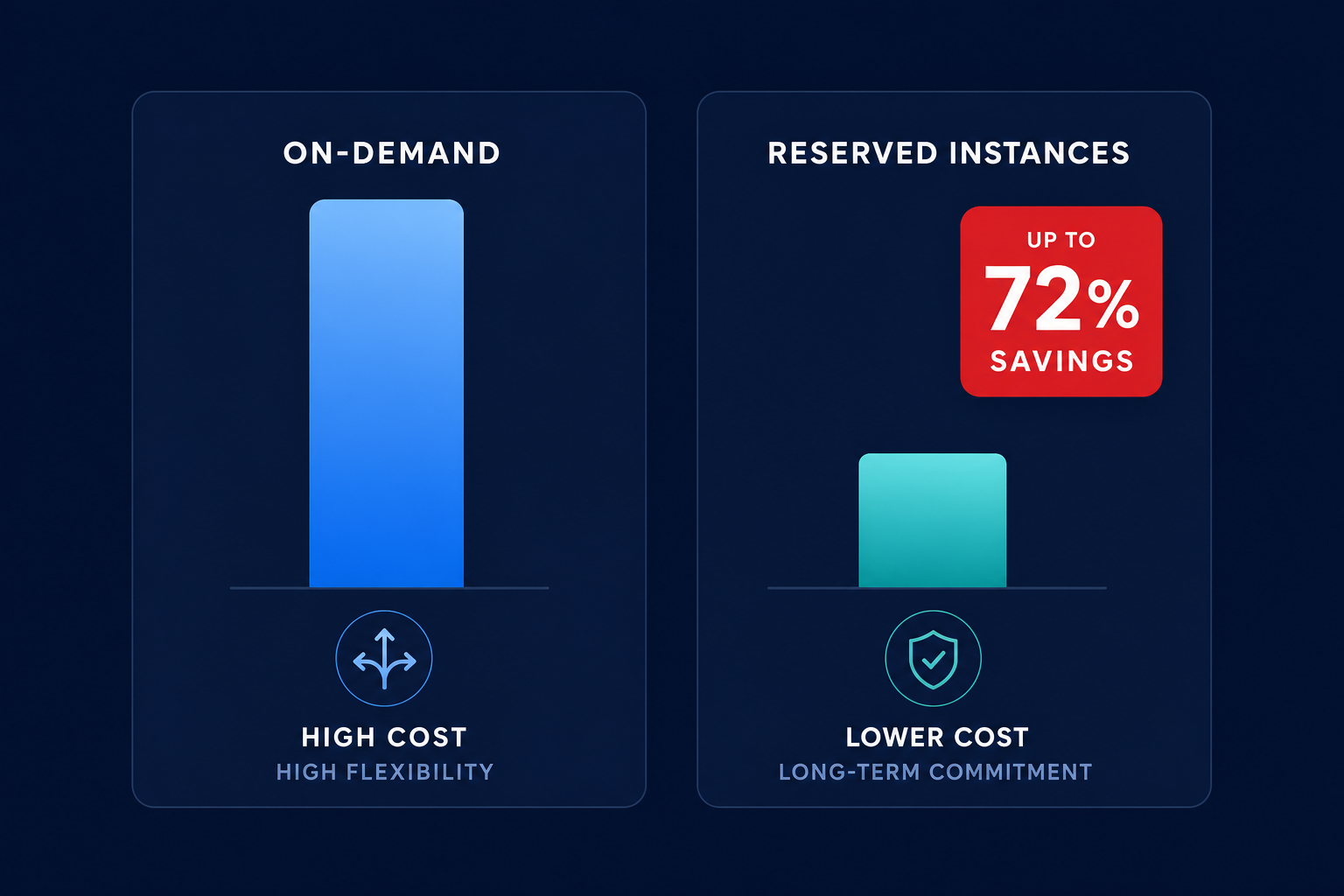
Choosing between On-Demand and Reserved Instances (RIs) is a balancing act between agility and deep discounts. While On-Demand offers the ultimate freedom to scale, Amazon EC2 Reserved Instances can provide up to a 72% discount compared to standard rates. Understanding the mechanics of these two models – and how to blend them – is the first step toward significant cost reduction.
On-Demand: The price of total flexibility
Amazon EC2 On-Demand Instances operate on a pure pay-as-you-go model. You pay for compute capacity by the hour or the second, with no long-term commitments or upfront payments. This is the baseline for AWS pricing and offers the highest level of flexibility, ensuring you only pay for the time your instances are in the running state.
On-Demand is ideal for:
- Short-term, unpredictable workloads that cannot be interrupted.
- Applications being developed or tested for the first time.
- Spiky traffic that exceeds your baseline capacity.
The primary trade-off is the cost. Because AWS must maintain a massive pool of available hardware to meet On-Demand requests, they charge a premium. If your instances run 24/7, staying on On-Demand is effectively paying a massive surcharge for flexibility you are not actually using. Before committing to a specific instance type, you can use the AWS pricing calculator guide to model your expected baseline and compare different purchasing options.
Reserved Instances: Trading commitment for 72% savings
A Reserved Instance is not a physical instance; it is a billing discount applied to your account in exchange for a commitment to use a specific amount of capacity over a one-year or three-year term. These commitments can slash your compute spend by nearly three-quarters if managed correctly, particularly for steady-state workloads.
RIs come in two primary flavors that dictate your future flexibility:
- Standard RIs: These offer the deepest discounts but are the most rigid. You generally cannot change the instance family or region once purchased. However, if you no longer need them, the AWS Reserved Instance Marketplace allows you to list unused Standard Reserved Instances for sale to other customers.
- Convertible RIs: These offer a lower discount than Standard RIs but allow you to exchange them for another Convertible Reserved Instance with a different configuration. This is useful if you need to change instance families or operating systems as your technology stack evolves.
The payment and term trade-offs
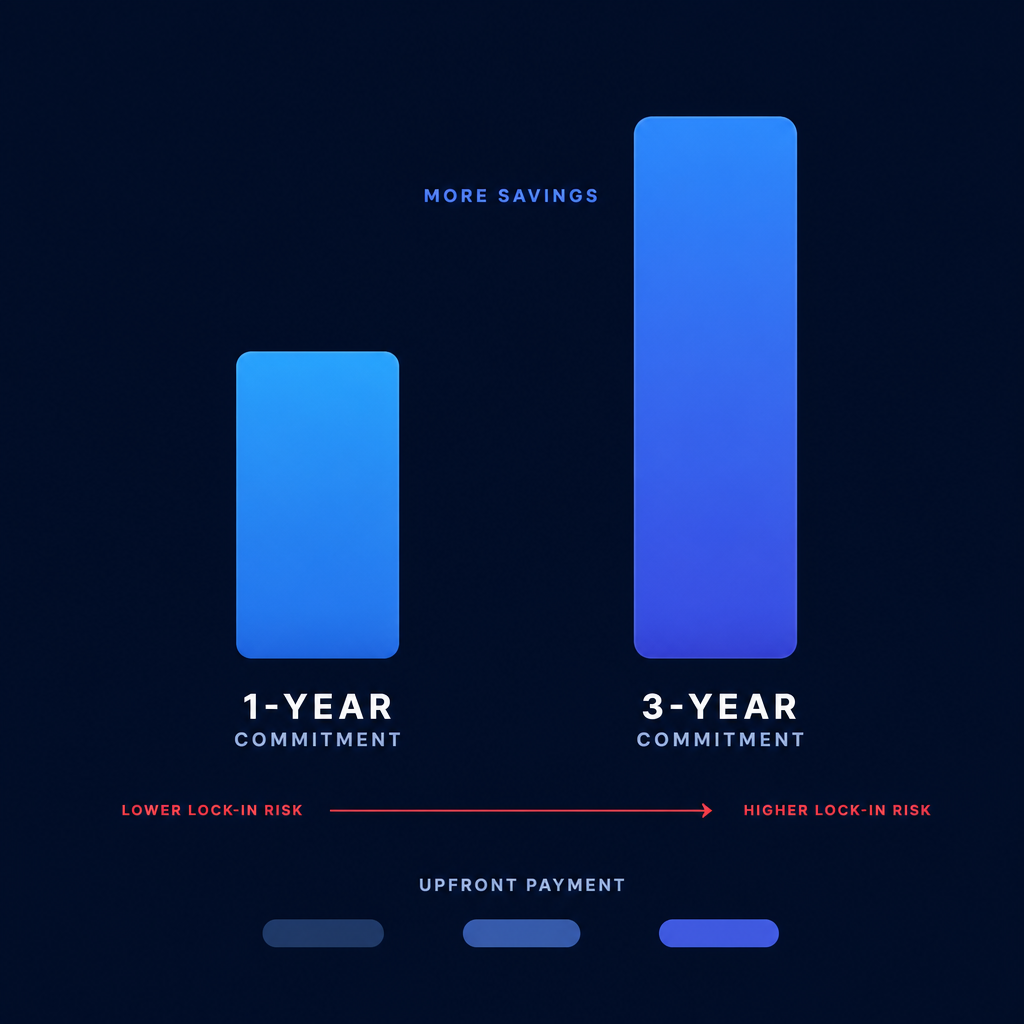
Your total savings depend heavily on how much you are willing to pay upfront and how long you are willing to commit. A three-year commitment always offers a steeper discount than a one-year term, but it also carries higher “lock-in” risk if your infrastructure requirements change.
You have three payment options for RIs that affect your cash flow and discount depth:
- All Upfront: You pay for the entire term at once, yielding the highest possible discount.
- Partial Upfront: A portion is paid at the start, with the remainder billed at a discounted hourly rate.
- No Upfront: You pay nothing today but commit to a fixed, discounted hourly rate for the duration of the term.
For teams worried about locking into a specific instance family for several years, AWS Savings Plans offer a more modern, flexible alternative. They function similarly to RIs by providing discounts in exchange for a spend commitment, but they are often easier to apply across evolving environments.
The execution gap in manual management
The biggest challenge with Reserved Instances isn’t buying them – it’s using them. Many organizations suffer from an “execution gap” where they purchase RIs but fail to align them with running workloads. If your instance types change but your RIs do not, you end up paying for the reservation and the On-Demand rate for the new instances simultaneously.
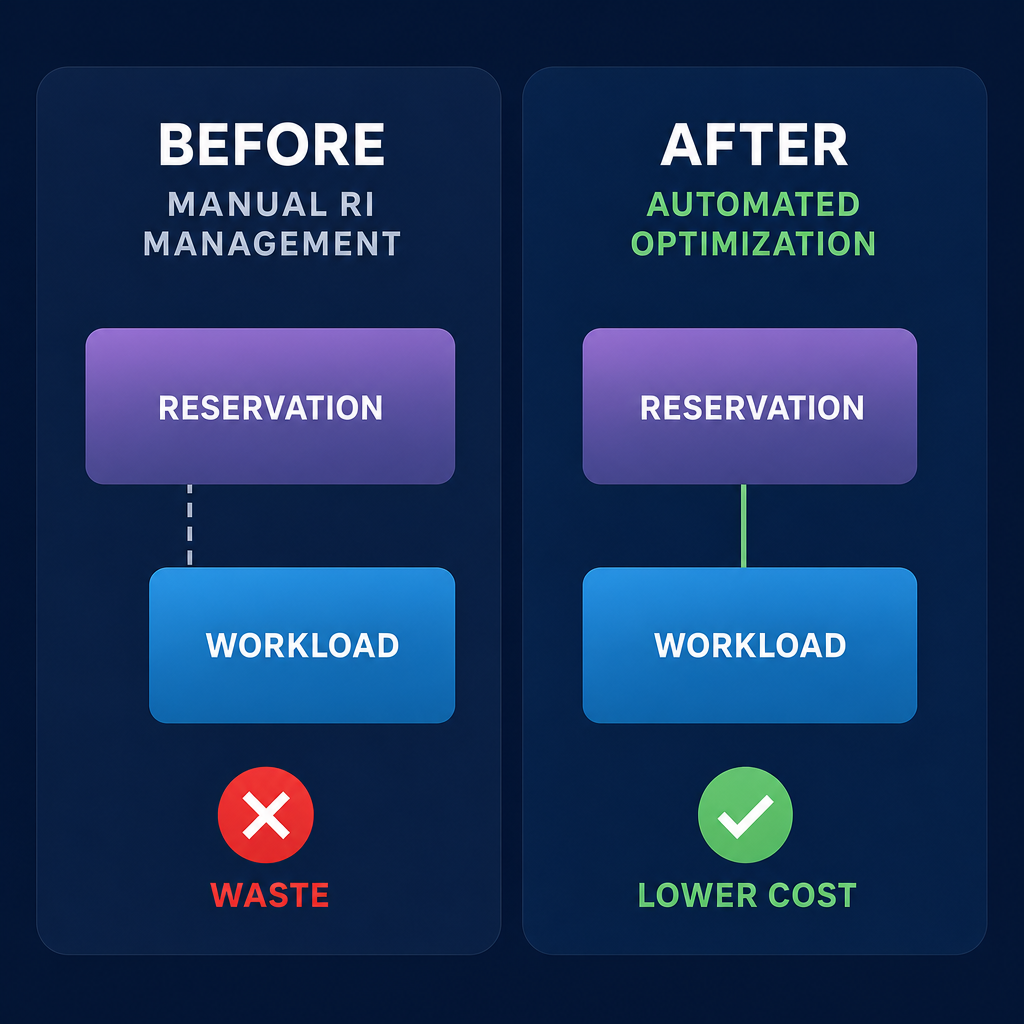
Properly auditing Reserved Instance utilization is essential to ensure your coverage stays high. Most teams aim for 70-80% coverage for steady-state workloads, leaving the remaining portion for On-Demand or Spot Instances to handle variable spikes. Managing this balance manually requires constant monitoring and engineering hours that could be better spent on product development.
Automating the On-Demand vs. RI choice
The reality of modern cloud infrastructure is that it moves too fast for manual spreadsheets and reactive audits. Your engineers should be focused on building products, not playing the AWS Marketplace. This is where AWS rate optimization through automation becomes a significant competitive advantage.
Hykell eliminates the complexity of choosing between On-Demand and RIs by operating your rate optimization on autopilot. Our platform uses AI to analyze historical usage and real-time shifts, automatically buying, selling, and converting RIs and Savings Plans. This ensures you always have the highest possible discount without the risk of over-commitment or paying for unused capacity.
By implementing automated Reserved Instance management, Hykell customers typically achieve 30-40% compute cost reductions with zero engineering effort. We only take a slice of what we save you – if you don’t save, you don’t pay.
Stop overpaying for the flexibility you don’t use. Use our cloud cost savings calculator to see exactly how much your business could save by moving from On-Demand to an automated commitment strategy.