Is your NAT Gateway costing you more than the EC2 instances it serves? For many AWS users, this “convenience tax” becomes a primary driver of bill shock, with data processing fees scaling invisibly until they dominate the monthly networking budget.
Understanding the mechanics of NAT Gateway pricing is the first step toward reclaiming your margins. While these managed services provide essential outbound internet connectivity for private subnets, they are among the most expensive ways to move data within the AWS ecosystem. By implementing specific architectural shifts and leveraging AWS rate optimization strategies, you can often reduce these specific charges by up to 80%.
The three pillars of NAT Gateway pricing
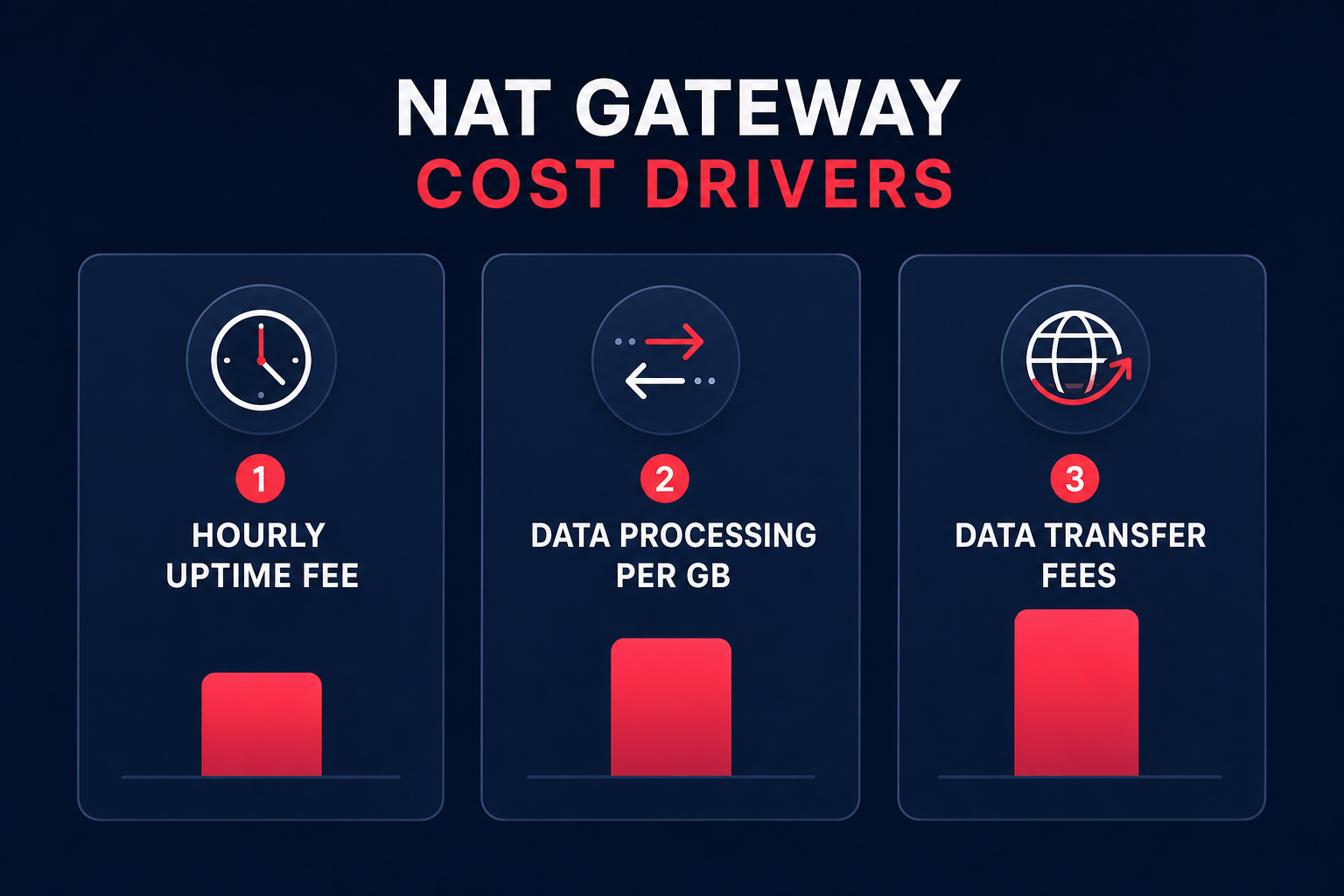
AWS calculates NAT Gateway costs using three distinct metrics. If you do not monitor all three, you risk optimizing the wrong variable and leaving significant savings on the table.
- Hourly uptime fee: AWS charges a flat rate for each hour the NAT Gateway is provisioned. For the majority of standard regions, Amazon VPC pricing sets this at $0.045 per hour. This cost remains constant regardless of whether the gateway handles one megabyte or one terabyte of traffic.
- Data processing charge: This is the most common multiplier for unexpected expenses. AWS charges $0.045 per GB for every gigabit that passes through the gateway. Unlike standard AWS data transfer costs, which often only apply to egress, this fee applies to both inbound and outbound traffic.
- Data transfer fees: Once data leaves the NAT Gateway and heads to the internet or another region, standard AWS egress costs apply. This typically adds another $0.09 per GB for internet-bound traffic in most US regions.
Why NAT Gateway costs spiral out of control
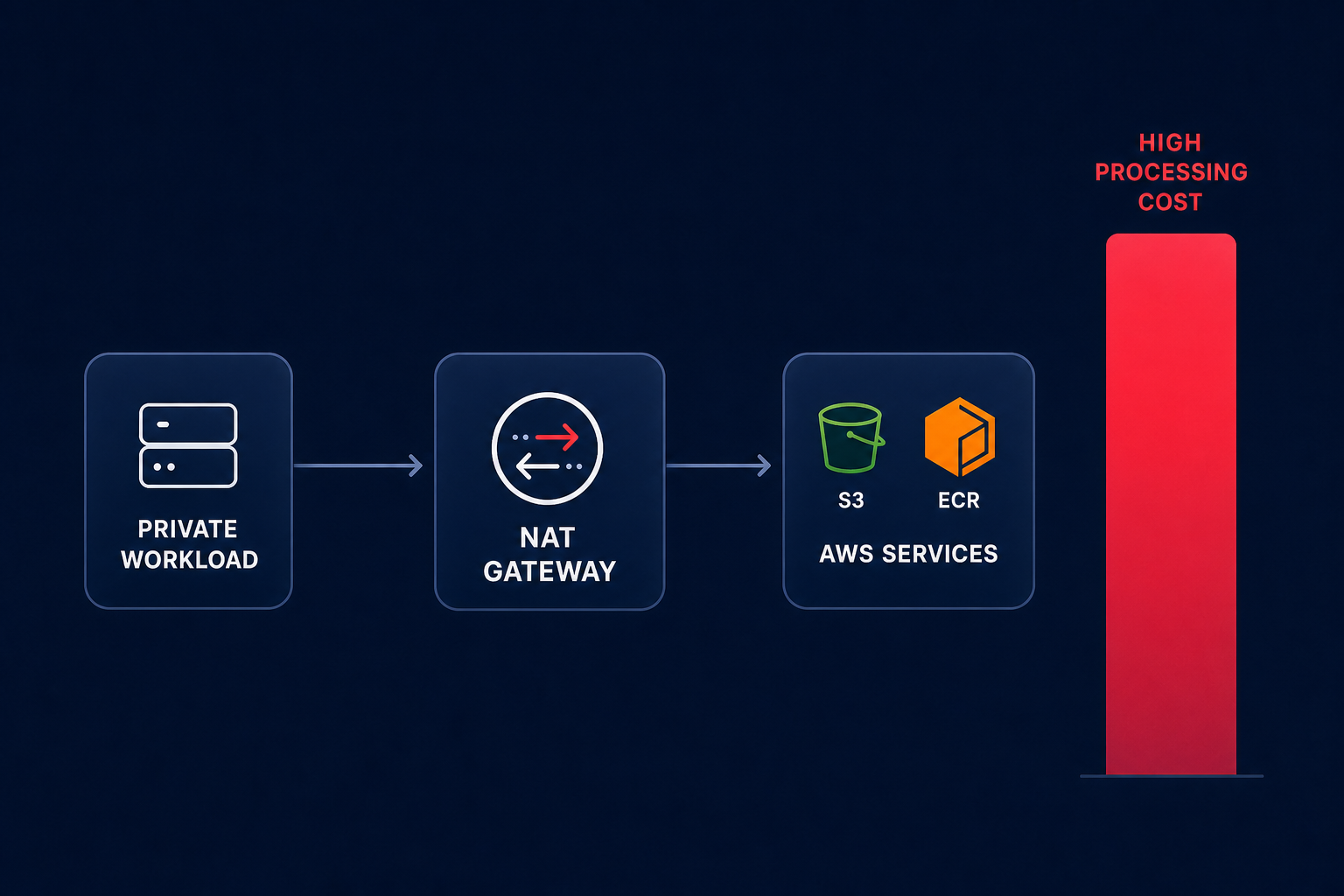
The most common reason for inflated NAT bills is routing traffic to other regional AWS services – such as S3, DynamoDB, or ECR – directly through the NAT Gateway. Because the gateway charges $0.045 per GB just to process the data, small architectural oversights can lead to massive invoices. For example, a containerized workload pulling 178,000 GB of images from ECR through a NAT Gateway can rack up over $8,010 monthly in processing charges alone.
Furthermore, NAT Gateways are Availability Zone (AZ) specific. If you have EC2 instances in one AZ routing traffic through a NAT Gateway in a different AZ, you are paying for more than just the processing fee. You are also being billed $0.01/GB for cross-AZ data transfer in both directions, which can represent a 25–35% inflation of your networking spend.
Strategies to calculate and reduce NAT costs
To stop the financial bleed, you must move high-bandwidth traffic off the NAT path and onto more cost-effective AWS networking routes.
Implement VPC endpoints
VPC endpoints allow your private resources to communicate with AWS services without ever touching the public internet or a NAT Gateway.
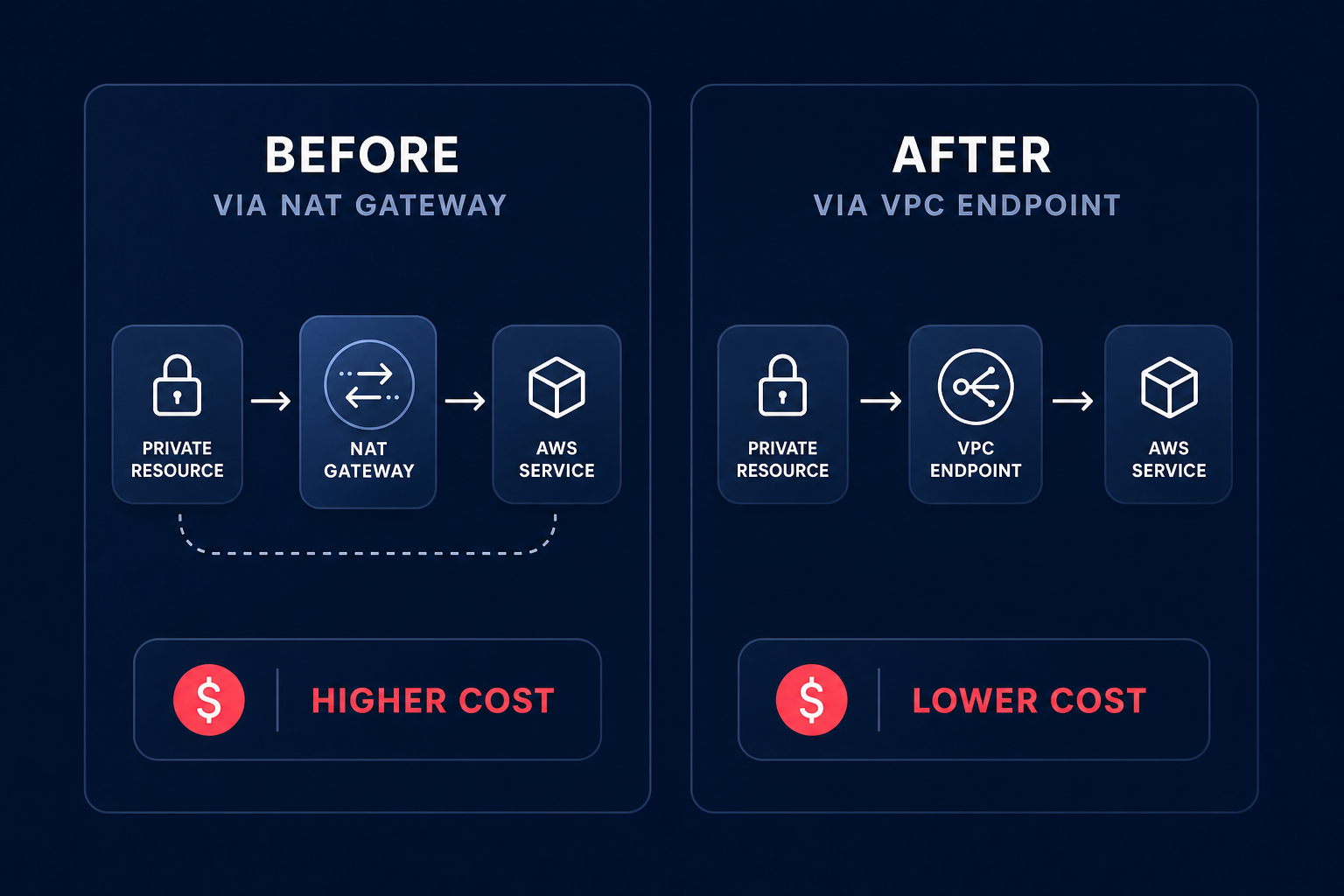
- Gateway endpoints: These are completely free and support S3 and DynamoDB. By routing traffic through a Gateway Endpoint, you eliminate the $0.045/GB NAT processing fee entirely for these high-volume services.
- Interface endpoints (PrivateLink): These carry a small hourly fee but include a processing charge of approximately $0.01/GB. While they are not free, they represent a 78% reduction in data processing costs compared to NAT Gateways. These are ideal for services like Kinesis, ECR, or Secrets Manager.
Align availability zones
AWS recommends maintaining a NAT Gateway in each AZ where you have active private resources. While this increases your hourly uptime fee to roughly $32 per month per gateway, it eliminates the $0.01/GB cross-AZ transfer charge. For high-traffic environments, the savings from avoiding cross-AZ charges far outweigh the base hourly cost of an additional gateway. You can use the Hykell Savings Calculator to model which approach is more efficient for your specific traffic volume.
Identify and remove unused gateways
Infrastructure often evolves faster than cleanup scripts, and NAT Gateways are frequently left running after the instances they served have been terminated. AWS Compute Optimizer now provides specific recommendations for unused NAT Gateways. Regularly auditing your environment for these “zombie” resources can save hundreds of dollars in idle uptime fees every year.
Monitoring NAT metrics for proactive control
Visibility is the only way to catch cost spikes before they hit your invoice. According to AWS documentation, you should monitor several CloudWatch metrics at one-minute intervals for effective NAT oversight.
- BytesInFromSource: This tracks the volume of data sent from your private instances to the gateway.
- BytesOutToDestination: This measures the volume of data the gateway sends to the internet or other AWS services.
- PeakBytesPerSecond: This metric is vital for identifying bursty workloads that might be better suited for architectural refactoring or different networking paths.
By integrating these metrics into a central dashboard, you can implement cost anomaly detection to alert your team the moment a misconfigured backup script or log export begins driving up your networking fees.
Automating your networking optimization
Manually tracking every route table and VPC endpoint is a heavy engineering lift that often takes a backseat to product development. Hykell solves this by providing automated cloud cost optimization and deep infrastructure audits that identify these networking inefficiencies on autopilot.
Hykell dives deep into your cloud costs to uncover hidden savings, helping you reduce your overall AWS bill by up to 40% without compromising performance. Because we operate on a pay-from-savings model, you only pay a fraction of the actual money we save you – if you don’t save, you don’t pay.
Ready to see how much your NAT Gateways are overcharging you? Use the Hykell Savings Calculator to get a detailed breakdown of your potential savings today.