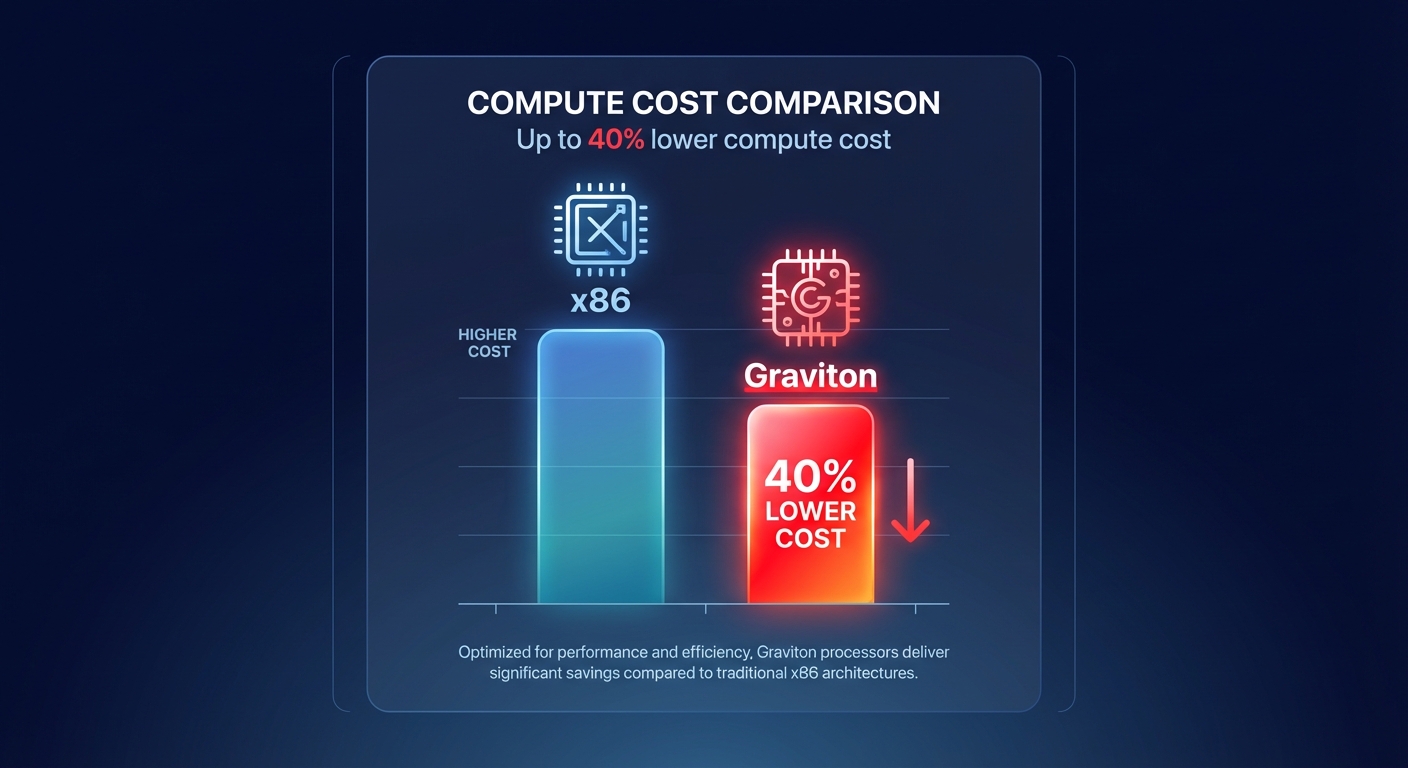
Are you still paying the “x86 tax” for your compute-heavy workloads? While traditional Intel instances rely on hyperthreading to squeeze out performance, AWS Graviton’s custom silicon offers a leaner, faster, and significantly cheaper path to scaling your infrastructure.
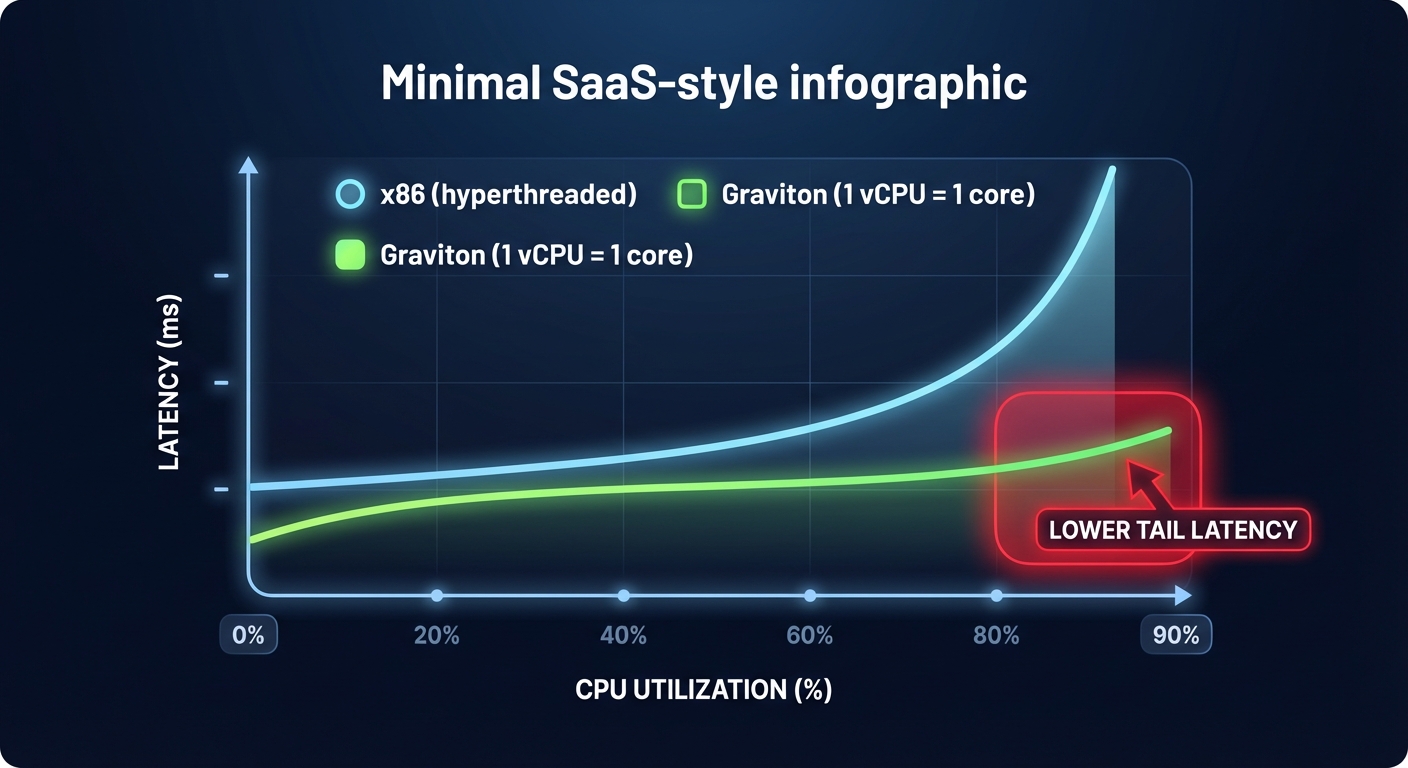
For cloud architects and engineering leaders, the shift to Arm-based architecture is not just about a lower hourly rate; it is about fundamentally changing the cost comparison between Graviton and Intel instances. By mapping one vCPU to one physical core – rather than sharing cores via hyperthreading – Graviton provides more predictable performance when your applications are under intense pressure. This architecture eliminates the resource contention inherent in hyperthreaded systems, ensuring your “tail latency” stays lower even as CPU utilization climbs toward 90%.
Performance reality under heavy load
When your traffic spikes, the architectural differences between AWS Arm vs x86 pricing become visible in your latency metrics. Graviton instances, particularly the Graviton3 and Graviton4 generations, are purpose-built for high-concurrency environments. Research indicates that Graviton3 delivers 115-120 GB/s of memory bandwidth, which significantly outperforms Intel Xeon and AMD EPYC processors. This makes Graviton-based instances like the R7g family ideal for memory-intensive tasks. In real-world deployments, organizations moving from R5 x86 instances to R7g have reported up to 20% better memory throughput and 35% cost savings simultaneously.
For compute-optimized workloads, C7g instances have demonstrated a 25% computational performance improvement over C5 instances while slashing compute costs by 30%. These gains are even more pronounced in the latest generation; Graviton4 delivers up to 12% better performance than Graviton3 and a staggering 73% improvement over Graviton2 in specific tasks like video encoding. Because you are getting more work done per clock cycle, your infrastructure scales more efficiently. In many cases, workloads running on 10 x86-based instances require only 6 to 8 Graviton instances to achieve the same or better performance.
Scaling data processing and .NET workloads
The benefits of Graviton extend across the most common enterprise stacks, provided you understand the compatibility of software with AWS Graviton. For data processing and analytics, frameworks like Apache Spark, Hadoop, and Presto have mature Arm64 support. Because data processing often hits memory and I/O bottlenecks, Graviton’s superior memory bandwidth allows for faster shuffles and joins. This efficiency translates directly to the bottom line, as you can process larger datasets with fewer resources.
While Windows Server is not supported on Graviton, modernization does not have to stop for Microsoft-heavy shops. .NET Core and .NET 5/6/7/8 on Linux run natively and efficiently on Arm. If your team has modernized to containerized .NET applications, migrating to Graviton can offer a 19% better price-performance ratio compared to x86. Applications written in interpreted or runtime-based languages like Java, Python, Go, and Node.js are the “low-hanging fruit” for migration. Since these run on top of virtual machines or interpreters already optimized for Arm, you often need zero code changes to see immediate gains.
Security and governance in an Arm-based world
Adopting a new architecture often raises red flags for compliance teams. However, Graviton instances inherit the same extensive certifications as the rest of the AWS ecosystem, including SOC, ISO, and PCI DSS. From a technical perspective, security considerations for Graviton instances are largely identical to x86. You still utilize IAM for access control, KMS for encryption, and GuardDuty for threat detection. Graviton4 even offers a 12% performance boost that allows for stronger encryption without the typical performance overhead associated with older architectures.
To maintain operational efficiency, you should incorporate Graviton into your existing cloud cost governance framework. This includes updating your Infrastructure as Code templates to support multi-architecture Auto Scaling Groups. By using a mixed instances policy, your environment can prioritize Graviton instances for cost efficiency while maintaining the ability to fall back to x86 instances if Graviton capacity is ever constrained in a specific Availability Zone. Furthermore, deploying in specific regions like Frankfurt can assist with GDPR compliance while potentially reducing costs by 20-30% compared to equivalent x86 instances.
Automating Graviton gains with Hykell
The biggest barrier to Graviton adoption is not the technology – it is the engineering time required to assess, benchmark, and migrate hundreds of instances. Most organizations find that a manual migration takes 9 to 12 weeks, which can offset the initial savings. Hykell removes this friction by providing a platform designed to accelerate your Graviton gains on autopilot. Our system analyzes your EC2, EBS, and Kubernetes environments to identify exactly which workloads are ready for Arm64.
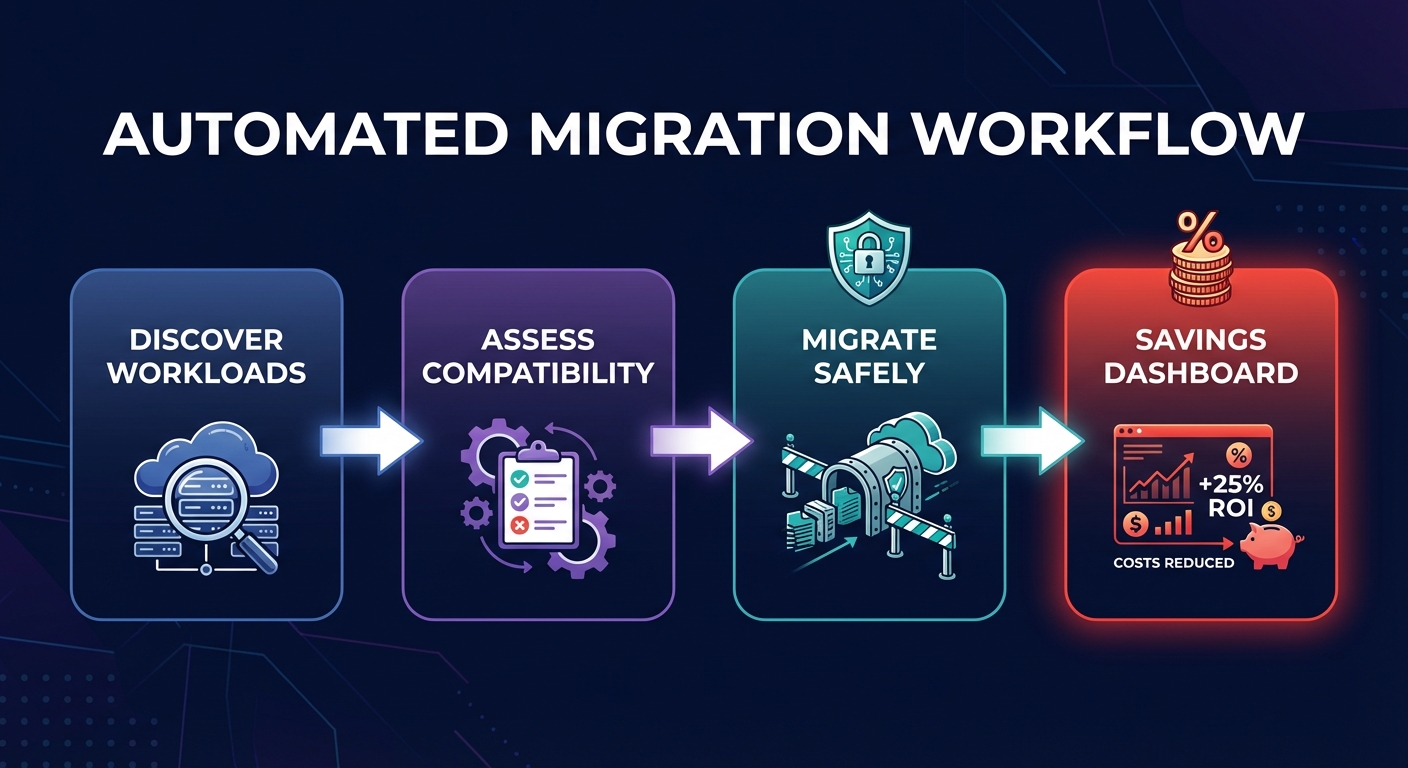
When you combine Graviton’s 40% better price-performance with Hykell’s AWS rate optimization, the savings stack. You get the lower hourly rate of the Arm architecture combined with the deepest possible discounts from Savings Plans and Reserved Instances – all without manual commitment planning or engineering lift. We help you automate these infrastructure changes with built-in rollout and rollback protections to ensure your performance never dips during the transition.
The transition to Graviton represents a massive opportunity to optimize your cloud spend without compromising on performance. By choosing an architecture that maps physical cores to vCPUs, you gain stability under heavy load that hyperthreaded x86 instances cannot match. Hykell’s automated cloud cost optimization typically saves businesses up to 40% on their AWS bill, and we only get paid if you save money. Review Hykell’s pricing and start your automated cost audit today to uncover the hidden savings waiting in your infrastructure.