Navigating the landscape of AWS discounts often feels like a full-time engineering project. While most teams are familiar with the potential to reach 72% savings using Reserved Instances and Savings Plans, the introduction of specialized Savings Plans across various services has fundamentally changed the strategy for cost-efficient infrastructure. Understanding how these commitments apply to Amazon RDS compared to EC2, Lambda, and Fargate is the difference between a static budget and a truly optimized cloud bill.
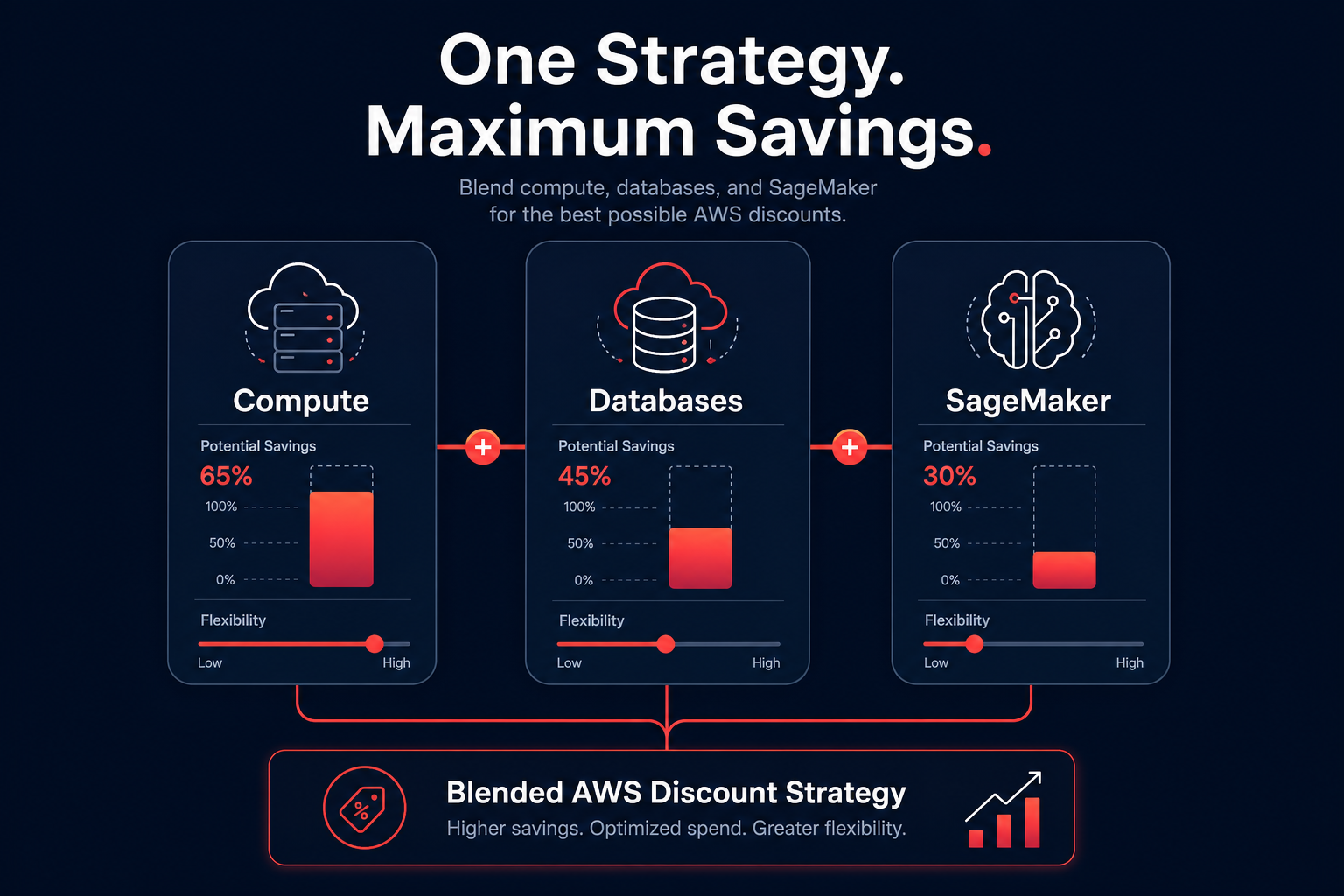
The primary challenge you face is that Savings Plans are no longer a single, monolithic category. AWS now offers distinct plans for compute, databases, and SageMaker, each with its own set of rules, flexibility, and maximum discount rates. For businesses looking to scale without ballooning costs, the goal is to blend these instruments so you get the benefits of long-term commitments without the traditional downsides of being locked into specific instance families or regions.
The new reality of database cost optimization
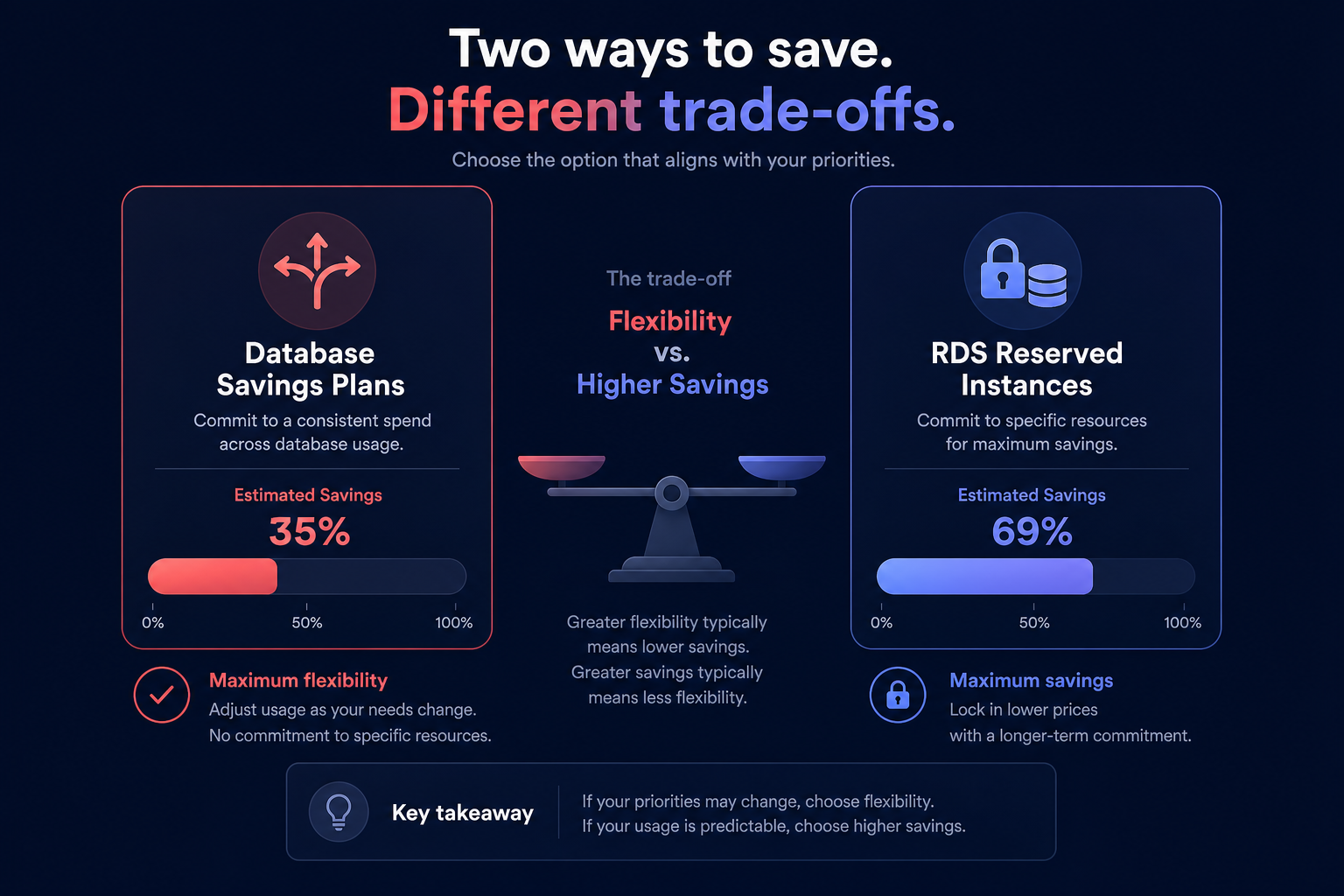
For years, the only way to lower your RDS bill was through RDS Reserved Instances. These require you to commit to a specific database engine, instance family, and region for a one- or three-year term. While Amazon RDS Reserved Instances offer substantial discounts – up to 69% – they are notoriously rigid. If you decide to migrate from RDS MySQL to Amazon Aurora or switch from an R5 to an R6g instance, your RIs could easily become wasted spend because the commitment must match the specific engine and instance attributes.
The introduction of Database Savings Plans has shifted this dynamic. Unlike RIs, Database Savings Plans provide a flexible pricing model that covers eligible serverless and provisioned usage across Amazon RDS, Aurora, and DynamoDB. This flexibility allows you to shift workloads between regions or modernize your database engine, such as moving from RDS for Oracle to Amazon Aurora PostgreSQL, without losing your discount. These plans automatically apply each hour to eligible usage regardless of the instance family, size, or deployment option.
However, there is a financial trade-off to consider. Database Savings Plans are currently limited to one-year terms with no upfront payment options and offer a maximum discount of approximately 35%. For steady-state workloads where you are certain of your instance type for the next three years, traditional RDS RIs often provide a significantly better financial outcome. Hykell helps businesses manage this balance through automated AWS rate optimization, ensuring you use flexible Savings Plans for evolving workloads while locking in deeper RI discounts for your permanent database baseline.
Comparing compute savings plans vs. EC2 RIs
When it comes to compute, your choice is usually between Compute Savings Plans, EC2 Instance Savings Plans, and Reserved Instances. Each serves a specific purpose in a modern AWS FinOps strategy:
- Compute Savings Plans are the most flexible option, applying to EC2, AWS Lambda, and AWS Fargate regardless of region, instance family, or operating system. They offer savings of up to 66% and are ideal for organizations using containers or serverless architectures where the underlying infrastructure changes frequently.
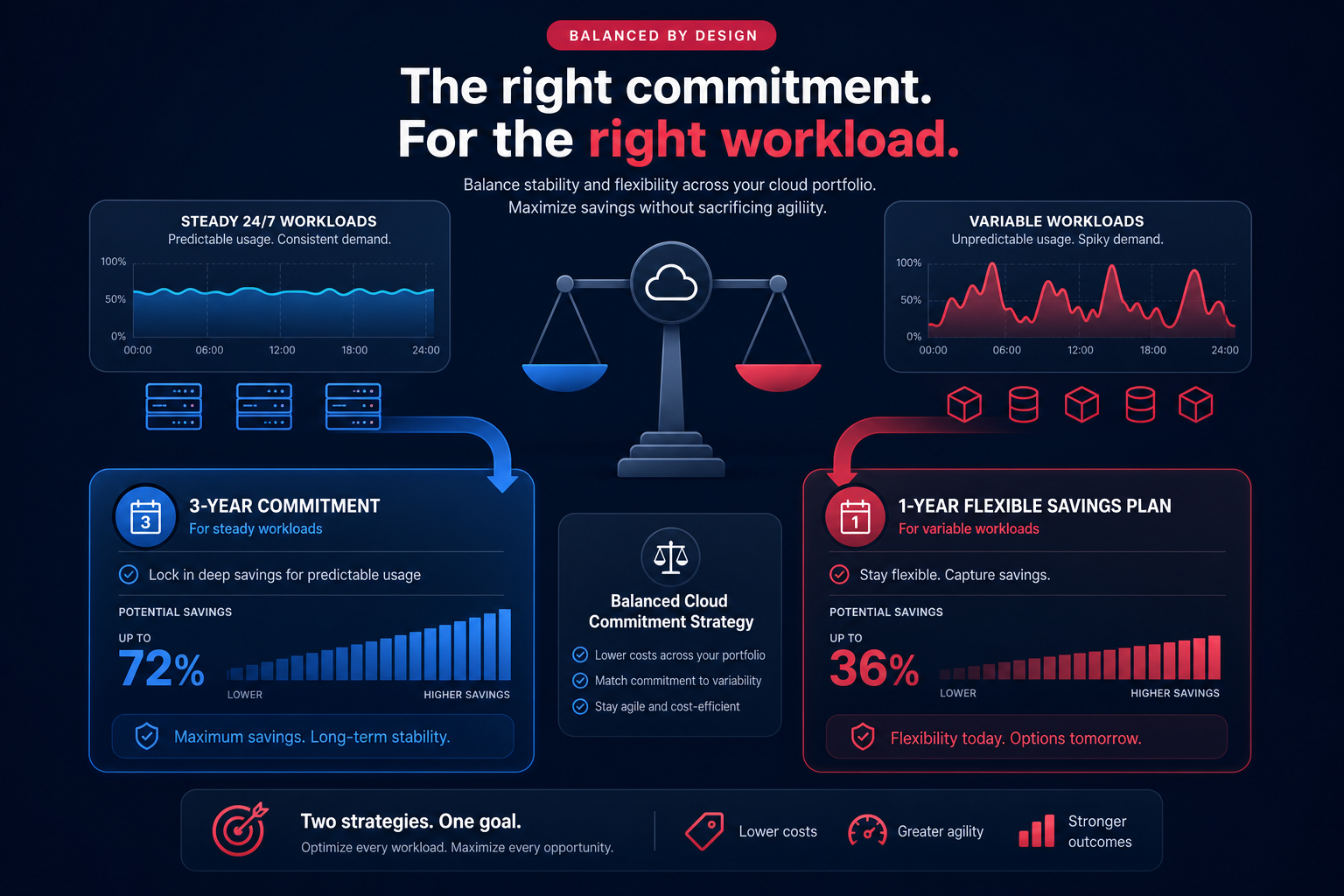
- EC2 Instance Savings Plans provide deeper discounts of up to 72% but lock you into a specific instance family within a single region. They are effectively the modern, more flexible replacement for Standard RIs within a chosen family.
- Reserved Instances have largely been superseded by Savings Plans for compute, but Zonal Reserved Instances remain the only way to get a guaranteed capacity reservation in a specific Availability Zone.
Because Savings Plans apply automatically to the highest discount-eligible usage first, they are significantly easier to manage than RIs. However, managing the mix of these plans is where most manual efforts fail. Committing blindly can backfire if your engineering team decides to migrate from x86 to AWS Graviton processors or changes their instance sizing. This is why AI-powered commitment planning is essential; it forecasts your usage curves to ensure your commitments match your actual infrastructure evolution rather than your past configurations.
Savings for ElastiCache, Redshift, and SageMaker
The commitment landscape extends beyond just compute and databases. If you are running high-performance caching or data warehousing, you must account for service-specific commitments that may not yet fall under the standard Savings Plan umbrella:
- Amazon ElastiCache and Redshift do not currently support Savings Plans. To reduce costs for these services, you must still use Reserved Nodes. These function similarly to RDS RIs, requiring a commitment to a specific node type and region in exchange for a lower hourly rate.
- Amazon SageMaker is eligible for SageMaker Savings Plans, which provide a consistent discount on SageMaker instance usage regardless of the instance family or region. This is particularly valuable for AI and machine learning workloads that fluctuate during training and deployment phases.
- Amazon DynamoDB usage can be covered by Database Savings Plans, but you can also purchase Reserved Capacity for specific read and write throughput if your usage patterns are highly predictable and you want to lock in specific capacity rates.
Navigating these various silos of savings can be overwhelming for even experienced DevOps teams. A common mistake is to over-index on one service while leaving others running at full On-Demand rates. A comprehensive AWS pricing guide can help clarify these differences, but real-time monitoring is required to prevent “leakage” where discounts go unapplied because a workload moved to a new region or instance class.
How to determine your commitment strategy
The most cost-effective strategy is rarely choosing one instrument over the other; it is almost always a strategic blend. To determine the right mix for your business, you should start by analyzing your steady-state usage. Resources that run 24/7 with less than 20% idle time are your primary candidates for 3-year commitments, which offer the highest discounts. For everything else, the flexibility of 1-year Savings Plans is usually worth the slightly lower discount rate to avoid the risk of paying for unused capacity.
You must also consider your technological roadmap. If your team plans to adopt Kubernetes or migrate to different instance families within the next year, rigid RIs will likely become a liability. In these scenarios, Compute Savings Plans provide the insurance you need to stay agile while still capturing significant savings.
Managing this manually requires constant attention to AWS Savings Plan calculator recommendations and manual spreadsheet tracking. Hykell removes this burden by providing automated cloud cost optimization. Our system dynamically manages the mix of Savings Plans and RIs, often doubling the savings of teams who attempt to manage their spend manually. We perform detailed cost audits to identify underutilized resources and apply precision-engineered rate strategies so you get the benefits of long-term commitments without the risk.
If you are ready to stop guessing and start saving, use our cloud cost calculator to see your potential savings. We help businesses reduce their AWS bill by up to 40% automatically, ensuring you only pay for the infrastructure you actually need. Hykell only takes a slice of what you save – if you don’t save, you don’t pay. Contact us today to see how we can optimize your AWS commitments.