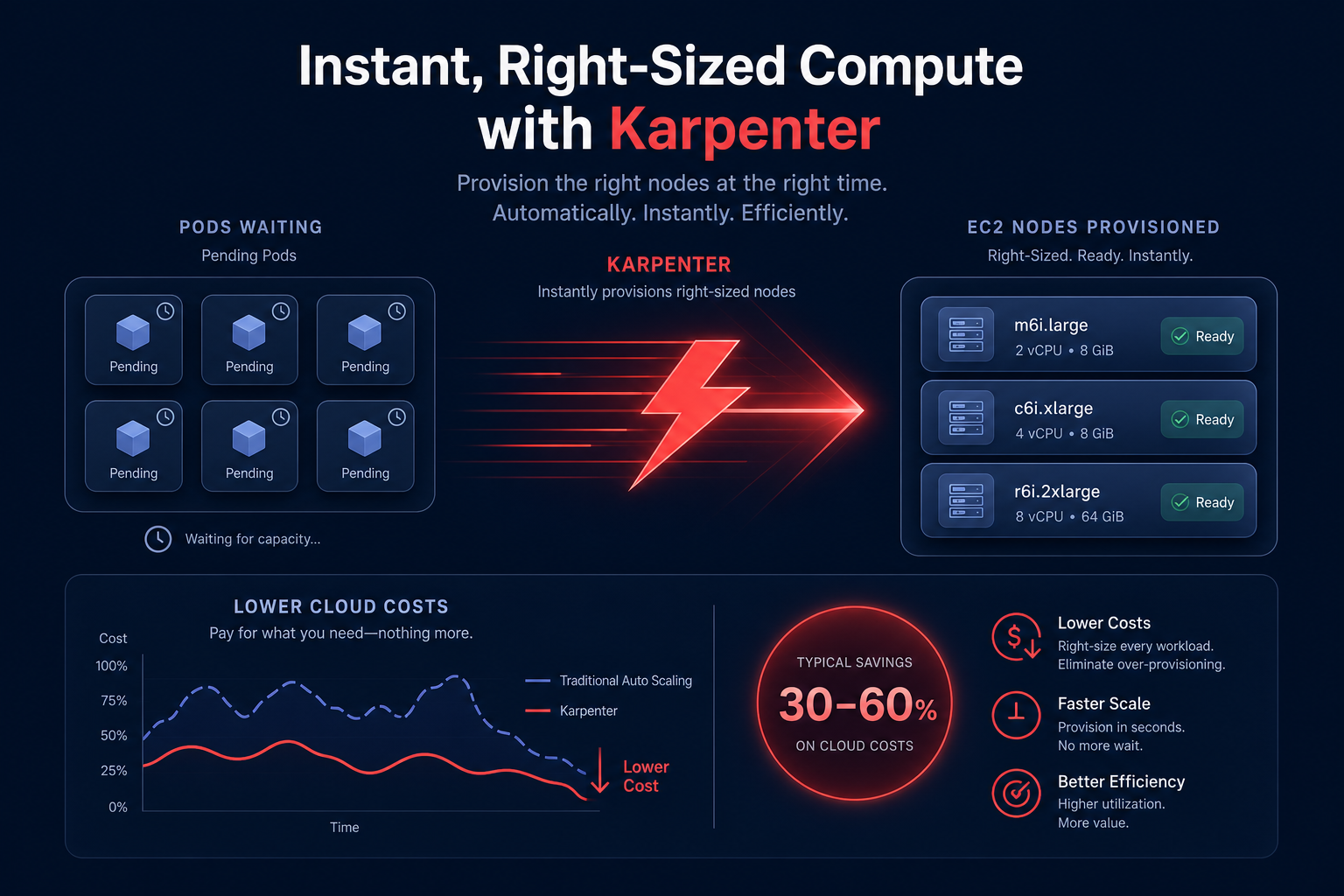
Are your Kubernetes scaling delays costing you customers and cloud budget simultaneously? Traditional node autoscaling often leaves pods pending for minutes while overprovisioning static instances that inflate your AWS bill. Karpenter changes this by provisioning resources precisely when your applications need them.
What is Karpenter and why does it matter?
Karpenter is an open-source, high-performance Kubernetes cluster autoscaler built with AWS to handle the challenges of modern, dynamic workloads. Unlike the standard Kubernetes Cluster Autoscaler, which manages nodes through AWS Auto-Scaling Groups (ASGs), Karpenter bypasses these abstractions to communicate directly with Amazon EC2 APIs.
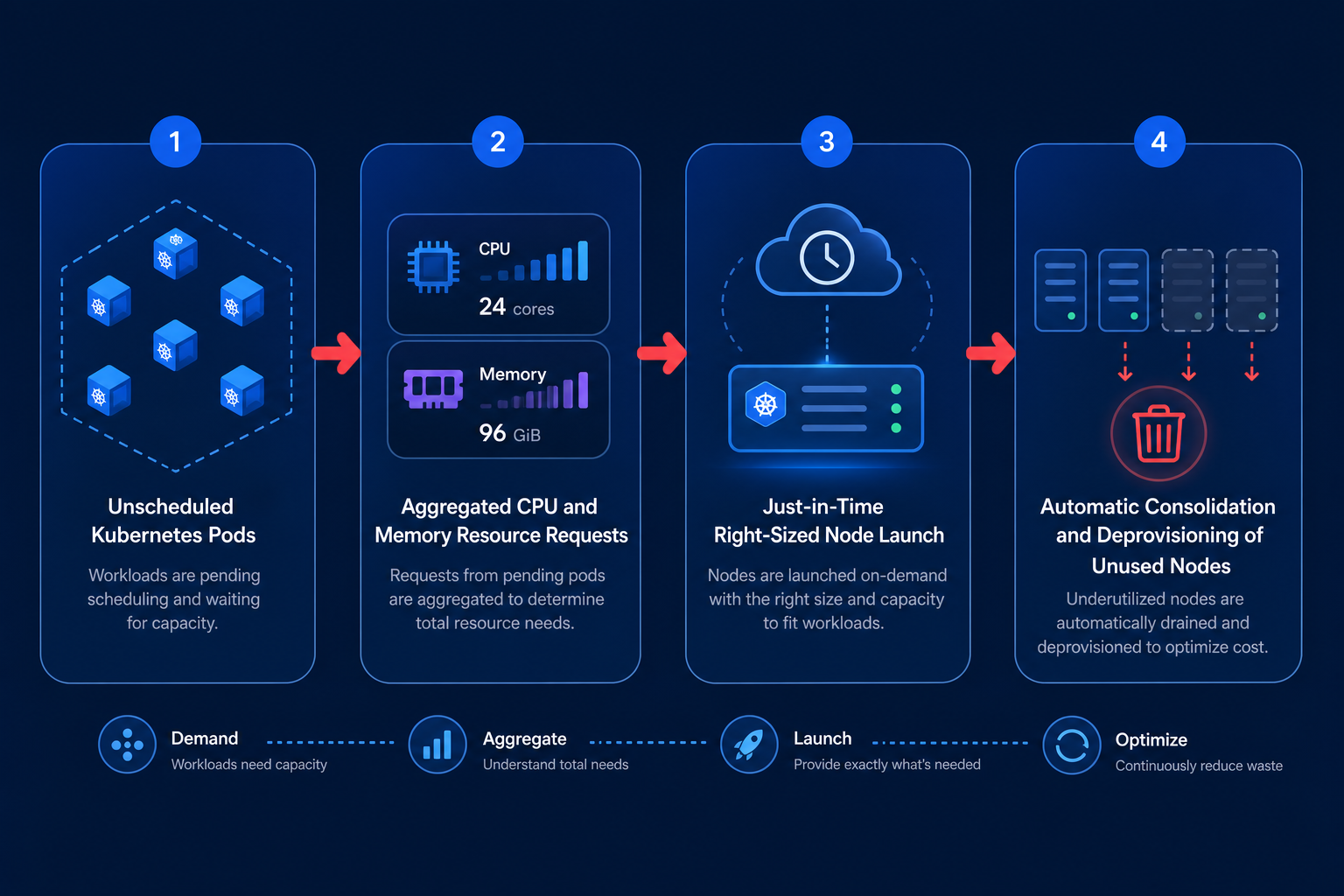
By observing the aggregate resource requests of unscheduled pods, Karpenter launches right-sized compute resources just-in-time. This approach significantly improves application availability and minimizes the operational overhead associated with managing complex node groups. When pods are removed, Karpenter automatically deprovisions underutilized nodes, ensuring you only pay for the capacity your cluster actually uses.
How Karpenter improves upon traditional auto-scaling groups
While automated cloud resource scaling has long relied on ASGs, Karpenter offers a more Kubernetes-native experience. The primary difference lies in how these tools respond to pending workloads.
- Scaling speed: ASGs often suffer from slower response times due to fixed scaling policies and the need to wait for launch templates. Karpenter provisions new nodes immediately for pending pods, which is critical for maintaining performance during traffic spikes.
- Workload flexibility: ASGs are typically restricted to preconfigured instance types. Karpenter evaluates the specific CPU and memory needs of your pods to select the most cost-effective instance type from the entire EC2 catalog.
- Resource optimization: Traditional autoscalers often lead to “bin-packing” inefficiencies, where nodes are left with significant unused capacity. Karpenter uses a consolidation policy to remove empty nodes and rearrange pods onto fewer, more efficient instances.
- Operational simplicity: Because Karpenter manages the node lifecycle directly, you no longer need to manage dozens of distinct node groups for different instance types or purchase options.
Best practices for implementing Karpenter on EKS
Successfully deploying Karpenter in an Amazon EKS environment requires a strategic setup to ensure stability and Kubernetes cost optimization. Following these industry best practices will help you build a more resilient data plane:
- Run the controller on stable ground: To avoid a scenario where Karpenter scales down its own control plane nodes, it is a best practice to run the Karpenter controller on EKS Fargate or a small, dedicated EKS Managed Node Group.
- Use broad NodePool definitions: Keeping your instance type requirements broad allows Karpenter to choose from a wide range of instance types and purchase options. This flexibility is essential for AWS EKS node group cost optimization and ensures higher availability during Spot capacity fluctuations.
- Prioritize Spot instances for tolerant workloads: For non-critical services, leveraging Spot instances via Karpenter can reduce compute costs by up to 90%. Karpenter can handle Spot interruption handling natively if you configure the `aws.interruptionQueueName` setting.
- Set node expiration policies: Use the `expireAfter` policy to cycle nodes regularly. This ensures your cluster is always running on the latest Amazon Machine Images (AMIs) with the most recent security patches and performance updates.
- Right-size your pods first: Karpenter’s efficiency is limited by the accuracy of your workload definitions. Establishing Kubernetes pod resource limits based on historical p95 usage allows Karpenter to pack pods more densely and select smaller, cheaper instances.
Enhancing Karpenter with Hykell for maximum savings
Karpenter is an excellent tool for managing the “where” and “when” of node scaling, but it does not address the underlying “rate” you pay for those nodes or the efficiency of the pods themselves. Hykell bridges this gap, turning your infrastructure into a self-optimizing engine that can reduce your AWS cloud costs by up to 40% on autopilot.
Hykell provides AI-powered AWS rate optimization, managing a dynamic blend of Savings Plans and Reserved Instances. While Karpenter scales nodes up and down, Hykell ensures those nodes are covered by the best possible discounts, often achieving an Effective Savings Rate (ESR) of 50–70% on compute.
Furthermore, Hykell automates workload-aware adjustments, such as a Graviton migration that transitions your nodes to high-performance ARM instances without code modifications or downtime. By combining Karpenter’s rapid scaling with Hykell’s automated execution layer, your team can focus on innovation rather than manual infrastructure tuning.
Through a comprehensive observability dashboard, you can track real-time cost KPIs and see exactly how automated Kubernetes cost optimization is impacting your bottom line. This level of transparency ensures that every scaling action Karpenter takes is fully aligned with your broader cost management strategies for AWS EKS clusters.
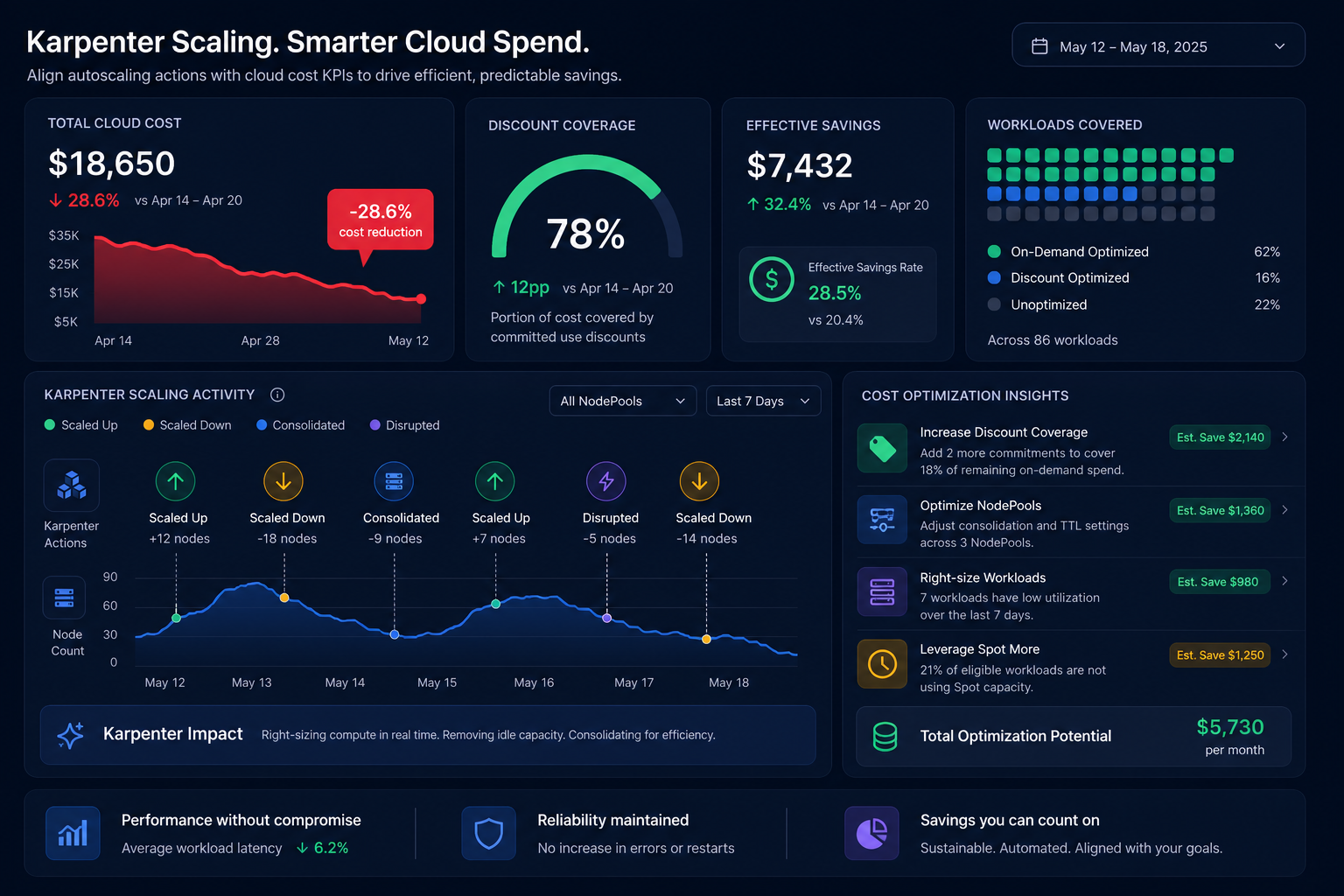
Transform your EKS environment from a cost center into a competitive advantage. By pairing Karpenter’s dynamic provisioning with Hykell’s automated rate and workload optimization, you achieve a cluster that is faster, more reliable, and significantly cheaper to operate.
To see how much your organization could save with automated optimization, contact Hykell for a cost assessment.