Are you leaving half of your potential cloud savings on the table because of a fear of commitment? While 1-year AWS Savings Plans offer a shorter lock-in, the 3-year term frequently doubles your discount, making it a powerful choice for stable, long-term growth.
Deciding between a 1-year and 3-year commitment is the most significant lever you have when optimizing your AWS bill. Understanding the pricing delta, flexibility constraints, and break-even points is essential to ensure you aren’t overpaying for the “safety” of a shorter term. Because AWS pricing models are built on predictability, the duration you choose dictates your baseline efficiency for years to come.
The pricing gap: why duration matters
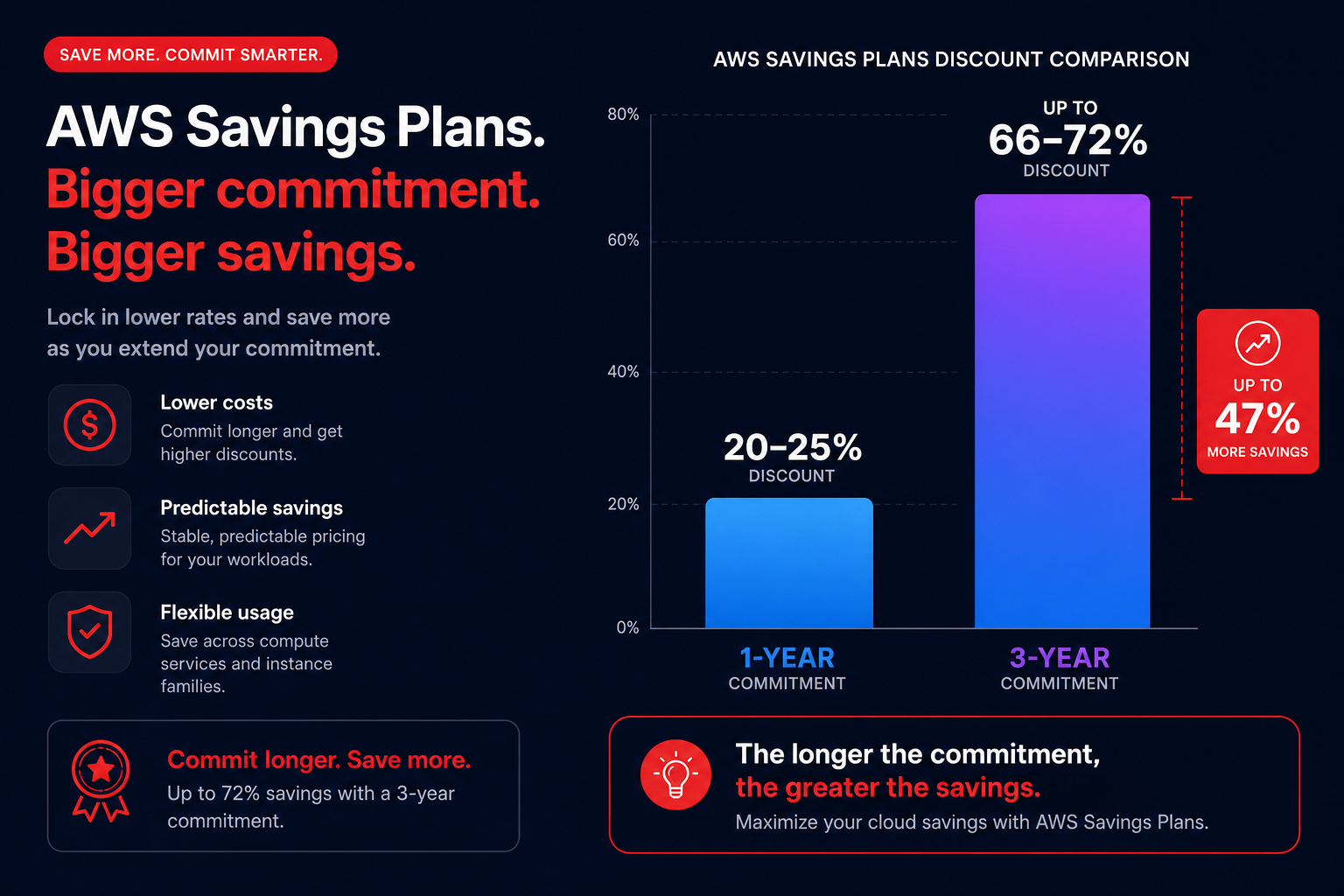
The primary difference between these two terms is the discount level. AWS rewards long-term predictability with significantly lower hourly rates. According to official documentation, a 1-year term (365 days) typically offers a discount of roughly 20% to 25% for steady workloads. In contrast, a 3-year term (1,095 days) provides much deeper savings, reaching up to 66% for Compute Savings Plans and up to 72% for EC2 Instance Savings Plans.
When you move from a 1-year to a 3-year commitment, you often double your discount rate. For a business spending $100,000 a month on compute, that difference represents hundreds of thousands of dollars in annual savings. If your infrastructure has a stable baseline that hasn’t changed significantly in the last six months, you may find that one-year savings plans are the worst tool for cutting AWS costs because they cap your savings potential at a fraction of what is possible.
Flexibility and coverage across terms
Regardless of the term you choose, the underlying mechanics of how these plans apply to your usage remain identical. Choosing a 3-year term over a 1-year term does not change the scope of what is covered or how AWS calculates your savings. You still have to choose between the primary plan types:
- Compute Savings Plans: These provide the highest level of flexibility, automatically applying to EC2, AWS Lambda, and AWS Fargate usage regardless of region, instance family, size, or operating system.
- EC2 Instance Savings Plans: These offer the deepest discounts but require a commitment to a specific instance family within a single region.
The real trade-off lies in “duration risk.” With a 3-year plan, you are locked into a specific spend level for 1,095 days. If your architecture shifts – for example, if you migrate from EC2 to a completely different service not covered by your plan – you still owe the hourly commitment. However, many startups find that Compute Savings Plans mitigate this risk because they follow your usage across different regions and instance types. Understanding the differences between Compute and EC2 Instance Savings Plans is vital before you lock in a multi-year term.
Calculating the break-even point and commitment risk
Many finance teams choose 1-year plans to avoid “lock-in,” but they often ignore the math of the break-even point. Because the 3-year discount is so much deeper, you often save more money with a 3-year plan even if you only use it for two years and let it sit idle for the third, compared to buying three consecutive 1-year plans.

The hidden cost of AWS commitments is the manual effort required to manage them. If you opt for 1-year plans, your team must re-evaluate and re-purchase every 12 months. This often leads to “coverage gaps” where you accidentally pay full On-Demand rates while waiting for approval on the next purchase.
Furthermore, AWS policy regarding returns is extremely strict. You can only return a purchased Savings Plan if the hourly commitment is $100 or less, the purchase was made within the last seven days, and it falls within the same calendar month. Once that window closes, you are committed. This is why using an AWS savings plan calculator to model growth and seasonality is critical before signing a 3-year deal.
1-year vs 3-year comparison at a glance
| Feature | 1-Year Savings Plan | 3-Year Savings Plan |
|---|---|---|
| Average Discount | ~20% – 25% | Up to 66% (Compute) / 72% (EC2) |
| Risk Profile | Low: Short-term commitment | Higher: Long-term spend obligation |
| Flexibility | Depends on plan type | Depends on plan type |
| Payment Options | All, Partial, or No Upfront | All, Partial, or No Upfront |
| Resale Potential | None (cannot be sold) | None (cannot be sold) |
It is also worth noting that Savings Plans apply only after your existing Reserved Instances have been exhausted. If you are struggling to decide between these commitments, a comparison of Savings Plans vs Reserved Instances can help clarify which instrument provides the best coverage for your specific regional or zonal needs.
How to get 3-year discounts with 1-year flexibility
The traditional choice between 1-year and 3-year terms is often a false dilemma. Most businesses end up with a sub-optimal “On-Demand tail” because they are too conservative with their commitments, fearing they will be stuck with unused capacity. This hesitation is a core part of the broader AWS pricing and cost optimization challenge.
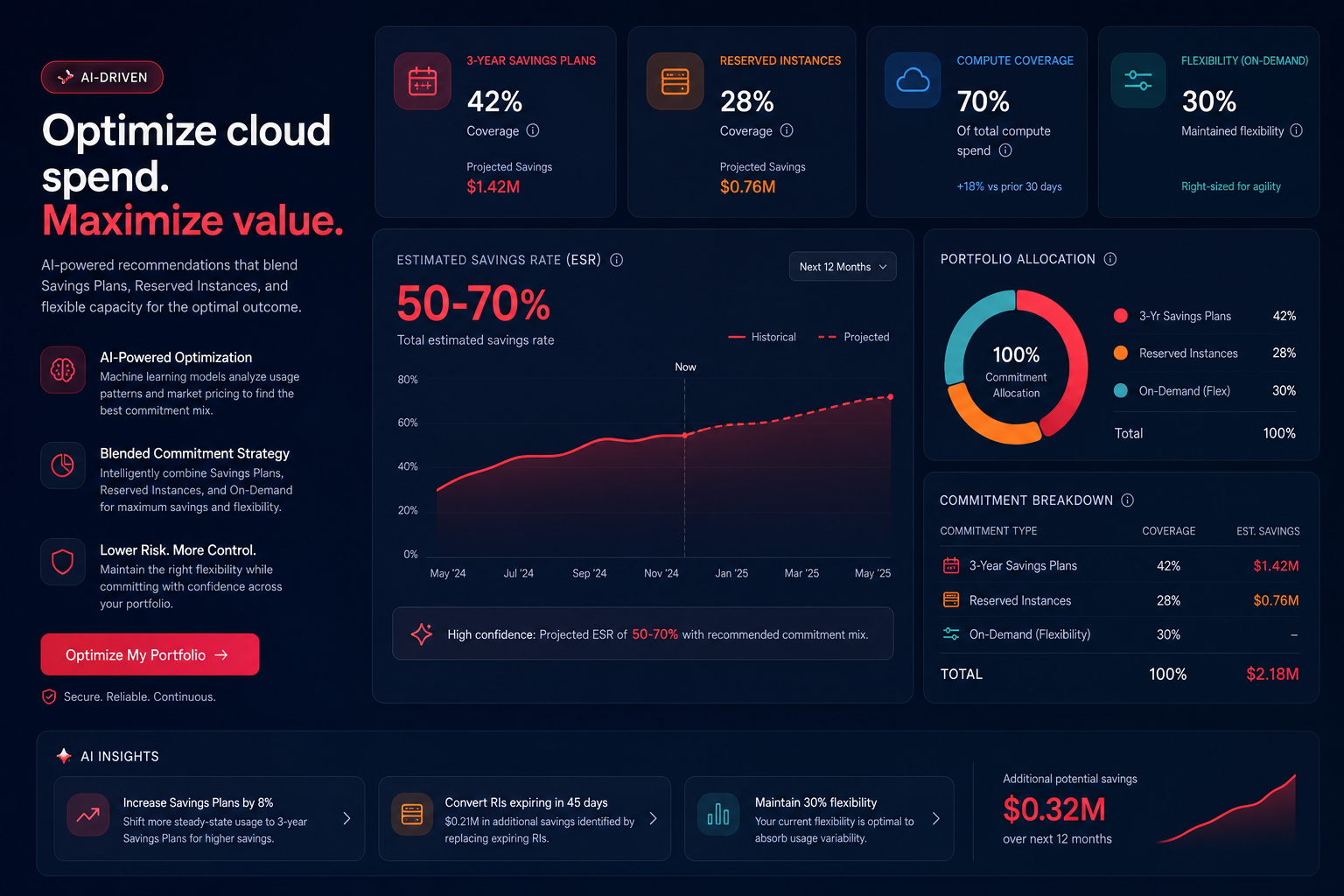
At Hykell, we help businesses achieve an Effective Savings Rate (ESR) of 50–70% by blending multiple commitment types. By using AI-driven rate optimization, we manage a portfolio of 3-year Savings Plans and Reserved Instances on your behalf. Our system monitors your usage in real-time and makes adjustments automatically, giving you the deep discounts of a 3-year term with the flexibility to shift your infrastructure whenever you need.
You do not have to choose between saving money and staying agile. Hykell takes a small slice of what we save you – if you don’t save, you don’t pay. Our automated solutions operate on autopilot to reduce your AWS bill by up to 40% without requiring any engineering effort.
Find out exactly how much you can shave off your monthly bill by using the Hykell cloud cost calculator or contact our team for a detailed audit of your commitment strategy.