Is your networking bill growing faster than your user base? Data transfer charges often act as a hidden tax, silently devouring up to 35% of cloud budgets. Reclaiming your margins starts with mastering the nuances of how AWS bills for every byte that moves through your architecture.
The hierarchy of data transfer pricing
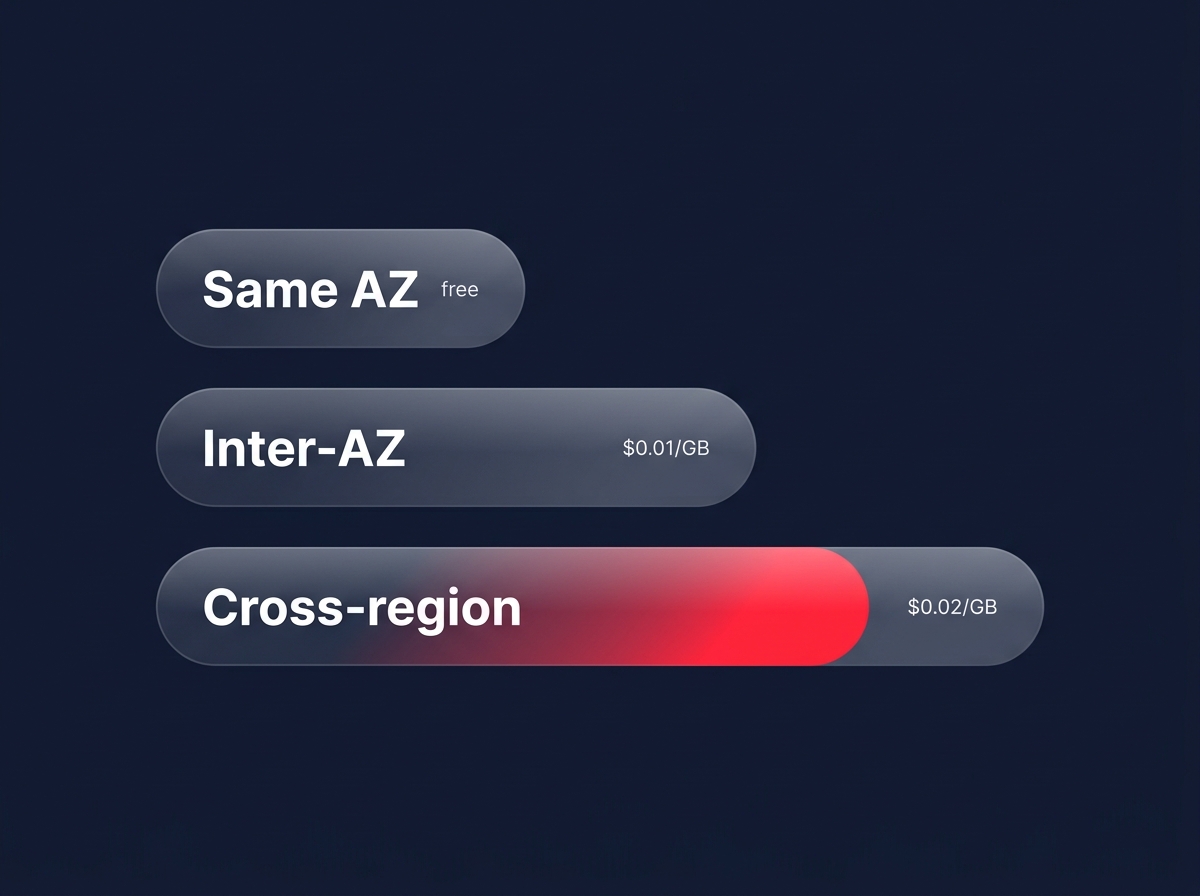
AWS networking costs are primarily determined by the “distance” data travels across the global infrastructure. Generally, the further data moves from its source, the more expensive the transfer becomes. Within a single Availability Zone (AZ), traffic using private IP addresses is typically free for services like EC2, RDS, and ElastiCache, making co-location an attractive strategy for high-bandwidth workloads.
However, modern reliability requirements often necessitate spreading resources across multiple zones. Once data moves between Availability Zones in the same region, AWS charges $0.01/GB in each direction. While this may seem nominal, a full round trip costs $0.02/GB, which can accumulate rapidly for chatty microservices or high-volume database replications.
The costs escalate further when data leaves a region entirely. For most US-based region pairs, such as US East to US West, the rate is approximately $0.02/GB. These AWS data egress costs can stack quickly if you utilize multi-region replication for disaster recovery or maintain global data consistency across disparate geographic locations.
Reducing the NAT Gateway processing tax
One of the most frequent sources of “bill shock” for cloud engineering teams is the NAT Gateway. While these gateways are essential for allowing resources in private subnets to access the internet or other AWS services, they carry a heavy processing fee. AWS charges $0.045 per GB for data processing on top of standard egress rates and hourly uptime fees. For a containerized workload pulling 178,000 GB of images from ECR through a NAT Gateway, this processing fee alone can exceed $8,010 per month.
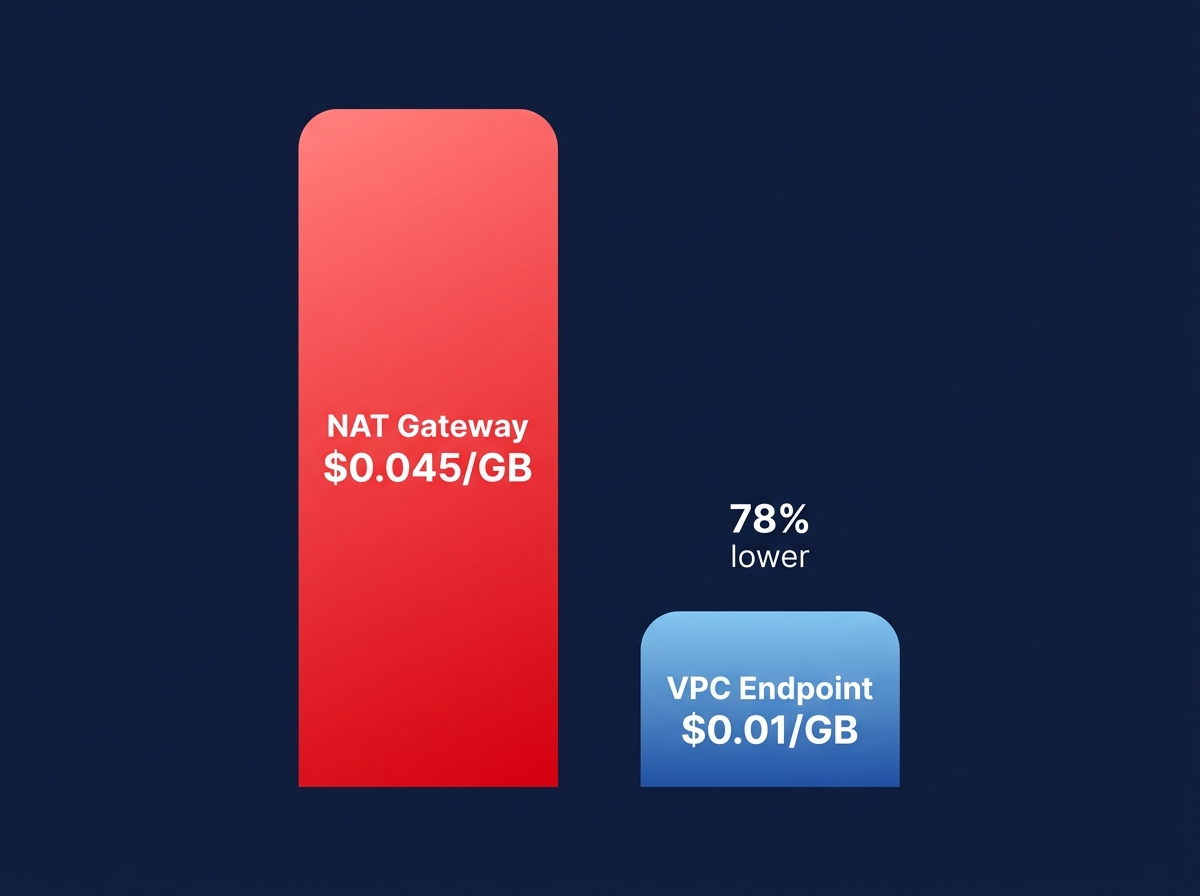
You can often bypass these charges by refactoring your architecture to use VPC Endpoints. Gateway Endpoints for S3 and DynamoDB are free and carry no hourly or processing fees. For other regional services, Interface Endpoints powered by AWS PrivateLink cost approximately $0.01/GB for processing. This represents a 78% reduction in costs compared to NAT Gateway processing fees. Transitioning high-volume traffic to these endpoints is a foundational step in optimizing NAT Gateway costs without sacrificing security.
Managing internet egress and CDN acceleration
Data transferred from AWS to the internet carries the highest per-GB rates in the networking catalog. AWS uses tiered pricing for internet egress, typically starting at $0.09/GB for the first 10 TB in US regions. While an aggregate free tier of 100 GB per month exists across all services, high-growth businesses and media-heavy platforms quickly outpace this allowance.
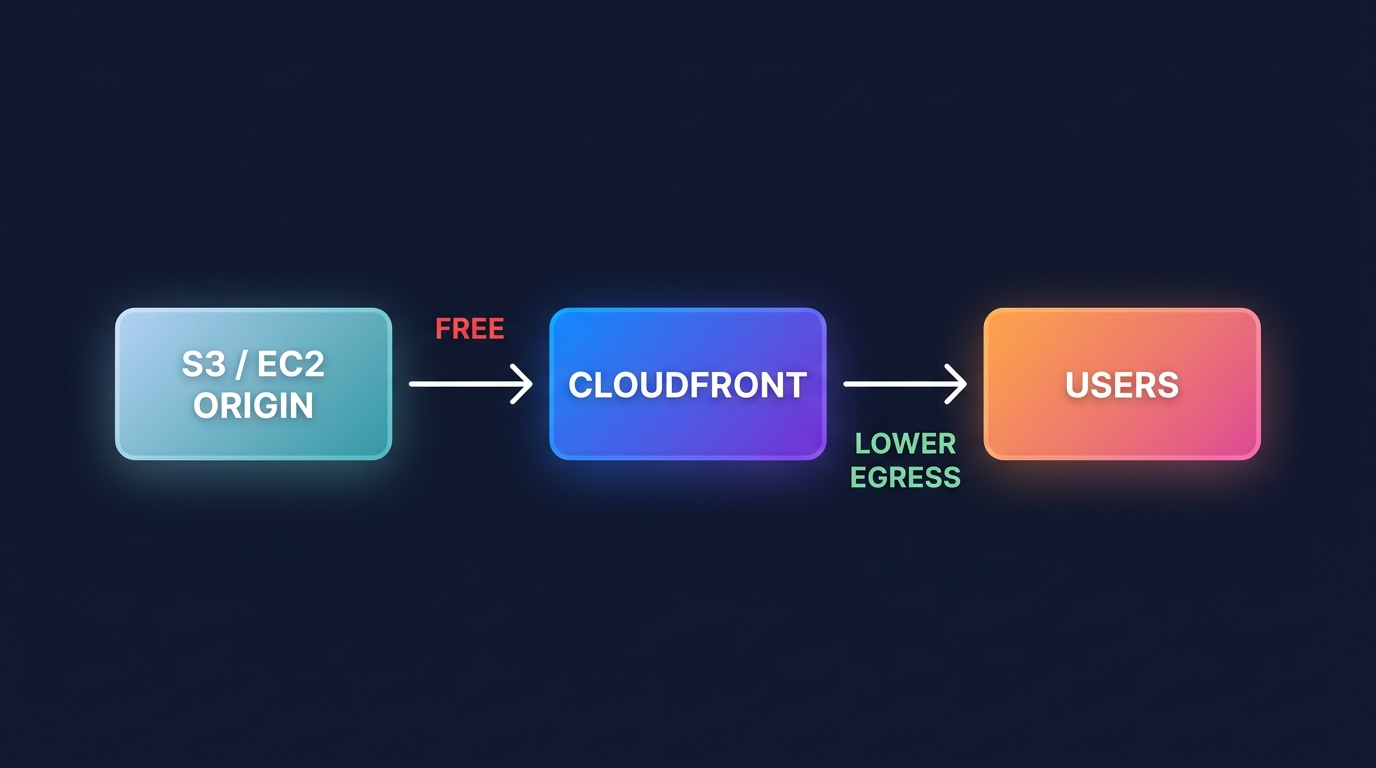
To mitigate these expenses, many organizations leverage Amazon CloudFront. Moving data from an AWS origin like S3 or EC2 to CloudFront is free, and the egress rates from CloudFront to the internet are often significantly lower than direct EC2-to-internet rates. According to Amazon S3 pricing, using a CDN not only reduces your monthly bill but also improves global application performance by caching content at edge locations closer to your end-users.
Practical strategies for networking efficiency
Predicting and controlling networking spend requires a combination of architectural discipline and active monitoring. Implementing a few high-impact changes can lead to immediate reductions in your monthly invoice.
- Keep high-bandwidth microservices within the same Availability Zone whenever your high-availability requirements allow, eliminating the $0.01/GB inter-AZ charge.
- Configure applications to communicate via private IP addresses rather than public IPs to avoid being billed at internet egress rates for internal traffic.
- Route all S3 and DynamoDB traffic through free Gateway Endpoints to remove NAT processing fees from those specific data paths.
- Compress data payloads for API responses and log exports, as smaller packet sizes directly correlate to lower bandwidth requirements and costs.
- Use automated tagging for AWS cost allocation to identify exactly which departments or applications are driving egress spikes.
Regularly auditing your traffic patterns with tools like AWS Cost Explorer or the Cost and Usage Report (CUR) provides the granular visibility needed to catch inefficiencies. By following cloud cost management strategies, you can ensure that your infrastructure scales in alignment with your business goals rather than your overhead.
Maximize your AWS networking ROI
Manually tracking every byte that moves across your VPCs is a demanding task that often competes with critical product development. Ignoring these architectural inefficiencies, however, can lead to thousands of dollars in monthly waste that could otherwise be reinvested into innovation.
Hykell provides automated cloud cost optimization that dives deep into your networking architecture. We identify hidden processing taxes, misaligned traffic patterns, and expensive egress routes to help you achieve AWS rate optimization automatically. Our “pay-from-savings” model ensures that we only succeed when your infrastructure becomes more efficient.
To see exactly where your networking spend is going and how much you could be saving, use the Hykell cloud cost savings calculator or schedule a detailed audit of your infrastructure today.