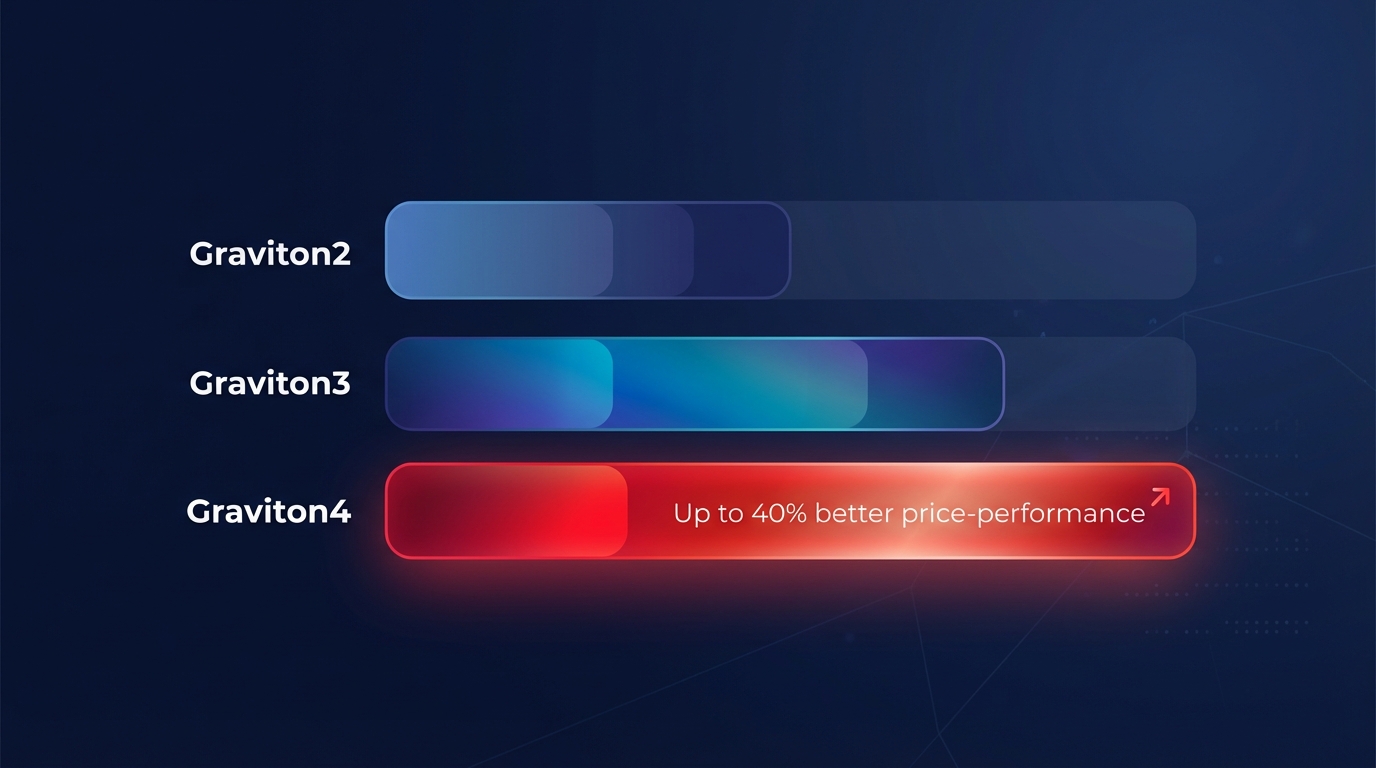
Did you know that AWS Graviton4 provides up to 40% better performance and 29% better price-performance than its predecessor? For engineering leaders, migrating to AWS Graviton instances is no longer just a technical experiment; it is the most effective way to slash compute spend by up to 40% without compromising application speed.
The Graviton4 leap: Benchmarking performance and value
The introduction of Graviton4 marks a significant milestone in custom silicon for the cloud. In Amazon RDS testing, Graviton4 delivered 41% higher throughput compared to Graviton2 and 23% compared to Graviton3. Beyond raw speed, the price-performance gains are equally impressive, showing a 23% improvement over Graviton3 for database-heavy workloads. These efficiency gains allow teams to handle higher traffic volumes without the linear cost increases typically associated with x86 scaling.
For high-transaction environments, the results are even more dramatic. Graviton4-based I8g clusters have sustained up to 1.16 million transactions per second (TPS), representing a six-fold improvement over the previous Graviton2-based I4g family. These gains are powered by technical enhancements like DDR5-5600 memory and improved memory bandwidth, resulting in 60% higher compute performance compared to the second generation.
While Graviton4 excels in diverse tasks, it is particularly dominant in cryptographic benchmarks and CI/CD operations. In fact, organizations like Depot reported a 30% reduction in CI/CD build times and a corresponding 30% cost reduction after making the switch. Whether you are running large-scale Java applications or intensive compression tasks, the latest generation of custom silicon provides a substantial performance edge.
Selecting the ideal Graviton instance family for your stack
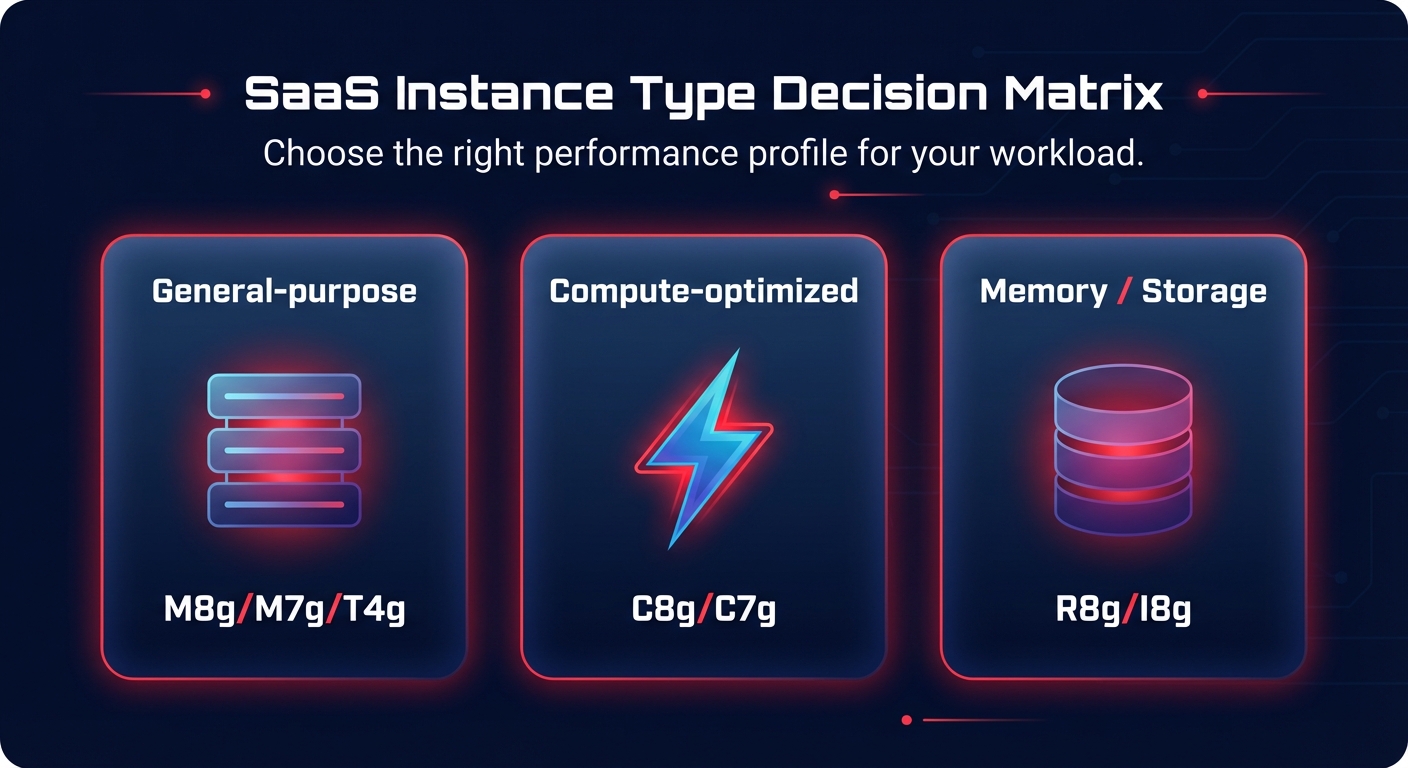
AWS offers over 268 Graviton-based instance types, making it essential to match the specific family to your workload profile to optimize EC2 workloads effectively. General-purpose families like the M8g, M7g, and burstable T4g serve as the primary workhorses for web servers, microservices, and small databases by offering a balanced ratio of CPU to memory. When you require higher clock speeds or handle machine learning inference, compute-optimized instances like the C8g and C7g are superior choices. These have demonstrated 25% better computational performance at 30% lower cost compared to their x86 equivalents.
For memory-intensive applications such as Redis caches, big data analytics, or PostgreSQL databases, the R8g and R7g families are purpose-built to provide high memory throughput. If your architecture demands high-speed local NVMe storage for NoSQL databases or transactional systems, the storage-optimized I8g and I4g families are the correct selection. When comparing Graviton and Intel instances, Graviton typically costs about 20% less per hour. Because Graviton maps one vCPU to one physical core – eliminating the hyperthreading found on Intel chips – many workloads experience an immediate performance boost even before any software-level tuning occurs.
Real-world compatibility and software support
A primary concern for engineering teams is whether their existing software stack will run on Arm64 architecture. While Graviton does require Arm-compatible binaries, the ecosystem is now highly mature. Most managed services, including RDS, Aurora, Lambda, ElastiCache, and Fargate, support Graviton natively, often requiring only a simple configuration change to migrate. Major Linux distributions like Amazon Linux 2, Ubuntu, RHEL, and Debian also offer robust support for these chips.
The compatibility of modern languages is equally strong. Python, Java (OpenJDK), Node.js, Go, and .NET Core on Linux are fully compatible with the architecture. Technical data shows that Graviton4 is up to 45% faster for large Java applications than previous generations. Most popular Docker images now offer multi-architecture support, which simplifies the transition for containerized environments. The main limitations remain Windows-based workloads and legacy x86-specific binaries, but for Linux-based stacks, the compatibility of software with Graviton is likely already sufficient for migration.
A blueprint for a seamless Graviton migration
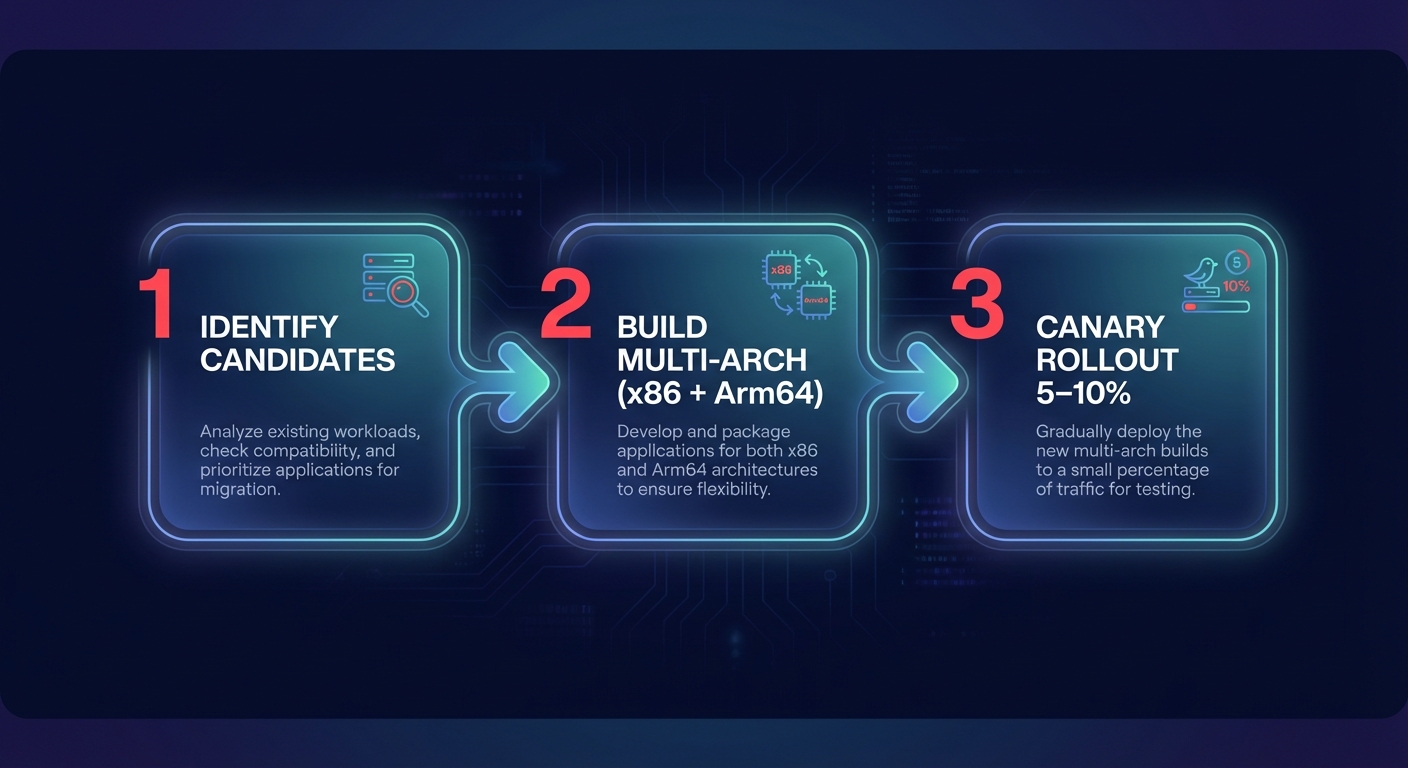
Successful migration does not require a risky “rip and replace” strategy. Instead, a phased approach allows you to capture savings while maintaining system stability. The process begins with identifying low-risk candidates, such as stateless web tiers or development environments. Using data-driven tools can help prioritize these workloads based on potential ROI and technical readiness.
Once initial candidates are selected, you must update your CI/CD pipelines to build images for both x86 and Arm64. This multi-architecture approach ensures that your orchestrator can pull the correct image regardless of the underlying node type. For teams running Kubernetes, you can optimize EKS clusters by creating Graviton-based node groups alongside existing x86 groups. This hybrid setup allows you to migrate pods gradually using node selectors or taints and tolerations, providing an environment for side-by-side performance benchmarking.
The final stage involves deploying Graviton instances for a small percentage of production traffic, typically between 5% and 10%. By monitoring latency and error rates through your observability tools, you can validate that the Arm64 version handles real-world load as expected before completing the full rollout.
Maximizing savings through automated optimization
Choosing the right instance type is a vital first step, but the most significant savings come from a “stacked” approach. Graviton’s lower hourly rate should be combined with AWS rate optimization strategies, such as Savings Plans and Reserved Instances, which can push total savings beyond 50%. However, managing these migrations and continuous right-sizing tasks manually can place a heavy burden on busy engineering teams.
This is where Hykell simplifies the transition. Hykell provides an automated path to accelerate your Graviton gains by identifying migration candidates and executing transitions with zero manual engineering effort. The platform operates on autopilot, analyzing your usage patterns to ensure your workloads always run on the most cost-effective architecture and instance size. By combining architecture migration with automated resource management, Hykell helps you reduce cloud costs by up to 40% while maintaining peak performance. You only pay a slice of what you actually save – ensuring your cloud modernization efforts are always cash-flow positive.