Does your AWS EventBridge bill spike even when your traffic seems stable? Understanding the 64KB metering rule is the first step to stopping the leak. While event-driven architectures offer incredible scale, unmanaged ingestion fees can silently devour your cloud budget.
Breaking down EventBridge pricing dimensions
To control your spend, you must first understand how AWS meters your event bus activity. Unlike services that charge flat rates, EventBridge pricing is multi-dimensional, revolving around ingestion, delivery, and specialized features like archives or API destinations.
Custom events and the 64KB metering rule
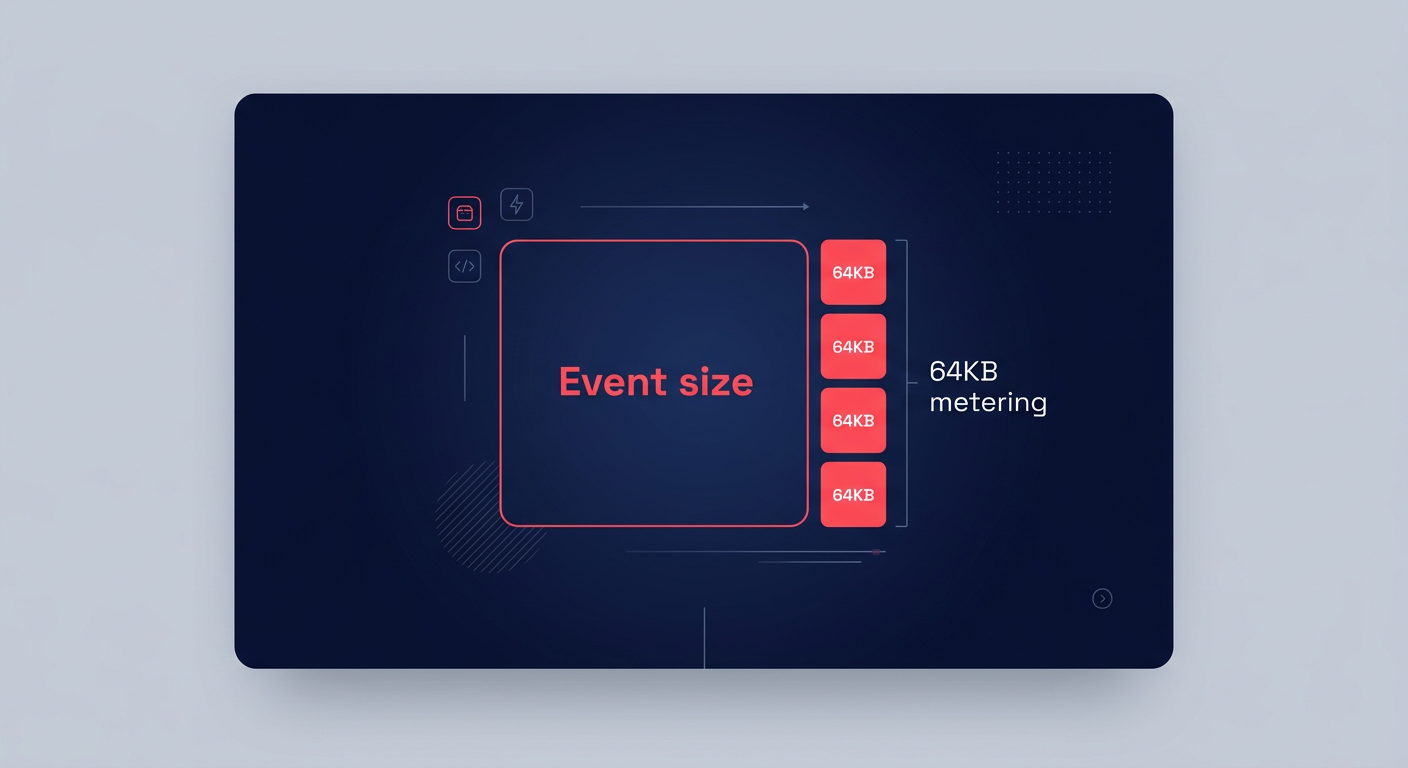
The baseline cost for custom events and SaaS partner events is $1.00 per million events published to an event bus. While this sounds straightforward, AWS meters events in 64KB “chunks.” If you publish a 256KB event, AWS bills you for four events at a rate of $4.00 per million rather than one. Events emitted by AWS services – such as an EC2 state change or an S3 bucket notification – are free to ingest, making EventBridge a cost-effective way to react to infrastructure changes.
Cross-account delivery and regional transfers
Delivering events between different AWS accounts or regions adds another layer of cost. While same-account delivery is generally free, cross-account delivery is billed at $1.00 per million events at the source account. This can lead to “double billing” scenarios if you are not careful with your architecture. If you are managing a complex multi-account environment, implementing automated tagging for AWS cost allocation becomes essential to see which team or project is driving these cross-account charges.
Archive, replay, and API destinations
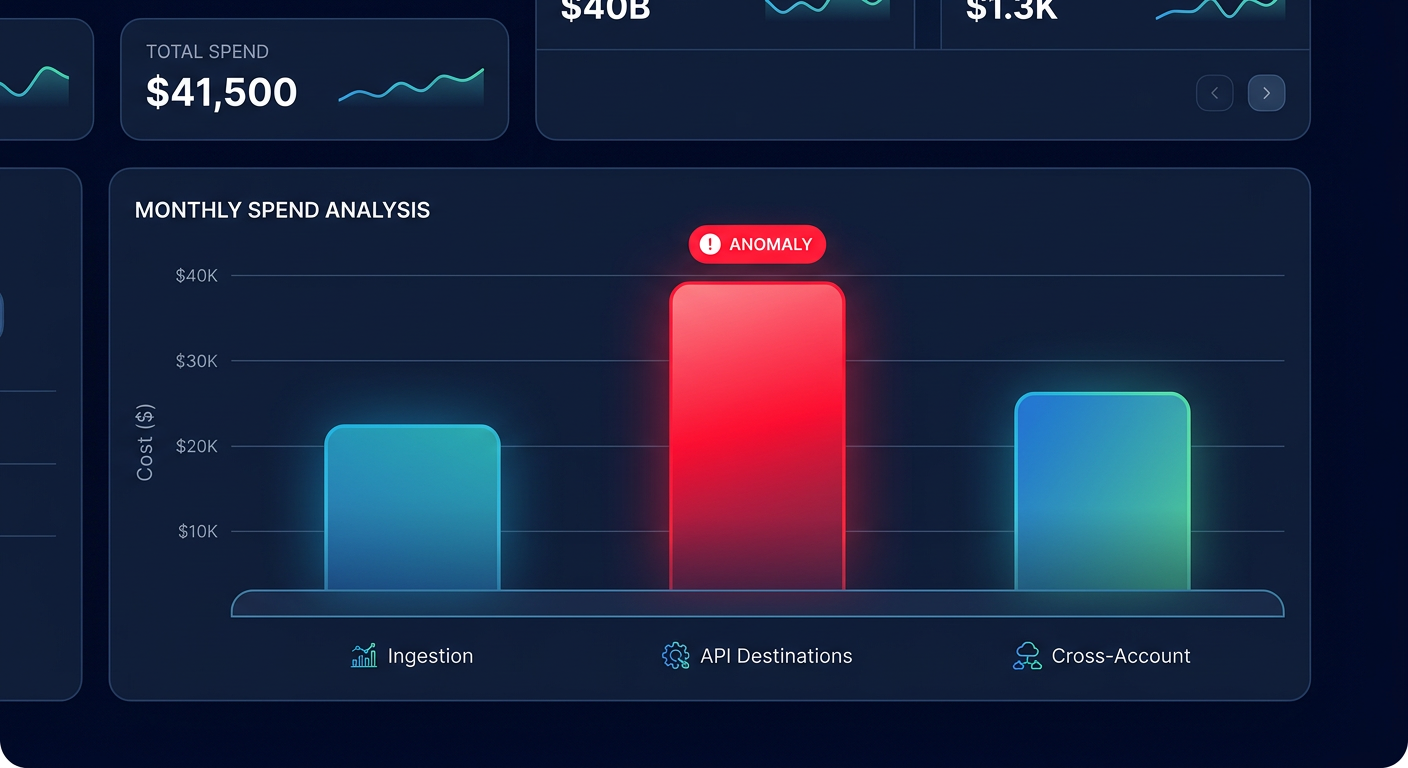
EventBridge allows you to archive events for later replay, which is invaluable for debugging or disaster recovery, but this involves a three-part cost structure. You will pay $0.10 per GB for processing data into the archive, a storage fee of $0.023 per GB-month, and a replay fee of $1.00 per million events. API Destinations, which allow EventBridge to send events directly to HTTP endpoints outside of AWS, are often the most expensive dimension at $3.10 per million invocations. If you send high-volume traffic to external SaaS providers, these costs can escalate much faster than your standard compute expenses.
Strategies to optimize EventBridge costs
Reducing your EventBridge spend requires a shift in how you handle data payloads and routing logic. By applying architectural best practices, you can realize significant savings without sacrificing the performance of your event-driven system.
The most effective way to save money is to prevent unnecessary events from ever reaching the bus. You can use EventBridge Pipes to filter events at the source, which can reduce ingestion costs by up to 90% if you successfully filter out non-matching events before they hit the bus. This approach is far more efficient than letting every event hit the bus only to be discarded by a rule later in the pipeline.
Since AWS meters in 64KB chunks, stripping your event payloads of unnecessary metadata is a direct path to savings. If your events frequently exceed the 64KB limit, you should consider the “Claim Check” pattern. This involve storing the large data payload in an S3 bucket and passing only the S3 object reference through EventBridge. This keeps your events small and ensures you only pay for one event per message. Similar AWS Lambda cost reduction techniques involve this payload-stripping approach to minimize processing overhead.
Finally, EventBridge Pipes supports batching, which allows you to group multiple events into a single invocation for targets like Lambda or SQS. This reduces the total number of downstream requests and lowers your overall architectural costs. When combined with optimizing AWS rates, these architectural refinements ensure you are not overpaying for the connections between your services.
Monitoring and detecting EventBridge cost anomalies
You cannot optimize what you do not measure. AWS provides several native tools to help you track your EventBridge usage and detect cost spikes before they become a crisis for your finance team.
To get a clear view of your spend, you should use AWS Cost Explorer and filter specifically by the EventBridge service. Grouping your results by “Usage Type” or “API Operation” will reveal exactly which dimension – ingestion, API destinations, or cross-account delivery – is driving the total. If you notice a sudden jump, AWS Cost Anomaly Detection can help you trace the spike back to a specific resource or account by analyzing historical spending patterns.
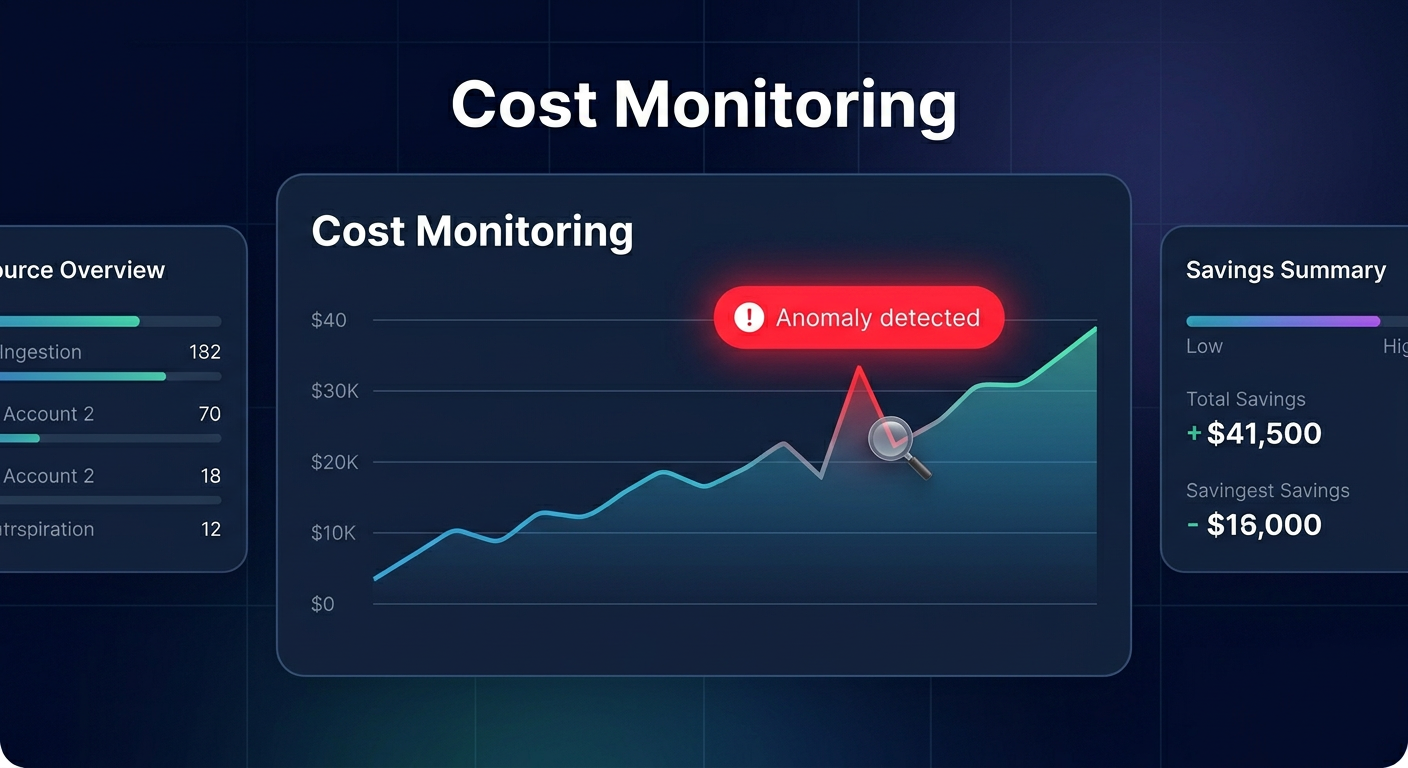
CloudWatch also provides granular metrics like `Invocations`, `MatchedEvents`, and `TriggeredRules` that are essential for operational monitoring. If you see high numbers for matched events but low numbers for triggered rules, you are likely paying to ingest events that are never used. Furthermore, high-growth teams must be wary of the CloudWatch Logs pricing associated with auditing these events, as ingestion and storage fees can spiral if you lack appropriate retention policies.
Navigating the difference between Cost Explorer and AWS Budgets is also critical; use budgets to set forward-looking alerts and Cost Explorer for retrospective deep dives into event patterns.
Maximizing your event-driven ROI
EventBridge is a powerful tool for building decoupled, scalable systems, but its consumption-based pricing model requires active management. By focusing on payload reduction, aggressive source-side filtering, and consistent monitoring, you can keep your event-driven architecture lean and efficient. Visibility is only the first step. While native tools tell you when you have overspent, they do not automatically fix the underlying inefficiencies.
Hykell specializes in identifying these hidden savings and implementing rate optimizations that reduce your total AWS bill by up to 40% – all without requiring engineering effort or code changes. To see exactly how much you could be saving on your event-driven workloads, use our AWS savings calculator or contact Hykell for a free cost audit. We only take a slice of what you save; if you do not save, you do not pay.