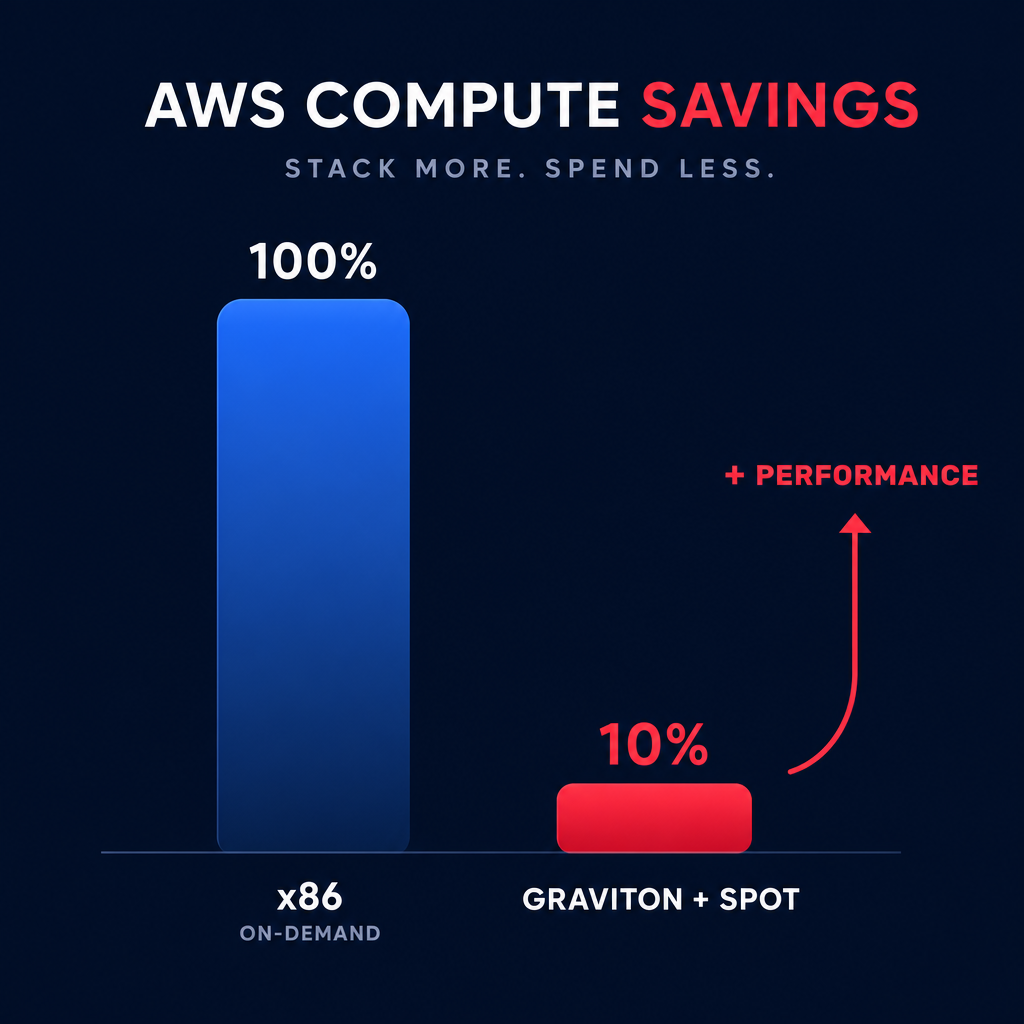
Are you still paying the “x86 tax” on your monthly AWS bill? You can slash compute costs by up to 40% while gaining 25% better performance by shifting your strategy toward AWS Graviton processors and automated spot instance management.
Most businesses view cloud cost optimization as a choice between performance and price. However, by combining AWS native Graviton instances with the steep discounts of the spot market, you can achieve “stacked savings” that reduce your total compute spend by as much as 90%. Implementing this strategy requires a shift from manual provisioning to automated orchestration, but the financial returns and performance gains are immediate.
The architectural advantage of AWS Graviton
AWS Graviton processors, built on the ARM64 architecture, represent a paradigm shift in cloud efficiency. Unlike traditional x86 processors from Intel or AMD that rely on hyperthreading, Graviton instances map one vCPU to one physical core. This design provides 15–25% better price-performance for compute-intensive workloads like web servers, microservices, and databases. When you perform a cost comparison between Graviton and Intel instances, the architectural benefits become clear: you gain more consistent performance without the latency spikes often associated with shared hardware resources.
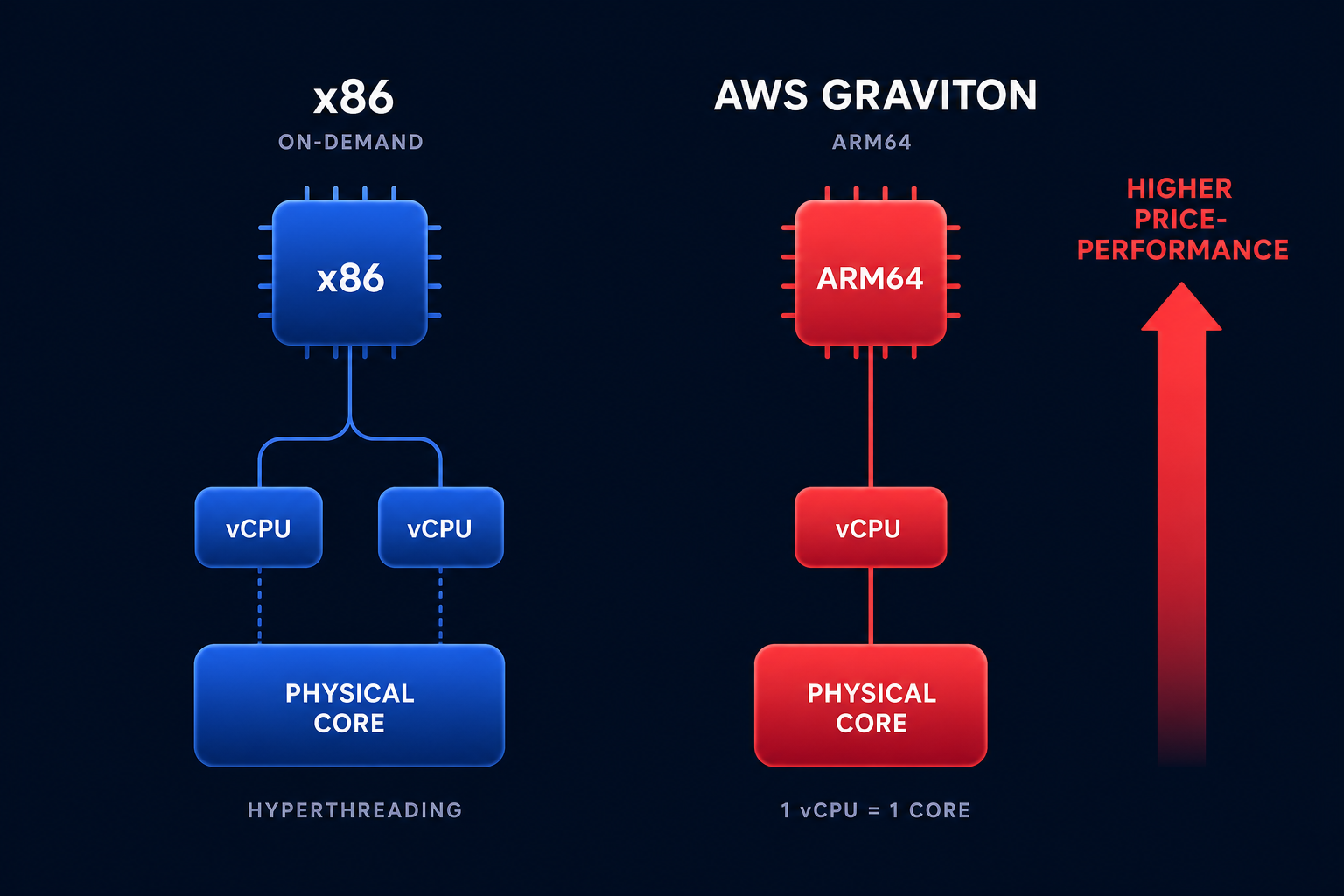
Beyond pure speed, Graviton is more cost-effective at the unit level. These instances generally cost 20% less than their x86 counterparts while providing superior throughput. When you accelerate your Graviton gains, you are not just saving money; you are also moving toward a more sustainable infrastructure. Graviton instances use up to 60% less energy than comparable EC2 instances for the same performance, helping you meet environmental goals while lowering overhead.
Layering spot instances for maximum savings
While Graviton lowers your baseline price, Amazon EC2 spot instances allow you to access unused AWS capacity at discounts of up to 90% compared to on-demand pricing. The challenge with spot instances is their interruptible nature, as AWS can reclaim the capacity with a two-minute warning. However, treat these interruptions as routine events rather than crises.
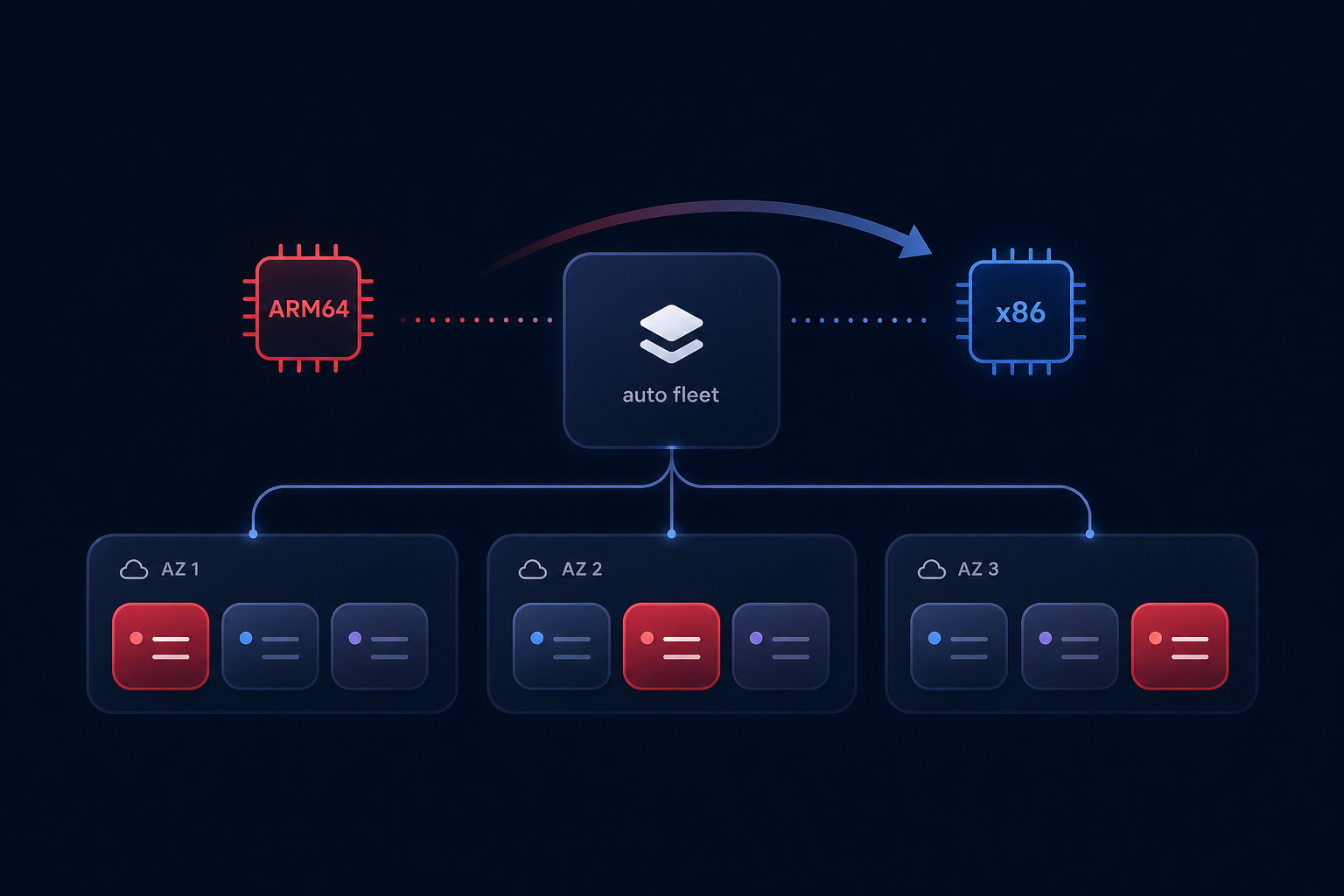
To run stable workloads, you must implement an automated AWS spot fleet management strategy. This involves diversifying your fleet across at least 10 different instance types and multiple availability zones. By using Graviton instances in auto-scaling groups, you can create launch templates that include both ARM64 and x86 alternatives. This ensures that if Graviton spot capacity is unavailable, your system automatically falls back to Intel or AMD instances, maintaining uptime while searching for the most cost-efficient resources. Successful teams focus on spot instance automation for stable workloads to ensure that capacity rebalancing happens proactively.
Automated infrastructure tuning and EBS optimization
A complete cost-optimization strategy goes beyond the CPU. Storage is often the hidden culprit behind ballooning AWS bills, with many teams still utilizing older gp2 volumes that rely on a restrictive burst-credit system. Migrating to gp3 volumes provides a baseline of 3,000 IOPS and 125 MiB/s regardless of volume size, typically reducing storage costs by 20% per GiB. Understanding the relationship between AWS EBS throughput and IOPS is critical to avoiding bottlenecks.
Furthermore, cloud resource rightsizing is essential to ensure you are not over-provisioning. If your instances consistently run at 10–20% CPU utilization, you are overpaying for unused capacity. Automated tuning tools can identify these mismatches in real-time, allowing you to downsize or switch instance families based on actual IOPS and throughput demand. This multi-dimensional approach ensures that every component of your stack is optimized for both cost and delivery.
Implementing the strategy on autopilot
The primary barrier to adopting these optimizations is the engineering effort required to assess workloads, recompile binaries for ARM, and manage spot interruptions. Hykell removes this friction by automating the entire optimization lifecycle. Our platform continuously monitors your usage patterns, identifies the best candidates for Graviton migration, and manages spot instance orchestration without requiring manual intervention from your DevOps team.
By integrating real-time cloud observability with automated AWS rate optimization, Hykell ensures your infrastructure always runs on the most cost-efficient instance type. This “autopilot” approach typically reduces cloud bills by up to 40% while maintaining, or even improving, application performance. You get the benefits of advanced architecture and market-driven pricing without the operational burden.
Combining Graviton’s superior architecture with the deep discounts of spot instances and automated storage tuning creates a highly efficient cloud environment. This strategy doesn’t just cut costs; it provides your business with a competitive edge by allowing you to redirect engineering resources from infrastructure maintenance to core product innovation. To see exactly how much your business could save by moving to an automated Graviton and spot instance strategy, use our cloud cost savings calculator for a detailed analysis of your infrastructure.