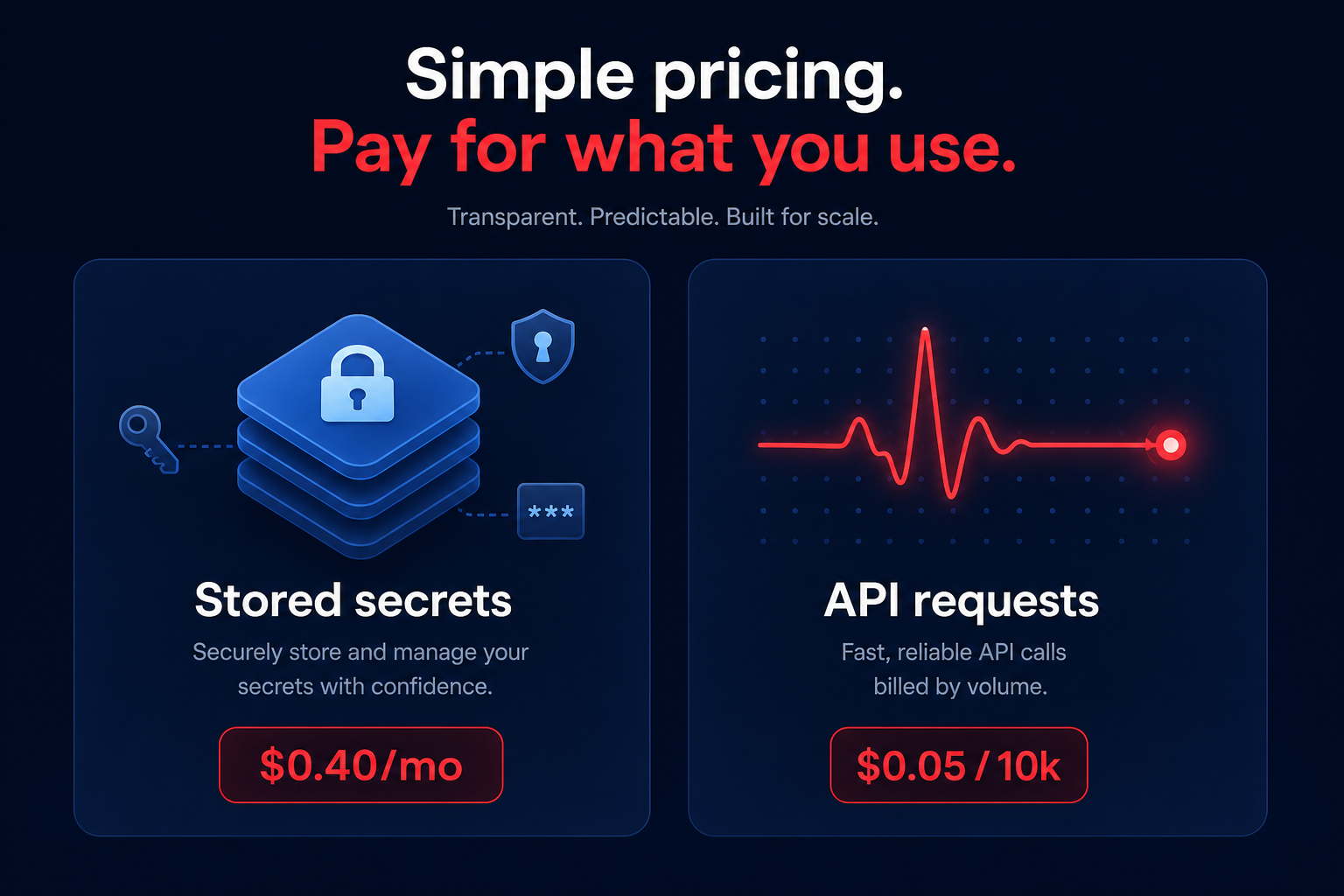
Are you paying more to manage your API keys than to run the services that use them? While $0.40 per secret seems negligible, unoptimized retrieval patterns and redundant replicas can silently inflate your monthly bill by thousands of dollars.
Understanding the AWS Secrets Manager cost structure is essential for technical decision-makers who need to balance high security with architectural efficiency. Unlike many AWS services that scale purely on data volume, Secrets Manager charges are driven by the number of unique items you store and the frequency with which your applications request them.
The two pillars of AWS secrets manager costs
AWS Secrets Manager pricing in the United States is built on two primary consumption metrics with no upfront contracts or minimum fees. According to official AWS pricing documentation, new users can also take advantage of a 30-day free trial to rotate, manage, and retrieve secrets when they first start the service.
Secret storage fees
AWS charges $0.40 per secret per month for storage. This fee is prorated by the hour, meaning if you create a secret for a short-term 24-hour deployment and then delete it, you only pay for that specific window of time. It is also important to note that secrets marked for deletion do not incur storage charges during their waiting period, helping you avoid “zombie” costs during the cleanup process.
API interaction fees
The second pillar involves the cost of retrieval and management, priced at $0.05 per 10,000 API calls. While this unit price sounds inexpensive, a poorly configured microservice that fetches a secret on every single request – rather than caching it – can generate millions of calls in a high-traffic environment. You can track these spikes using AWS Cost Explorer, which helps you visualize if your API costs are scaling linearly with your traffic or if a configuration error is driving up spend.
Hidden drivers: Rotation, replication, and KMS
While the base fees appear straightforward, complex architectures often introduce additional line items that can catch teams off guard. Managed rotation for services like RDS and Redshift, for instance, does not have a separate feature fee, but it relies on other billed AWS resources. To rotate a secret, AWS triggers a Lambda function and encrypts the new value using the AWS Key Management Service (KMS). You will be billed for the Lambda execution time and the KMS API requests associated with each cycle. Because these micro-costs accumulate with every execution, frequent rotation – such as every four hours – requires careful budget monitoring.
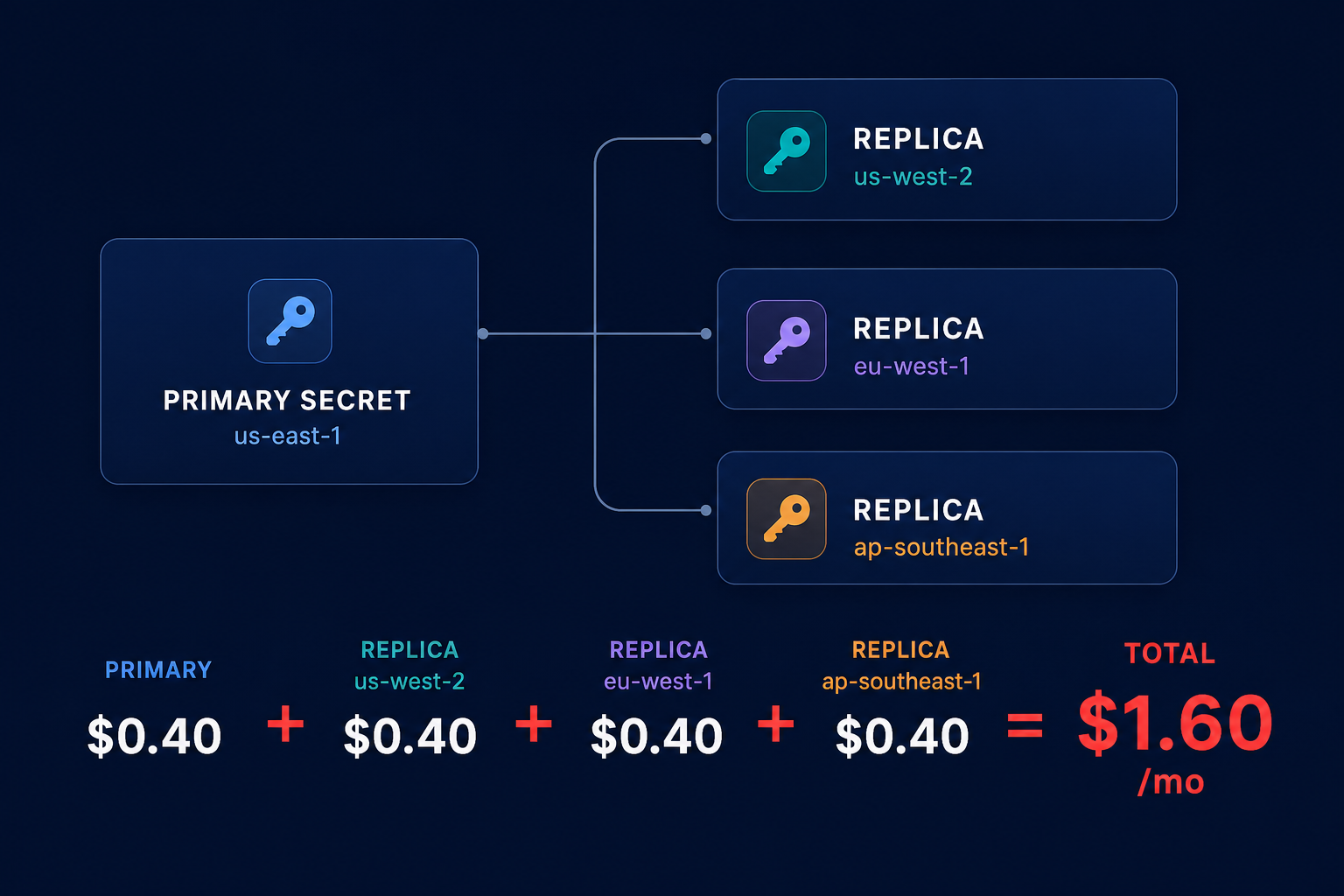
Multi-region replication is another frequent source of budget variance. If you replicate a secret to a secondary region for disaster recovery, AWS treats that replica as a standalone secret for billing purposes. A single secret replicated to three regions will cost you $1.60 per month ($0.40 for the primary plus $0.40 for each of the three replicas) in addition to the API calls made in each respective region. While there is no separate “cross-region replication” transfer fee, the storage cost scales linearly with the number of regions. For teams managing hundreds of secrets across multiple environments, consulting an AWS pricing calculator guide is vital to ensure these replicas do not exceed your projected budget.
Secrets manager vs. SSM parameter store
A frequent debate for AWS architects is whether to use Secrets Manager or the Systems Manager (SSM) Parameter Store. AWS Systems Manager pricing offers standard parameters at no additional charge, making them an attractive alternative for non-sensitive configuration data. However, Secrets Manager offers native features that the standard Parameter Store does not, such as cross-account access and fully automated rotation.
If your architecture requires advanced parameters in SSM, you will pay $0.05 per parameter per month. For high-throughput scenarios, SSM also charges $0.05 per 10,000 API interactions, which is identical to the API pricing for Secrets Manager. Choosing between them usually depends on whether you need the automated lifecycle management and native security features that Secrets Manager provides for sensitive credentials.
Strategies for cost optimization
If your secret management costs are scaling faster than your revenue, you can use several technical levers to bring them back under control. Implementing these strategies ensures that your security posture remains robust without becoming a financial burden.
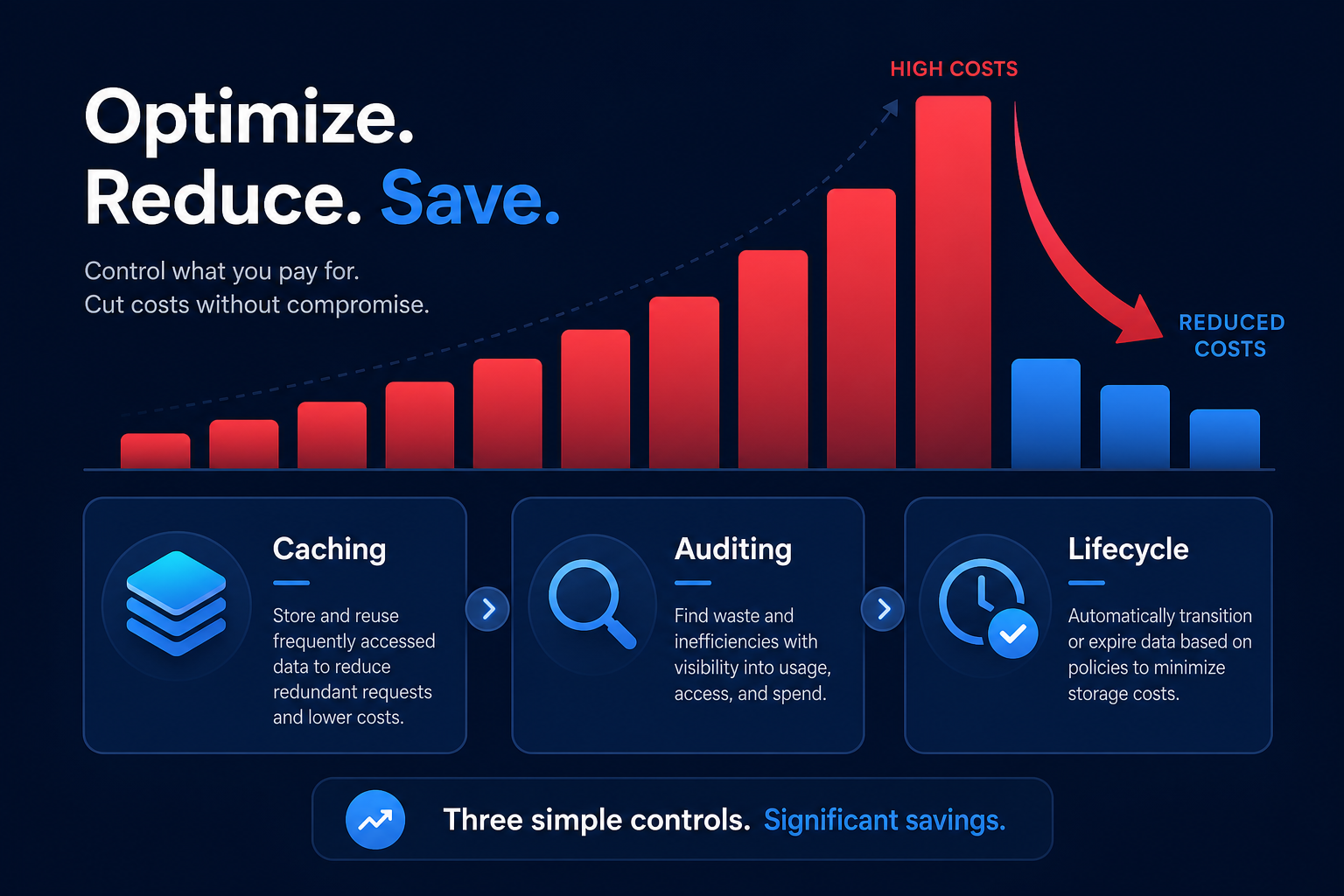
- Implement client-side caching: The most effective way to reduce API call costs is to implement caching. By using the AWS Parameters and Secrets Lambda extension or client-side caching libraries, you can reduce API calls by as much as 98%. Instead of calling the Secrets Manager API on every function invocation, your application retrieves the secret once and stores it in memory for a specified Time to Live (TTL).
- Audit and consolidate: Many organizations suffer from “secret sprawl,” where separate secrets are created for every individual developer or environment when a shared secret would suffice. Regularly auditing your environment to identify and delete unused secrets can provide immediate relief to your storage bill.
- Track lifecycle changes: You can use AWS Config to track the lifecycle of your secrets and identify resources that have not been accessed in months. This visibility allows you to decommission abandoned secrets that are otherwise silently accruing hourly charges.
While managing secret-specific costs is an architectural task, you can optimize your broader cloud spend through automation. Hykell provides AWS rate optimization that works in the background to manage your Reserved Instances and Savings Plans. By achieving an Effective Savings Rate of 50–70% on your compute spend, you can free up the budget necessary to maintain a secure secret management infrastructure.
Managing the cost of AWS Secrets Manager requires a proactive approach to both architecture and governance. By implementing caching to minimize API calls and choosing the right storage service for your specific data types, you can ensure your security posture remains sustainable as you scale. If you are looking to uncover deeper savings across your entire infrastructure, Hykell can help you reduce your total AWS bill by up to 40% on autopilot. Use our cloud cost calculator to see how much you could be saving today.