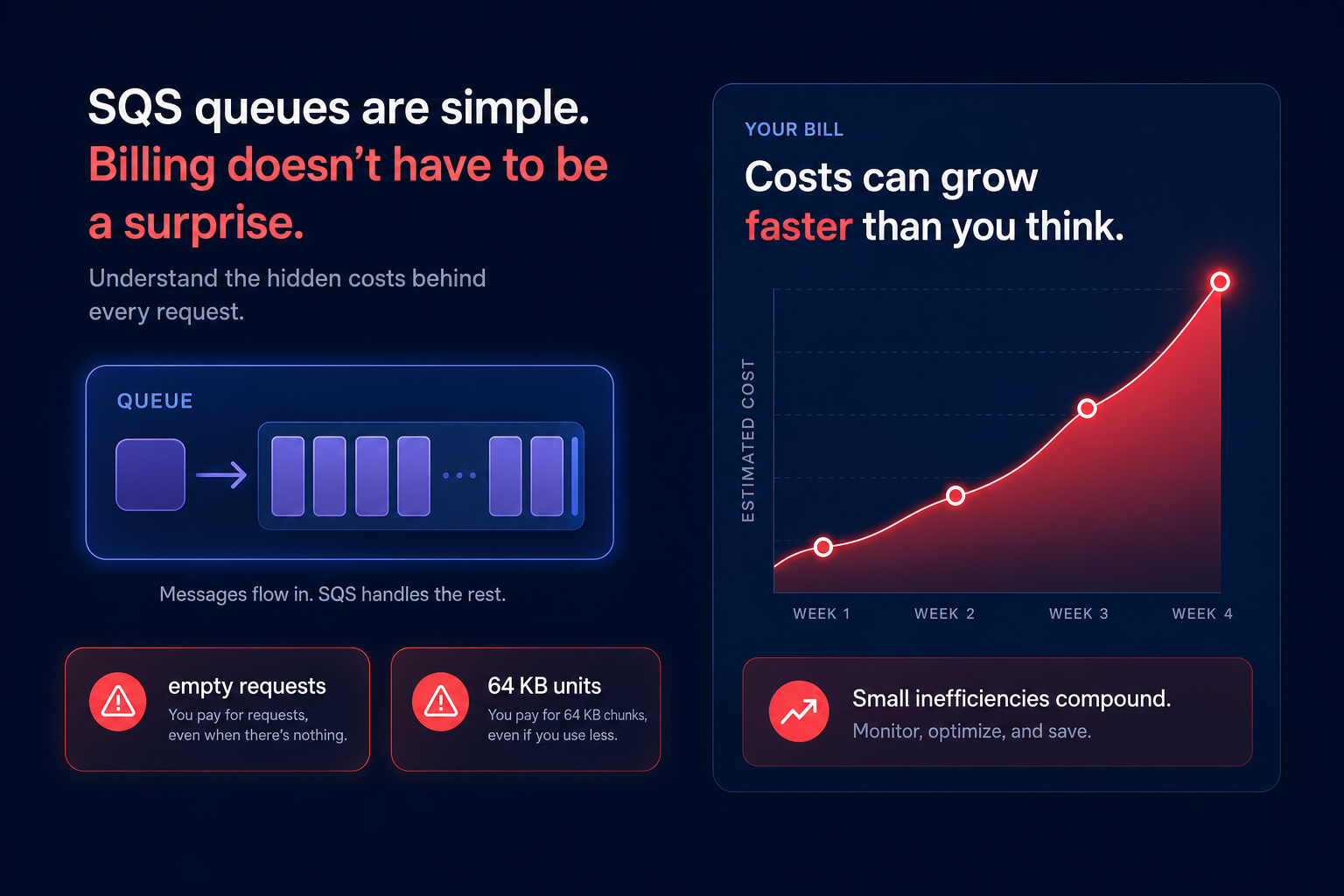
Are you paying for “empty” requests in your Amazon SQS bill? While SQS is affordable at low volumes, inefficient polling and 64 KB metering can cause messaging costs to spiral. Understanding these mechanics is essential to keep your AWS architecture lean and predictable.
Amazon SQS operates on a pay-as-you-go model with no minimum fees or commitments. All AWS customers receive a free tier of 1 million monthly requests, which applies across all regions except GovCloud and refreshes every month. However, once you exceed this threshold, the choice of queue type, your payload size, and your API interaction patterns determine your monthly spend.
Choosing between standard and FIFO queues
The most fundamental cost driver is your choice of queue type. Standard queues provide nearly unlimited throughput and best-effort ordering. In the us-east-1 region, these are priced at $0.40 per million requests. These queues are ideal for decoupling applications where message order is not a strict requirement and you can tolerate at-least-once delivery.
If your application requires exactly-once processing and strict first-in-first-out delivery, you must use FIFO queues. These carry a higher baseline price of $0.50 per million requests. While API actions like sending, receiving, and deleting messages in FIFO queues are billed at this higher rate, management operations for these queues are still billed at standard rates. To help high-volume users, AWS offers tiered pricing that reduces the cost per million requests as your volume grows. Once you surpass 100 billion requests per month, costs can drop as low as $0.24 for standard queues and $0.35 for FIFO queues.
The 64 KB metering rule and payload impact
You might assume one API call equals one billable request, but AWS meters SQS usage in 64 KB increments. This means a single API action with a 256 KB payload is billed as four requests. Because payload efficiency is a significant lever for cost management, you should optimize how much data you send in each message.
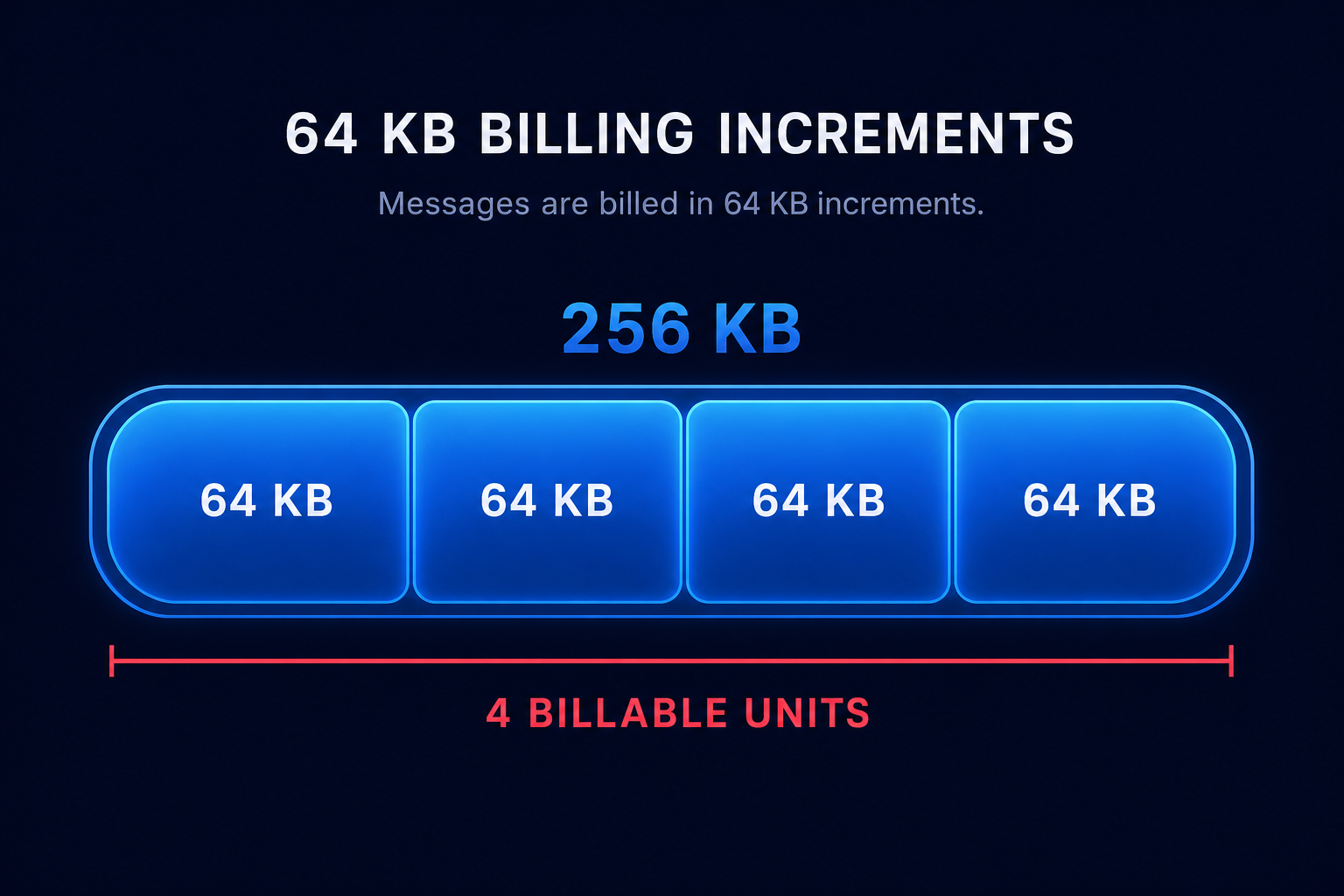
You can significantly reduce unit costs by utilizing batching. The `ReceiveMessageBatch` API allows you to retrieve up to 10 messages in a single call. Since SQS bills in 64 KB chunks, packing several small messages into a single batch ensures you aren’t paying for “air” – the unused space within those billable units. For teams handling massive payloads, the Amazon SQS queue types documentation details how the Extended Client Library can use Amazon S3 to store message bodies up to 2 GB, though this introduces separate S3 storage and request charges.
Hidden drivers: polling, encryption, and data transfer
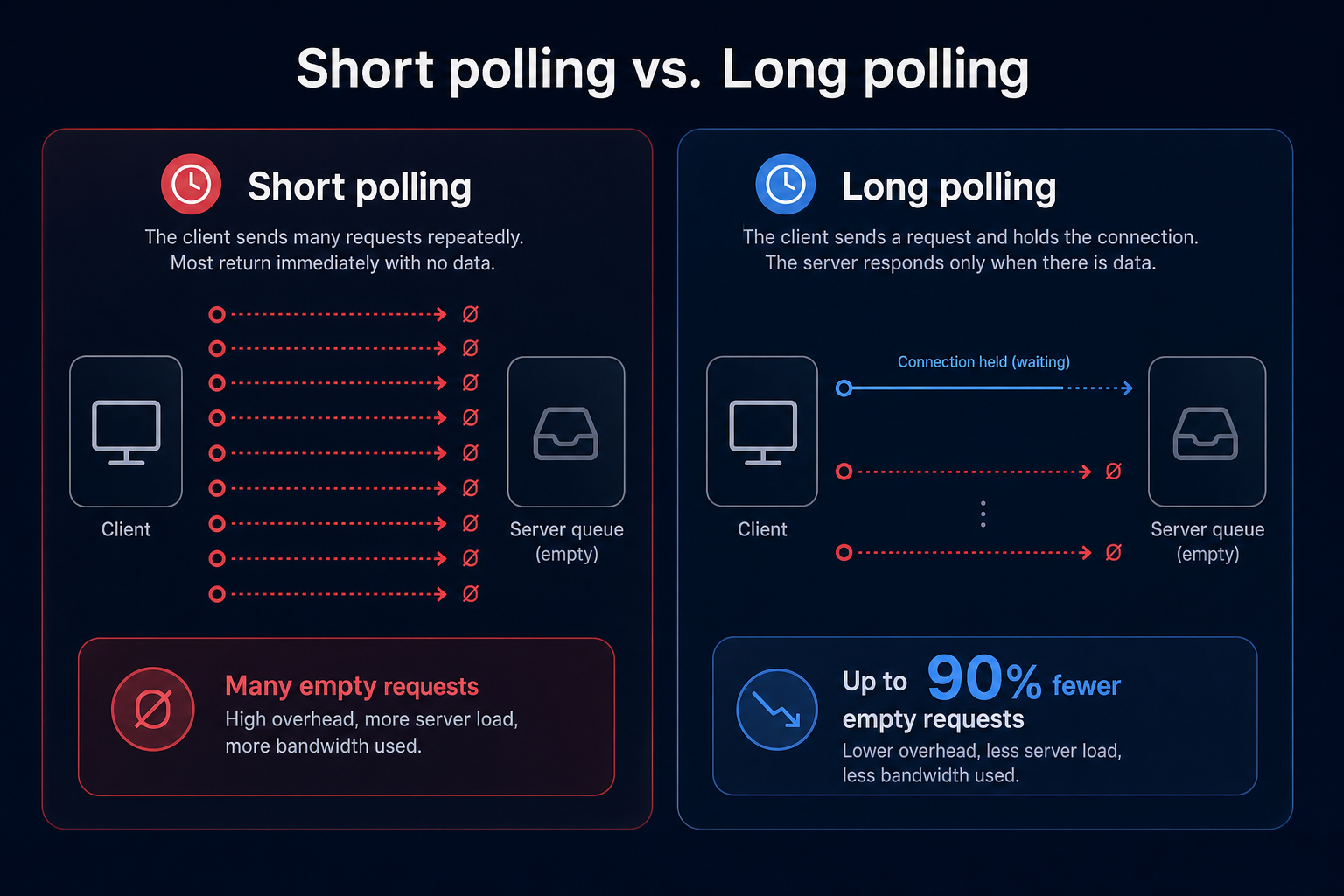
Short polling is the most common cause of inflated SQS bills. When your application constantly asks SQS if new messages are available and the queue is empty, you are still billed for those empty receive requests. Switching to long polling – where the connection stays open for up to 20 seconds waiting for a message – is an essential AWS SQS cost optimization strategy. This simple change can reduce empty receive requests by up to 90%, instantly lowering your bill without changing your application logic.
Security and observability requirements also add layers to your spend:
- Server-side encryption: If you use the AWS Key Management Service (KMS), you will incur KMS charges for every SQS call that interacts with your keys.
- Data transfer: While data transfer into SQS and out to the same region is free, transferring data across regions follows standard egress pricing, which can impact global architectures.
- Monitoring: You should use a cloud observability dashboard to track metrics like the number of empty receives and visibility timeouts to spot inefficiencies in real-time.
Modeling your spend for growth
To accurately estimate your costs before deployment, you should use the AWS Pricing Calculator. It allows you to model what-if scenarios, such as the impact of increasing message frequency or switching from standard to FIFO queues. Our AWS Pricing Calculator guide explains how to set these baselines to avoid “reality drift” when the actual bill arrives.
While SQS optimization is often a matter of fine-tuning API calls, broader cloud savings require a more automated approach. Hykell provides AWS rate optimization that identifies underutilized resources and manages complex commitment strategies like Savings Plans on your behalf. We typically help teams reduce their total AWS spend by up to 40% without any manual engineering effort. Our performance-based model means we only take a slice of what you save – if we don’t find savings, you don’t pay.
Calculate your potential savings with Hykell today and see how much you could be overpaying on your AWS infrastructure.