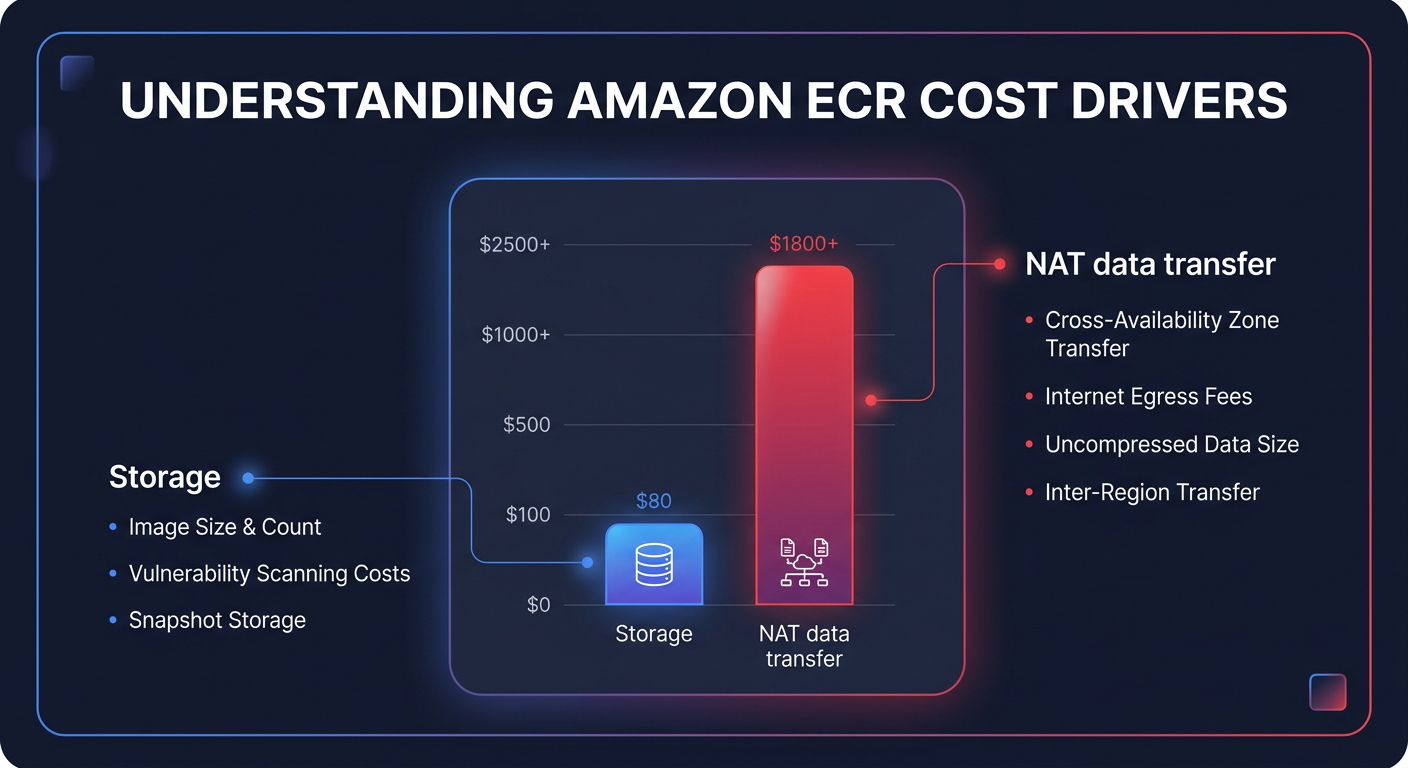
Did you know a single misconfigured CI pipeline can balloon your Amazon ECR bill by 900%? While storage is cheap, the silent accumulation of untagged images and high-frequency NAT Gateway data transfer creates an unnecessary drain on your budget.
Understanding the primary drivers of ECR spend
Amazon Elastic Container Registry (ECR) pricing seems straightforward, but it scales aggressively as your infrastructure grows. In most US regions, you pay $0.10 per GB-month for storage. While the first 500 MB are free, a busy engineering team can easily generate terabytes of data across dozens of repositories, leading to a linear increase in monthly expenses.
The real hidden cost often isn’t the storage itself, but the data transfer involved in pulling those images. Pulling images to your EC2 or AWS Fargate cost optimization tips tasks is free within the same region, yet if that traffic traverses a NAT Gateway, you incur a $0.045 per GB processing fee. For high-scale Kubernetes cost optimization efforts, these networking charges frequently eclipse the total cost of storage.
Automating cleanup with ECR lifecycle policies
The most effective way to slash storage costs is to stop paying for what you do not use. Many teams retain every single build from their CI/CD pipeline, leading to thousands of “untagged” images. These are orphaned layers that no longer have a version label but continue to occupy space and drive up your bill.
You should implement lifecycle policies to automate the deletion of these resources. A common production-grade strategy involves two primary rules that target the most common sources of waste:
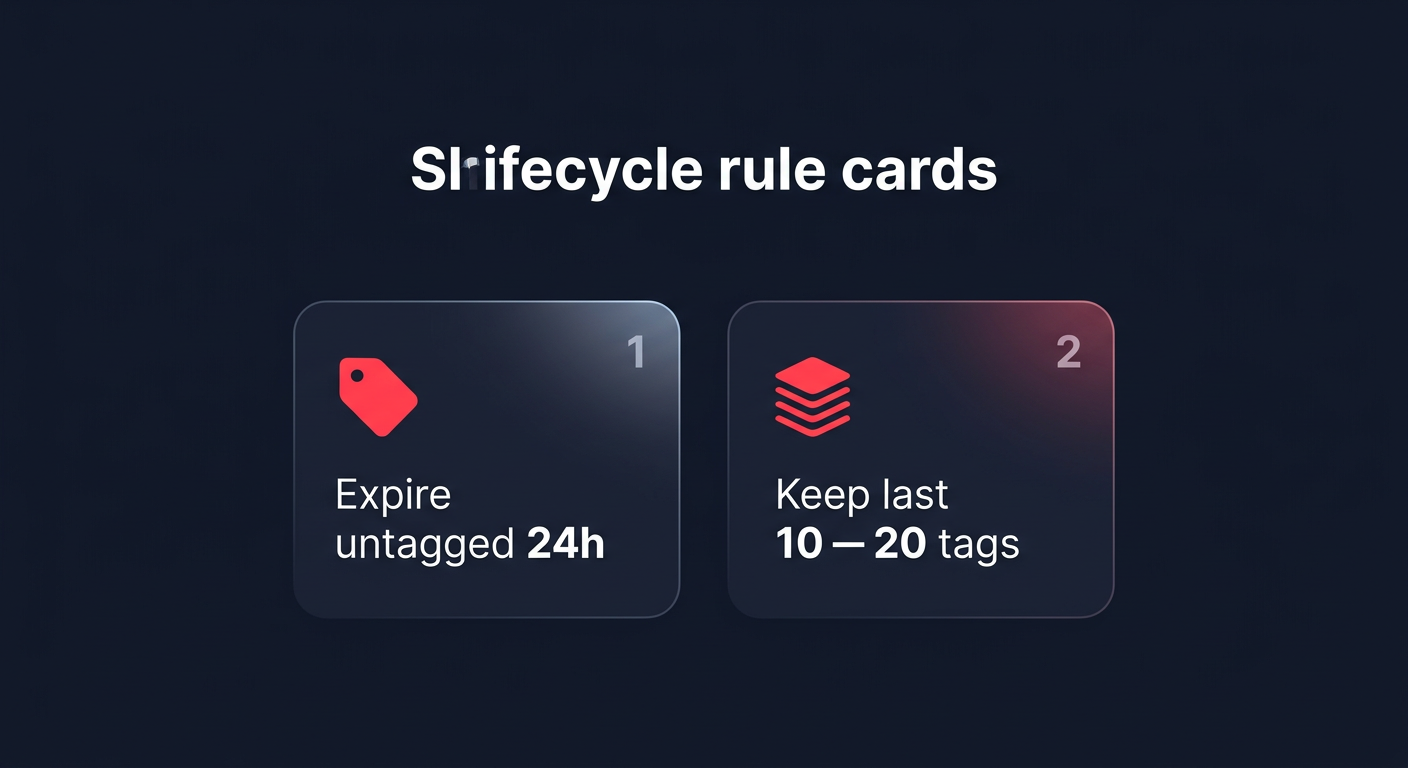
- Expire untagged images by setting a rule to delete any image without a tag after 24 hours. This captures the temporary layers created during failed builds or overwritten tags that are no longer necessary.
- Limit the total tag count for development and staging repositories by retaining only the last 10 or 20 versions. You rarely need a build from six months ago to debug a current staging issue, and pruning these can reduce storage requirements by up to 90% in active environments.
Case studies indicate that simple automation like this helps teams managing cost management strategies for AWS EKS clusters significantly improve their bottom line without impacting application performance.
Architectural optimizations for data transfer
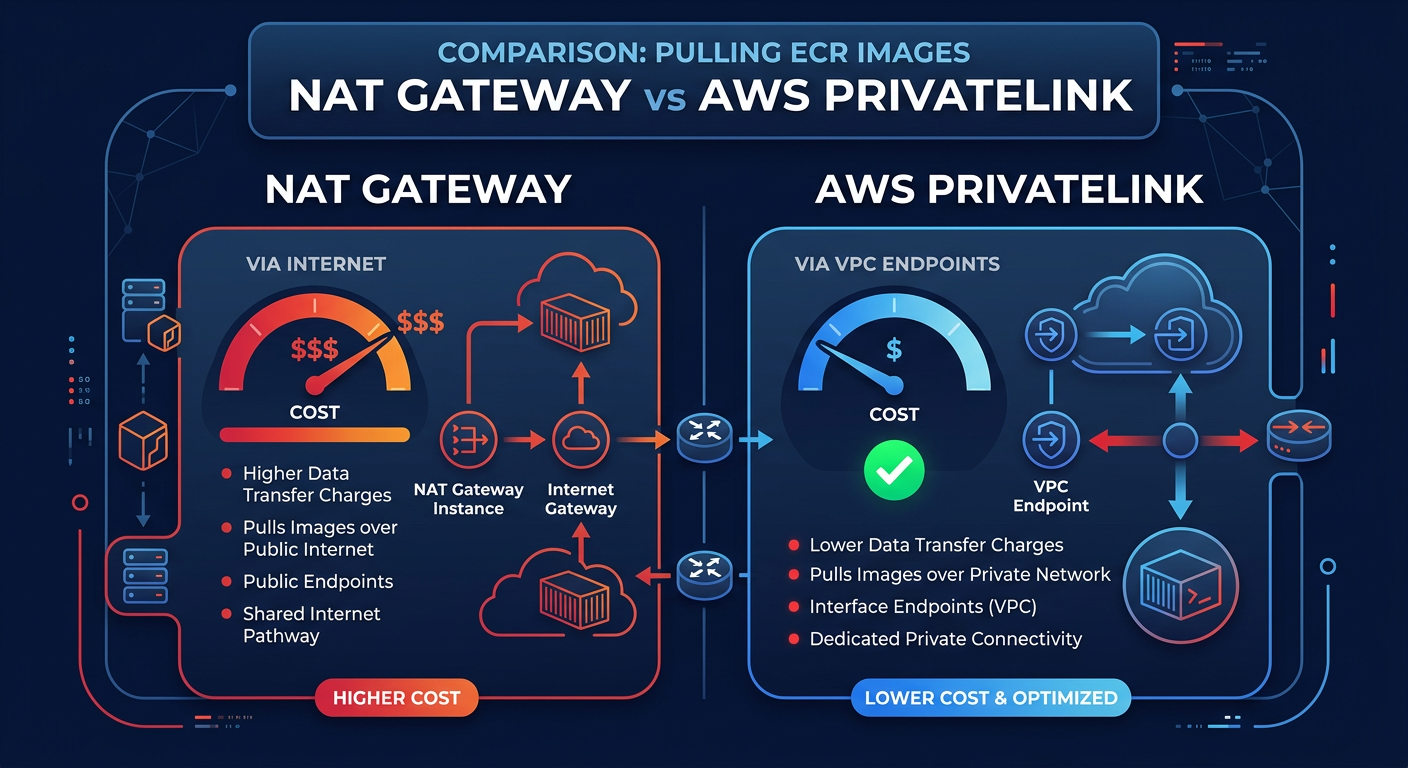
If your ECR bill is dominated by data transfer, the culprit is likely your VPC architecture. When your private instances pull images through a NAT Gateway, you pay twice: once for the NAT processing and again for any potential AWS egress costs if the traffic leaves the region.
The solution involves deploying AWS PrivateLink, also known as Interface VPC Endpoints, for ECR. This allows your container instances to pull images over the private AWS network, bypassing the NAT Gateway entirely. While PrivateLink has a small hourly fee, it reduces data processing costs by nearly 80% compared to NAT Gateway rates. This architectural shift is a critical step for reducing AWS NAT Gateway costs in container-heavy environments.
Optimizing image size and layer reuse
Your CI/CD practices directly influence your final bill. Large, monolithic images increase both storage costs and pull times, which can slow down your deployment cycles. To minimize this footprint, you should adopt multi-stage Docker builds. This technique allows you to use a heavy image for compiling your code while shipping only the minimal binary and runtime in the final production image.
Furthermore, you should pay close attention to layer deduplication. ECR only stores a single copy of a layer if it is shared across different images in the same repository. By standardizing your base images, such as using a specific version of Alpine Linux across all your microservices, you maximize layer reuse and significantly reduce your total GB-month storage requirements.
Monitoring and continuous optimization
Cost management is a continuous process rather than a one-time task. You should use AWS Cost Explorer to filter your spend by the ECR service and look for spikes in storage metrics. If you notice a steady upward trend despite having lifecycle rules in place, it is time to audit your cross-region replication settings. Replication not only doubles your storage costs but also incurs inter-region transfer fees that can quickly add up.
For teams looking to maximize their AWS rate optimization strategies, managing container overhead is just the beginning. While lifecycle rules handle the data cleanup, broader compute savings require a more dynamic approach to how you commit to AWS resources.
Hykell helps you take these optimizations further by providing an automated platform that identifies underutilized resources and applies precision-engineered rate strategies. We typically help organizations reduce their overall AWS bills by up to 40% on autopilot, ensuring you never pay for “zombie” storage or inefficient networking patterns again. To see exactly where your container registry and compute costs can be trimmed, book a free cost audit or use our AWS cost savings calculator to discover your potential savings.