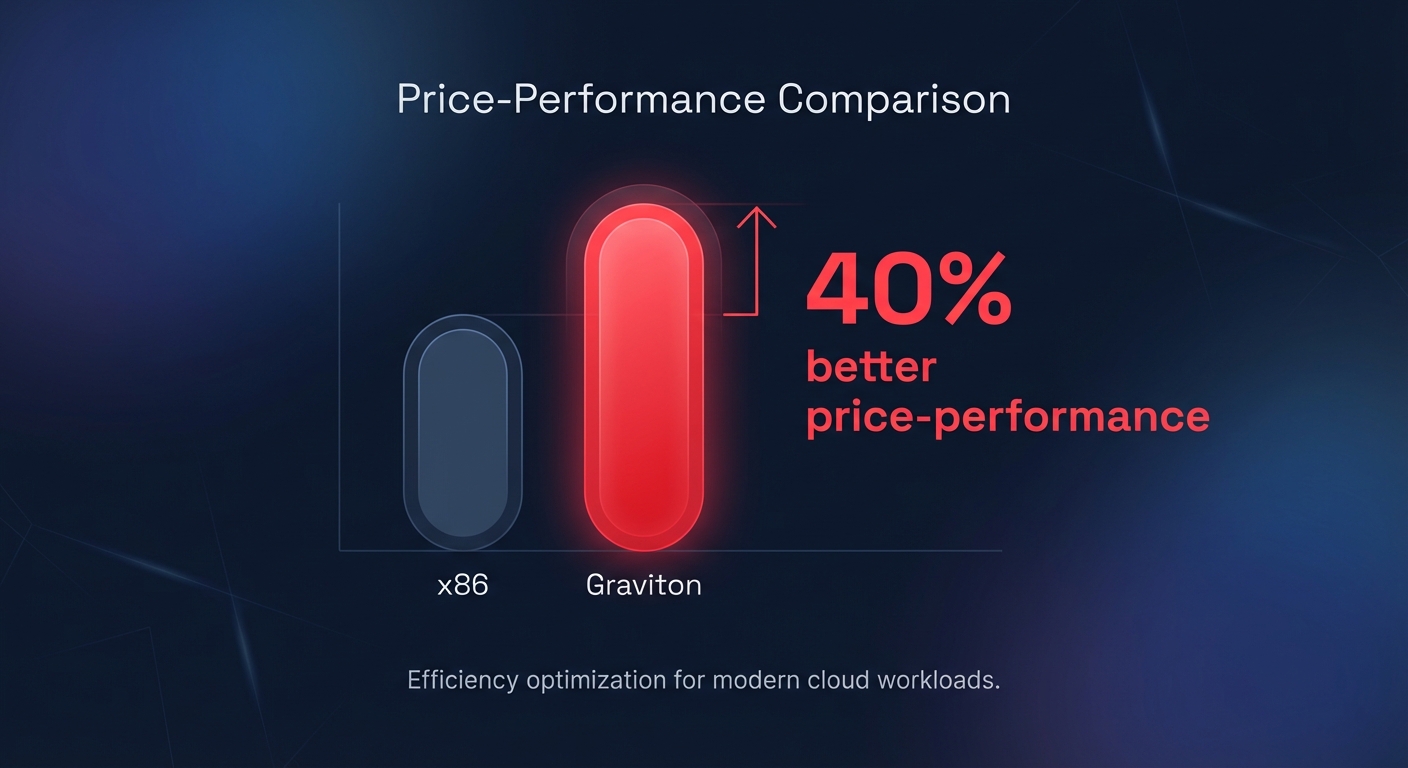
Could your infrastructure run 40% cheaper while actually getting faster? Moving to AWS Graviton isn’t just a cost-cutting exercise; it’s a strategic modernization that aligns your stack with custom ARM64 silicon designed specifically for the cloud.
The promise of AWS Graviton instances is compelling, offering up to 40% better price-performance over comparable x86 instances. For instance, migrating from x86-based C5 instances to Graviton-powered C7g instances can deliver up to 25% better computational performance while slashing compute costs by 30%. Beyond pure speed, these instances are also more sustainable, capable of reducing energy consumption by up to 60% compared to traditional x86 alternatives. However, capturing these gains safely requires a disciplined approach to compatibility, benchmarking, and deployment.
Assessing workload compatibility and technical requirements
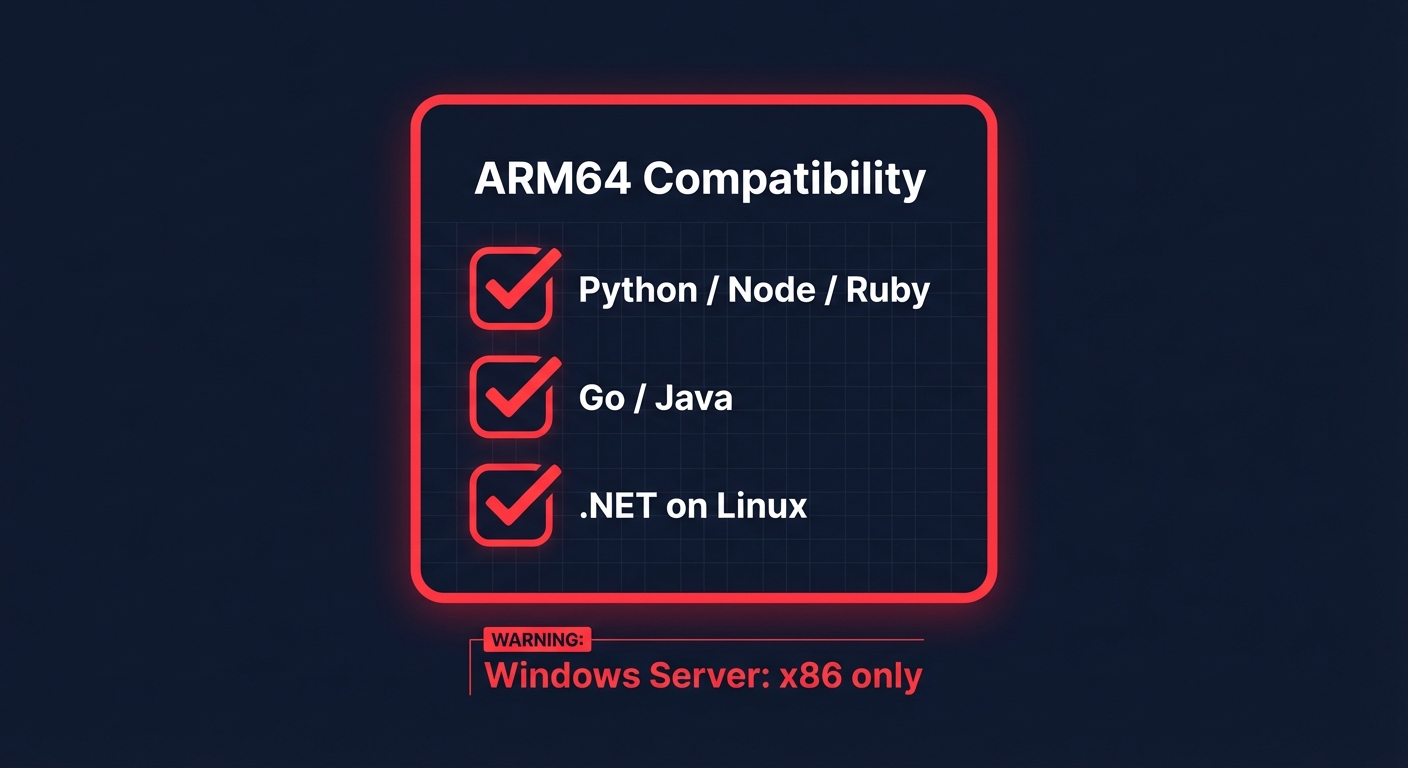
Before you change a single instance type, you must determine which workloads are Graviton-ready. Because Graviton uses the ARM64 architecture, any software you run must be compatible with or compiled for ARM. Most modern, interpreted languages like Python, Node.js, and Ruby transition with minimal friction. Similarly, compiled languages with strong ARM support, such as Go and Java, often see immediate benefits. In fact, large Java applications can run up to 45% faster on Graviton4 compared to Graviton3.
If you are currently running .NET workloads, you can achieve up to 45% savings by migrating from the legacy .NET Framework to .NET Core or .NET 5+ on Linux. The primary restriction remains Windows Server, which is not supported on Graviton, making it necessary to keep those specific workloads on x86. Additionally, you should audit your environment for legacy x86-only binaries or proprietary libraries that lack ARM64 versions. Hykell’s Workload Compatibility Assessment helps automate this discovery phase by scanning your environment to identify high-payoff candidates while flagging potential dependency roadblocks.
Navigating code and dependency changes
If your application is containerized, your migration path is significantly smoother because containers abstract much of the underlying hardware complexity. Most popular Docker images now offer multi-architecture support, and by using tools like Docker Buildx, you can create multi-architecture container images that allow the same image tag to run seamlessly on both x86 and ARM64 nodes. This approach avoids the need to maintain separate production lines for different architectures.
For non-containerized Linux workloads, ensuring your distribution is updated is the first priority. Major distributions like Amazon Linux 2, Ubuntu 18.04+, and RHEL 8+ have built-in ARM64 support optimized for the cloud. You should also evaluate your CI/CD pipeline, as moving build and test servers to Graviton can reduce compilation costs by approximately 35%. This provides an immediate win for your engineering budget before you even begin shifting production traffic.
Performance and cost benchmarking
You shouldn’t assume that Graviton’s 1:1 vCPU-to-physical-core mapping will behave exactly like the hyperthreaded cores found in x86 architectures. While Graviton excels in high-concurrency and multi-threaded scenarios, single-threaded performance can sometimes favor high-clock Intel or AMD chips. For example, x86 instances may offer 6–14% better price-to-performance for strictly single-threaded tasks.
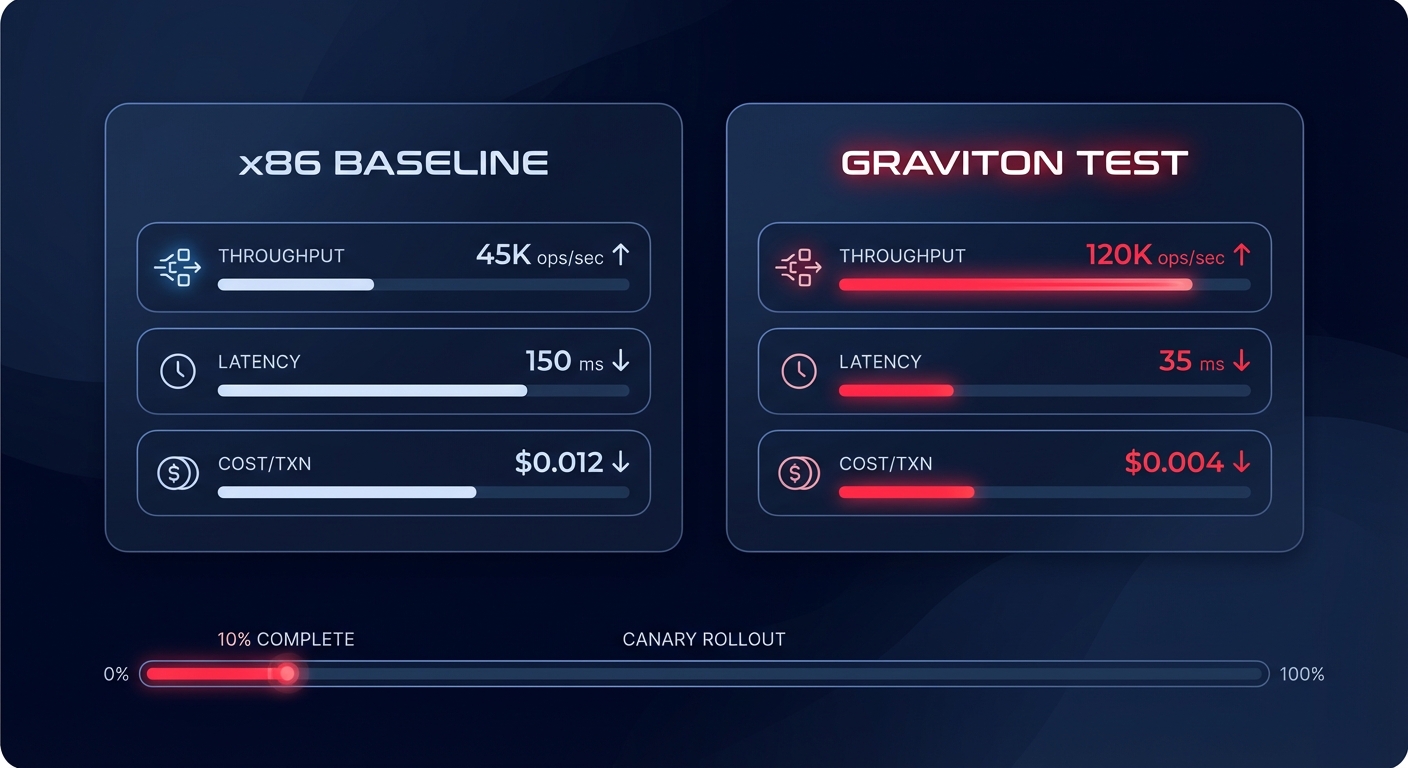
Rigorous cloud performance benchmarking is therefore essential to validate your specific use case. You should run side-by-side tests under identical load conditions, measuring throughput, latency, and cost-per-transaction. In memory-intensive scenarios, R7g instances often provide 20% better memory throughput compared to R5 equivalents. If a workload on 10 x86 instances can be handled by only 8 Graviton instances, your total cost of ownership drops even further than the standard 20% hourly price discount suggests.
Leveraging AWS tooling and deployment patterns
AWS provides several native tools to assist your transition, most notably the AWS Compute Optimizer, which offers high-confidence recommendations based on your actual utilization patterns. To minimize risk during the rollout, you can utilize Mixed Instance Policies in Auto Scaling Groups. This configuration allows you to combine ARM and x86 instances within the same fleet, enabling a gradual “canary” migration where you shift small percentages of traffic to Graviton to validate stability in real time.
For stateless microservices, this phased approach allows you to revert almost instantly if performance anomalies arise. As you gain confidence, you can expand Graviton’s footprint to more complex services like RDS or Aurora, where Graviton4-powered instances deliver faster query execution and lower latency. This transition often catalyzes broader infrastructure modernization, allowing you to benefit from the latest DDR5-5600 memory and NVMe SSD support.
Maximizing gains with Hykell’s automated optimization
The challenge for most engineering teams isn’t the technical possibility of Graviton migration, but the timing. Finding the bandwidth to benchmark every service and manage a phased rollout often takes a backseat to feature development. Hykell accelerates this transition by providing automated cloud cost optimization that works on autopilot, identifying the best candidates for migration without requiring extensive manual effort.
We don’t just identify the best Graviton candidates; we help you layer these architectural savings on top of commitment-based rate optimization. This “stacked” approach ensures that as you move to Graviton, your Savings Plans and Reserved Instances adapt dynamically to your new architecture. Our clients typically see a 30–35% reduction in compute costs with zero engineering lift. Because our model is based on your success – if you don’t save, you don’t pay – you can modernize your infrastructure with absolute financial confidence.
See how much you could save on AWS with a free Hykell audit today.