Ninety-one percent of enterprises admit to wasting significant money in the cloud, with average waste now reaching 32% of total cloud budgets. If your multi-cloud environment feels like a financial black hole, controlling spend is now the top challenge for 82% of organizations.
For mid-to-large US companies, the complexity of managing AWS, Azure, and GCP simultaneously often leads to analysis paralysis. You likely have access to the data, but you may lack the mechanism to turn that visibility into realized savings. Bridging this gap requires a combination of the FinOps framework, advanced visibility, and the strategic application of automation.
Building a foundation with the FinOps framework
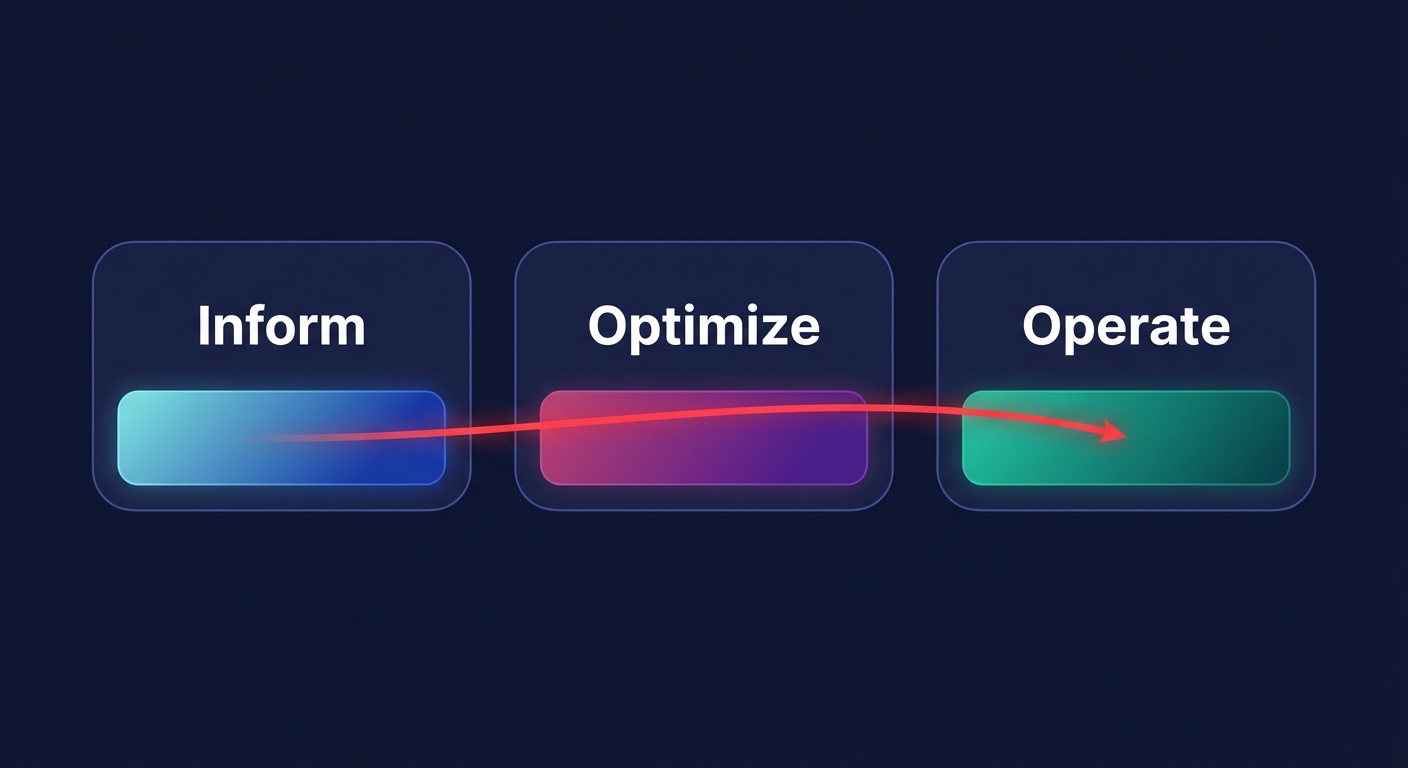
Effective multi-cloud management is about maximizing the business value of every dollar spent rather than just slashing budgets. Most mature organizations utilize the FinOps Foundation’s three-phase lifecycle – Inform, Optimize, and Operate – to govern their environments.
The Inform phase centers on cloud cost budgeting and forecasting to ensure that finance and engineering teams operate from a single source of truth. Accurate forecasting prevents capital from being tied up in overestimations while protecting against mid-cycle budget shortages.
In the Optimize phase, you take direct action to identify underutilized resources, rightsize overprovisioned instances, and leverage commitment-based discounts. This leads naturally to the Operate phase, where you integrate cost-consciousness into the daily engineering culture. Implementing cloud chargeback and showback strategies is a key part of this phase, as it holds individual teams accountable for their usage and aligns cloud spend with specific business outcomes.
Solving the multi-cloud visibility gap
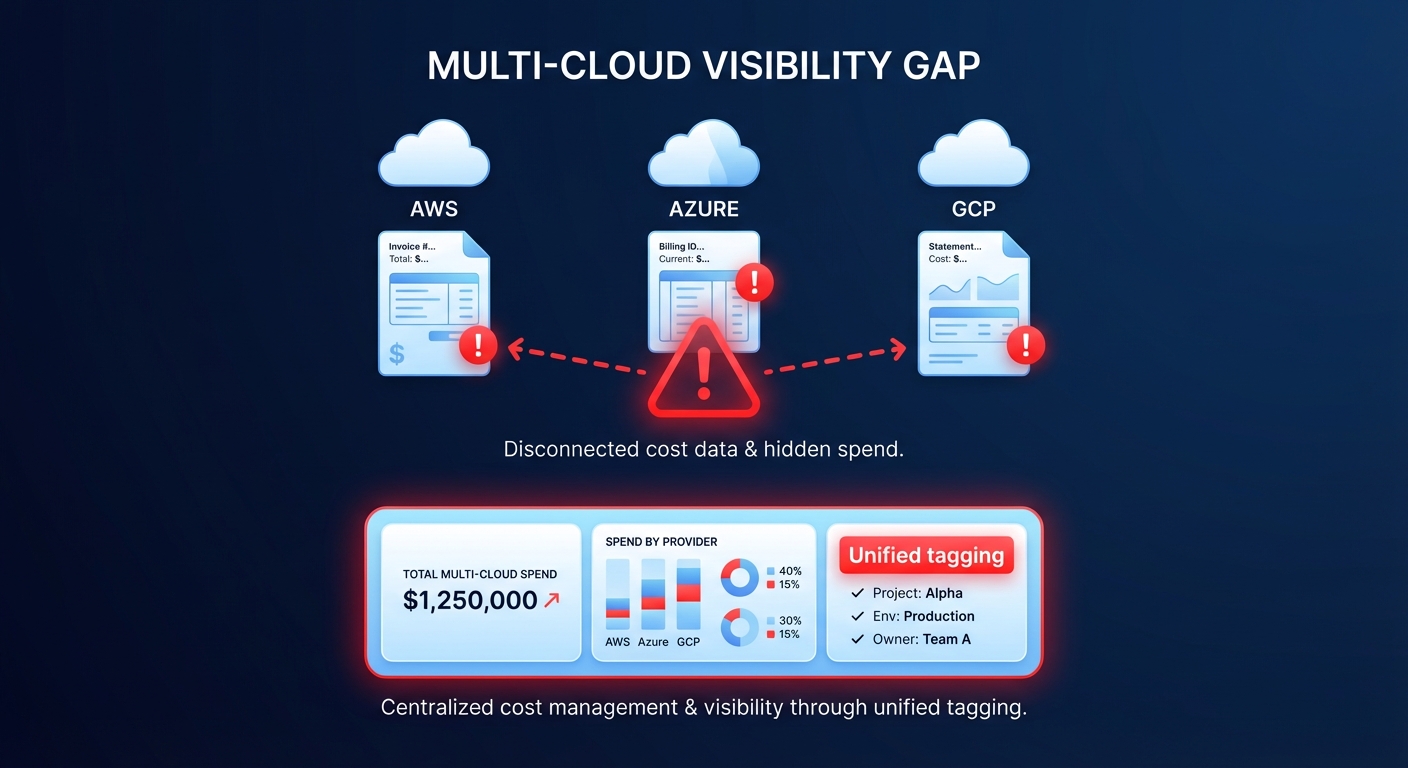
Visibility remains the primary hurdle in a multi-cloud strategy because each provider uses different billing cadences, terminology, and native interfaces. While the AWS vs. GCP pricing comparison reveals significant structural differences, your fundamental goal across all platforms is granular transparency.
Leveraging AWS-native tools for the Inform phase
Because AWS typically represents the largest portion of the cloud bill for US enterprises, mastering its native tools is critical for financial health. AWS Cost Explorer provides a deep historical lens, offering 38 months of data that often reveals significant waste, such as the fact that 40% of EC2 instances run at under 10% CPU utilization.
To move from reactive firefighting to proactive governance, you can coordinate AWS Budgets and Cost Explorer to set early warning alerts. For more complex threats, AWS Cost Anomaly Detection uses machine learning to find spend spikes that traditional budgets might miss, such as a misconfigured Lambda function or a runaway data transfer that could otherwise cost thousands before discovery.
Establishing a global tagging taxonomy
To achieve true multi-cloud transparency, you must enforce a unified tagging strategy across all providers. Without cost allocation tags, unallocated spend can swallow up to 50% of your total budget, leaving finance teams unable to attribute costs to projects.
Your taxonomy should include business tags like cost center and owner, technical tags such as application ID and environment, and automation tags that provide instructions for scheduled shutdown or cleanup policies. Consistency is vital because cloud tags are case-sensitive; a global naming convention is the only way to maintain a “Goldilocks” taxonomy that is neither too sparse nor too cluttered.
Practical optimization: Moving beyond visibility
Once you have established clear visibility, the next step is execution. Multi-cloud optimization is a game of stacked gains, where small architectural changes compound into massive financial reductions.
Rightsizing and resource elasticity
Rightsizing involves matching instance types and sizes to your actual workload requirements. This is a continuous effort rather than a one-time event. Organizations that implement cloud resource rightsizing effectively often reduce their compute costs by 20–40%.
On AWS, you can take this further by migrating to ARM-based processors. Adopting AWS Graviton instances can offer up to 40% better price-performance compared to traditional x86 instances. These savings are particularly powerful because they stack on top of your existing Reserved Instances and Savings Plans.
Storage and networking optimization
Compute often receives the most attention, but storage and networking waste are often the silent drivers of a ballooning bill. Using the right AWS cost optimization tools can help you identify opportunities to migrate from gp2 to gp3 storage volumes, which can save up to 30% while actually improving performance.
Data transfer and egress costs also require careful management, as they can account for 25–35% of a total cloud bill. Architecting for data locality is essential in multi-cloud environments, where cross-cloud egress fees are notoriously high. Simple hygiene, such as removing orphaned EBS volumes – which can cost over $100 monthly for a single 1TB volume – can save large firms thousands of dollars every month.
Automating the AWS pillar with Hykell
While multi-cloud strategy requires a broad perspective across several providers, the actual execution of savings – especially on AWS – is often too complex for manual engineering efforts. This is where Hykell fits into a modern FinOps stack. Hykell provides automated cloud cost optimization specifically for AWS, acting as an execution engine that handles the heavy lifting on your behalf.
Rather than providing a static dashboard of recommendations that your engineers may not have the bandwidth to implement, Hykell operates on autopilot to deliver the following:
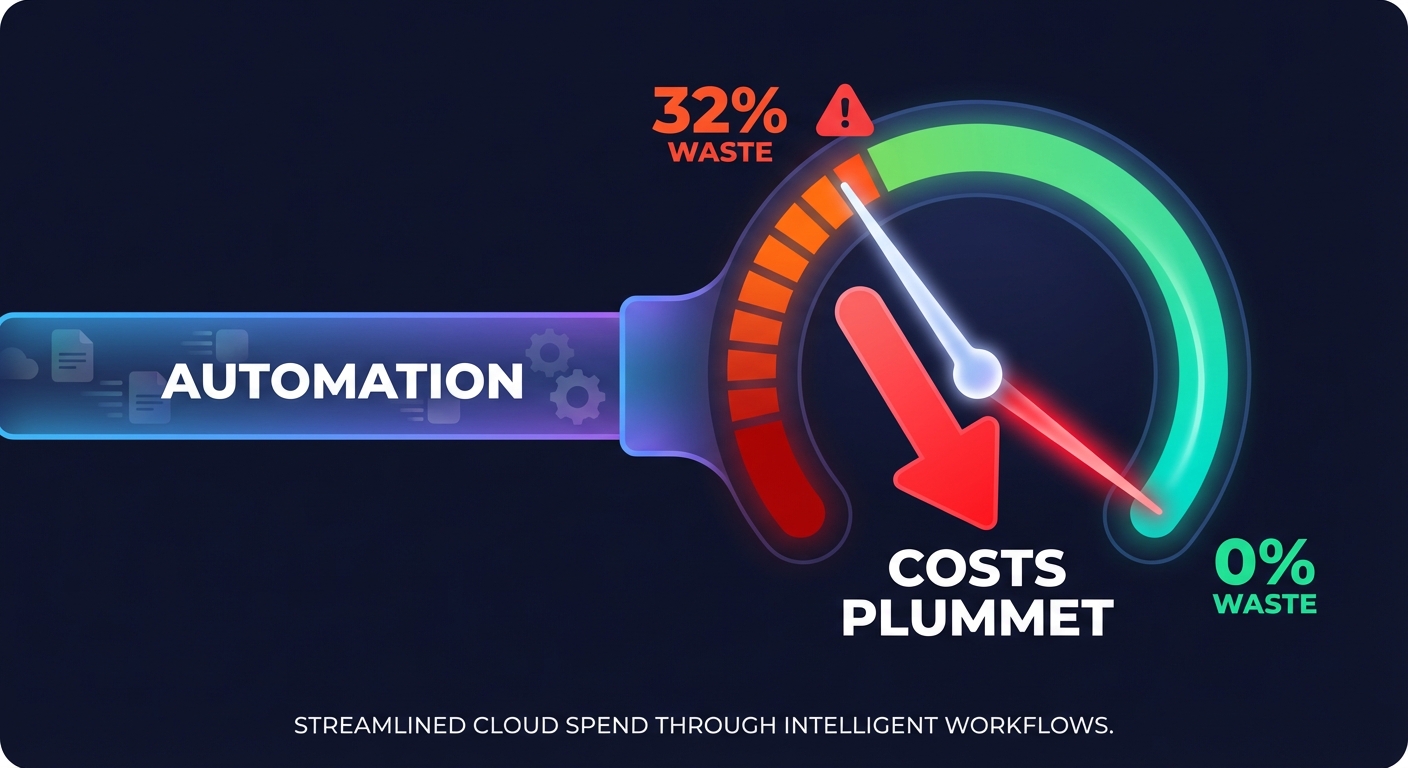
- Rate Optimization: Hykell manages a sophisticated mix of Savings Plans and Reserved Instances to boost your Effective Savings Rate to 50–70%+, often doubling what companies achieve through manual management.
- Zero Engineering Lift: The platform automates EBS and EC2 optimization, Graviton migrations, and Kubernetes efficiency without requiring code changes or infrastructure modifications.
- Pay-for-Performance: Hykell only takes a slice of the actual savings generated. If the platform does not save you money, you do not pay.
For leaders managing multi-cloud environments, Hykell handles the AWS portion of the estate so that internal teams can focus on higher-level architecture and governance across Azure and GCP.
Scaling your cloud cost governance
The most successful companies treat cloud cost optimization as a continuous journey. By implementing a formal cloud cost governance framework, you ensure that as your infrastructure scales, your waste does not scale with it. This framework should include clear policies for provisioning, automated controls for budget enforcement, and a culture of accountability.
The best way to begin is by conducting a cloud cost audit to establish your financial baseline. By identifying your biggest zombie resources, enforcing tagging policies, and automating commitment management, you can consistently reduce your AWS spend by up to 40% while maintaining peak performance. Effective multi-cloud management is about more than just monitoring; it is about building an environment that optimizes itself.