Are you paying for “ghost” capacity during your slow months or getting hit with massive On-Demand bills during peak season? For businesses with seasonal workloads, AWS Savings Plans offer a powerful discount, but their rigid hourly mechanics often lead to expensive surprises during usage bursts. Understanding how these plans interact with your architecture is the first step toward effective cloud financial management.
The hourly “use it or lose it” mechanic
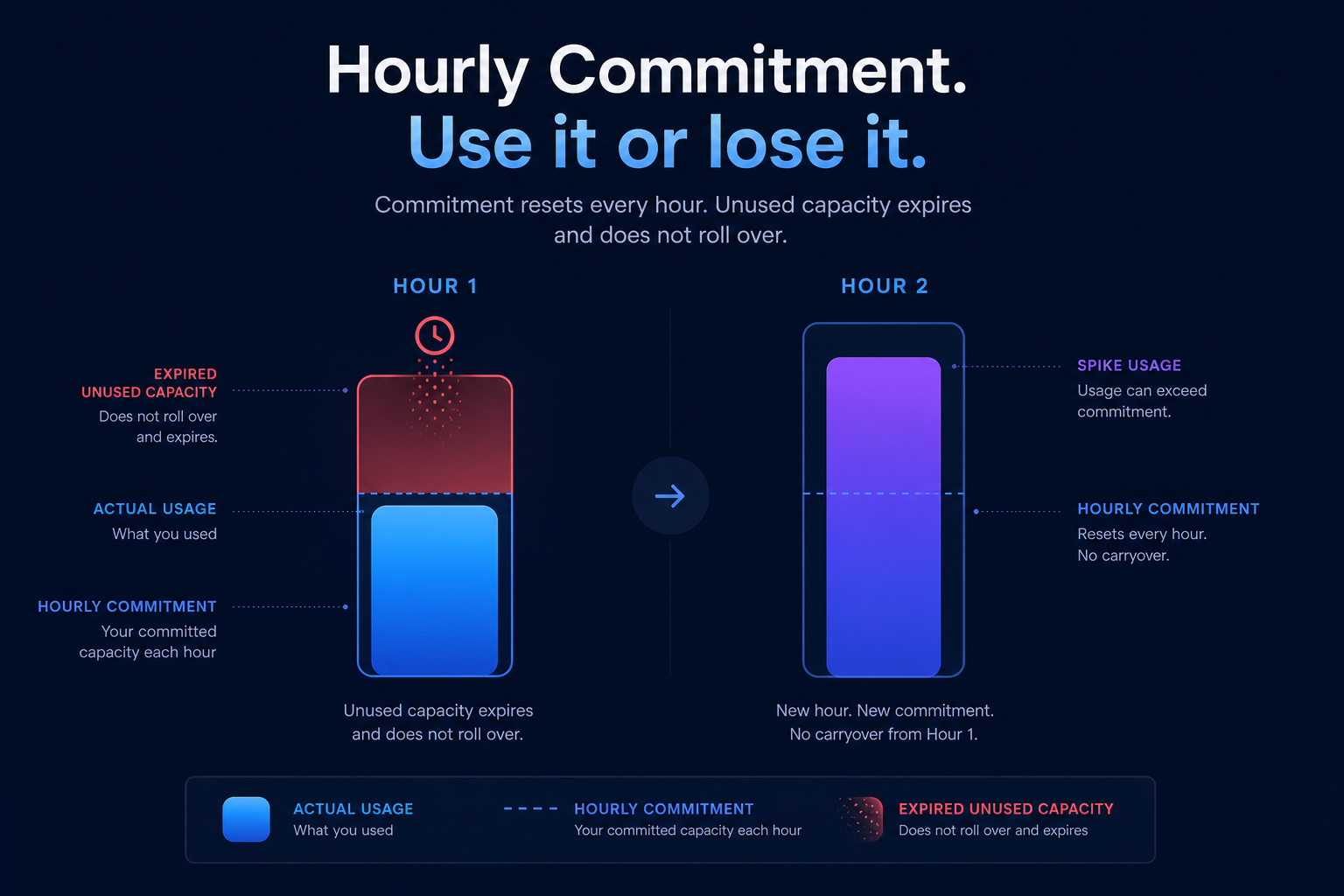
The most critical factor to understand about AWS Savings Plans is that they operate on a strictly hourly granularity. When you commit to a specific dollar amount per hour, AWS applies that discount to your eligible usage until the commitment is exhausted for that specific sixty-minute window.
However, if your usage drops below your committed level – which is common during off-peak hours or seasonal lulls – you still pay the full commitment price. According to AWS documentation on applying Savings Plans, you cannot carry over unused commitment from one hour to offset a spike in the next. This “use it or lose it” structure means that overcommitting during a seasonal dip effectively erases the financial benefits of the plan, as you are paying for capacity that sits idle.
How overage billing works during spikes
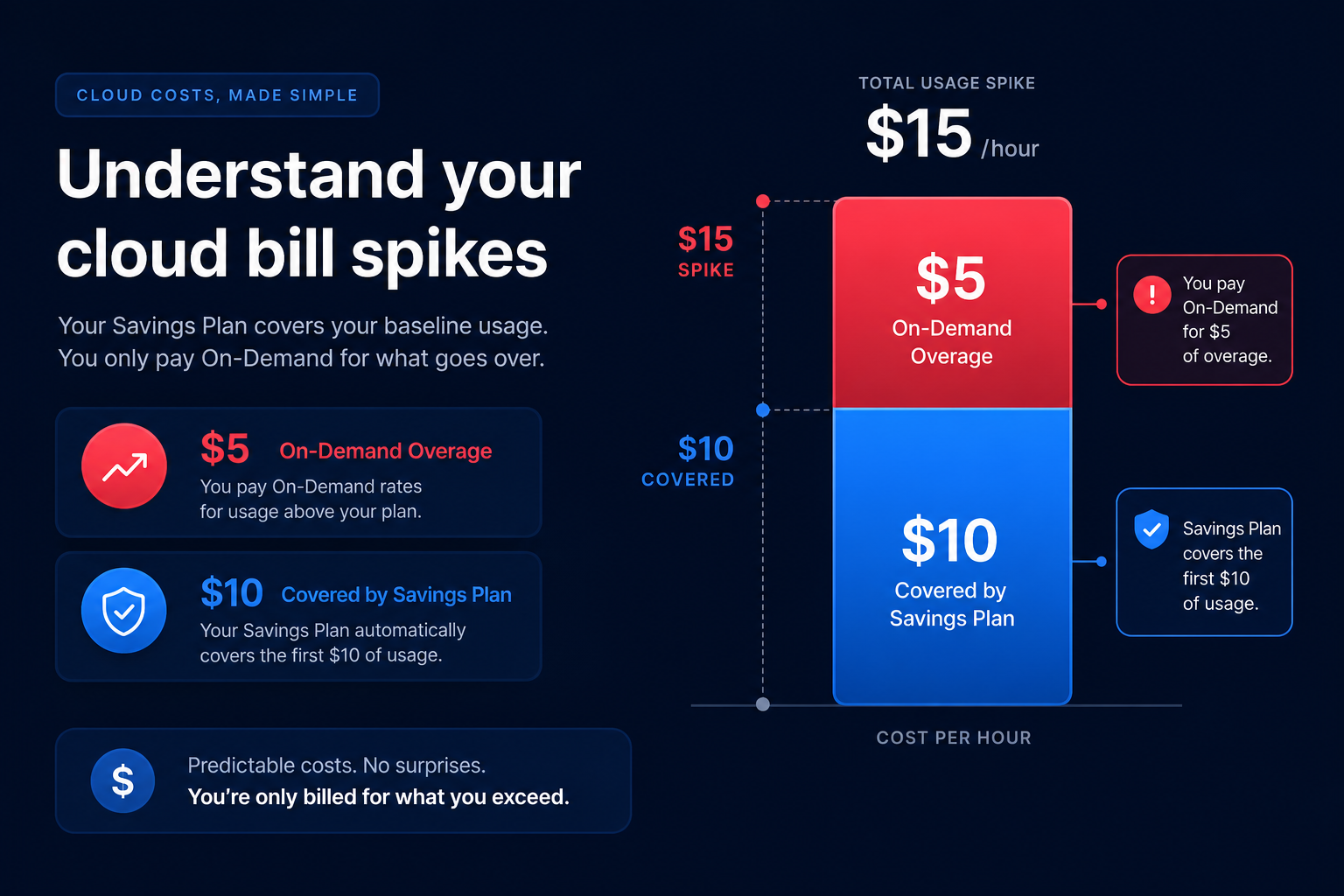
When your workload spikes beyond your hourly commitment – whether due to a holiday sale, a product launch, or a scheduled batch processing job – AWS bills the excess usage at the standard On-Demand rate. This can lead to significant cost volatility if your baseline commitment is too conservative.
For example, if you commit to $10 per hour but your usage spikes to $15 per hour during a peak afternoon, only the first $10 of that usage receives the Savings Plan discount. Since these plans can offer savings up to 72% compared to On-Demand pricing, that $5 overage is significantly more expensive than the covered portion. AWS specifically designs its internal recommendations to leave some room for On-Demand spend to avoid the trap of paying for idle capacity during non-peak hours, but this often leaves money on the table during high-traffic events.
Strategies for optimizing seasonal workloads
Managing seasonal volatility requires a departure from a “set it and forget it” mentality. Relying on AWS Savings Plan recommendations based on a 30- or 60-day historical lookback might give you an accurate average, but it rarely accounts for the sharp, temporary peaks of a seasonal business. To maintain efficiency, you must look at broader organizational patterns and more flexible commitment types.
Leverage payer account aggregation
If your organization uses AWS Organizations, you should manage your Savings Plans at the payer account level. This strategy allows usage patterns from different linked accounts to offset one another. If one department is in a seasonal lull while another is peaking, the Savings Plan discount dynamically floats to the highest-priority usage across the entire organization. This centralized approach maximizes your utilization and ensures that a spike in one area is covered by the commitment that would otherwise go unused elsewhere.
The 70-80% coverage rule
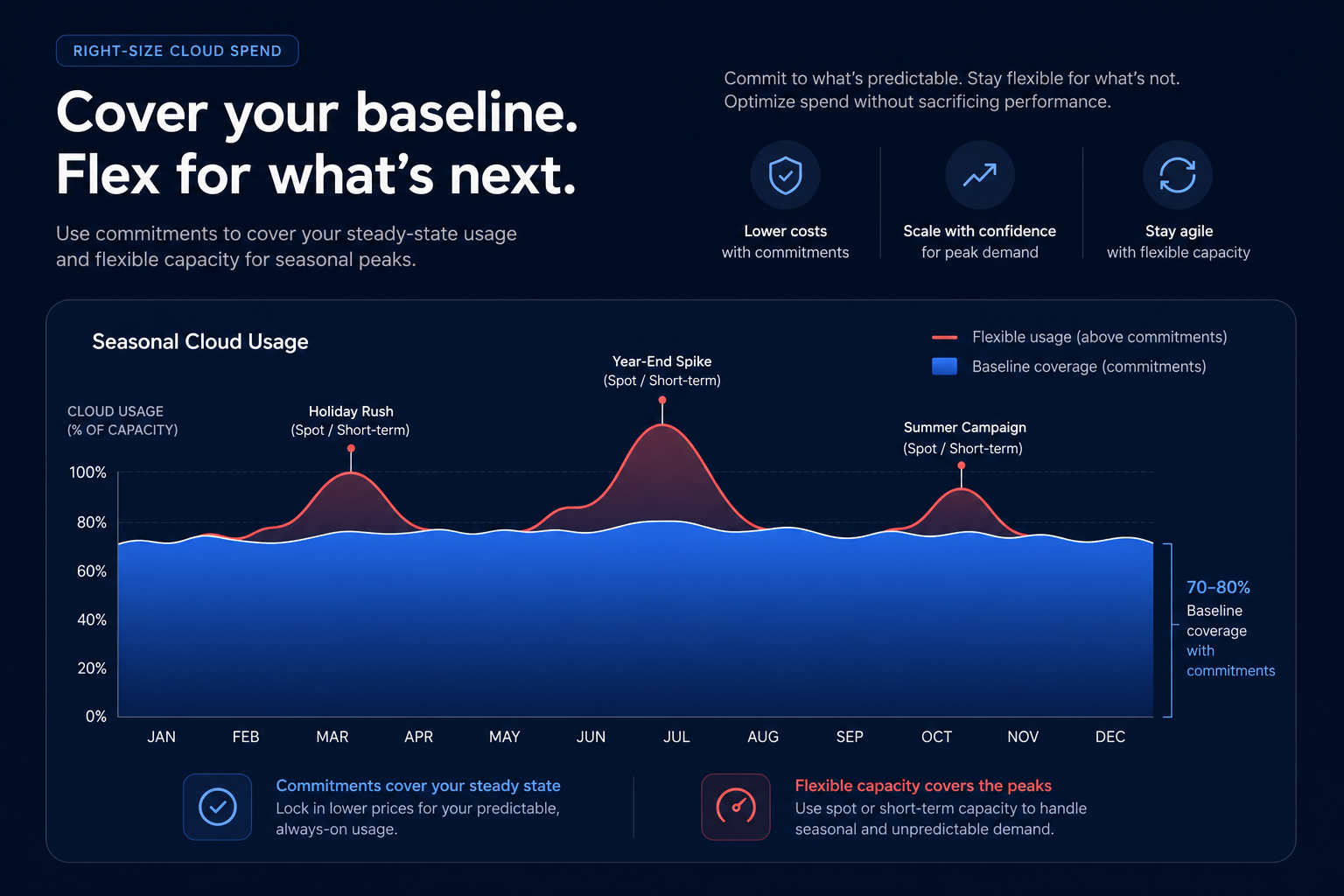
For highly variable environments, the most effective strategy is often to cover only your “floor” – the minimum amount of compute you use 24/7. Most AWS reserved instance planning guides suggest targeting 70–80% coverage of your steady-state baseline. You can then handle seasonal spikes using a mix of Spot Instances for interruptible tasks or short-term commitments to bridge the gap during peak months. This prevents you from locking into a high commitment that becomes a liability when traffic subsides.
AI-driven rate optimization
The challenge with manual management is that human teams cannot adjust commitments fast enough to match shifting telemetry and seasonal cycles. This is where Hykell changes the equation. By utilizing AWS rate optimization powered by AI, you can forecast usage curves based on both historical and real-time data.
Hykell applies an algorithmic mix of Savings Plans and Convertible Reserved Instances to ensure you stay covered during spikes without being locked into expensive, underutilized commitments when the season ends. This proactive management allows your infrastructure to scale financially as it scales technically, providing the deep discounts of long-term commitments with the flexibility of a pay-as-you-go model.
Stop guessing and start saving
Navigating the trade-off between flexibility and deep discounts doesn’t have to be a manual engineering burden. While AWS Savings Plans provide the foundation for cost reduction, maximizing their value requires active portfolio management that reacts to your business cycles in real-time. Without constant monitoring, you risk either overpaying for idle capacity or being punished by On-Demand rates during your most successful business periods.
Hykell helps businesses reduce their AWS compute costs by up to 40% on autopilot. We dive deep into your infrastructure to uncover hidden savings and manage your commitments so you never pay for capacity you aren’t using. We only take a slice of what you save – if you don’t save, you don’t pay.
Find out exactly how much you can shave off your next bill with the Hykell AWS Savings Plan calculator.