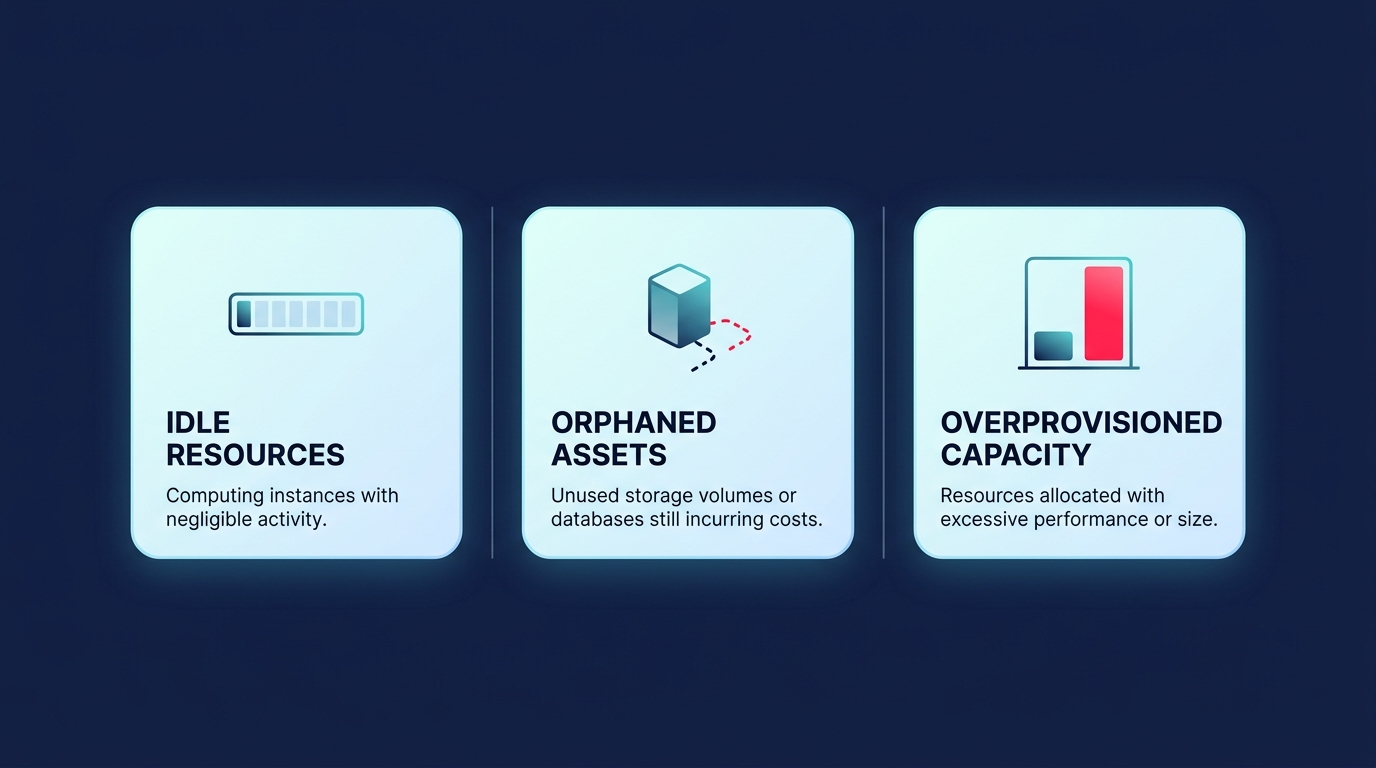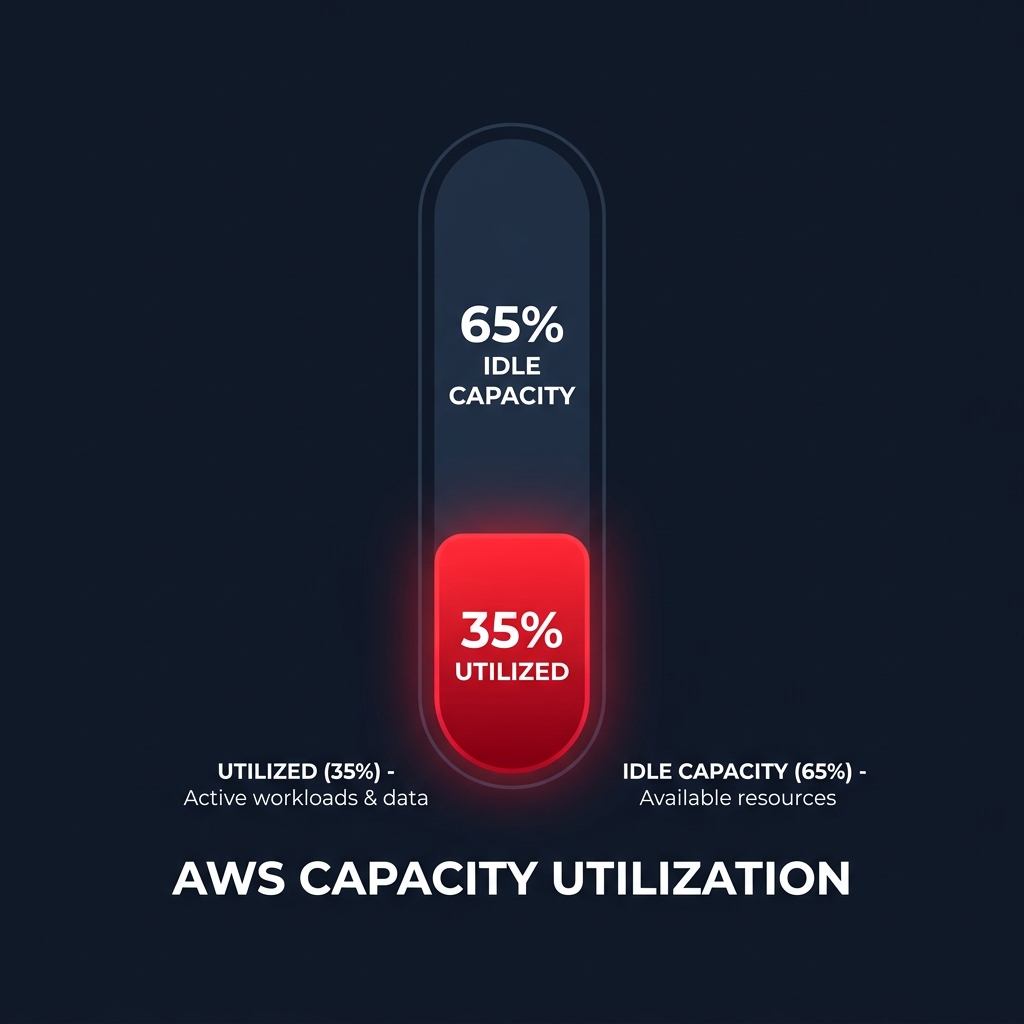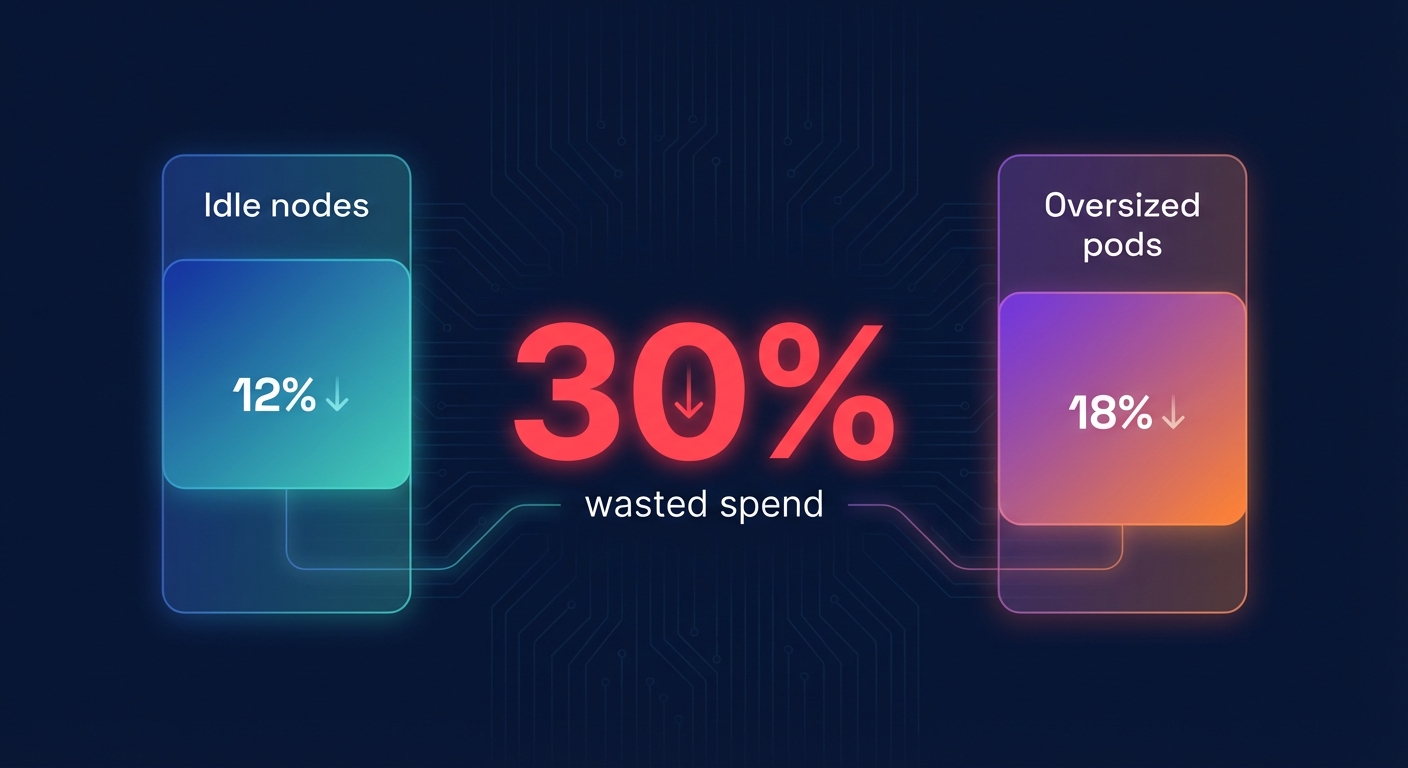
Did you know that idle nodes and oversized pods quietly account for up to 30% of your total cloud spend? While Amazon EKS provides the elasticity your microservices need, this flexibility often comes with a “hidden tax” that erodes your margins.
Unmasking the hidden costs of Kubernetes on AWS
Managing costs at the cluster level appears straightforward, but granular visibility into pod, namespace, and label-level spending is where most platform leaders struggle. Without this “financial X-ray,” idle resources can accumulate unnoticed. Beyond the standard $0.10 per hour cluster control plane fee, the real expenses hide within the data plane. Effective Kubernetes cost monitoring requires you to look past the surface-level bill to identify where over-provisioning occurs.
A comprehensive approach to Kubernetes optimization on AWS requires balancing compute, storage, and networking costs. For example, cross-AZ data transfer and load balancer fees can rival compute costs if left unchecked. You must ensure your scaling strategies do not introduce “scaling lag,” where delays in provisioning nodes lead to dropped requests or degraded user experiences.
Rightsizing pods and nodes for maximum density
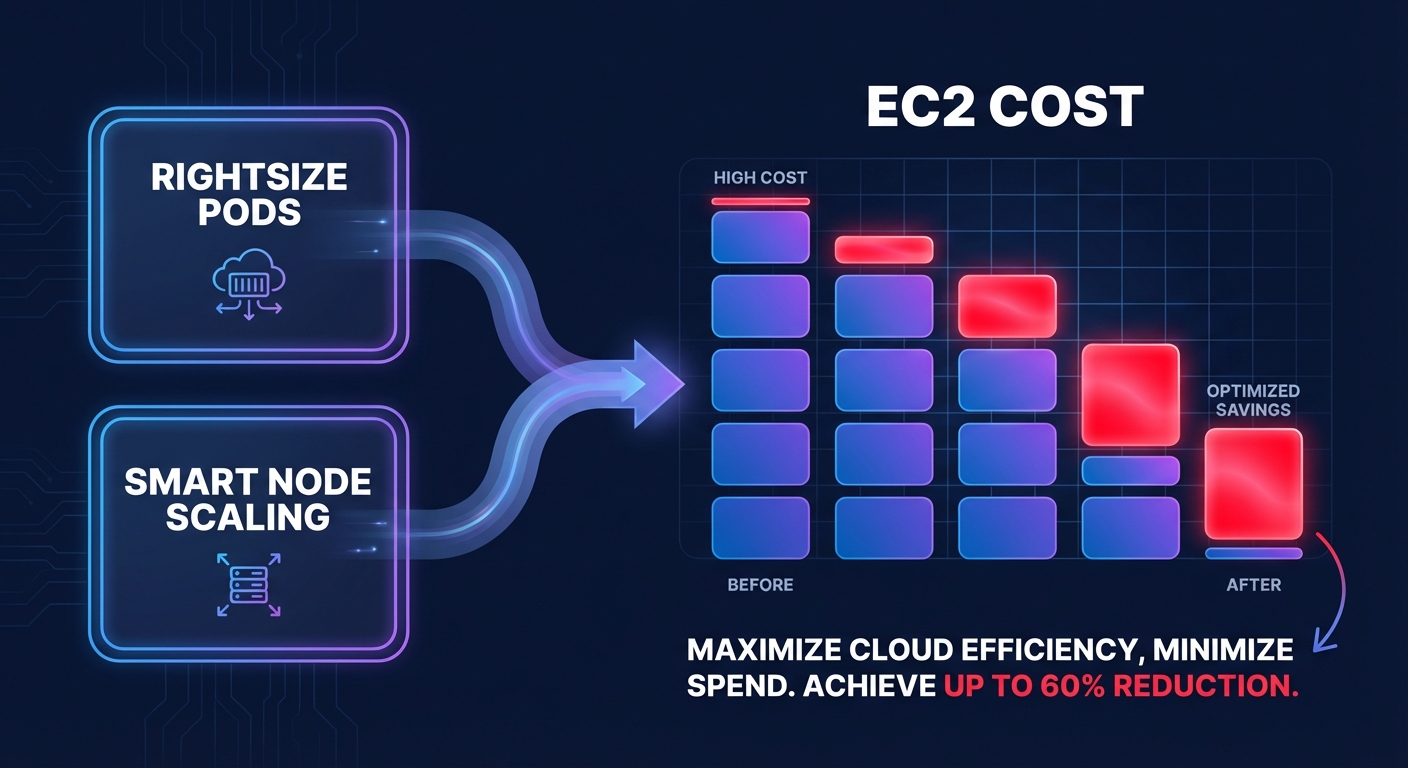
Manual rightsizing is a losing battle because workload demands shift constantly. Engineers naturally lean toward 30–50% “safety buffers” to avoid Out of Memory (OOM) kills, yet automated AWS rightsizing for pods can reduce EC2 costs by 20–40% without sacrificing performance. To achieve maximum density, you must align your pod resource requests with actual historical usage rather than theoretical peaks.
While tools like the Vertical Pod Autoscaler (VPA) provide resource recommendations, the most significant gains come from intelligent node scaling. By accelerating Kubernetes scaling strategies with tools like Karpenter, you can provision the most cost-effective instance types in real-time. This often leads to a 15% reduction in overall node count through more efficient bin-packing, ensuring you only pay for the compute you actually use.
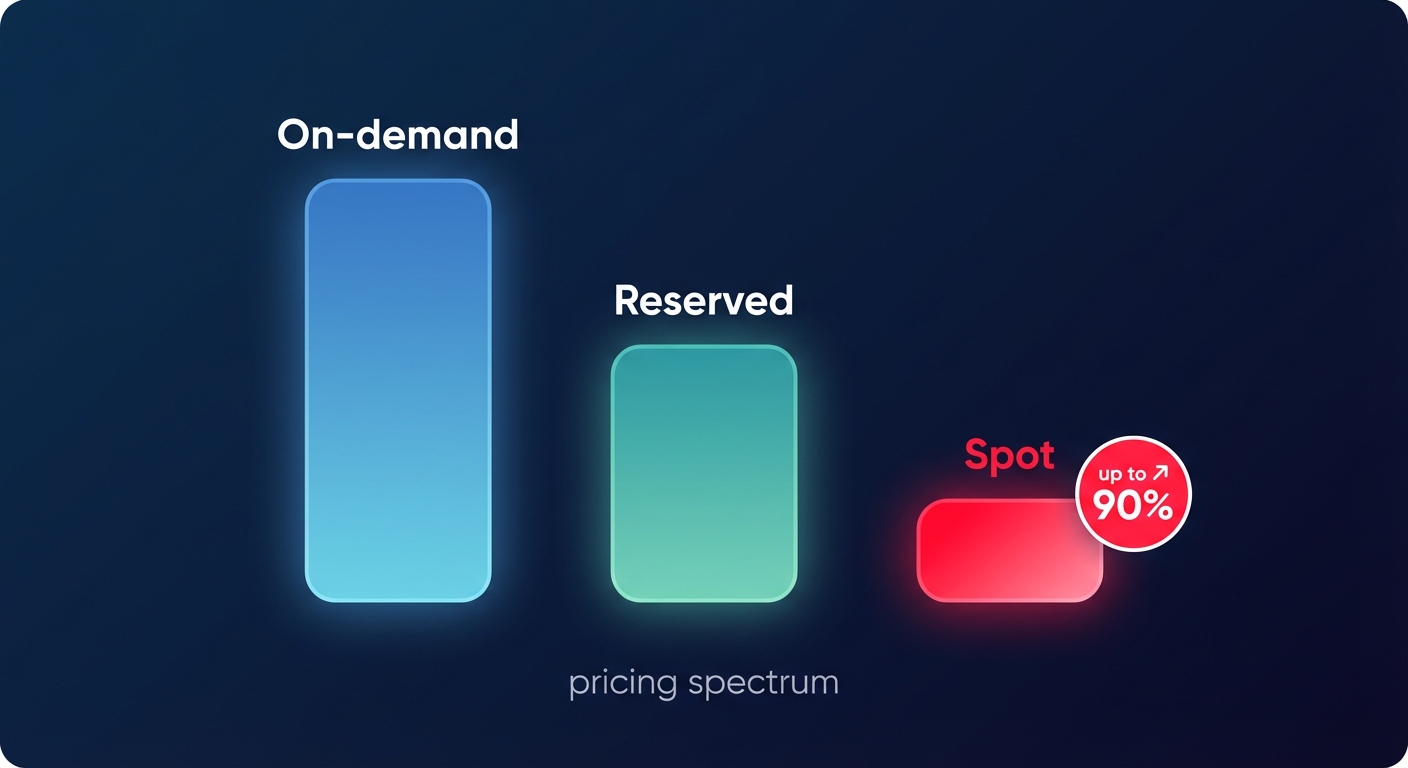
Navigating the AWS pricing spectrum
A mature EKS cost management strategy uses a hybrid approach to compute. You should aim to cover 60–80% of your baseline capacity with Savings Plans or Reserved Instances to secure discounts of up to 72%. For variable or interruptible loads, Spot instance vs Reserved Instance comparisons show that Spot instances offer up to 90% savings compared to on-demand pricing.
Spot instances are ideal for fault-tolerant batch processing or stateless microservices. For instance, a data analytics company achieved a 65% reduction in compute costs by migrating non-critical workloads to Spot. For critical path services, you can migrate from x86 to AWS Graviton instances, which typically offer 40% better price-performance and roughly 20% lower hourly costs than their Intel or AMD counterparts.
Achieving granular visibility and financial accountability
You cannot optimize what you cannot measure. Many organizations suffer from “unallocated” spend because they lack a robust tagging and cost attribution strategy. By deploying Kubecost on Amazon EKS, you can break down expenses by namespace and deployment, which is the first step toward implementing cloud chargeback and showback strategies.
This visibility transforms cloud spend from a centralized infrastructure cost into a departmental responsibility. When teams see that a specific microservice drives 40% of cross-AZ data transfer charges, they are incentivized to refactor for efficiency. AWS now supports importing up to 50 Kubernetes custom labels per pod into your Cost and Usage Reports (CUR), providing the necessary data to reconcile EKS spend with your broader AWS bill.
Orchestrating the optimization lifecycle with Hykell
The primary challenge for most enterprise leaders is not a lack of data, but a lack of engineering bandwidth to act on it. This is where Hykell fits into a modern Kubernetes cost management stack. While monitoring tools provide visibility, Hykell provides automated execution. We handle the complex task of AWS rate optimization, managing your portfolio of Savings Plans and Reserved Instances to ensure high coverage without the risk of over-commitment.
By combining pod rightsizing, intelligent node scaling, and automated EBS volume tuning, Hykell customers typically see significant results. For example:
- A SaaS company reduced Kubernetes spend by 42% in just four weeks.
- An e-commerce retailer cut monthly EKS costs by 66% through node consolidation and Spot integration.
- Organizations regularly reduce their total AWS bill by up to 40% without compromising performance.
Our implementation takes days rather than months and requires zero code changes from your DevOps team. Because Hykell operates on a pay-for-performance model – we only take a slice of the actual savings generated – it provides a risk-free path to scaling your infrastructure efficiently. Stop guessing your resource limits and start reclaiming your budget. Use our cloud cost calculator to see exactly how much you could save on AWS today.