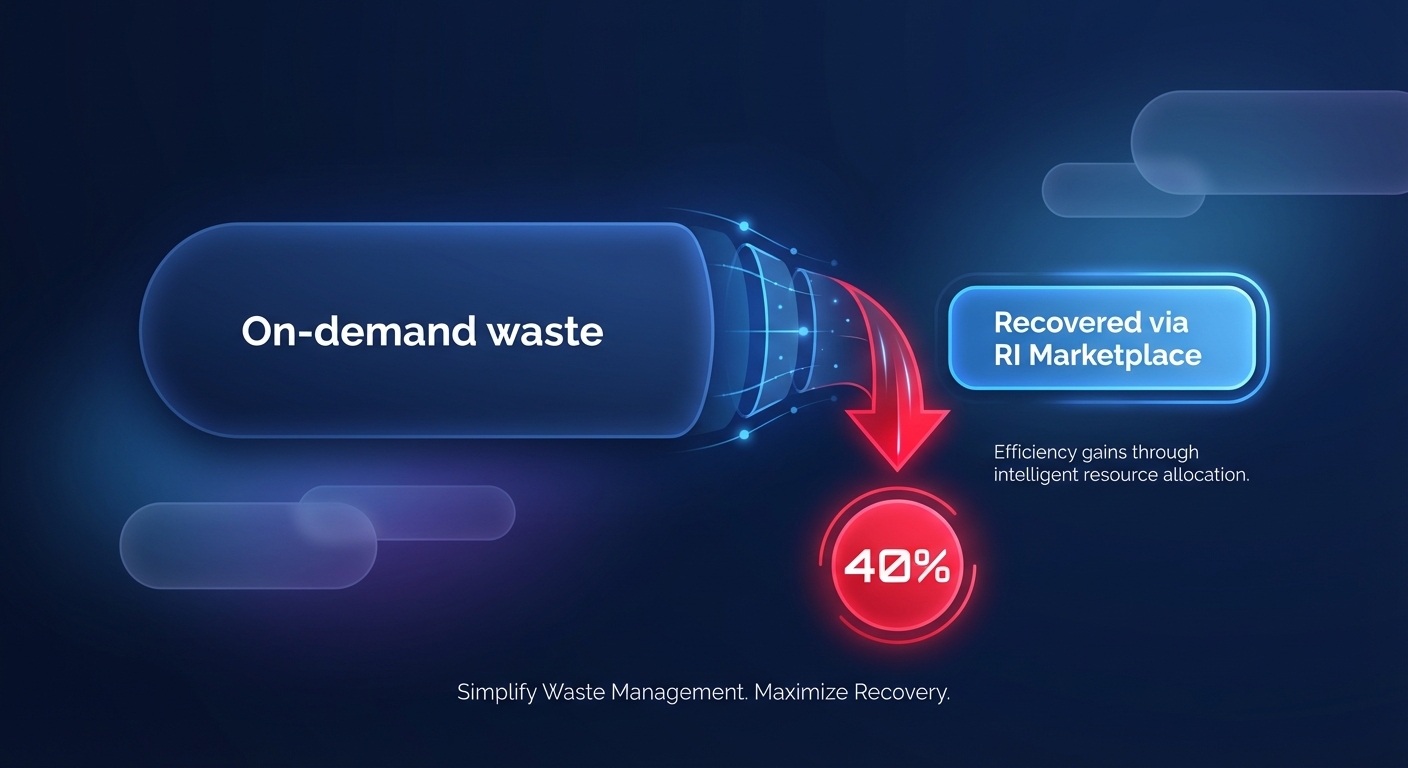
Are you bleeding cash on “stranded” Reserved Instances after a migration? The AWS EC2 Reserved Instance Marketplace lets you recoup those costs or buy short-term capacity at deep discounts, but strict rules and 12% fees make manual trading a minefield.
Understanding the secondary market for EC2 capacity
The AWS Reserved Instance Marketplace acts as a secondary exchange where you can list unwanted Standard Reserved Instances (RIs) for sale to other AWS users. For engineering leaders, this platform serves as a vital liquidity exit when infrastructure shifts leave your pre-purchased capacity misaligned with actual usage. Beyond offloading waste, it also functions as a specialized sourcing tool. While direct purchases from AWS usually require one-year or three-year terms, the marketplace allows you to acquire RIs with as little as one month remaining.
This flexibility is particularly useful for temporary project spikes or transition periods where a full AWS Savings Plans commitment would be overkill. However, the marketplace has narrow boundaries. It only supports Standard EC2 Reserved Instances; you cannot use it to trade Convertible RIs, Savings Plans, or commitments for other services like RDS.
Strict rules for marketplace participants
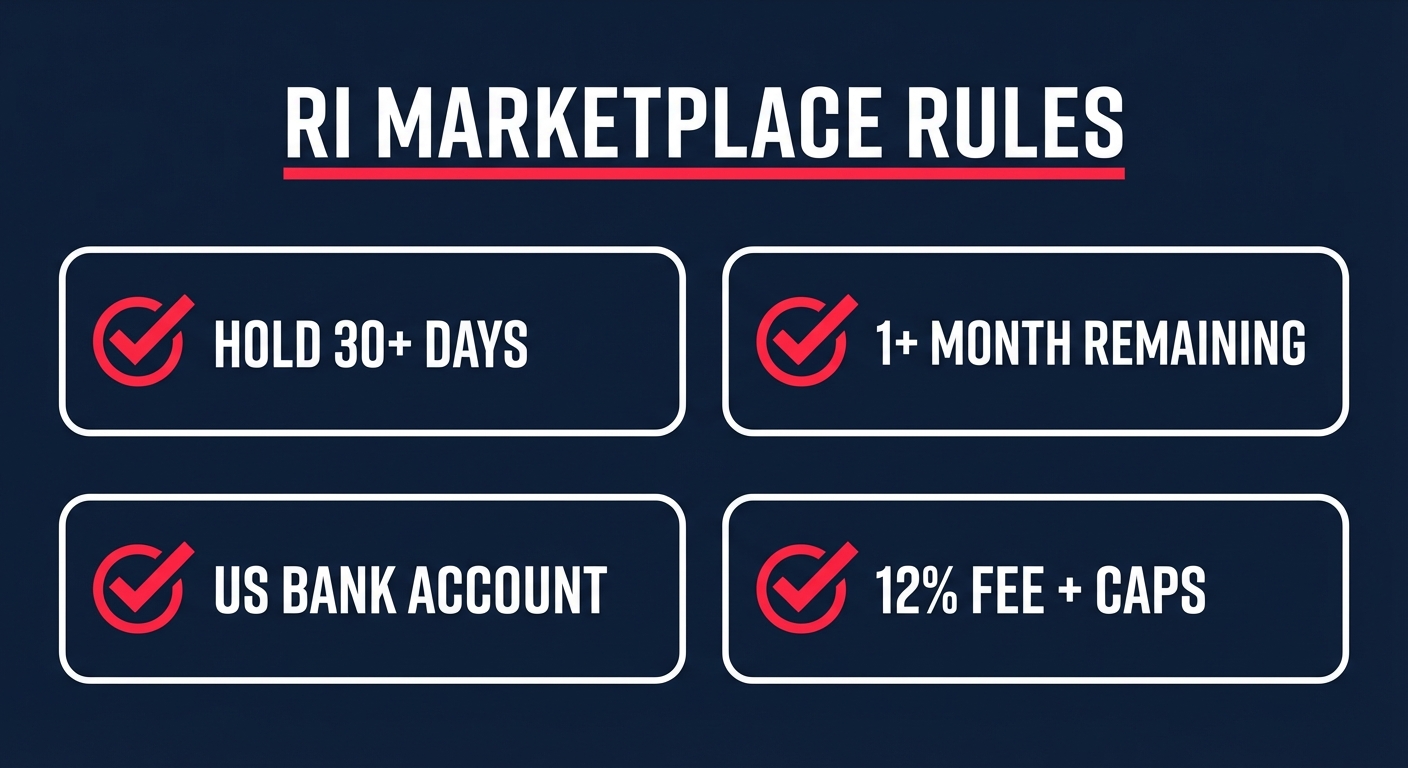
Navigating this secondary market requires adherence to specific eligibility criteria and AWS limitations on sellers. To list an RI, you must have held it for at least 30 days, and it must have at least one month left on its term. A significant operational hurdle for global organizations is the requirement for a US bank account to receive sale proceeds. Additionally, AWS imposes a lifetime selling cap of $50,000 or 5,000 RIs per account. If your organization operates a massive footprint, this limit makes manual trading a poor long-term strategy for AWS RI management.
Policy changes in early 2024 have further tightened the marketplace. As of January 15, 2024, AWS no longer permits the resale of any Reserved Instance that was originally purchased through the marketplace. Furthermore, new policy updates prohibit customers enrolled in the Enterprise Discount Program (EDP) from selling discounted RIs. These restrictions mean the marketplace is increasingly reserved for standard, non-discounted commitments, requiring more precision during the initial procurement phase.
How to sell your unused Reserved Instances
If auditing Reserved Instance utilization reveals that your Standard RIs are sitting idle, you can list them via the EC2 console under the “Reserved Instances” section. As a seller, you only control the upfront price. The recurring hourly rate and the instance configuration – such as the family and region – remain identical to your original purchase. When setting your price, remember that AWS rounds the remaining term down to the nearest month, which can slightly reduce the recovery value of your listing.
The financial mechanics of the sale involve a 12% service fee taken by AWS from the total upfront price. Once a buyer completes the purchase, ownership transfers immediately, and your proceeds are typically distributed via ACH within three to five business days. Because these sales are final and cannot be reversed, it is essential that your AWS EC2 cost optimization roadmap confirms the capacity is no longer needed before you hit the sell button.
Buying from the marketplace for short-term savings
Purchasing from the marketplace is one of the fastest ways to layer AWS discounts onto your bill without a multi-year lock-in. When you search for RIs in the AWS console and filter for the marketplace, the system automatically matches you with the lowest available upfront price from third-party sellers. This allows you to secure deep discounts on “steady-state” workloads that might only exist for six to nine months, such as a legacy application in its final decommissioning phase.
The billing benefits apply to your account immediately after the purchase is confirmed. Because the RI specifications – instance type, region, and platform – must match your running instances exactly, no restart or downtime is required for the discount to take effect. However, buyers should proceed with caution regarding architectural changes. Since marketplace-bought RIs cannot be resold, you must be certain the workload will remain stable for the remainder of the purchased term.
Why manual marketplace trading is a FinOps risk
While the marketplace offers a tactical escape hatch, relying on manual trading creates an operational burden that often leads to “analysis paralysis.” Many teams spend weeks debating whether to sell a commitment, inadvertently paying more in on-demand “waste tax” during the delay than they would have lost through the 12% seller fee. Effective AWS rate optimization requires a more dynamic approach than occasional manual intervention.
A truly resilient strategy involves a blend of instruments. You might use Compute Savings Plans for broad flexibility across your evolving containerized workloads while using the marketplace to pick up cheap, localized Standard RIs for static database instances. When managed manually, this balancing act is prone to human error, resulting in either over-commitment or missed savings opportunities.
Automate your commitment strategy with Hykell
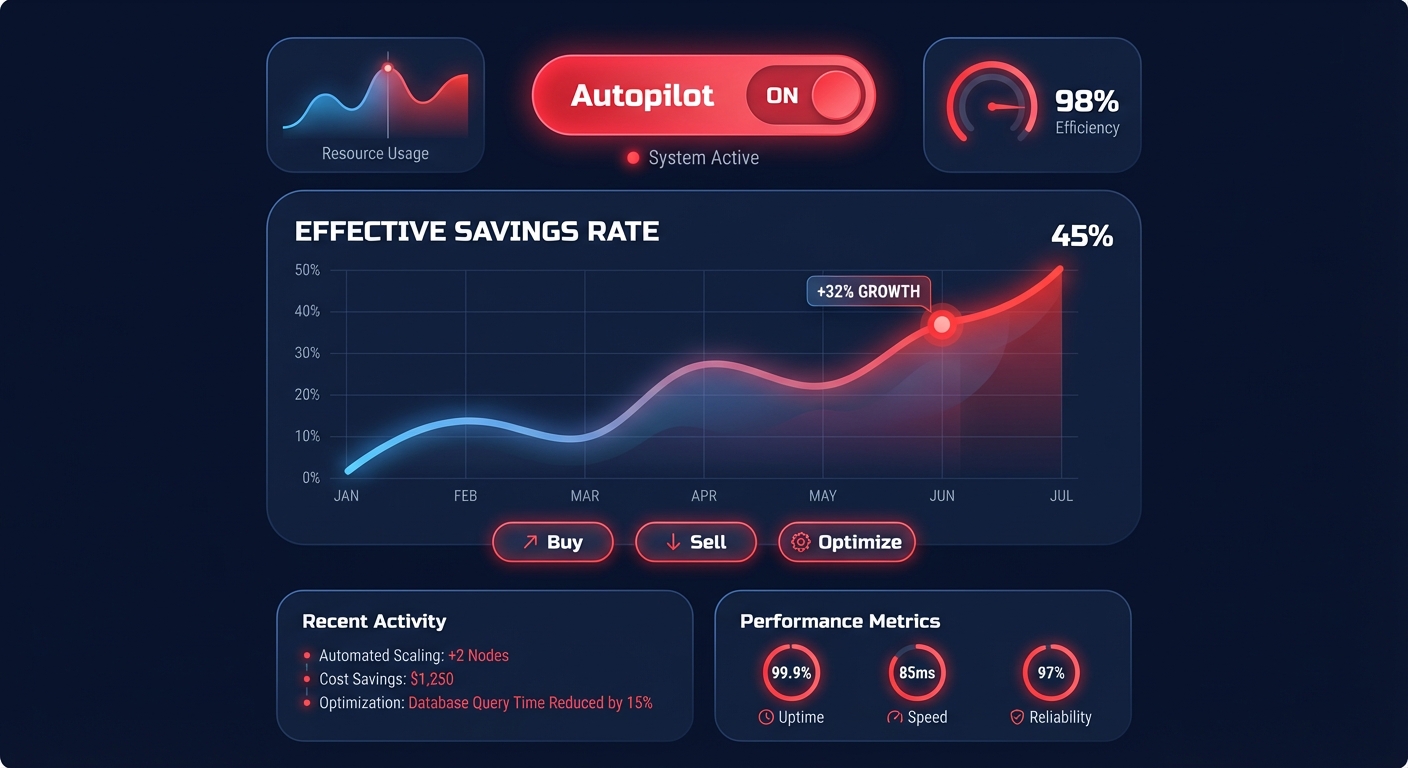
Hykell removes the complexity and engineering effort from managing the RI Marketplace. Our platform operates on autopilot, continuously monitoring your infrastructure and identifying the perfect moments to buy, sell, or convert commitments. By leveraging AI to manage a sophisticated mix of Savings Plans and Reserved Instances, Hykell helps you achieve an Effective Savings Rate that often doubles the results of manual management.
Modern cloud environments change too fast for manual spreadsheets. Hykell’s automated cloud cost optimization ensures you are never stuck with “stranded” capacity by proactively exiting inefficient positions and reallocating your budget toward the highest-performing instruments. We operate on a pure performance-based model, meaning we only get paid when we save you money.
Calculate your potential AWS savings with Hykell today and transform your cloud commitments from a liability into a strategic advantage.