Are you still paying premium S3 Standard rates for data your team hasn’t touched in months? Defaulting to the most expensive tier is a common “cloud tax” that drains your budget. You can slash these costs by over 50% by automating how data moves through S3.
The high cost of default storage settings
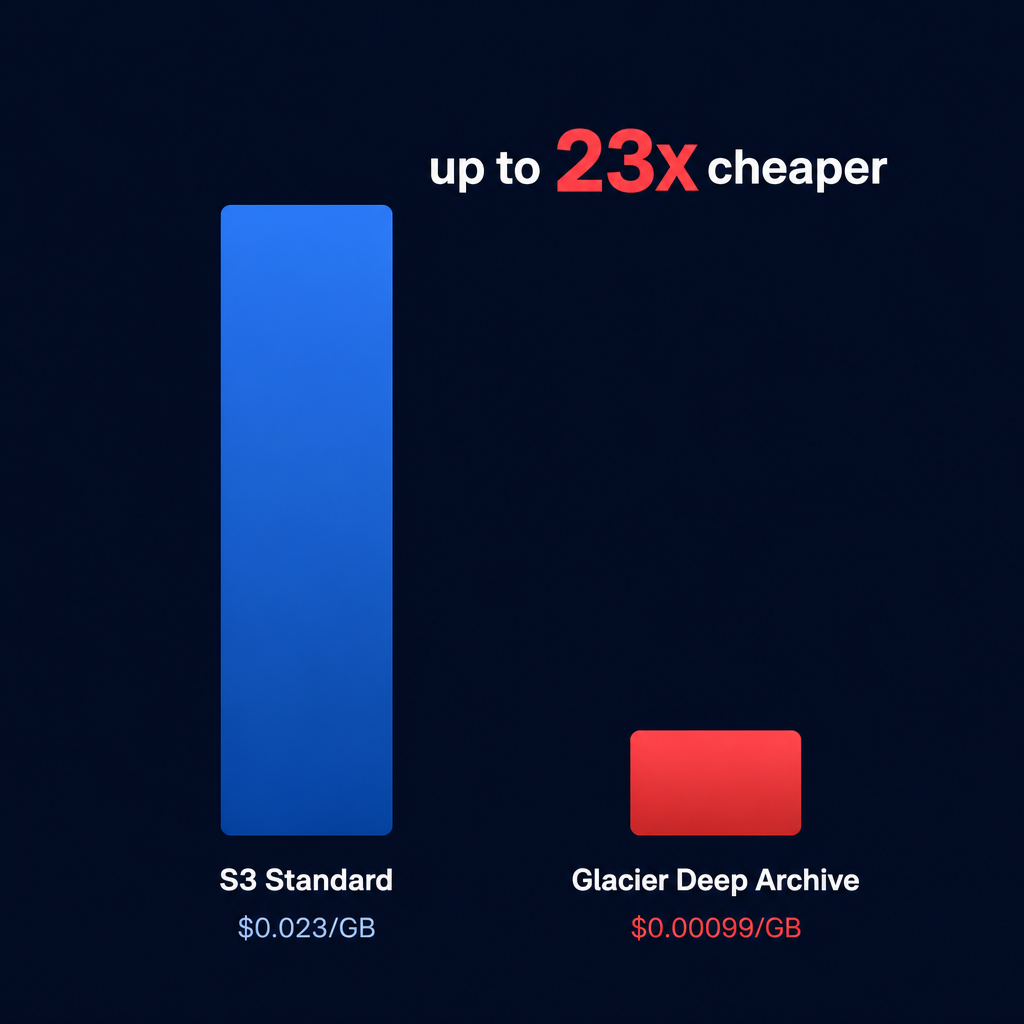
Defaulting every object to S3 Standard is one of the most common ways to inflate your cloud spend. While S3 Standard offers high durability and low latency, it is also the most expensive tier, starting at approximately $0.023 per GB in regions like US-East-1. By contrast, choosing different AWS S3 storage classes can offer dramatic savings. S3 Glacier Deep Archive costs just $0.00099 per GB, making it roughly 23 times cheaper for long-term retention.
The challenge for most DevOps teams is that manually moving millions of objects between tiers is a massive drain on resources. This is where AWS S3 lifecycle policies and Intelligent-Tiering become essential. These tools allow you to align your storage costs with actual data access patterns without requiring constant manual intervention from your engineering staff.
Automating transitions with S3 lifecycle policies
S3 lifecycle policies are sets of rules that automatically manage your objects over time. These policies can perform two primary actions: transitions and expirations. Transitions move objects to lower-cost storage classes based on their age, while expirations permanently delete objects once they are no longer needed.
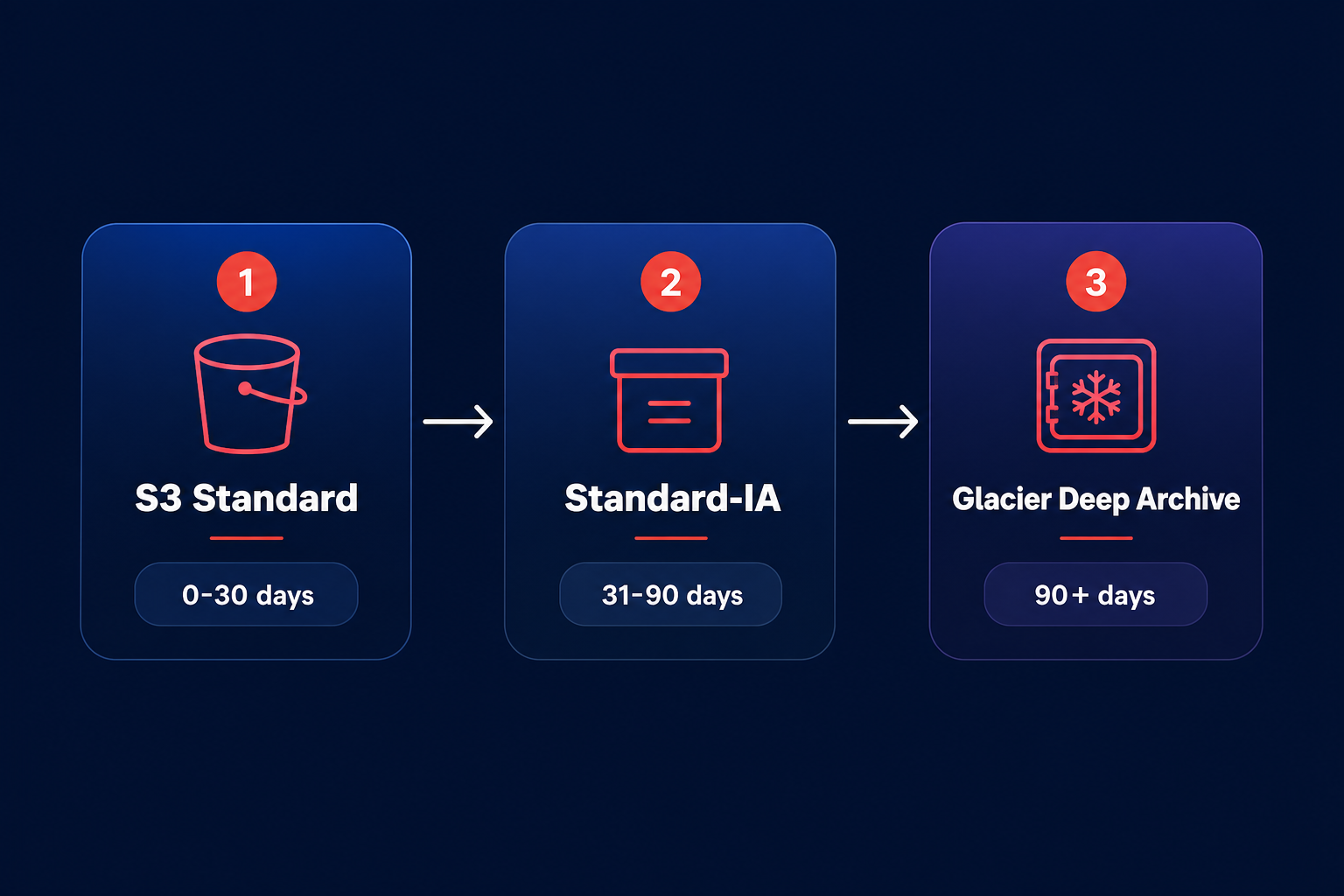
When configuring these rules, you must remember that AWS requires objects to remain in S3 for at least 30 days before they can transition to S3 Standard-IA or S3 One Zone-IA. For example, a common policy involves keeping logs in S3 Standard for 30 days, moving them to Standard-IA for the next 60 days, and finally archiving them in Glacier Deep Archive for long-term compliance.
Effective AWS cost management also involves managing noncurrent versions and incomplete multipart uploads. Incomplete uploads alone can account for 15–20% of S3 spend if left unchecked. A lifecycle rule that aborts these uploads after seven days can immediately trim waste from your monthly bill.
S3 Intelligent-Tiering for unpredictable access patterns
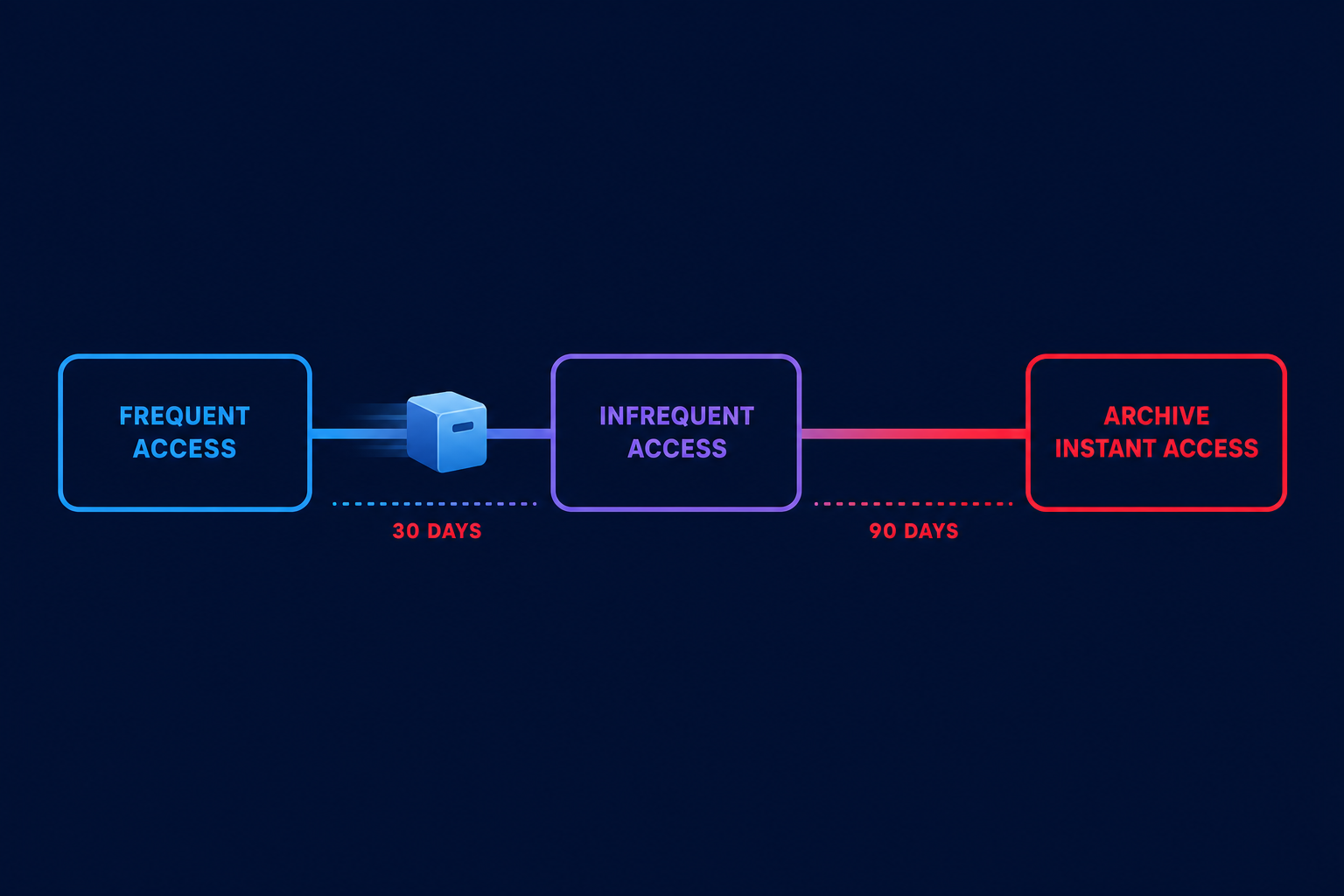
While lifecycle policies work best for data with predictable aging, S3 Intelligent-Tiering is designed for data with unknown or changing access patterns. This storage class automatically moves objects between Frequent, Infrequent, and Archive Instant Access tiers based on when they were last accessed.
Intelligent-Tiering is particularly powerful because it charges no retrieval fees and requires no tiering charges for movements within the class. After 30 consecutive days of no access, an object moves to the Infrequent Access tier; after 90 days, it moves to the Archive Instant Access tier. While there is a small monthly monitoring and automation fee per object, the savings for those who optimize AWS storage typically far outweigh this cost for larger datasets. This “set it and forget it” approach provides a reliable safety net against overspending on active storage tiers.
Strategic trade-offs and minimum durations
Optimizing your storage requires an understanding of the fine print regarding minimum storage durations. If you expire or delete data earlier than the required minimum – 30 days for Standard-IA, 90 days for Glacier Flexible Retrieval, or 180 days for Deep Archive – AWS will still charge you for the full duration.
Billing changes for lifecycle transitions happen as soon as an object becomes eligible, even if the physical movement occurs slightly later. Integrating these rules into a broader comparative cost strategy ensures that you aren’t just moving data for the sake of it, but are actually timing transitions to maximize your ROI.
Optimizing S3 on autopilot with Hykell
Manually auditing every bucket and configuring complex transition rules can still take hours of engineering time that startups and growing enterprises simply don’t have. Hykell provides a more efficient path by automating AWS rate optimization and infrastructure tuning.
Hykell’s platform operates on autopilot, identifying underutilized resources and misconfigured storage classes to reduce your AWS costs by up to 40%. Because we only take a slice of the actual savings we generate, there is no financial risk to your team. We handle the deep dive into your cloud costs so your DevOps team can focus on building products instead of managing storage tiers.
Ready to see how much you could be saving on your S3 bill? Use the Hykell savings calculator to discover your potential reduction in cloud spend today.