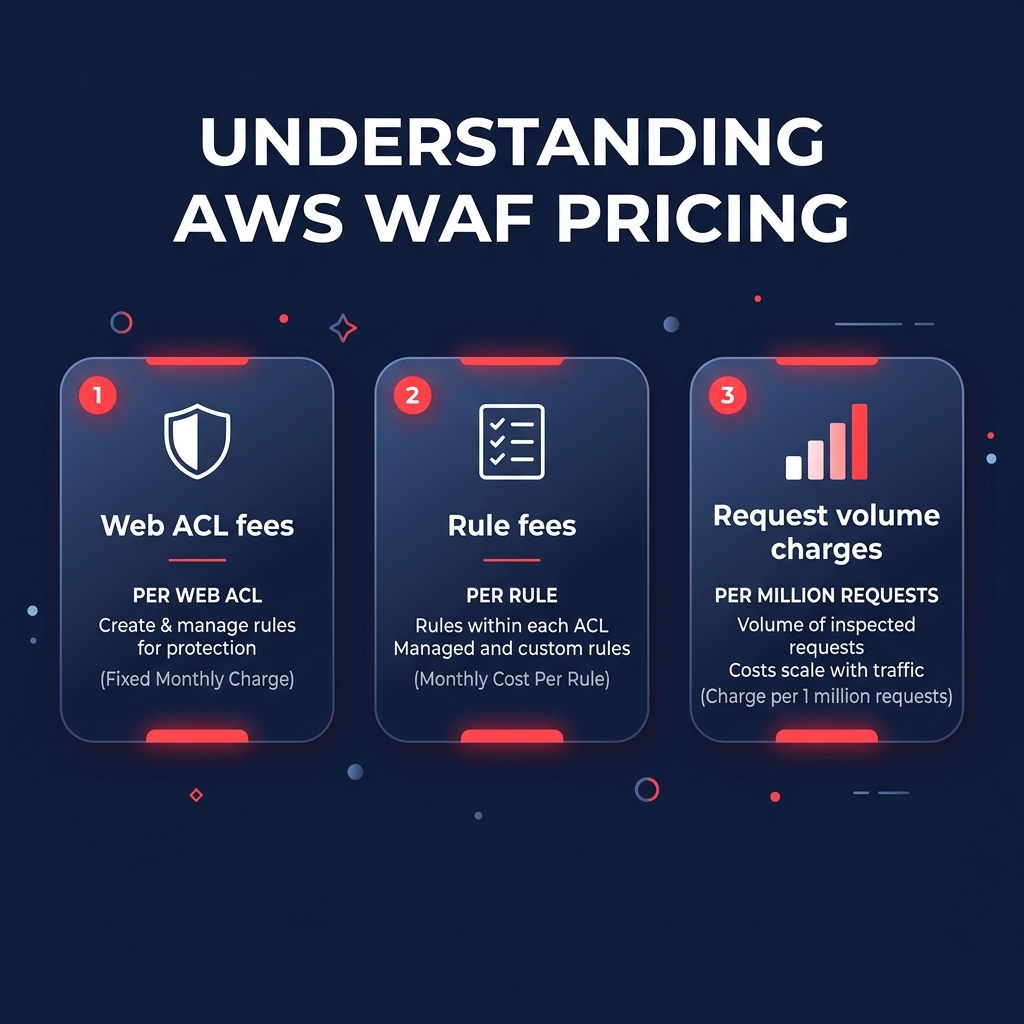
Is your security layer quietly inflating your AWS bill? While AWS WAF is essential for protecting your applications, its multi-layered pricing – from Web ACL fees to per-request charges – can lead to budget surprises. Understanding these components is the first step toward reclaiming your cloud budget.
Core components of AWS WAF pricing
AWS WAF (Web Application Firewall) charges are primarily driven by the number of resources you protect and the volume of traffic passing through them. Unlike services with a single flat fee, WAF costs are fragmented into three distinct pillars that scale based on your security posture and traffic patterns.
Web ACLs and rules
Every Web Access Control List (Web ACL) you create incurs a $5.00 monthly fee. Within each ACL, you pay $1.00 per month for every rule you implement. These charges are prorated hourly, meaning a rule active for only half a month costs $0.50. This structure applies to both custom rules you write and managed rule groups provided by AWS or third-party vendors.
Request processing
This is often the most significant variable in your monthly spend. AWS charges $0.60 per million requests processed by your Web ACL. While this rate appears low, high-traffic applications or environments experiencing volumetric attacks can see these costs scale rapidly. When estimating your expenses, it is vital to model your peak request volume rather than just your average daily traffic by using the AWS Pricing Calculator.
Managed rule groups
AWS provides standard managed rules, such as the Core Rule Set, for $1.00 per month. However, advanced protections introduce higher price points. Bot Control requires a $10.00 monthly subscription per Web ACL, plus tiered request fees ranging from $1.00 per million for common bots to $10.00 per million for targeted bots. Fraud Control features, like Account Takeover Prevention (ATP), also carry a $10.00 monthly subscription, but per-request fees can range significantly from $50.00 to $1,000.00 per million based on risk scores and inspection depth.
Hidden cost drivers in AWS WAF
Beyond headline rates, several technical factors can drive up your spend. One frequent culprit is Web ACL Capacity Units (WCU) overages. By default, an ACL has a limit of 1,500 WCUs. If you implement complex rule sets that exceed this threshold, AWS charges an additional $0.20 per million requests for every 500 WCUs beyond the limit. Similarly, deep body inspections beyond the default 16KB can add $0.30 per million requests to your bill.
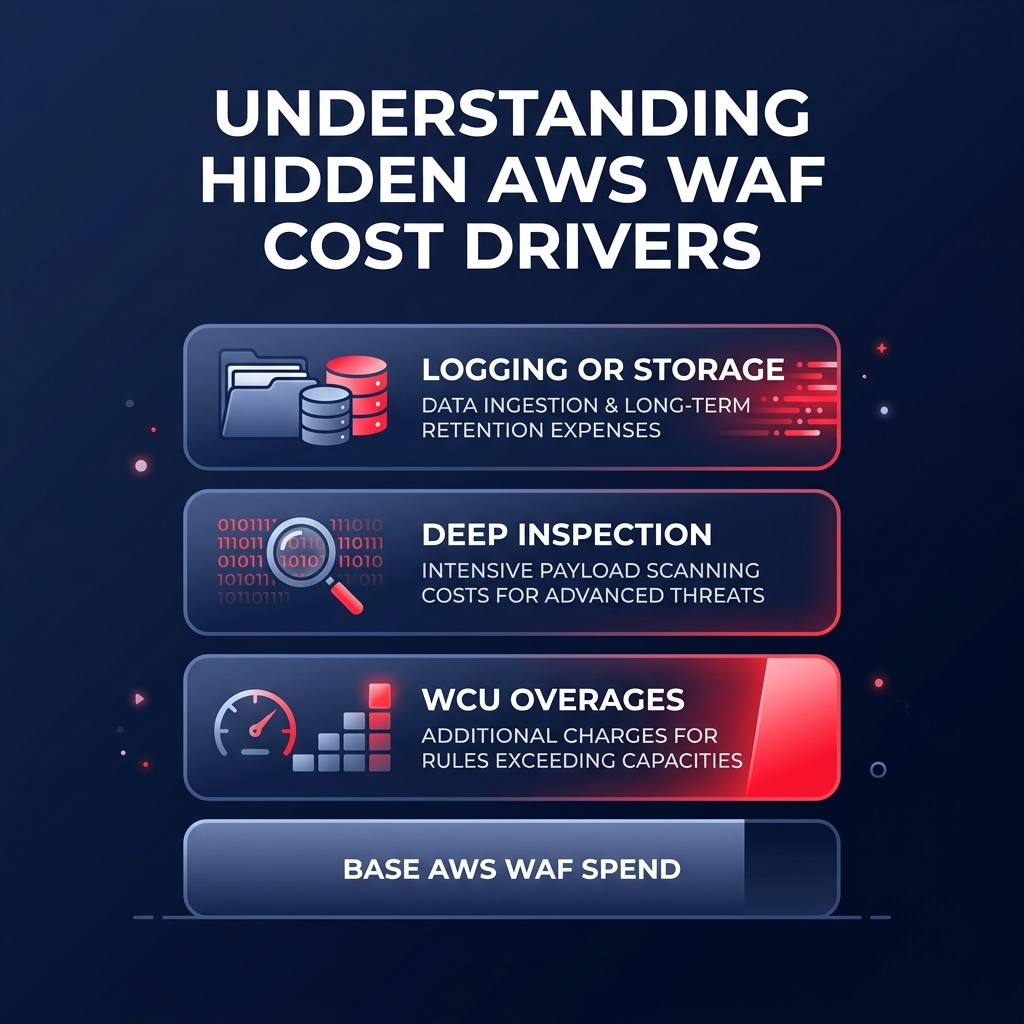
Logging can also lead to budget overruns. WAF logs are often verbose, and since they are typically sent to S3 or CloudWatch, ingestion and storage costs can rival the WAF fees themselves. You can find more detail on how these side-costs accumulate in our guide on Amazon CloudWatch Logs pricing. Furthermore, interactive challenges like CAPTCHA and silent “Challenges” have their own billing units. CAPTCHA completions cost $0.40 per 1,000 attempts, while serving a silent challenge page costs $0.15 per 1,000 responses.
Effective cost-management strategies
Optimizing your AWS WAF configuration is a balance between security and financial efficiency. You can maintain a high security posture while lowering your bill by being more surgical with how rules are applied across your infrastructure.
- Prioritize Rule Ordering: AWS processes rules sequentially. By placing “cheap” rules – such as IP blocklists or geographic blocking – at the top of your priority list, you can terminate malicious requests before they reach expensive inspection rules like Bot Control.
- Implement Scope-Down Statements: There is no reason to run expensive bot detection on static assets. By limiting advanced rules to sensitive paths like `/login` or `/checkout`, you significantly reduce the volume of requests that trigger premium charges.
- Utilize Rate-Limiting: Rate-based rules track requests from specific IP addresses. If an IP exceeds a threshold, such as 2,000 requests in 5 minutes, WAF can block them automatically. This is a cost-effective first line of defense against volumetric attacks.
- Monitor with Detailed Tagging: Use AWS Cost Explorer to tag your Web ACLs by application or department. This visibility allows you to see exactly which project is driving your security spend and is a fundamental AWS cost management best practice.
The Shield Advanced offset
If your organization subscribes to AWS Shield Advanced for $3,000 per month, your WAF pricing dynamic changes. Shield Advanced covers the standard costs of AWS WAF Web ACLs, rules, and requests for protected resources. For large enterprises processing up to 50 billion requests per month, the inclusion of WAF fees can transform Shield Advanced from a security upgrade into a strategic cost-saving measure.
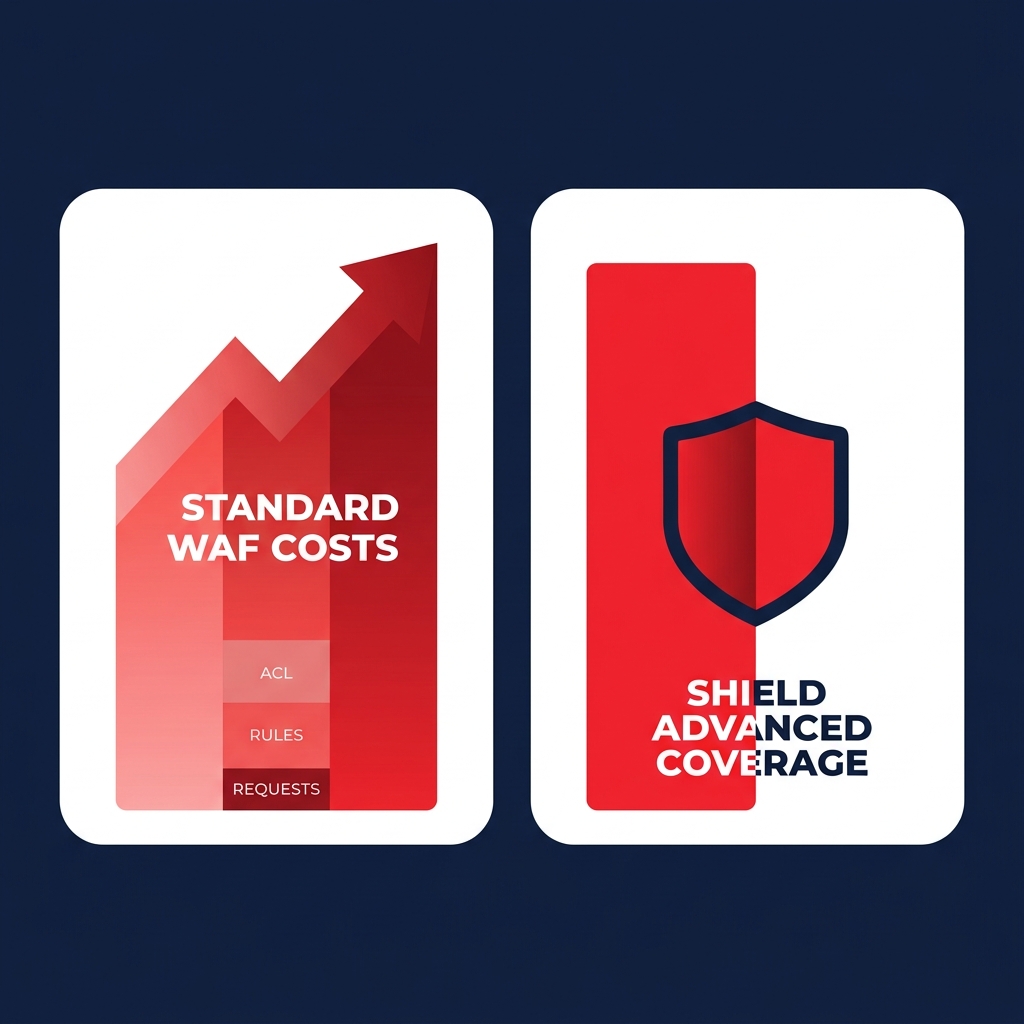
Security and cost should not be a zero-sum game. While WAF protects your infrastructure, unoptimized configurations can create financial waste that compounds every month. By implementing smarter rule logic and monitoring your request tiers, you can maintain a robust defense without overpaying for inspection.
To see how WAF fits into your broader cloud financial picture, use the Hykell savings calculator. Hykell helps businesses identify hidden inefficiencies and implement AWS rate optimization strategies that reduce overall spend by up to 40% on autopilot, keeping your applications secure without the manual engineering effort.