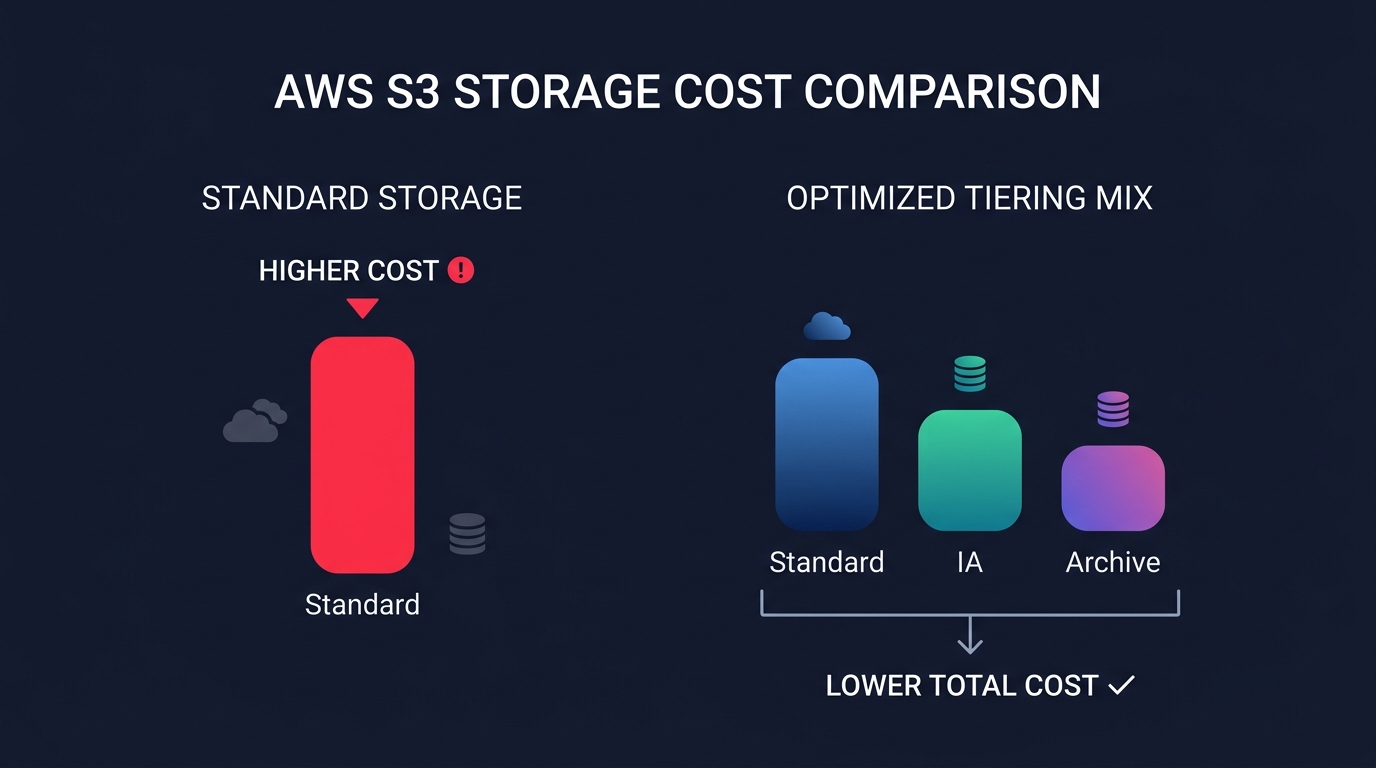
Are you overpaying for S3 storage by defaulting every bucket to the Standard tier? Selecting the wrong storage class can inflate your AWS bill by 70%, yet many teams stick with defaults to avoid complexity. Choosing the right class is the most direct path to AWS S3 cost optimization.
S3 Standard and high-performance options
S3 Standard serves as the default choice for the majority of cloud workloads. It provides low latency and high throughput, making it the ideal home for active applications, static websites, and content distribution. In the US East (N. Virginia) region, storage pricing typically starts at $0.023 per GB for the first 50 TB. While this tier offers a robust 99.99% availability SLA and eleven nines of durability, it is also the most expensive option for data that sits idle.
For specialized workloads requiring even lower latency, such as machine learning or high-frequency analytics, AWS S3 performance tuning often involves S3 Express One Zone. This high-performance class delivers sub-millisecond latency by storing data in a single Availability Zone. However, the performance boost comes at a premium cost of approximately $0.16 per GB. Most organizations find that while S3 Standard is excellent for “hot” data, keeping objects there for more than 30 days without frequent access is a missed opportunity for significant savings.
Intelligent-Tiering for unpredictable workloads
If you are unsure of your access patterns or find that usage changes sporadically, S3 Intelligent-Tiering acts as an automated safety net. This storage class uses machine learning to monitor access and automatically moves objects between two low-latency tiers – Frequent Access and Infrequent Access. This allows you to mirror the pricing of the Standard and Standard-IA tiers without the manual effort of tracking every object.
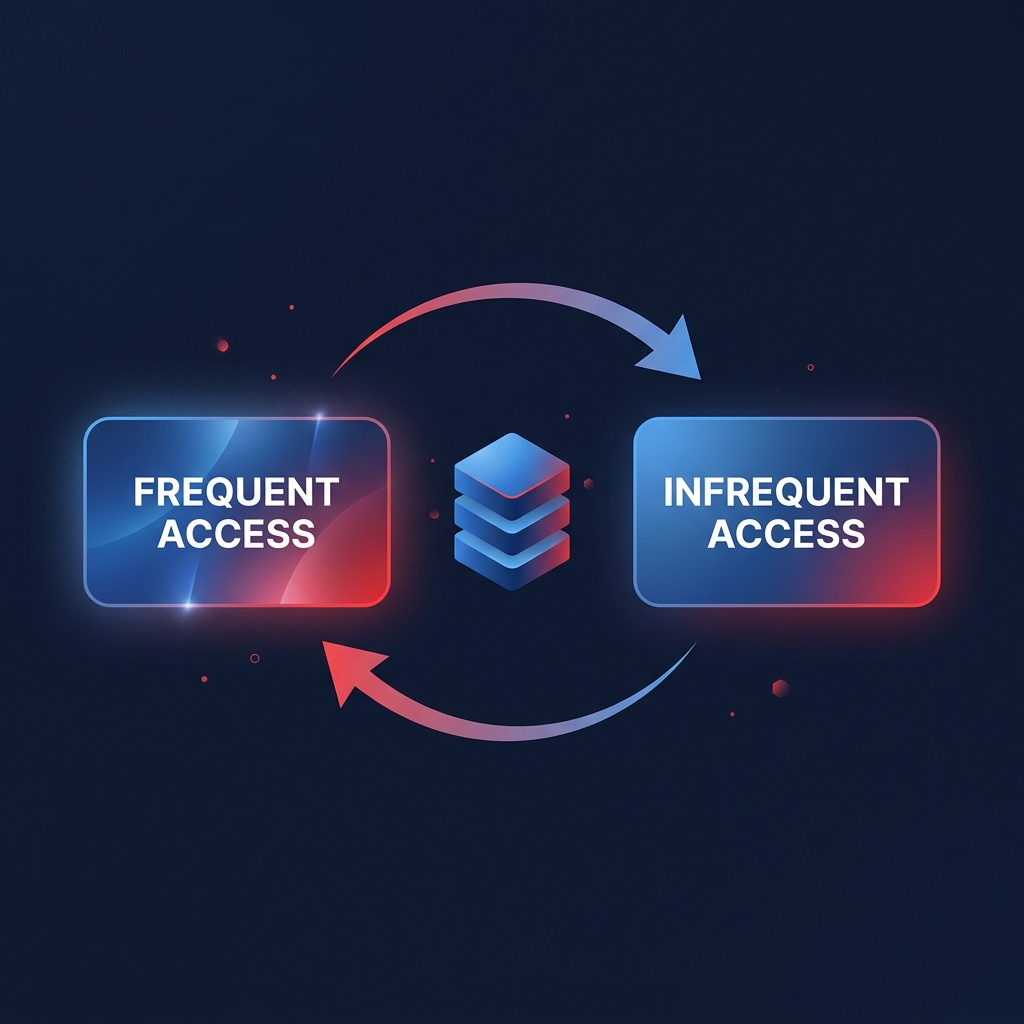
While Intelligent-Tiering requires a small monthly monitoring and automation fee of $0.0025 per 1,000 objects, it eliminates retrieval fees entirely. This makes it a powerful tool for auditing cloud storage expenses in environments like data lakes or new applications where user behavior is still being established. By automating the placement of data, you ensure that you never pay for high-frequency storage when it is no longer required.
Infrequent Access tiers for occasional needs
For data that you access less than once a month but still require in milliseconds when requested, the Infrequent Access (IA) tiers offer a compelling middle ground. S3 Standard-IA is roughly 45% cheaper than the Standard tier, with pricing around $0.0125 per GB. It is specifically designed for long-term storage, such as monthly backups or disaster recovery files. Because it maintains the same millisecond latency as the Standard tier, your applications will not experience any performance degradation when retrieving older data.
If your data is recreatable or backed up elsewhere, S3 One Zone-IA offers even deeper savings at approximately $0.01 per GB. This tier reduces costs by storing data in a single Availability Zone rather than the three zones used by standard classes. While this lowers the storage price, it increases the risk of loss if that specific zone fails. Both IA tiers carry a 30-day minimum storage duration and charge a per-GB retrieval fee, meaning they are best suited for data that truly stays “cool.”
Archive tiers for long-term retention
When you move into the territory of multi-year preservation or regulatory compliance, the Glacier family provides the most aggressive cost reductions. S3 Glacier Instant Retrieval is perfect for data accessed once a quarter, providing millisecond access at just $0.004 per GB. This is a common choice for medical records or news archives that are rarely touched but must be available immediately upon request.
For the lowest possible costs, S3 Glacier Deep Archive represents the pinnacle of comparative cost strategies for cloud providers. At just $0.00099 per GB, it is roughly 23 times cheaper than S3 Standard. The trade-off for this price point is retrieval time, which can range from 12 to 48 hours. Using these archive tiers effectively can slash your storage bill by 90% or more for data that is kept strictly for compliance or historical records.
| Storage Class | Cost (per GB/mo) | Retrieval Time | Ideal Use Case |
|---|---|---|---|
| S3 Standard | ~$0.023 | Milliseconds | Active apps, websites |
| S3 Intelligent-Tiering | ~$0.023 | Milliseconds | Unpredictable access |
| S3 Standard-IA | ~$0.0125 | Milliseconds | Monthly backups, DR |
| Glacier Instant Retrieval | ~$0.004 | Milliseconds | Medical images, news media |
| Glacier Deep Archive | ~$0.00099 | 12–48 Hours | Regulatory compliance |
Implementing a lifecycle strategy for savings
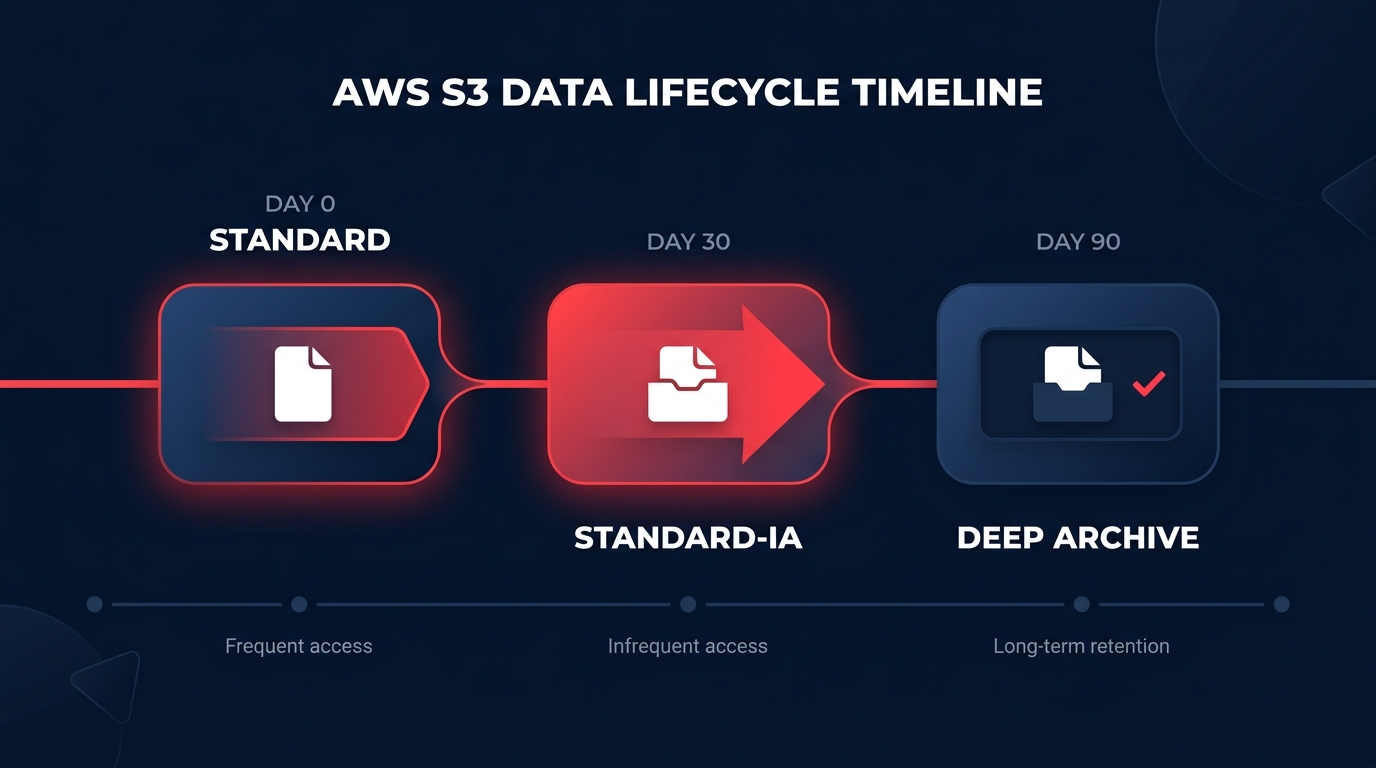
The most effective way to manage these classes is through S3 Lifecycle policies, which automate the transition of objects as they age. For example, you might configure a policy to move server logs from S3 Standard to S3 Standard-IA after 30 days, and then to Glacier Deep Archive after 90 days. Large enterprises have achieved 40% savings on massive datasets exceeding 1.8PB by adopting these AWS cost management best practices.
Managing these transitions manually across thousands of buckets is a massive engineering burden that often leads to human error. Hykell provides automated AWS rate optimization that operates on autopilot, identifying underutilized resources and moving data to the most efficient tiers without risking application uptime. We handle the complexity of cloud economics so your engineering team can focus on building products.
If you want to see exactly how much your current S3 configuration is costing you compared to an optimized setup, use the Hykell savings calculator to uncover hidden savings in your infrastructure. Hykell only takes a slice of what you save – if you don’t save, you don’t pay.