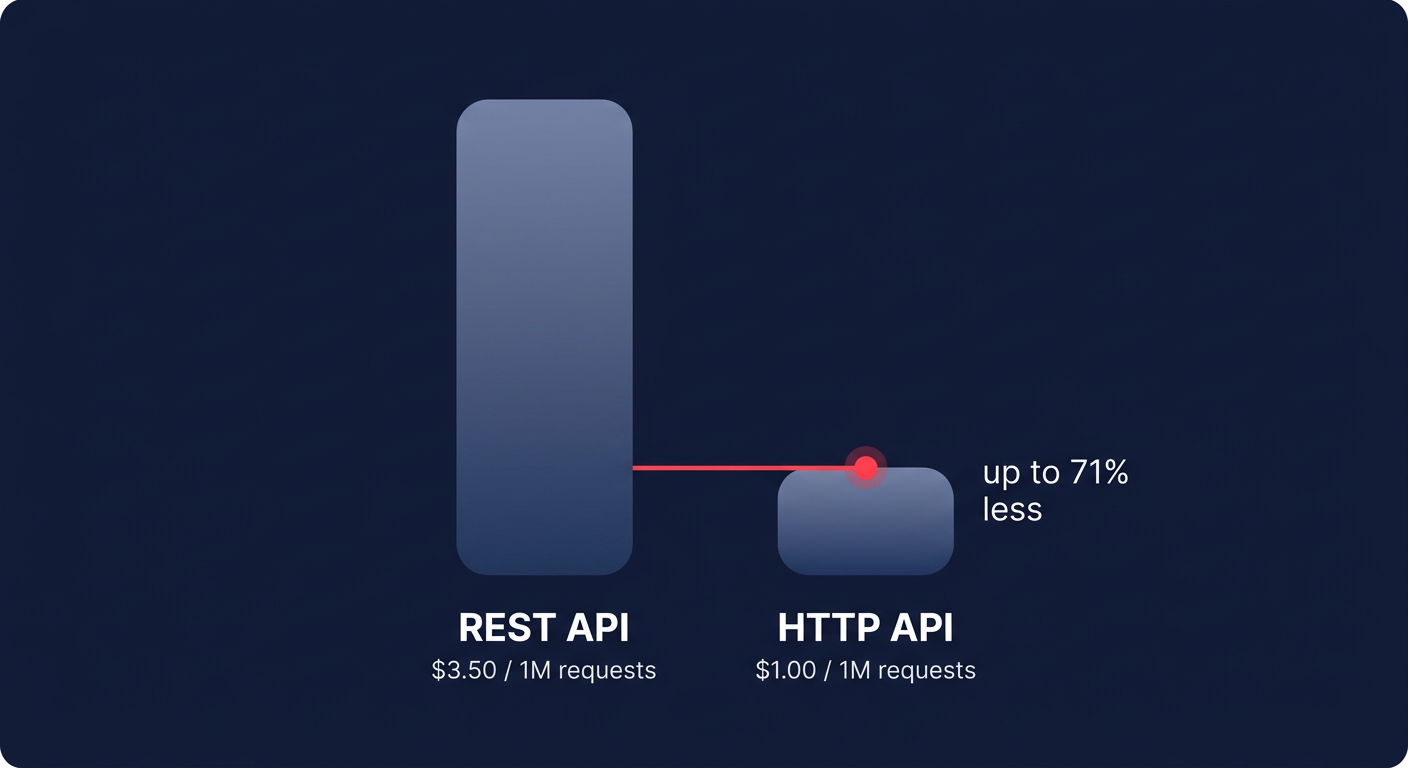
Did you know that switching from a REST API to an HTTP API can slash your gateway costs by up to 71%? Mastering API Gateway pricing is the first step toward reclaiming your budget and avoiding unexpectedly high cloud bills.
While the AWS API Gateway pricing page appears straightforward, high-volume microservices often run into ballooning costs due to data transfer, caching, and choosing the wrong API type for the workload. To optimize effectively, you must align your architectural choices with your specific traffic patterns.
Choosing the right API type
The most significant cost lever at your disposal is the choice between REST APIs and HTTP APIs. For most modern applications, REST APIs are an expensive legacy choice, priced at $3.50 per million requests for the first 333 million. In contrast, HTTP APIs cost only $1.00 per million requests for the first 300 million. This drastic price difference makes HTTP APIs the superior choice for high-performance, low-latency applications like Lambda-backed microservices.
While HTTP APIs lack some advanced features like native request transformation or specialized API keys, you can often handle these requirements more affordably at the application layer. By utilizing effective cloud workload balancing strategies, you can maintain control without paying the premium associated with REST infrastructure. If your architecture does not strictly require the legacy features of REST, migrating to HTTP APIs is the fastest way to lower your monthly bill.
Bypassing the gateway for internal traffic
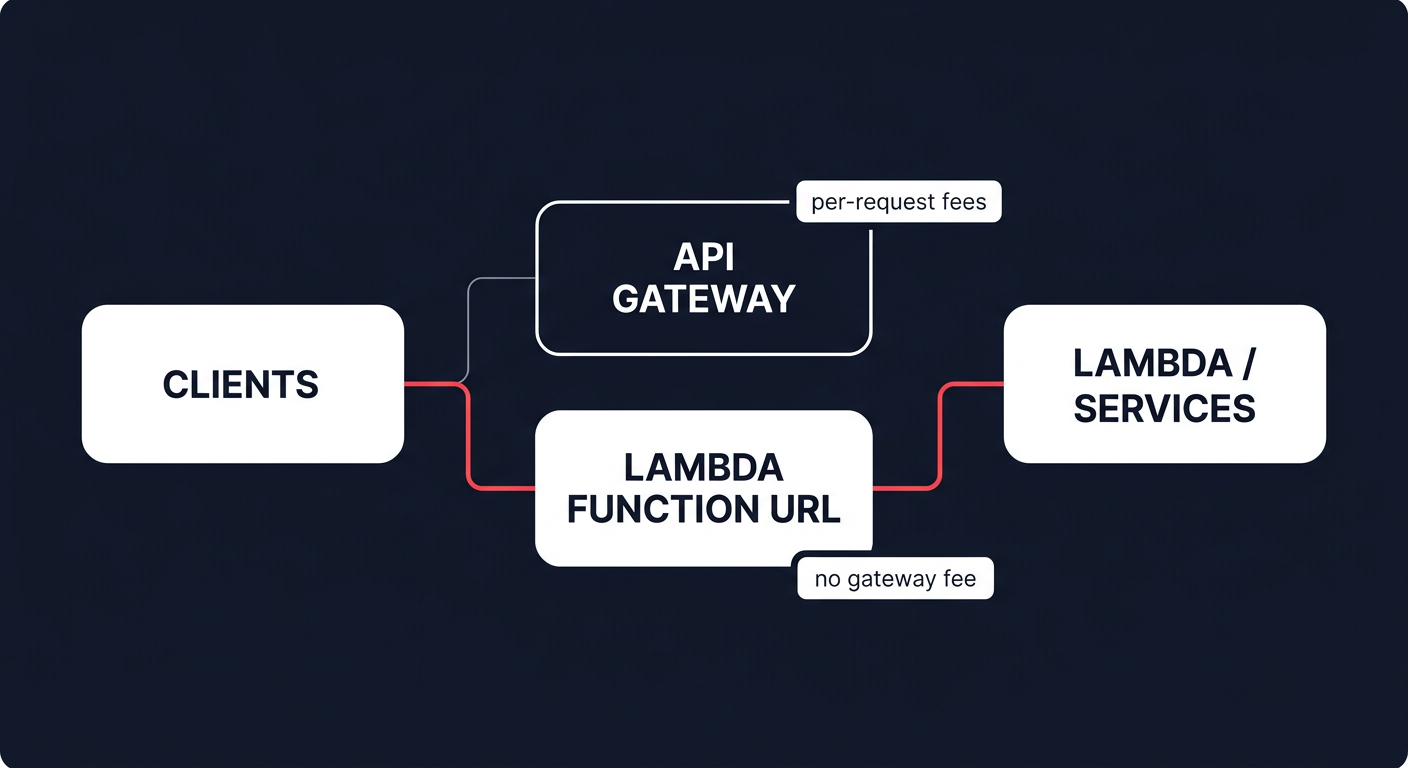
Not every request needs to pass through an API Gateway. For simple, low-traffic triggers or internal service communication, you should consider Lambda Function URLs. These provide a built-in HTTPS endpoint for your functions at no additional cost beyond the standard Lambda execution fee. This strategy is particularly effective for background tasks or administrative hooks where the advanced throttling and authorization features of a full gateway are unnecessary.
For high-volume, steady-state traffic, an Application Load Balancer (ALB) often proves more economical than any API Gateway variant. Once you cross the threshold of roughly one million requests per day, the LCU-based pricing of an ALB typically results in a lower total cost of ownership than the per-request pricing model. This shift is common in AWS billing best practices for Kubernetes environments, where ingress controllers handle routing more efficiently than an external gateway.
Reducing data transfer and networking fees
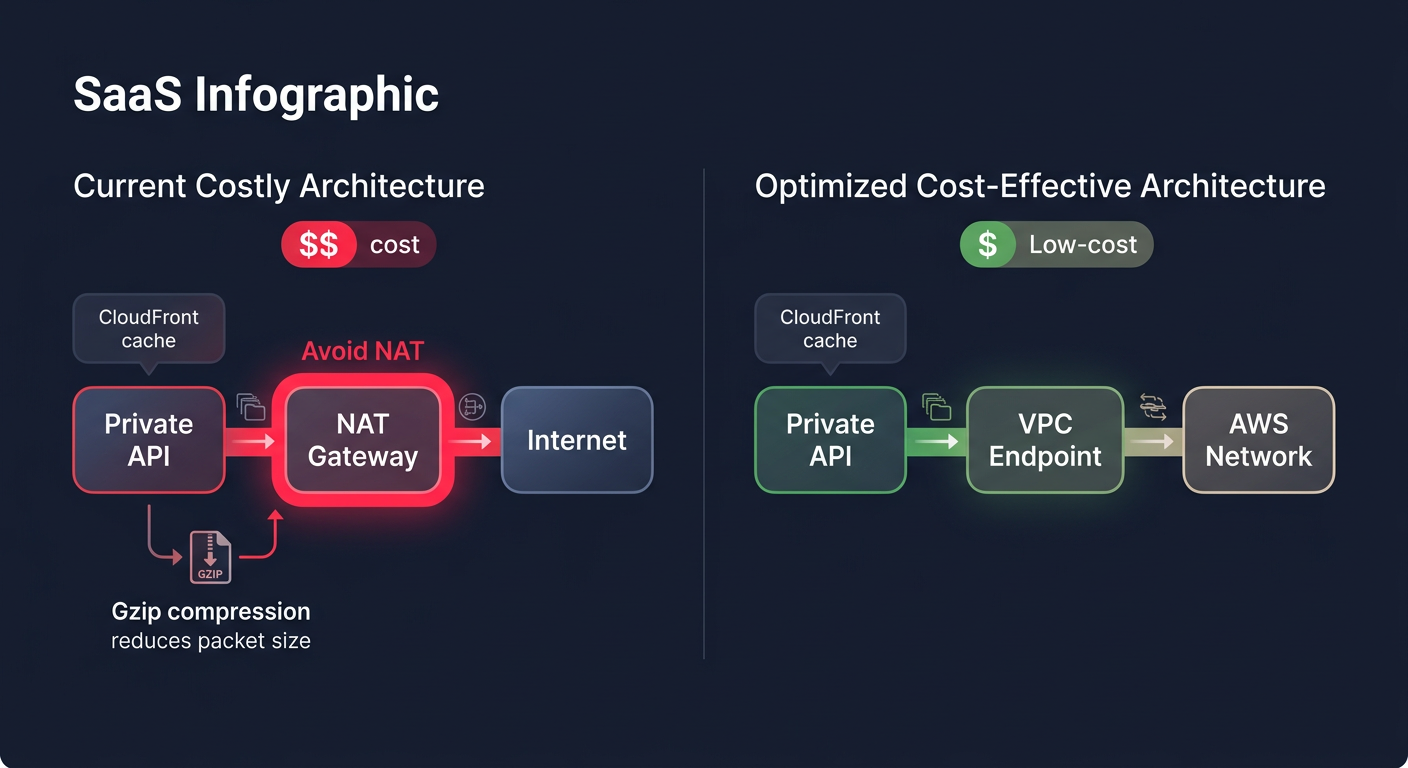
Data transfer out to the internet is a hidden cost driver, frequently billed at $0.09 per GB. You can mitigate this by enabling payload compression within API Gateway. Compressing your data with Gzip reduces the size of the transmitted packets and directly lowers your outbound transfer fees. Furthermore, for internal-only APIs, you should always utilize Private APIs integrated with VPC endpoints to keep traffic within the AWS network.
Using VPC endpoints instead of routing traffic through a NAT Gateway can reduce associated data processing fees by as much as 78%. Since NAT Gateways charge significantly more per GB processed, bypassing them is a priority for any data-intensive API. If you find your networking costs remain high, reviewing our AWS NAT Gateway cost optimization guide can help you identify further infrastructure redundancies and unnecessary hop costs.
Leveraging caching and throttling
Caching can be a double-edged sword for your budget. While it reduces the load on your backend integration – potentially saving money on Lambda or EC2 execution – AWS charges $0.50 per hour per GB for API Gateway caching in regions like us-east-1. This is often more expensive than the compute it saves. Instead of using gateway-level caching, you should place Amazon CloudFront in front of your API. CloudFront offers a larger free tier and lower data transfer costs, acting as a global cache that filters requests before they ever reach your gateway.
To prevent cost spikes during traffic surges or malicious attacks, you must implement strict throttling and usage plans. By setting request quotas and burst limits, you ensure that unexpected traffic does not lead to a massive bill. This proactive management is a core component of AWS cost allocation and auditing, ensuring every dollar spent on your API infrastructure is intentional.
Optimizing API Gateway requires a continuous balance between features and fees. Whether you are migrating to HTTP APIs, bypassing gateways with Lambda URLs, or refining your networking path to avoid NAT fees, these architectural shifts can result in massive savings. At Hykell, we specialize in identifying these inefficiencies and implementing optimizations on autopilot. We can help you reduce your total AWS spend by up to 40% without requiring your engineering team to lift a finger – and you only pay us a portion of what you save.
To see how much your business could save on API Gateway and other AWS services, use our cloud cost savings calculator or contact our experts for a detailed audit today.