Are you certain that every dollar spent across your AWS Organization is driving value? With global cloud waste projected to hit $44.5 billion in 2025, most enterprises find that roughly 32% of their budget vanishes into underutilized resources and forgotten test environments.
Managing costs in a single AWS account is challenging, but doing so across dozens or hundreds of accounts requires a shift from manual oversight to automated cloud FinOps practices. By leveraging AWS Organizations, you can transform your cloud financial management from a reactive monthly headache into a proactive, automated engine for growth.
The foundation of multi-account cost control
AWS Organizations serves as the central nervous system for your cloud footprint. It allows you to consolidate billing, which aggregates usage across all accounts to help you qualify for volume discounts. However, visibility is only the first step. Without a structured cloud cost governance framework, even the most organized account hierarchy can fall victim to “hidden” waste. Organizations often find that 25–35% of their cloud resources are wasted, and in high-growth environments, this can exceed 40% due to idle resources.
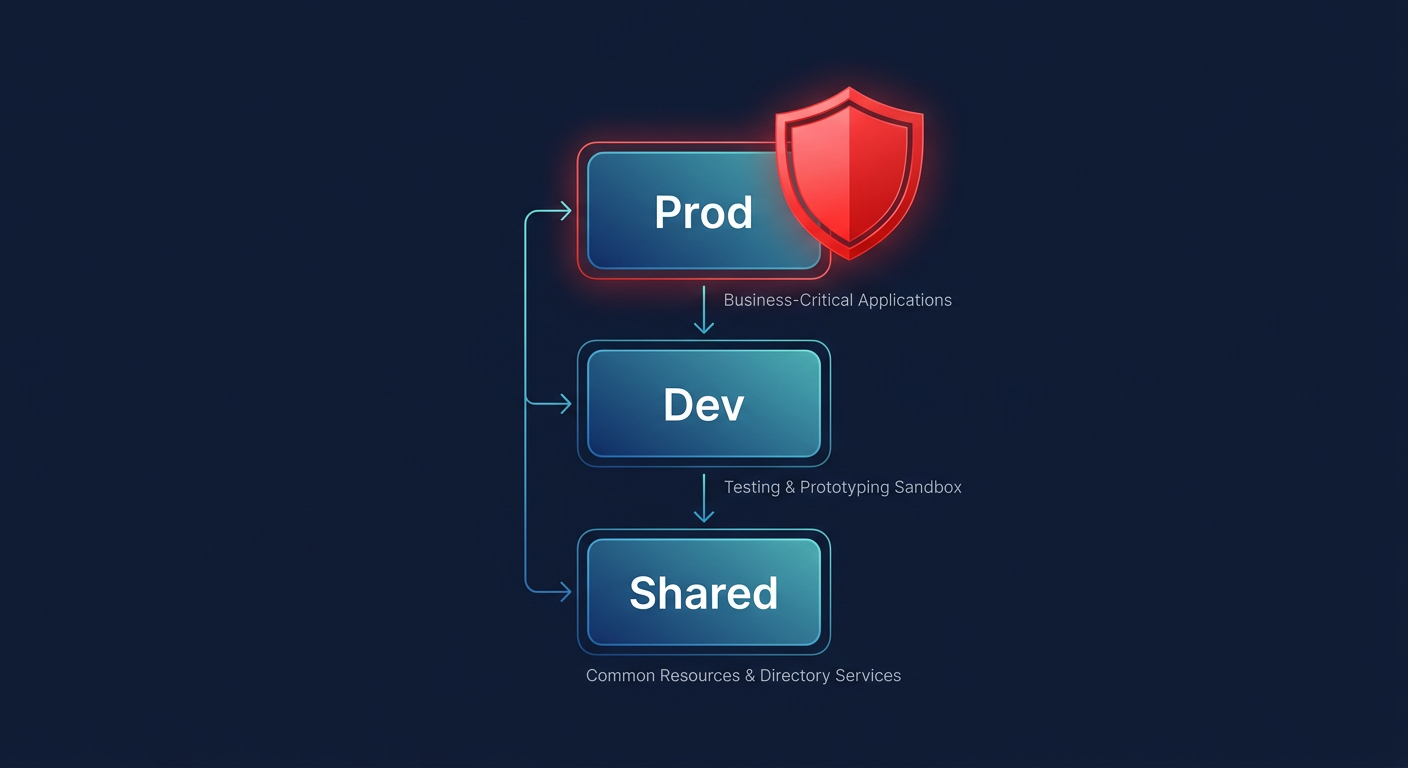
A mature strategy uses Organizational Units (OUs) to group accounts by purpose – such as production, development, and shared services. This structure enables you to apply specific Service Control Policies (SCPs) that prevent expensive mistakes before they happen. For example, you can block the launch of high-cost instance families in sandbox environments or deny the creation of resources in expensive regions where your team has no operational presence. This preventative layer ensures that governance is built into the architecture rather than added as an afterthought.
Automating visibility and accountability
You cannot optimize what you cannot see, yet many organizations struggle with “unallocated” spend because resources lack proper metadata. Research indicates that organizations waste 30–50% on cloud infrastructure due to poorly governed tagging, which creates fragmented reports and months of invisible spend. To solve this, you should implement automated tagging for AWS cost allocation to enforce standardized keys like CostCenter, Owner, and Environment.
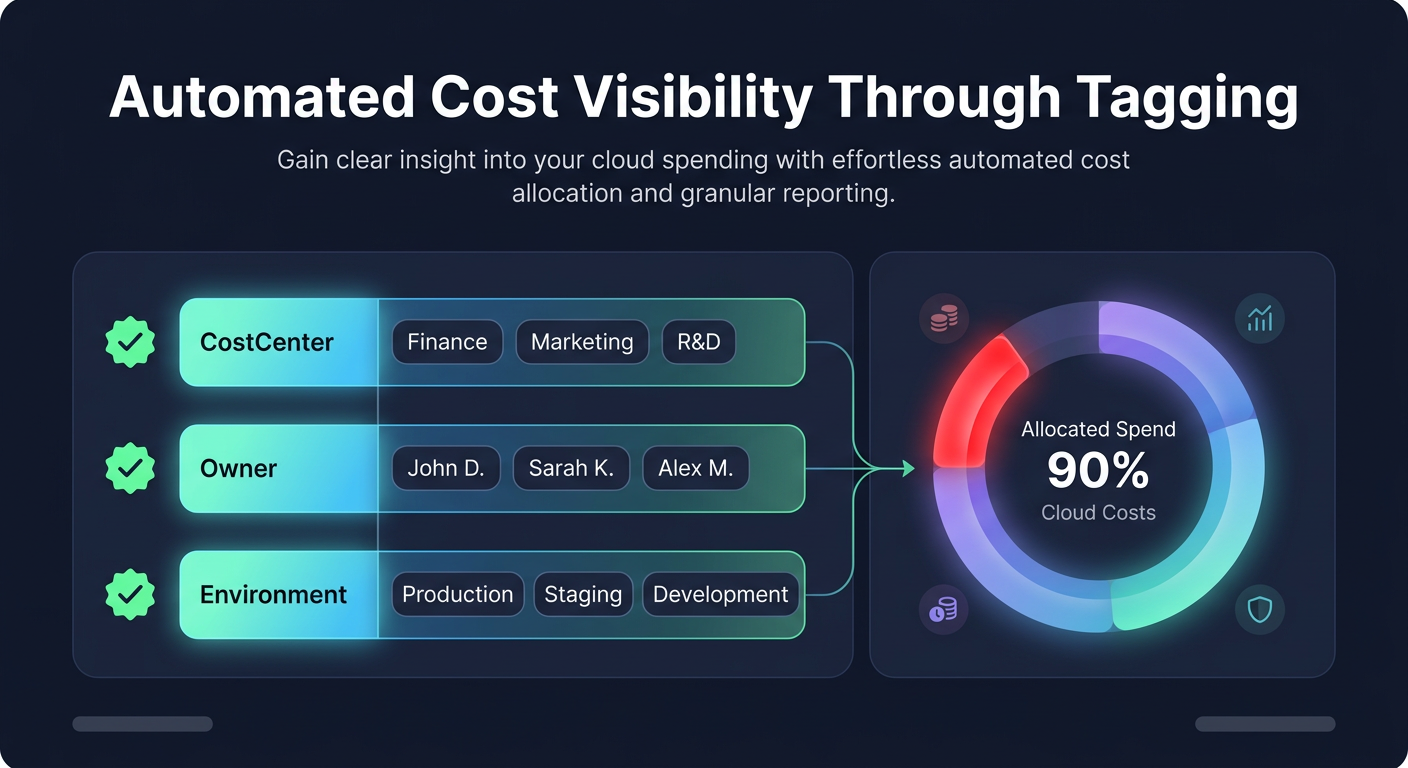
By using Tag Policies within AWS Organizations, you can ensure case-sensitive enforcement across your entire environment. When combined with AWS Config, you can automatically flag or even terminate resources that do not meet your compliance standards. Once your tagging is consistent, automated cost visibility for AWS environments tools can ingest your Cost and Usage Reports (CUR) to provide real-time insights. Instead of waiting for the end-of-month invoice, these tools allow you to identify spending spikes within hours and attribute 90% or more of your cloud spend to specific cost centers.
Implementing automated guardrails and remediation
The true power of cloud management in a multi-account setup lies in moving from “showback” to automated action. Manual rightsizing is a losing battle at scale; engineering teams often spend 10–15% of their time just managing resource sizes to keep up with usage changes. By automating these processes, you can reclaim these hours while ensuring your infrastructure remains lean.
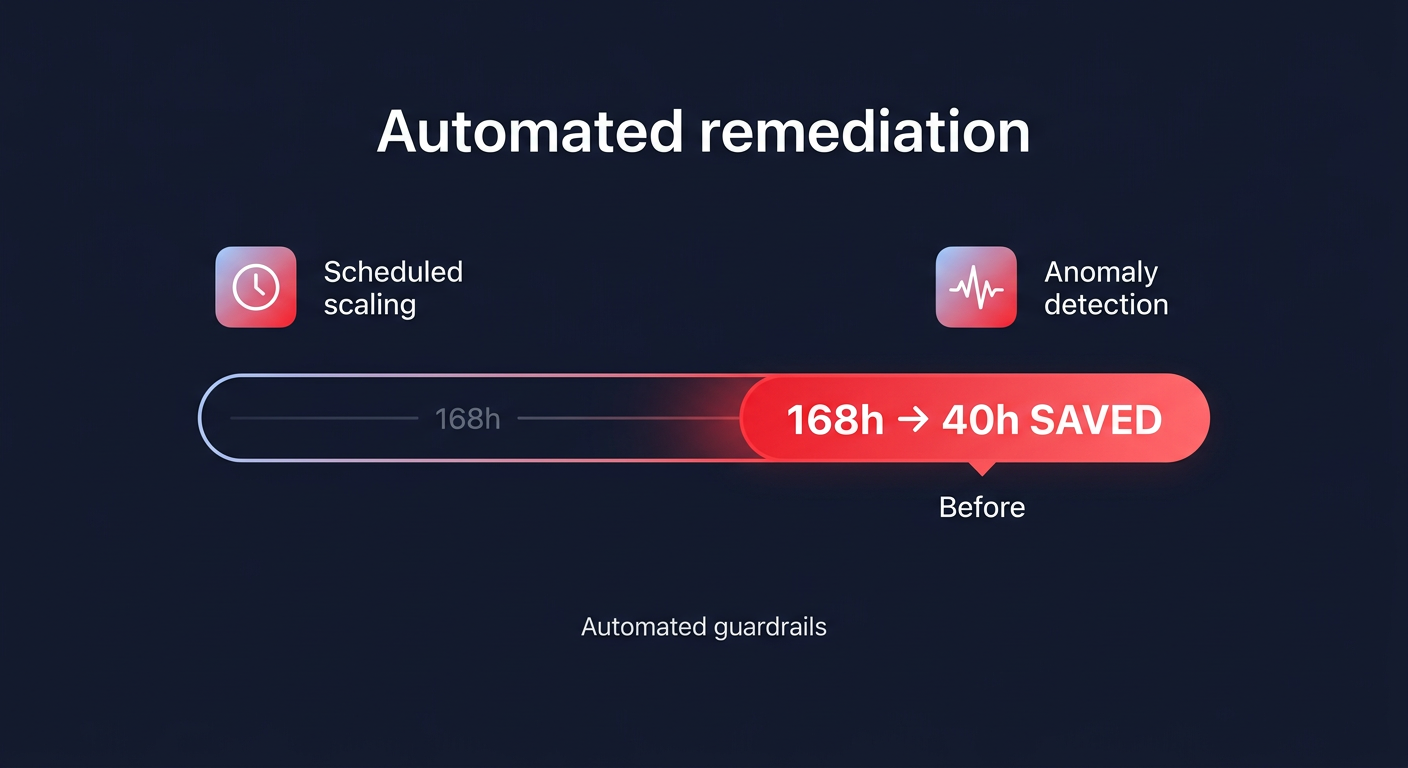
One of the most effective patterns is scheduled scaling. Using EventBridge and Lambda, you can automatically stop non-production instances during nights and weekends. This simple automation can reduce runtime from 168 hours to just 40 hours per week, capturing a 76% reduction in compute costs for those specific workloads. Similarly, implementing AWS cost anomaly detection using Terraform allows you to deploy machine-learning-driven monitors across every account in your organization simultaneously. This serves as an early warning system for runaway auto-scaling or misconfigured data transfers before they impact your bottom line.
Beyond monitoring, automated cleanup scripts are essential for eliminating “zombie” resources. Lambda functions can be set to delete unattached EBS volumes or old RDS snapshots that no longer meet your lifecycle policies. These orphaned resources often quietly inflate bills – for instance, a retail customer recently found that 200 unused EBS volumes were creating $10,000 in monthly waste before automation revealed and eliminated them.
Optimizing rates at scale
While rightsizing reduces the amount of cloud you use, rate optimization reduces the price you pay for what remains. Within an AWS Organization, commitment-based discounts like Savings Plans and Reserved Instances (RIs) can be shared across all linked accounts, allowing you to maximize coverage and minimize the risk of unused capacity. However, many businesses fail to maximize these discounts because they fear being locked into specific instance families or architectures.
Sophisticated practitioners use AWS rate optimization strategies to achieve Effective Savings Rates (ESR) of 50–70%. By automating the purchase and exchange of Convertible RIs and Savings Plans, you can maintain high coverage even as your architectural needs shift. This approach allows you to treat cloud spend like a portfolio, shifting commitments dynamically to match real-time usage across your entire multi-account footprint.
Recovering your cloud budget
The transition from manual cost tracking to a fully automated engine is what separates high-growth companies from those burdened by technical debt. Most organizations find they can recover 30–40% of their total AWS spend simply by eliminating waste and optimizing their commitment strategy. Formal practices have been shown to improve forecast accuracy from ±20% to as low as ±5%, providing the financial predictability needed for long-term planning.
At Hykell, we believe your engineering team should focus on building products, not auditing invoices. Our platform integrates directly with your AWS Organization to handle the heavy lifting of rightsizing, storage optimization, and rate management automatically. We only take a slice of what we save you – if you don’t save, you don’t pay.
To see how much waste is currently hiding in your environment, use our AWS cost savings calculator or contact our team for a detailed audit of your multi-account spend.