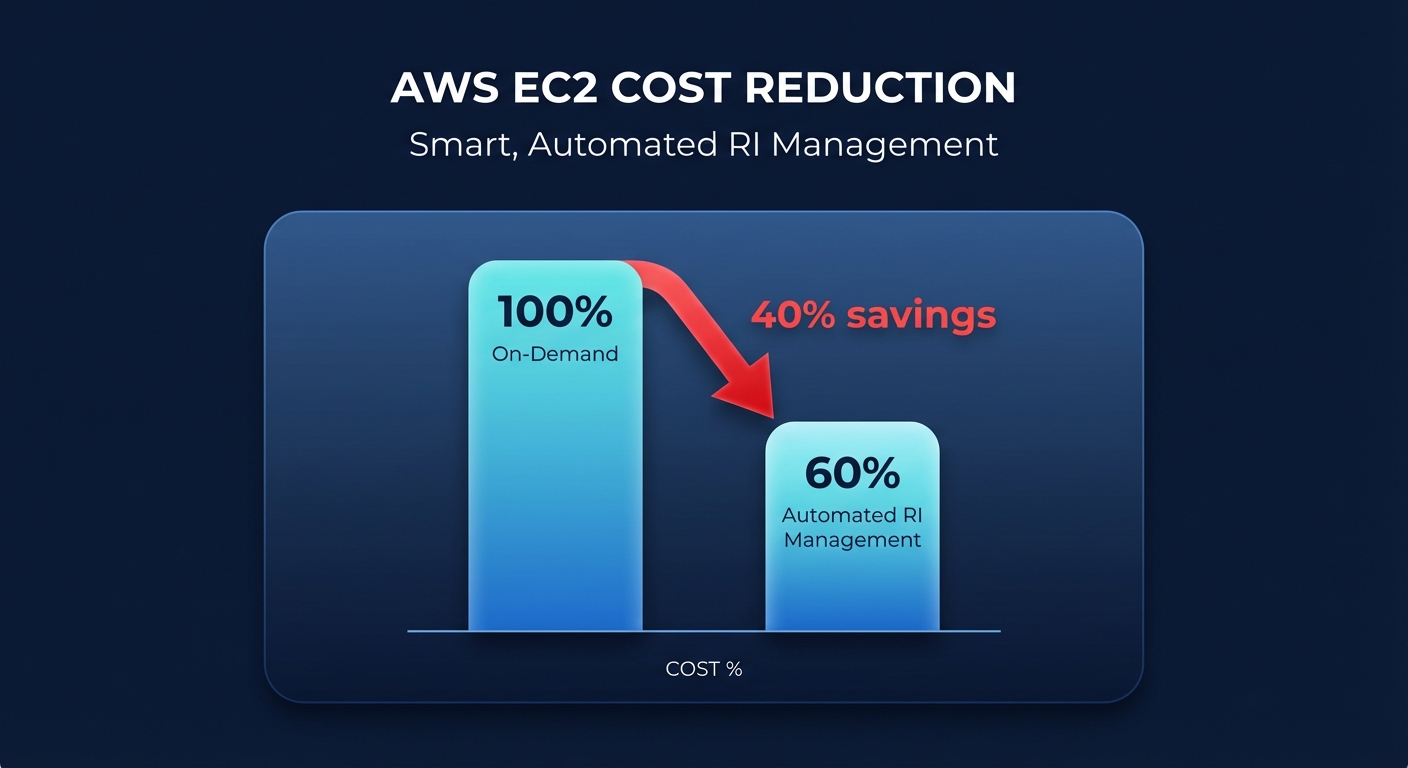
Are you still paying On-Demand rates because your team lacks the time to manage complex commitments? Most mid-sized enterprises leave 20% of potential savings on the table because manual management doesn’t scale. Automated Reserved Instance management can reclaim that budget, bridging the gap to a 40% reduction in compute spend.
While AWS often promotes Savings Plans for their ease of use, a comprehensive AWS RI management guide reveals that Reserved Instances remain a critical lever for engineering teams. They are essential for securing specific zonal capacity or recouping costs through secondary markets. By moving from reactive, manual purchasing to an automated portfolio approach, you can maximize your coverage without increasing your engineering workload.
Why Reserved Instances remain a FinOps cornerstone
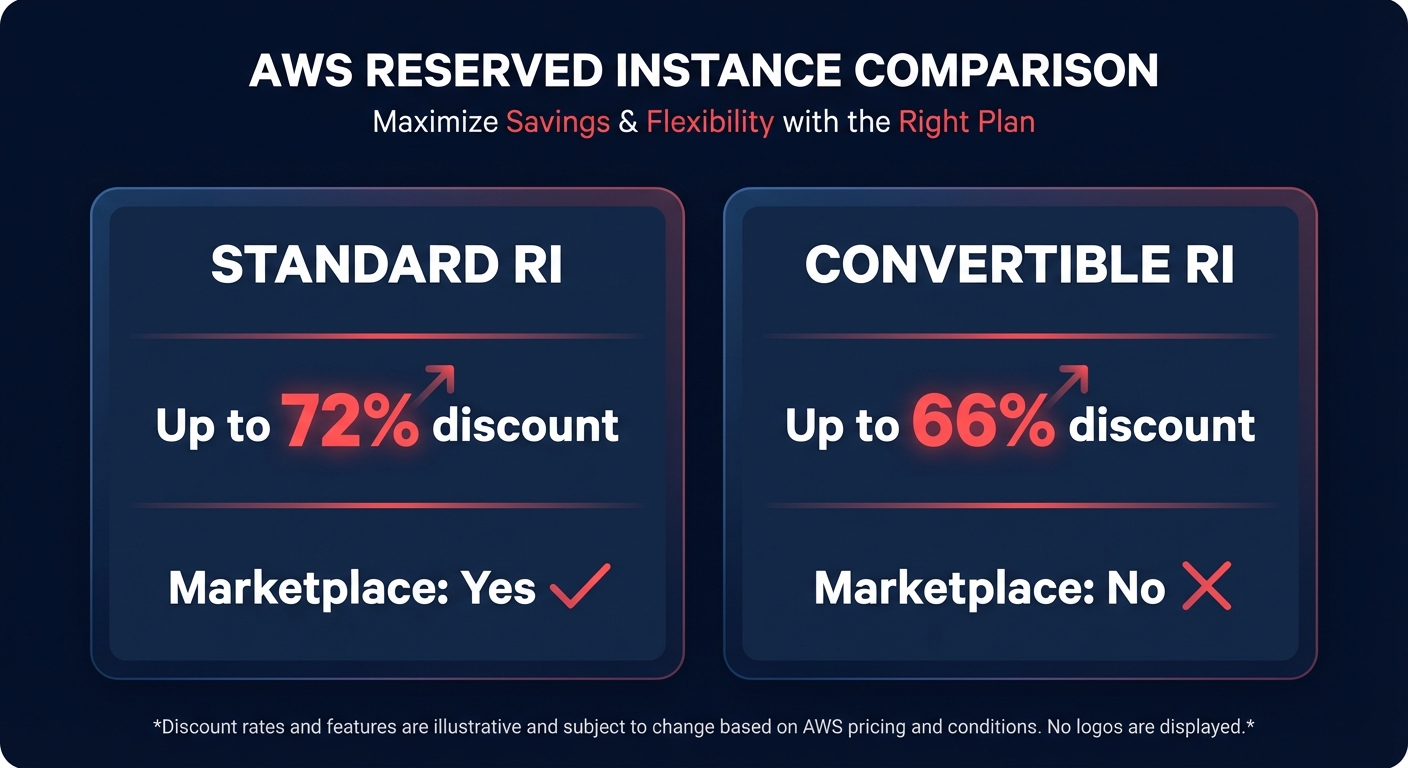
Despite the rise of Savings Plans, RIs offer unique advantages that are essential for a mature AWS rate optimization strategy. Standard RIs provide deep discounts, often reaching up to 72% off On-Demand pricing. More importantly, they remain the only commitment type that offers marketplace liquidity.
If your architecture requires Zonal RIs to guarantee capacity in a specific Availability Zone for mission-critical stateful services, Savings Plans cannot assist you. Furthermore, the ability to buy and sell Reserved Instances on the secondary marketplace allows you to exit commitments if your tech stack evolves. This is a level of flexibility that traditional “use it or lose it” Savings Plans simply lack.
Standard vs. Convertible: Balancing depth and flexibility
Choosing the right RI type is a calculated balance between risk and financial reward. Standard RIs offer the highest discounts, occasionally reaching 75% for specific SKUs, and can be sold on the marketplace if they become “stranded.” However, they are rigid, as you cannot change instance families or regions once they are purchased.
In contrast, Convertible Reserved Instances offer slightly lower discounts, typically ranging up to 66%. Their primary value lies in their adaptability, allowing you to exchange the reservation for different instance types, regions, or operating systems. They are ideal for managing evolving workloads but cannot be sold on the marketplace, making them a “hold-to-maturity” instrument.
The manual management gap: Why engineering teams struggle
Most organizations fail to maximize their savings because manual management is inherently slow. Engineering teams are often forced to choose between over-commitment and under-commitment. Over-commitment occurs when you buy three-year RIs for everything and get stuck with “zombie” capacity when applications are re-architected. Under-commitment usually involves relying on one-year Savings Plans, which cap discounts at roughly 20–25% and offer no exit strategy.
Manual oversight typically yields only 15-20% of potential savings because the data lag in native tools makes real-time adjustments impossible. High-performing teams aim for a Reserved Instance utilization audit that shows a utilization rate of ≥85% and coverage of ≥70%. Maintaining these targets requires constant auditing of the AWS Cost and Usage Report (CUR), a task that often diverts senior engineers from core product development.
Strategic lifecycle management for AWS RIs
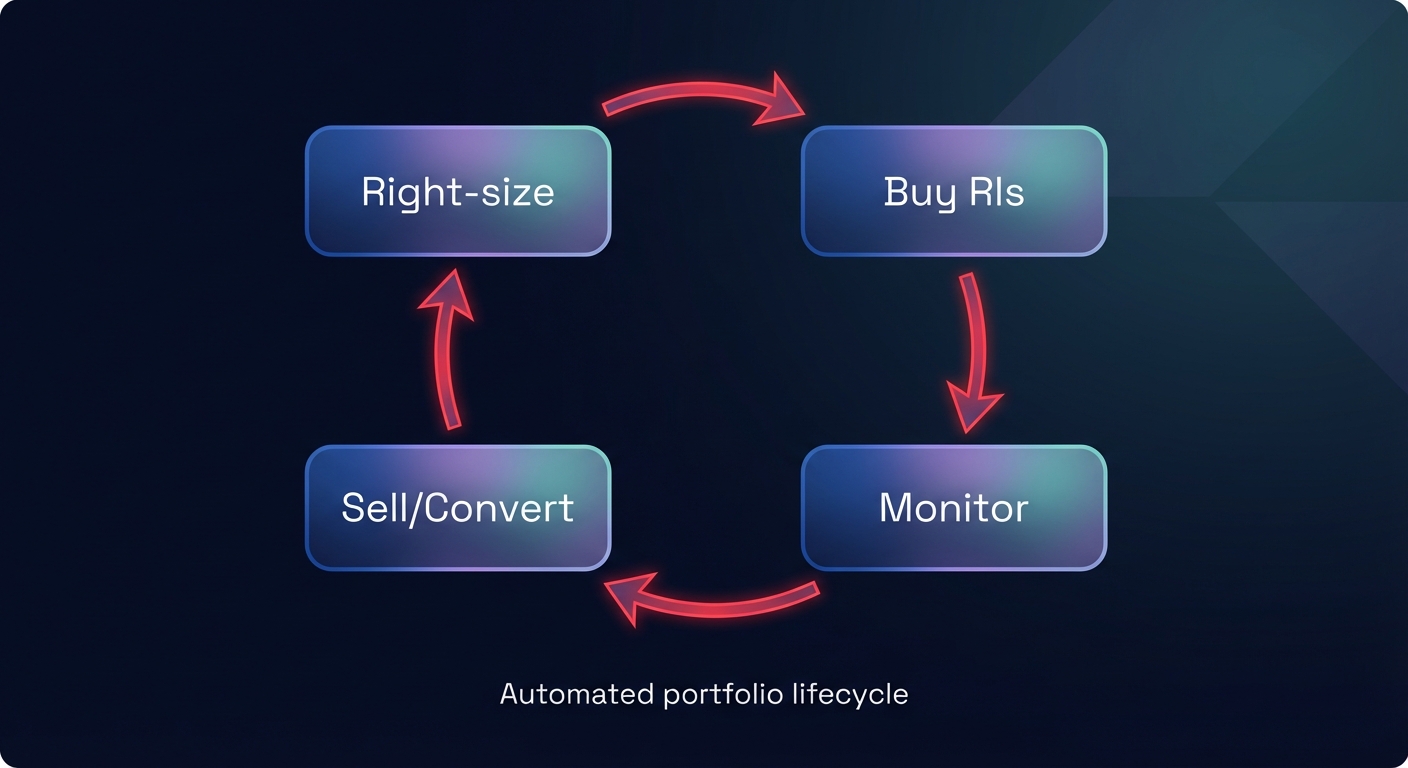
To achieve maximum savings, you must treat your commitments as a living portfolio rather than a static purchase. This lifecycle starts with efficiency and ends with active market participation.
Right-sizing as a prerequisite
Before locking into a multi-year term, you must ensure your underlying infrastructure is efficient. Committing to an oversized instance is simply prepaying for waste. Using automated rightsizing can reduce your baseline compute requirements by up to 35%, ensuring that every dollar spent on a reservation is actually working. You can use an AWS instance cost calculator to model your true steady-state before committing to large purchases.
Navigating the marketplace for liquidity
The AWS Reserved Instance Marketplace allows you to turn rigid commitments into liquid assets. For example, if you are migrating to Graviton from Intel-based m5 instances, you can list your unused m5 Standard RIs for sale to recoup their value.
However, manual trading is difficult because the marketplace is dominated by automated algorithms. Success requires competitive pricing, often 15-20% below the original price, and an understanding of the 12% service fee AWS charges on the upfront sale price. Without automation, these listings often sit dormant while you continue to pay for unused capacity.
Moving beyond one-year plans with automated optimization
The most significant savings jump occurs when organizations transition from static one-year plans to automated Reserved Instance management. While three-year commitments seem risky due to potential lock-in, automation removes that risk by continuously rotating the portfolio through marketplace sales and conversions.
By leveraging Hykell, you can utilize three-year No-Upfront RIs to secure discounts of 55% or more. If your usage drops or your architecture changes, the system automatically identifies the surplus and executes a marketplace sale. This ensures your effective savings rate remains at peak performance without requiring manual intervention from your DevOps team.
Achieving savings on autopilot
Managing RIs manually is a technical and political minefield that requires constant coordination between Finance and Engineering. While Finance wants budget predictability, Engineering needs the agility to change instance types as the product evolves.
Hykell eliminates this friction by operating on autopilot. Our platform performs detailed cost audits to identify underutilized resources and then layers a blended strategy of Standard RIs, Convertible RIs, and Savings Plans. Because we use a performance-based pricing model, you only pay a slice of the actual savings generated. You can calculate your potential savings today and see how an automated approach can reclaim your cloud budget while your engineers stay focused on building.