Ever opened your AWS bill to find AWS Config charging thousands for resources you rarely touch? While it is essential for compliance, the “pay-per-recording” model turns deployments into financial nightmares if left unchecked. You must master these mechanics to shift from reactive firefighting to proactive cost management.
Unlike many services that bill based on uptime or data volume, AWS Config bills based on activity. This means the more your environment changes – whether through manual updates or automated scaling – the more you pay. Understanding the specific mechanics of this service is the first step toward reclaiming your cloud budget.
The three pillars of AWS Config pricing
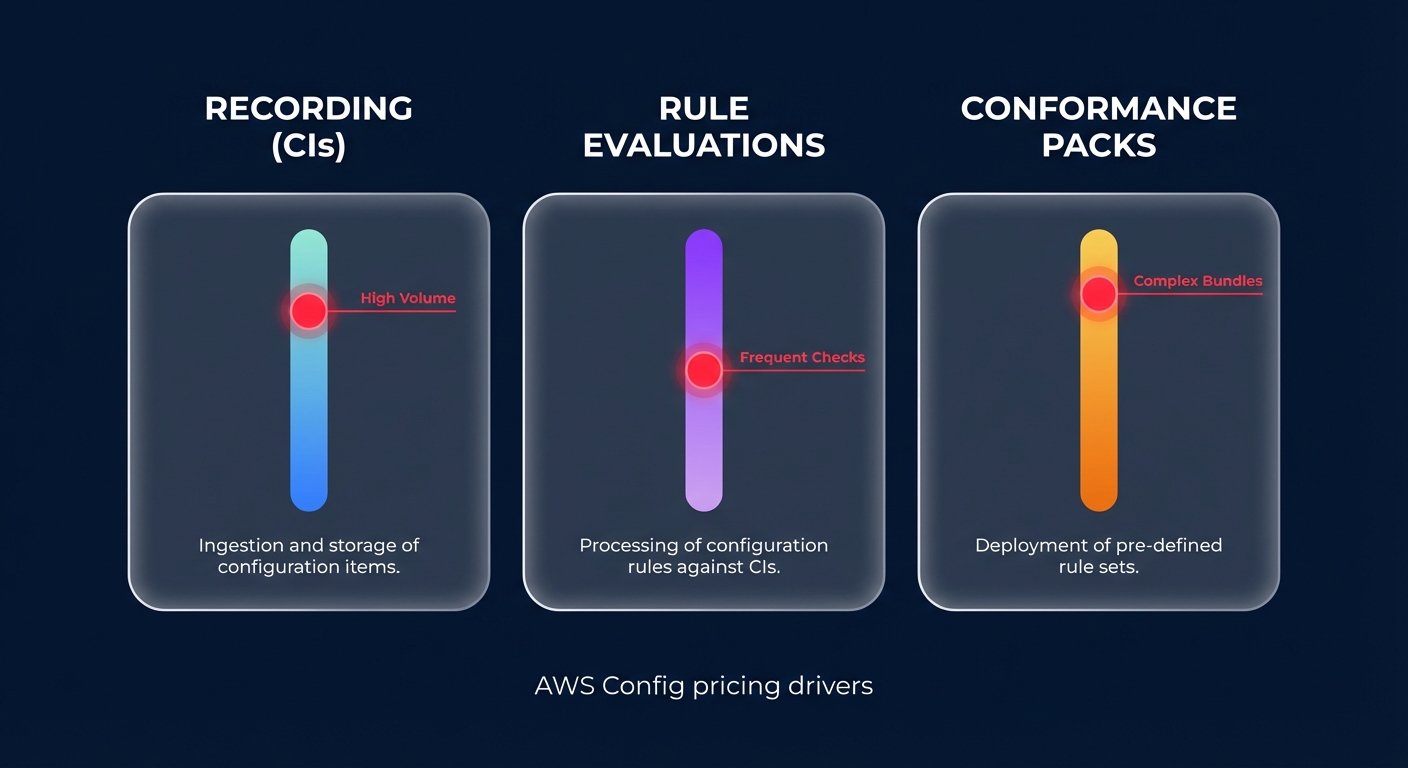
AWS Config utilizes a multi-layered pricing structure that targets three primary areas of activity: resource recording, rule evaluations, and conformance packs. By understanding these individual drivers, you can better predict how architectural changes will impact your monthly invoice.
Configuration items (CIs)
A configuration item serves as a point-in-time record of a resource’s attributes. AWS generates a new record every time a resource is created, deleted, or experiences a relationship change with another resource. Continuous recording is the standard approach, costing $0.003 per configuration item. This provides a granular, high-fidelity history of your environment. Alternatively, periodic recording captures the state at set intervals for $0.012 per item. While the unit price is higher, periodic recording often reduces total spend in dynamic environments by ignoring the noise of rapid, transient changes that occur between recording intervals.
AWS Config rule evaluations
Rules act as the automated compliance checks within your environment. Detective rules evaluate resources after changes occur, while proactive rules check them before deployment. Both modes are priced at $0.001 per evaluation, though the first 100,000 detective evaluations are typically included in the free tier for most accounts. If you enable both modes for a single rule, AWS only charges you for the detective evaluations. Managing these evaluations is a core component of a mature FinOps strategy, ensuring you are not paying for redundant compliance checks across your infrastructure.
Conformance packs
Conformance packs bundle rules and remediation actions into a single deployment unit, streamlining compliance for large organizations. Each evaluation within a pack costs $0.001. While this seems negligible, applying a single pack across hundreds of AWS accounts can generate millions of evaluations. Without real-time monitoring, these packs can quietly become the largest line item on your compliance bill, especially during large-scale migrations or deployments.
Why your AWS Config bill spikes unexpectedly
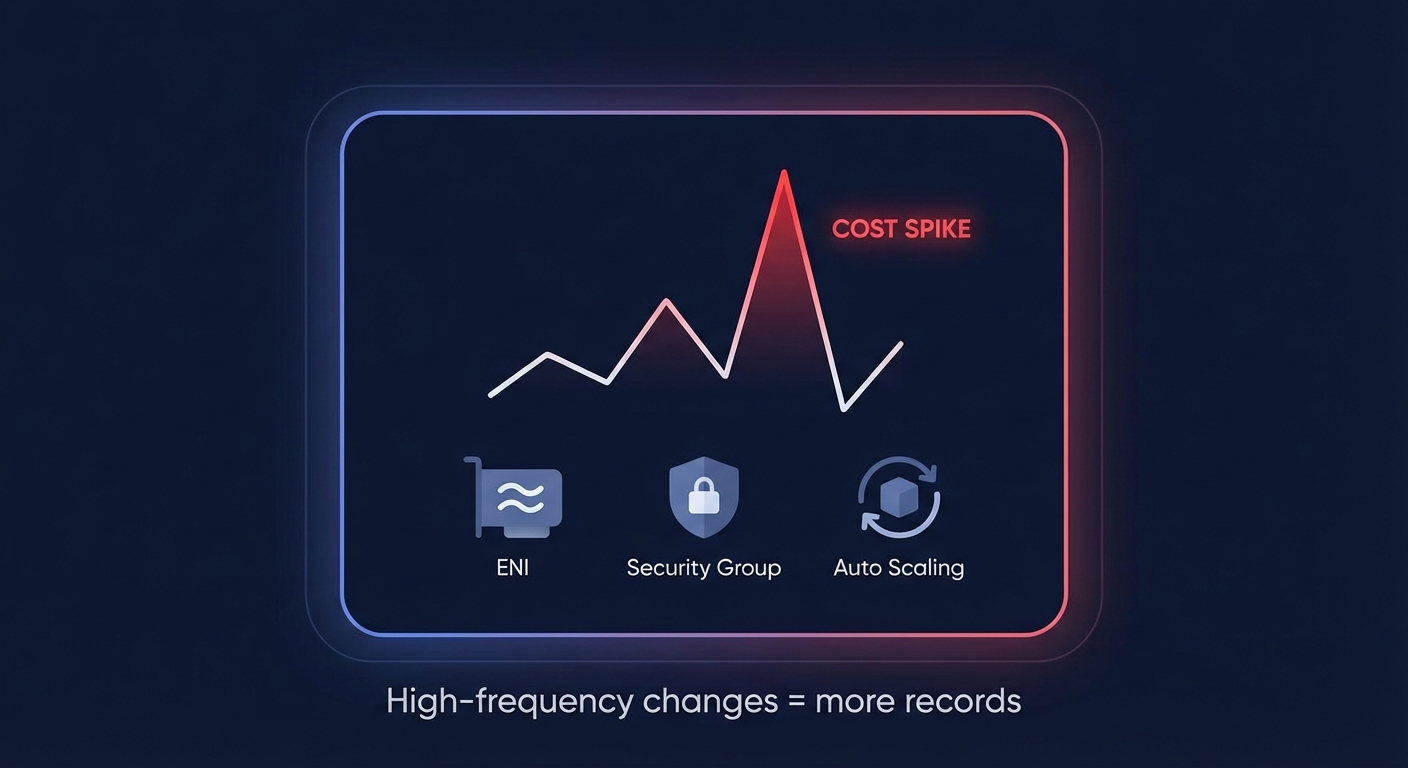
Most engineering teams encounter “bill shock” not because of a single large resource, but due to high-churn automation that generates thousands of events. One of the most common drivers of cost spikes is the recording of high-frequency resource types like Network Interfaces (ENIs), Security Groups, and EC2 instances within an Auto Scaling Group. If you have “record all resource types” enabled, every minor adjustment to a load balancer or a temporary Lambda execution environment generates a billable event.
Multi-account aggregators can also multiply these costs unexpectedly. If you aggregate data from dozens of accounts into a central security account, you are paying for CI recording in the source account and potentially for additional evaluations triggered by the aggregator itself. This highlights why a cloud cost governance framework is necessary to define exactly what needs to be recorded and what can be safely ignored to protect your margins.
Strategies to optimize and reduce AWS Config spend
You do not have to sacrifice visibility to achieve significant cost savings. By applying targeted optimization strategies, you can maintain a robust compliance posture while slashing your Config bill.
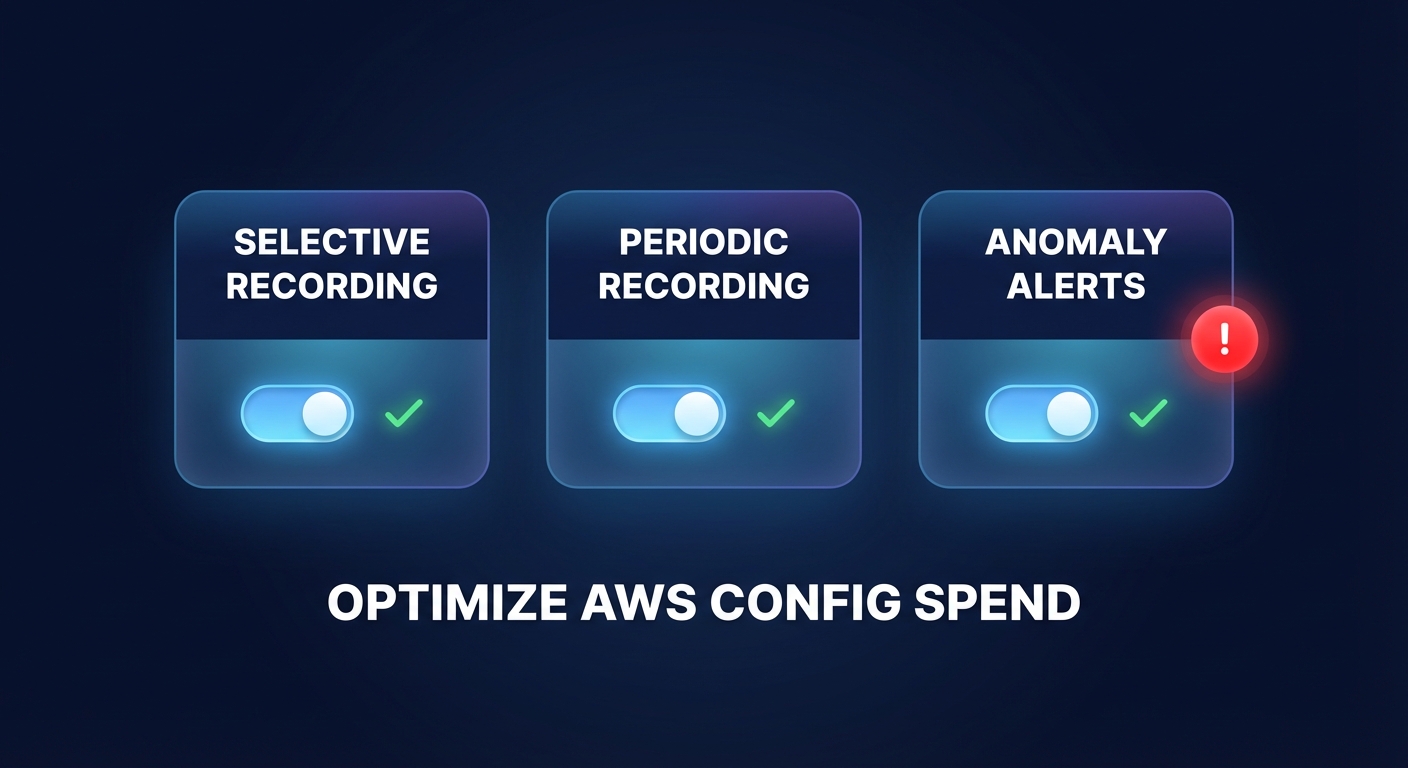
- Implement selective resource recording: By default, AWS Config records every supported resource. You can significantly reduce costs by switching to “specific resource types” and excluding noisy resources that offer little compliance value. For instance, unless your security policy explicitly requires it, excluding EC2:NetworkInterface or AWS::CodePipeline::Pipeline can drastically lower CI generation rates.
- Leverage periodic recording for non-prod: For development or staging environments, continuous recording is often overkill. Switching these environments to periodic recording allows you to capture the state of your infrastructure without paying for every transient change. This is a key AWS billing best practice that aligns costs with the actual risk profile of the workload.
- Perform root cause analysis with native tools: If you notice a spike, use AWS Cost Explorer to filter by “Usage Type.” Look specifically for “ConfigurationItemRecorded” or “ConfigRuleEvaluation” to see which region or account is driving the spend. Identifying the specific resource type generating the most CIs allows you to implement surgical exclusions rather than turning off Config entirely.
- Deploy automated guardrails: Manual audits are insufficient for dynamic cloud environments. Using building automated cost dashboards and anomaly detection helps you spot a Config spike within hours rather than waiting for the end-of-month invoice. Integrating AWS Trusted Advisor can also identify idle or underutilized resources that are generating unnecessary Config records.
Eliminating AWS waste with Hykell
Managing the intricacies of AWS Config is just one piece of a comprehensive cloud cost audit. Most organizations leave 30% to 40% of their cloud spend on the table due to inefficient configurations and unmanaged commitments. Manual tracking is often too slow to catch these leaks before they impact the bottom line.
Hykell provides the automated way to keep your entire AWS bill under control. Our platform operates on autopilot, identifying underutilized resources and optimizing your infrastructure without requiring ongoing engineering effort. We focus on deep rate optimization and resource-level tuning that ensures you only pay for what you actually use. This allows your engineering team to focus on innovation while we handle the financial heavy lifting.
Hykell’s performance-based model means we only get paid when you save. This aligns our incentives perfectly with your business goals: if we don’t uncover significant savings for your team, you don’t pay a dime. Calculate your potential savings today and let Hykell put your AWS cost optimization on autopilot.