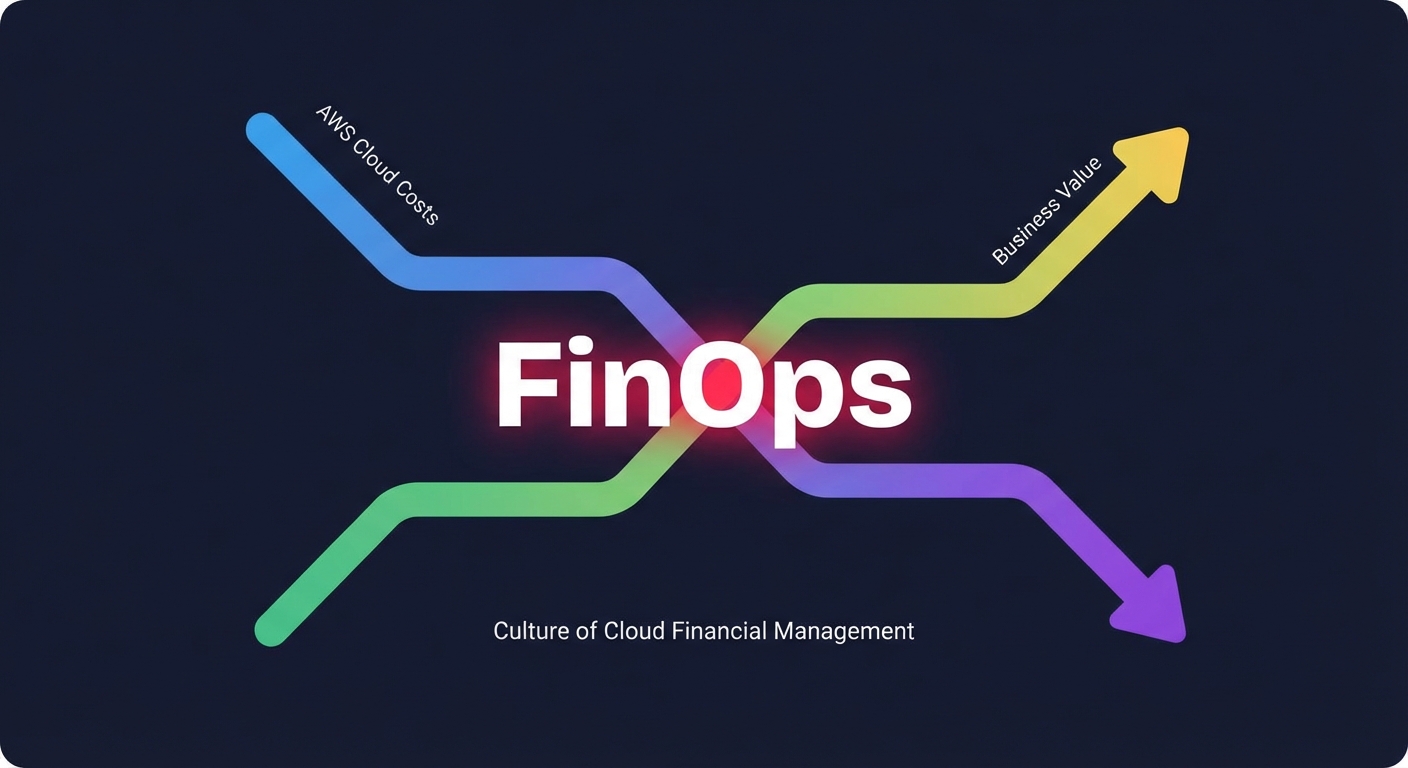
Is your AWS bill scaling faster than your revenue? While many teams view cloud costs as an unavoidable tax on innovation, top-performing engineering organizations treat cloud spend as a strategic lever. Here is how you can use FinOps to drive growth without the financial bloat.
What is FinOps?
FinOps is an operational framework and cultural practice designed to maximize the business value of cloud technology. A portmanteau of “Finance” and “DevOps,” the practice is also frequently referred to as cloud financial management or cloud financial engineering. According to the FinOps Foundation, which represents a community of over 95,000 members across 34,000 companies, the goal is to break down traditional departmental barriers. This creates a culture of financial accountability where engineering, finance, and business teams collaborate in real-time.
The core focus of this discipline is not simply spending less, but spending smarter. FinOps ensures that technical decisions are directly connected to financial outcomes, enabling you to build and scale with total cost clarity. While some perceive a friction between speed and thrift, understanding the synergies between FinOps and DevOps reveals that they are two sides of the same coin. DevOps accelerates software delivery, while FinOps ensures that innovation remains cost-effective and sustainable.
The three-phase FinOps framework for AWS
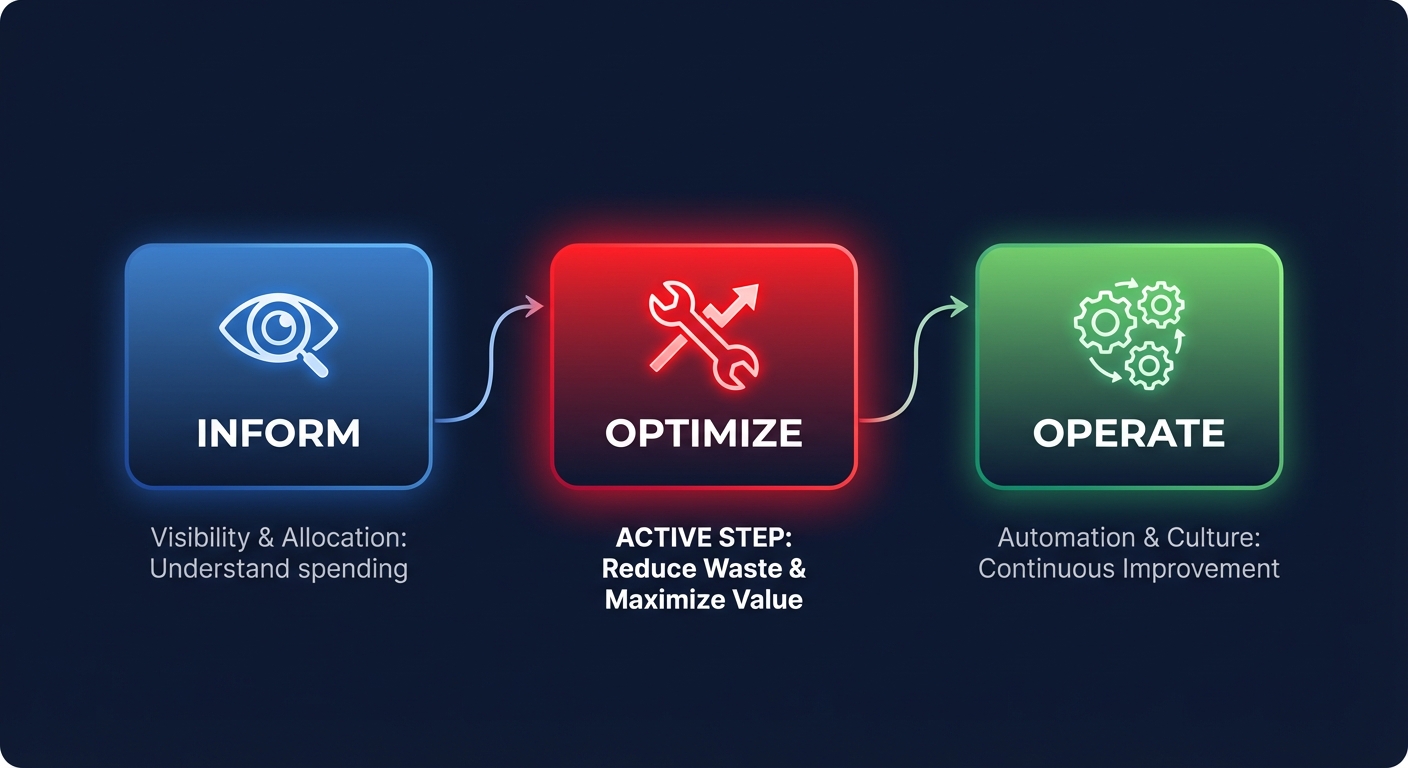
The journey toward cloud efficiency is an iterative lifecycle divided into three distinct phases: Inform, Optimize, and Operate. Most successful organizations cycle through these stages monthly or even weekly as their cloud footprint evolves.
Inform: Gain visibility and accountability
The first step is understanding exactly where your money is going, as you cannot optimize what you cannot see. This phase relies heavily on implementing a comprehensive tagging taxonomy that categorizes spending by department, project, and owner. By turning raw billing data into actionable business intelligence, you eliminate the “unallocated” line items that often consume up to 50% of unmanaged budgets.
Once tagging is established, you can use native tools like AWS Cost Explorer for historical trend analysis and forecasting. This visibility allows you to establish proactive financial guardrails and alerts. These systems prevent “bill shock” caused by accidental resource leaks, misconfigurations, or unplanned spikes in demand.
Optimize: Act on efficiency opportunities
With visibility secured, you can begin stripping away waste and refining your purchasing strategy. This phase focuses on rightsizing resources to match actual demand and moving beyond basic On-Demand pricing. You can significantly reduce unit costs by strategically leveraging Savings Plans and Reserved Instances for predictable, steady-state workloads.
Architectural efficiency also plays a major role here. For example, migrating to AWS Graviton instances can offer up to 40% better price-performance compared to x86-based alternatives. Optimization also involves a rigorous “cleanup” process to identify and eliminate orphaned EBS volumes, unattached Elastic IPs, and idle EC2 instances that contribute to unnecessary cloud bloat.
Operate: Institutionalize the practice
The final phase involves embedding cost-awareness into your organizational DNA. This requires a structured cloud cost governance framework that defines clear ownership and accountability for cloud spend. Many organizations implement chargeback or showback strategies to ensure that engineering teams see the direct financial impact of their architectural choices. When teams feel the weight of these decisions, they naturally shift toward more efficient resource utilization.
Defining core principles and roles
For FinOps to succeed, it must be supported by a cross-functional group often called a “Cloud Cost Council.” Success is shared across three primary pillars of the organization:
- Engineering and Operations: These teams own the architecture. In a mature FinOps model, roughly 68% of cost management responsibilities fall on engineering roles. They are responsible for technical rightsizing, investigating cost anomalies, and executing optimization recommendations.
- Finance and Procurement: This group manages the negotiation aspects of the framework. They handle complex agreements like the AWS Enterprise Discount Program (EDP) and manage long-term commitment planning to secure maximum discounts.
- Business Leadership: Executive sponsors ensure that efficiency goals align with the broader company roadmap. They balance the competing needs for speed-to-market and fiscal responsibility.
Measuring success with the Effective Savings Rate (ESR)
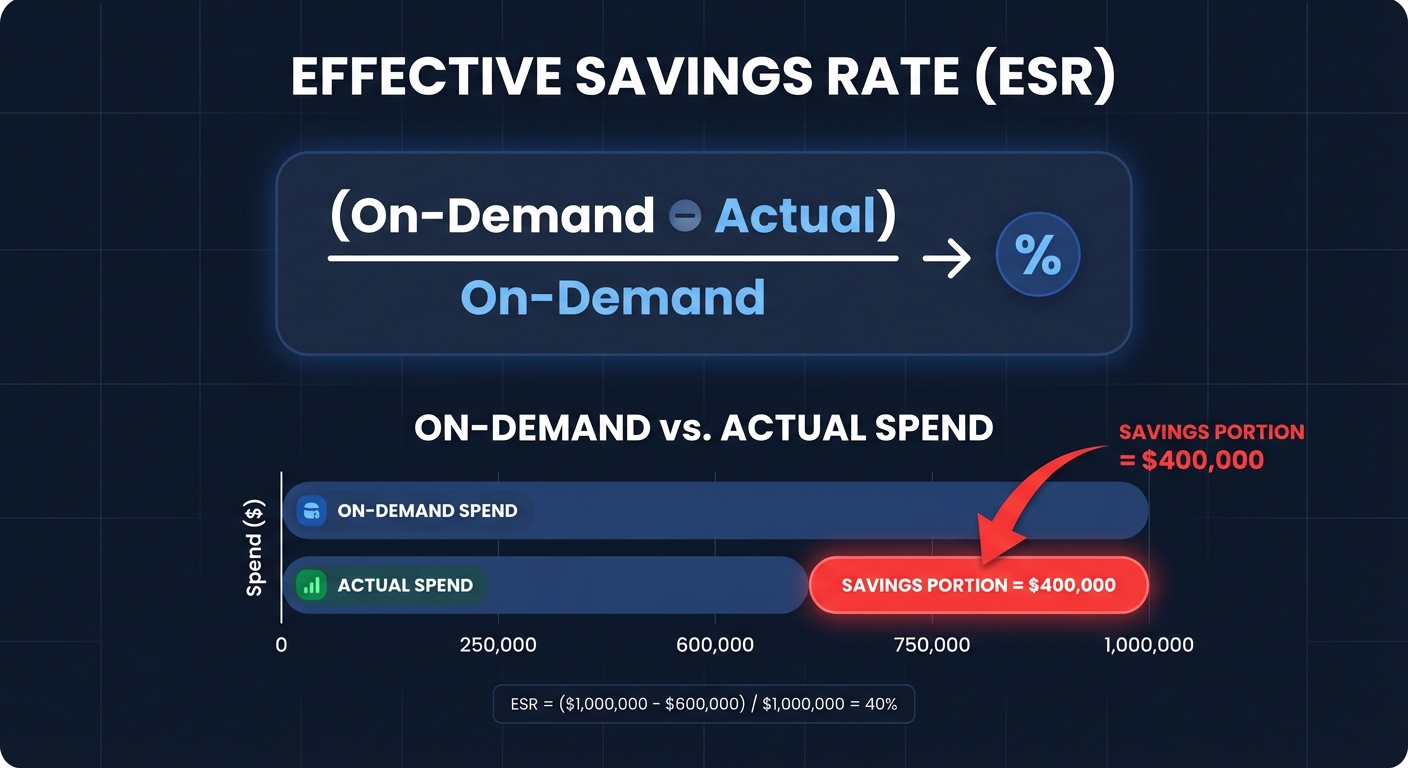
Many teams rely on traditional metrics like “Utilization” or “Coverage,” but these can be misleading when viewed in isolation. High coverage, for instance, might simply mean you are overcommitted and paying for resources you do not actually use. To capture the true efficiency of your AWS investment, you should prioritize the Effective Savings Rate (ESR).
The formula for ESR is: (On‑Demand spend – Actual spend) ÷ On‑Demand spend. This metric provides a unified view of how effectively you are blending various discount instruments – such as Spot instances, Reserved Instances, and Savings Plans – to lower your unit cost. While a typical team might see an ESR between 5% and 10%, top-performing FinOps organizations frequently reach ESR levels above 25%.
Applying automated AWS FinOps best practices
As your AWS environment scales to hundreds or thousands of instances, manual management becomes a liability. The future of the “Operate” phase is rooted in intelligent automation. Manually tracking and rebalancing commitments is error-prone and time-consuming, making automated AWS rate optimization essential for maintaining a high ESR without increasing financial risk.
Automation also extends to environmental scheduling and real-time monitoring. For instance, non-production environments do not need to run 24/7; automating shutdowns for idle development instances can reduce those specific compute costs by as much as 70%. Furthermore, providing engineers with a role-based observability dashboard allows them to see the financial impact of their code changes in real-time, enabling proactive adjustments before costs spiral.
By shifting from reactive firefighting to a proactive, automated FinOps culture, engineering leaders can reclaim significant portions of their budget to reinvest in innovation. Hykell helps you put your cloud optimization on autopilot, performing detailed audits and applying automated adjustments so you never overpay for infrastructure. Our performance-based model ensures we only win when you do – if you don’t save, you don’t pay.
Connect your AWS account for a free audit and discover how much you could be saving with automated FinOps intelligence.