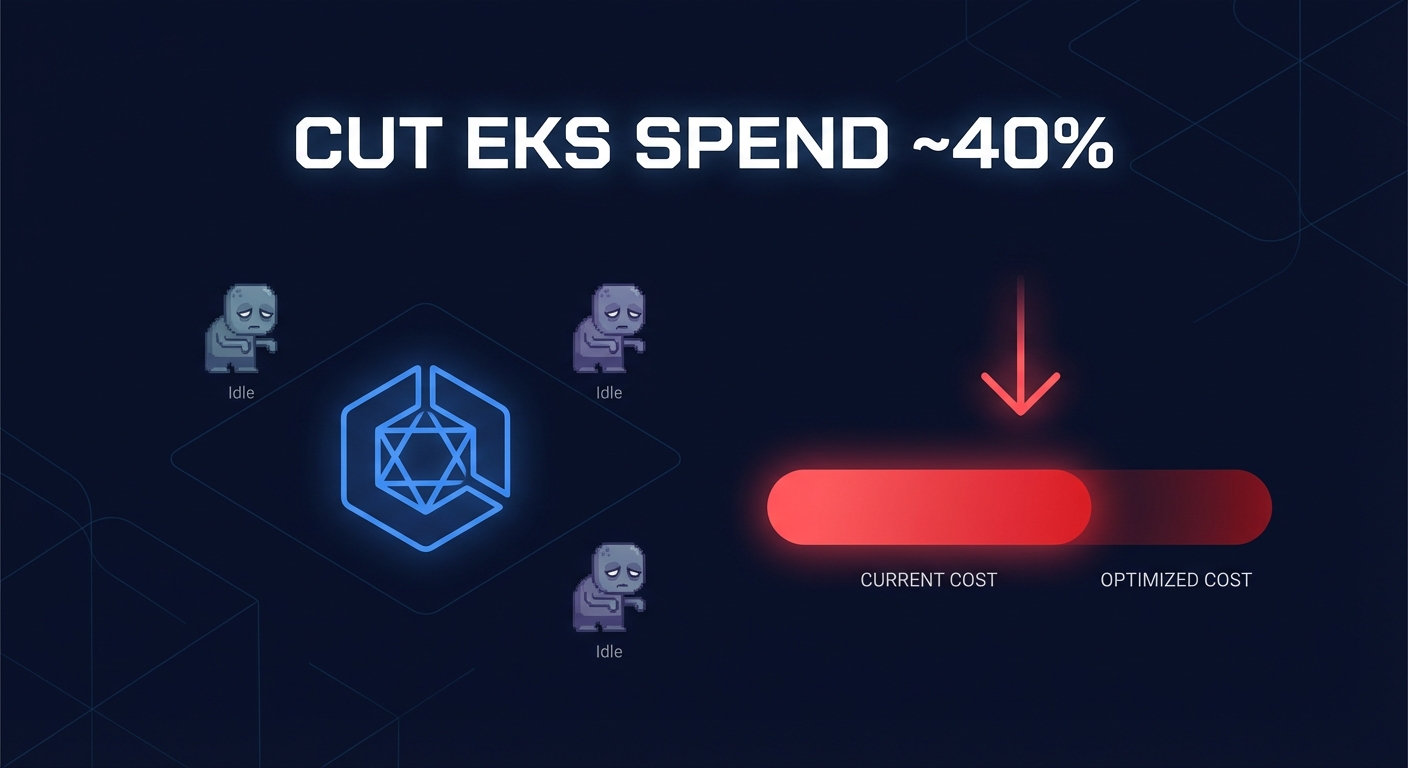
Is your EKS bill growing faster than your user base? While 82% of cloud-hosted Kubernetes workloads run on AWS, most teams overspend by up to 40% due to “zombie” clusters and idle resources. Here is how to reclaim your margin.
Where the money disappears in your EKS clusters
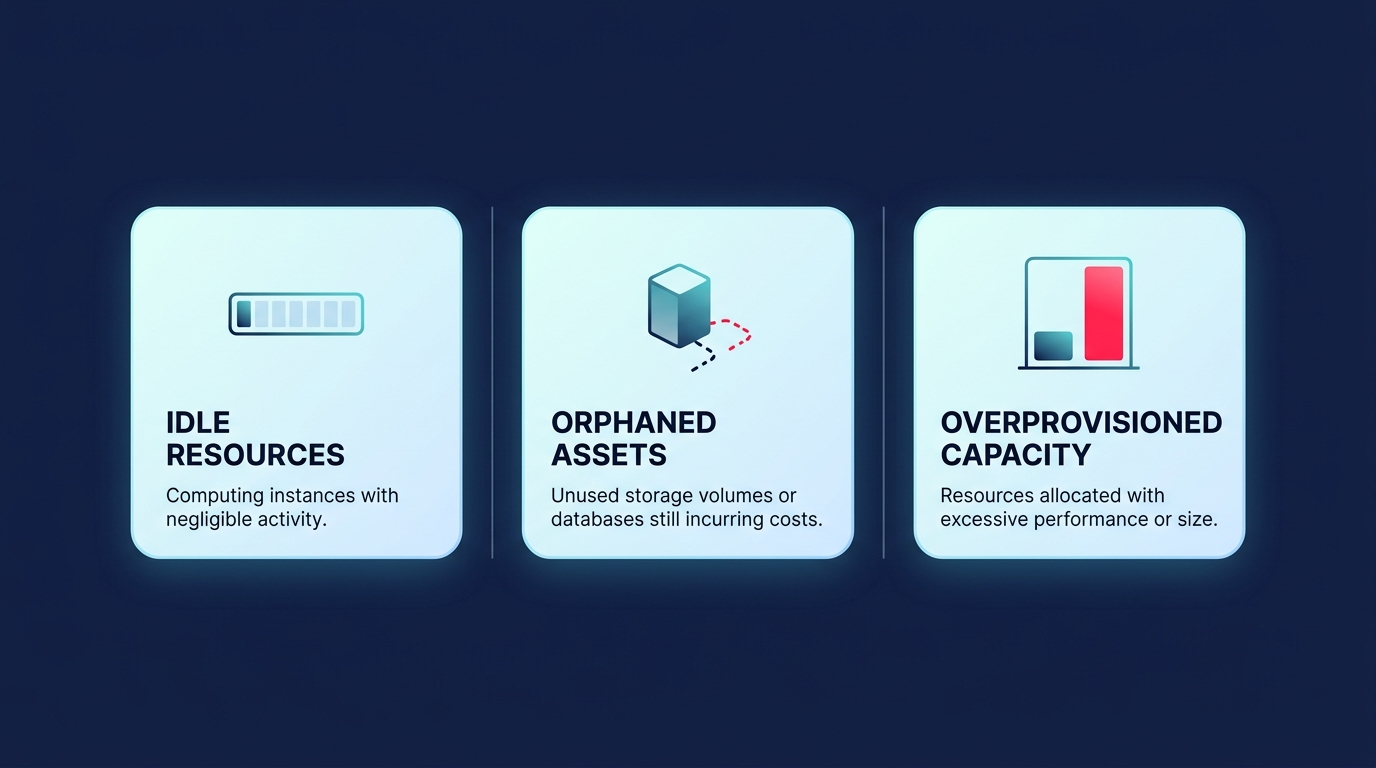
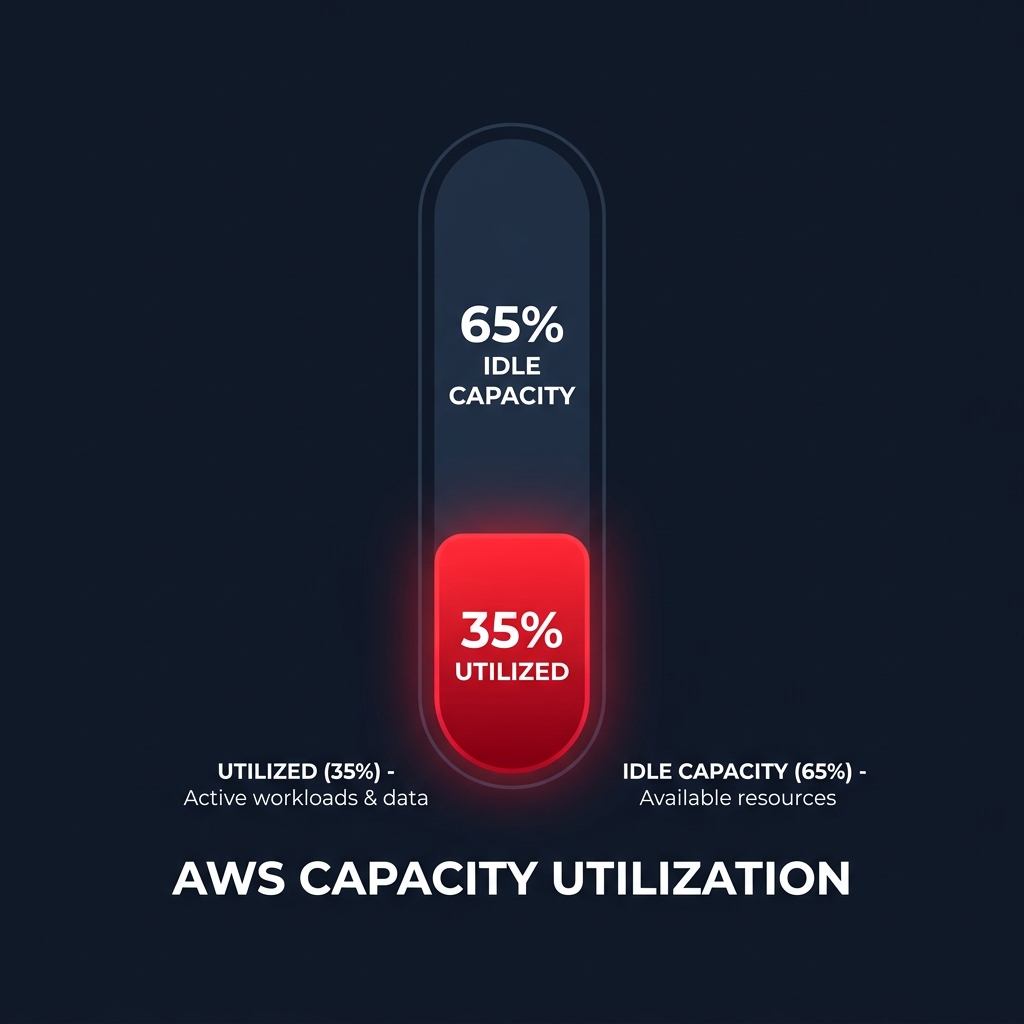
The flexibility of Kubernetes is a double-edged sword. While it allows for rapid scaling, it frequently leads to massive resource waste through over-provisioning at both the pod and node levels. Industry data indicates that nearly 40% of EC2 instances run at under 10% CPU utilization even during peak hours. When engineers set “just-in-case” resource requests that far exceed actual requirements, they create an expensive gap of idle capacity that you pay for regardless of whether it is used.
Hidden networking charges represent another silent budget killer for engineering teams. Cross-availability zone (AZ) traffic can account for 15–25% of total Kubernetes costs. Every gigabyte that travels between AZs or out through a NAT Gateway adds up quickly, often rivaling the cost of the compute resources themselves. Understanding the mechanics of AWS egress costs is the first step toward reclaiming this lost margin and optimizing your architectural layout.
Storage mismanagement further contributes to infrastructure bloat. Many teams continue to use older gp2 EBS volumes rather than the modern gp3 standard, which is 20% cheaper and allows you to scale IOPS and throughput independently of capacity. Without automated lifecycle rules, unattached volumes and stale snapshots often linger in your account long after their associated pods have been deleted, creating a persistent drain on your monthly budget.
Concrete tactics to optimize Kubernetes compute
The most immediate path to significant savings involves refining how you purchase and provision compute capacity. Relying exclusively on On-Demand instances is the most expensive way to run EKS. Instead, a hybrid strategy that integrates Spot Instances and Reserved Instances provides a superior balance of cost efficiency and workload reliability. Spot instances can reduce your compute costs by up to 90%, making them ideal for fault-tolerant workloads, CI/CD pipelines, or stateless microservices.
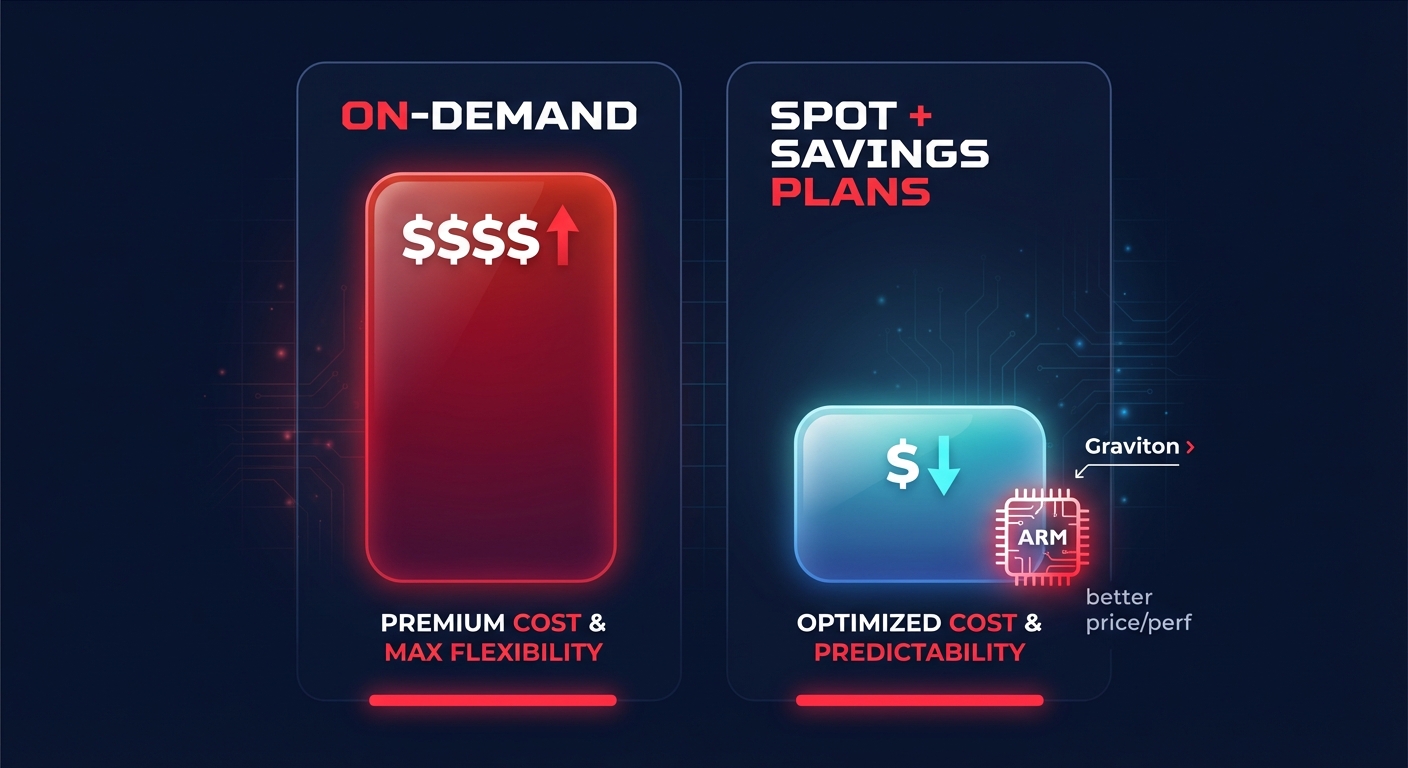
For your baseline, steady-state capacity, Compute Savings Plans offer up to 72% discounts with the flexibility to move across different instance families and AWS regions. To maximize these gains, you should also evaluate migrating your containerized workloads to ARM-based processors. You can accelerate your Graviton gains to achieve 40% better price-performance compared to traditional x86 instances, significantly lowering your unit economics.
Modernizing your scaling logic is equally vital for maintaining a lean cluster. Tools like Karpenter or the Vertical Pod Autoscaler (VPA) can automatically adjust node and pod sizes based on real-time demand rather than static estimates. Implementing EC2 auto-scaling best practices ensures that your cluster shrinks automatically when traffic drops, preventing you from paying for “ghost” infrastructure during off-hours or weekends.
Measuring and attributing spend with precision
You cannot optimize what you cannot see, and establishing deep visibility into your Kubernetes cost monitoring is essential for a successful FinOps strategy. While native tools like AWS Cost Explorer provide a high-level view of your bill, they often lack the granularity required to attribute spend to specific pods, namespaces, or individual engineering teams.
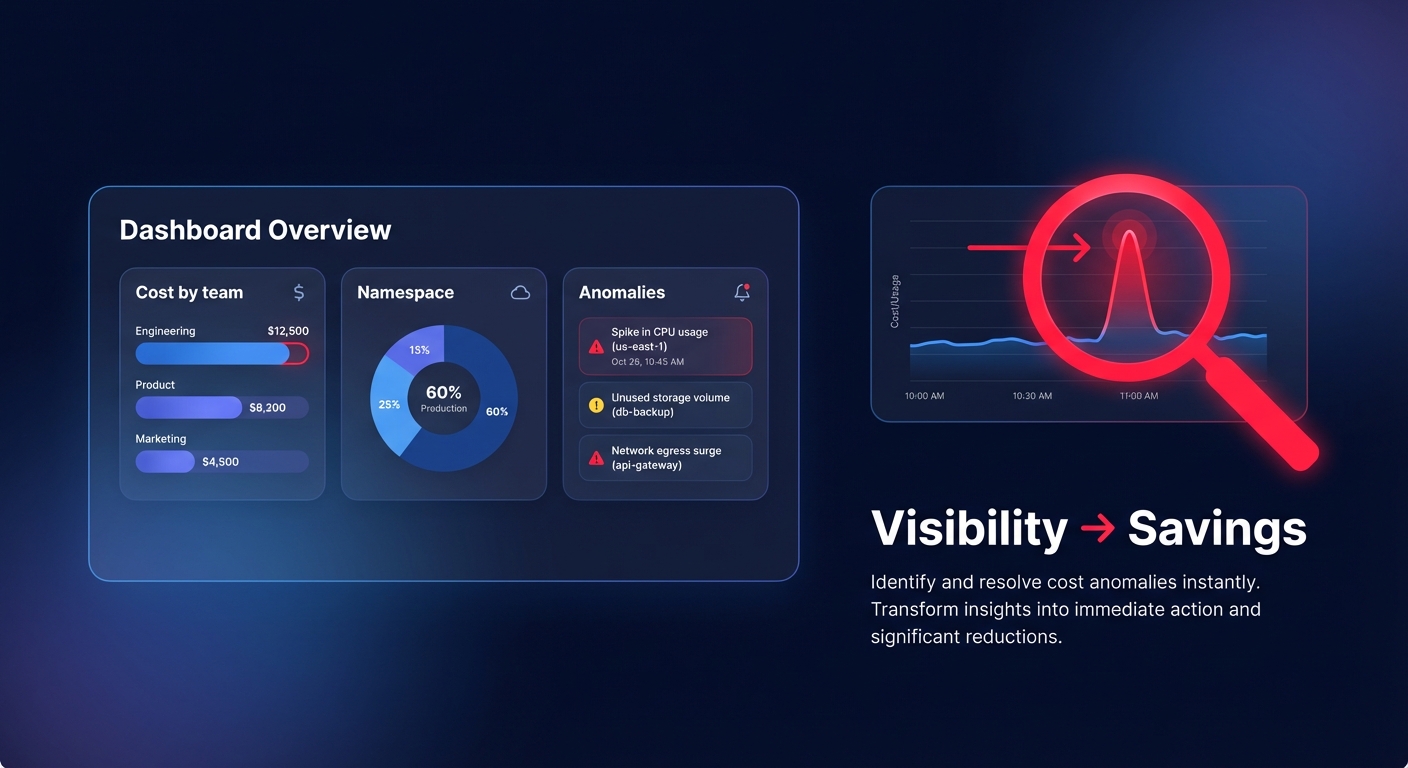
Integrating Kubecost with your EKS environment acts like a financial X-ray, breaking down expenses by team, project, or application. This granular data allows you to identify exactly which microservice is responsible for a sudden spike in AWS cost anomalies before the monthly bill arrives. When combined with Hykell’s role-based observability platform, engineering leaders gain the context they need to make data-driven architecture decisions without spending hours digging through raw billing files.
Putting your Kubernetes savings on autopilot
Manual optimization is a losing game in a dynamic cloud environment. As your architecture evolves and AWS releases new instance types, even the most diligent engineering teams struggle to keep their commitment coverage and resource sizing perfectly tuned. This is where Hykell transforms your cost management from a quarterly chore into a continuous, automated process that runs in the background.
Hykell’s proprietary solutions analyze your EKS usage patterns in real-time to identify inefficiencies you didn’t even know existed. By automating AWS rate optimization, Hykell ensures you always maintain the most efficient mix of Savings Plans and Reserved Instances, often doubling the savings that teams achieve on their own. This approach allows you to capture deep discounts without the risk of over-committing to unused capacity.
The best part of this automated approach is that optimizations happen on autopilot with zero code changes and no disruption to your application performance. Hykell only takes a slice of the actual savings generated – if you do not save, you do not pay. This “pay-on-success” model aligns engineering and finance goals perfectly, allowing you to reduce your cloud bill by up to 40% while your team stays focused on building products.
If you are ready to stop overpaying for idle capacity and start running your EKS clusters at peak efficiency, use our AWS instance cost calculator to see your potential savings today.