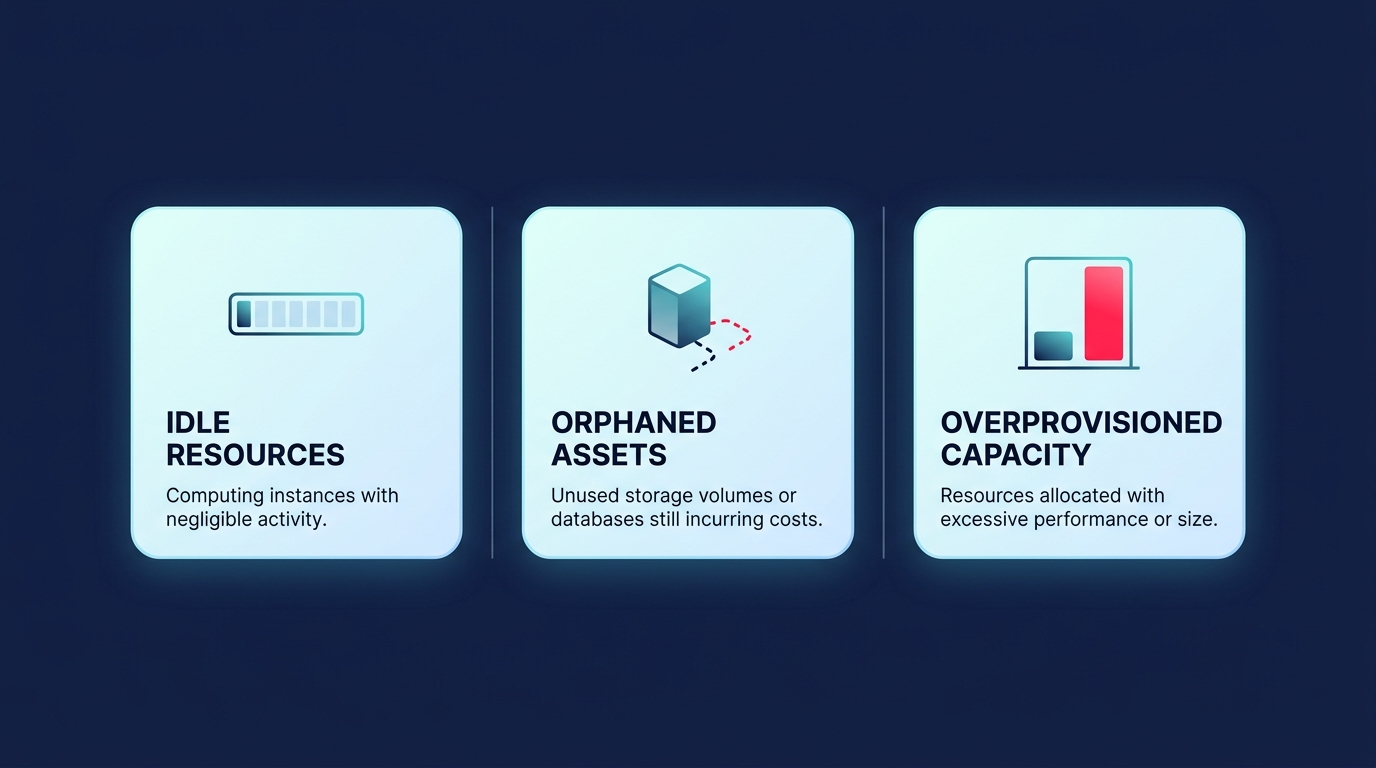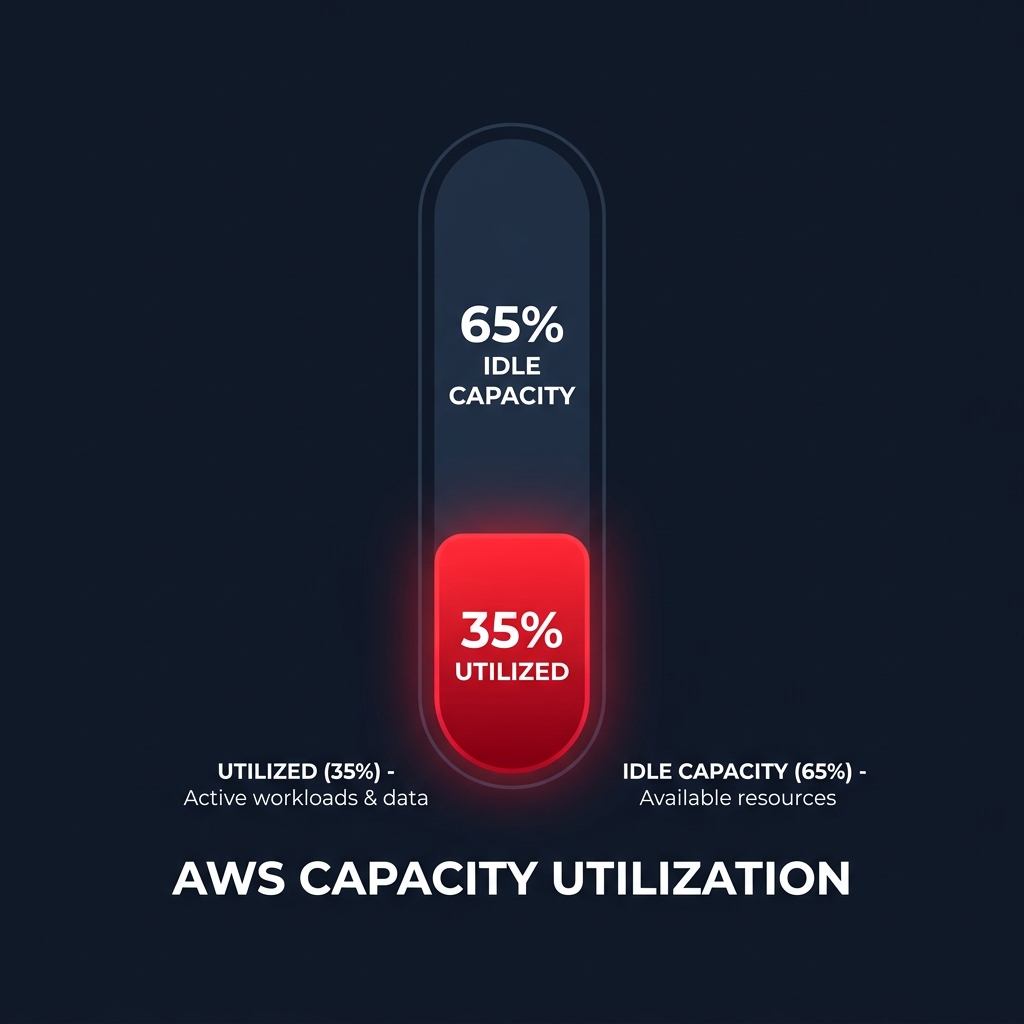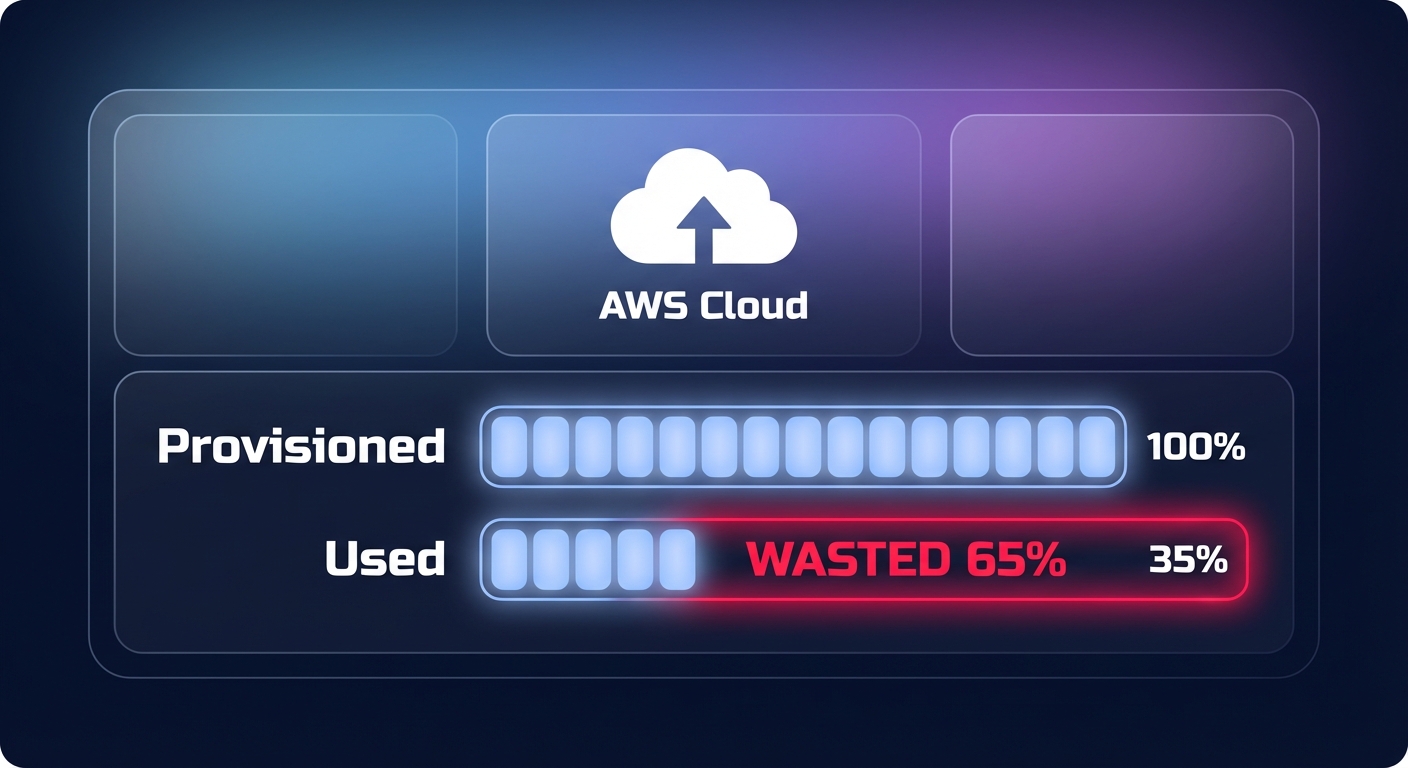
Are you paying for twice the cloud capacity your applications actually require? Most AWS environments operate at a meager 30–40% utilization, leaving nearly two-thirds of spend idle. Rightsizing bridges this gap, aligning your infrastructure with real-world performance demands to eliminate waste.
What is cloud resource rightsizing?
Cloud resource rightsizing is the systematic process of analyzing the performance requirements and usage patterns of your workloads to ensure they are running on the most cost-effective AWS instance types and sizes. While many engineering leaders confuse rightsizing with auto-scaling, they are fundamentally different levers. Auto-scaling adjusts the quantity of resources based on demand spikes, whereas rightsizing optimizes the type and size of the individual resources themselves.
By matching your provisioned capacity to your actual P99 utilization, you eliminate the safety buffers that often lead to significant cloud spend being wasted on idle resources. This applies not only to EC2 but also to EBS volumes, RDS databases, and Kubernetes clusters. When executed correctly, rightsizing identifies where you are over-provisioned and where you are under-provisioned, ensuring you pay only for the compute and storage you actually consume.
Reducing costs without hurting performance
A common fear among DevOps teams is that downsizing instances will trigger latency spikes or application failures. However, rightsizing frequently improves performance by moving workloads to better-suited instance families. For example, moving a memory-intensive application from a compute-optimized instance to a memory-optimized one can increase throughput while simultaneously lowering costs.
Organizations identifying hidden waste through a cloud cost audit often find that migrating to newer generations, such as AWS Graviton-based instances, provides up to 40% better price-performance than older x86 architectures. Rightsizing also allows you to address storage bottlenecks. Many teams provision EBS volumes with high IOPS that they never actually hit; migrating from gp2 to gp3 volumes can deliver approximately 30% cost savings and better baseline performance without any downtime.
Key metrics to track for effective rightsizing
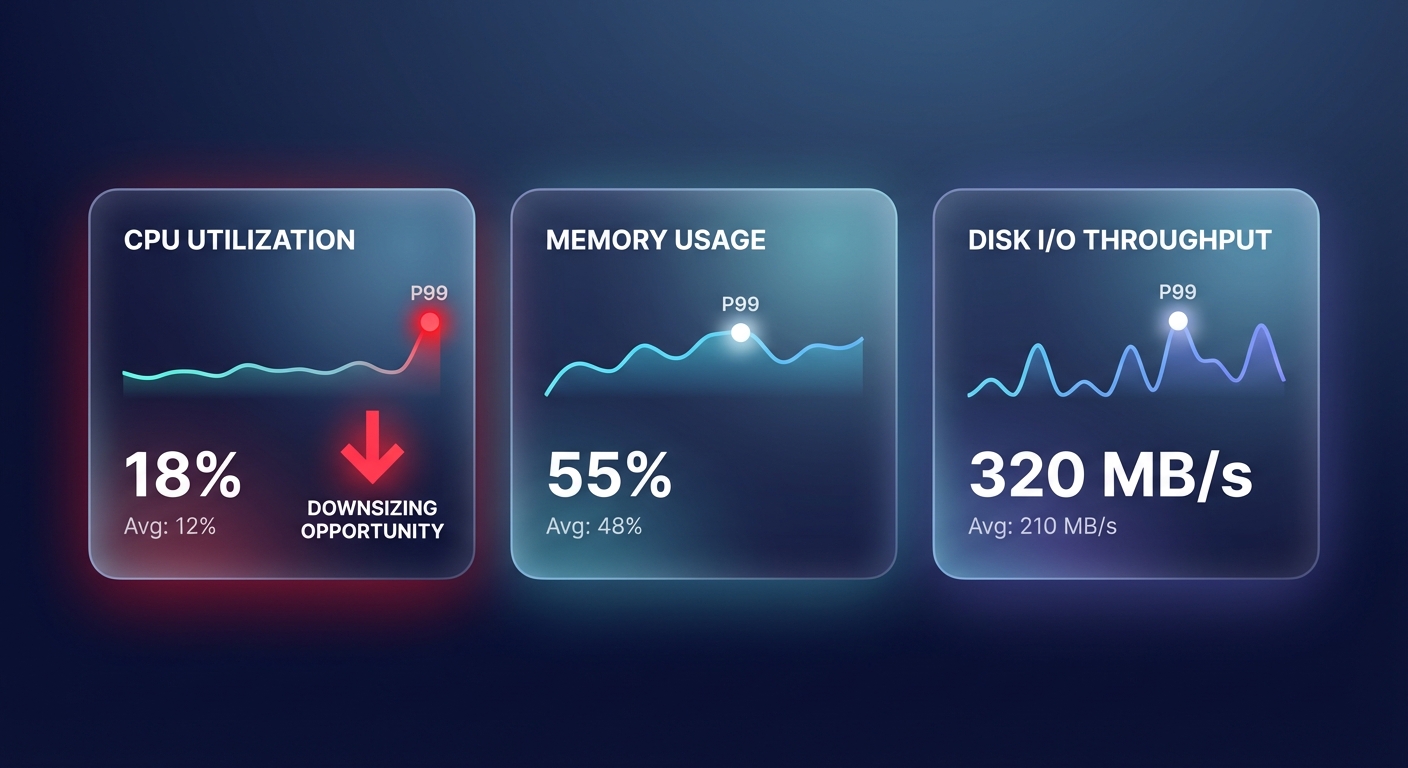
To rightsize with confidence, you must look beyond simple averages. Averages hide the bursts that define your application’s health. You should analyze historical data over a 2–4 week period to capture full business cycles, focusing on critical AWS KPIs such as CPU utilization. Instances consistently running below 40% are prime candidates for downsizing.
Memory usage is another vital metric, though it often requires the CloudWatch agent to track accurately. If your provisioned memory far exceeds application requirements, you are likely using the wrong instance family. Additionally, monitoring disk I/O and throughput can help identify zombie or unattached EBS volumes that eliminate thousands in monthly waste. One enterprise eliminated $10,000 in monthly spend just by cleaning up underutilized storage. Finally, track network in/out metrics, as high data transfer costs between regions often signal that your resource placement, rather than just size, needs optimization.
Best practices for continuous optimization
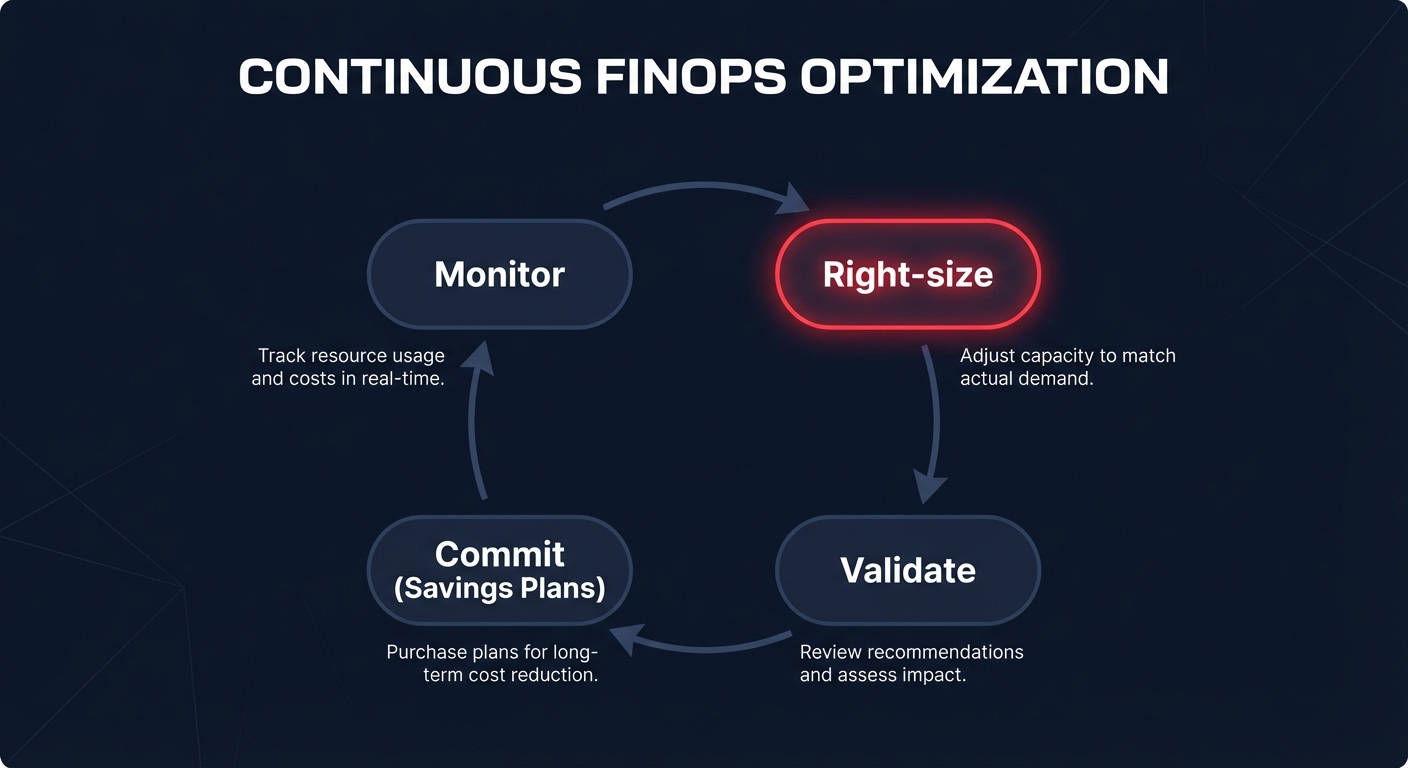
Rightsizing is not a one-time event; it is a continuous FinOps discipline. Performance requirements shift as code changes and user bases grow. To maintain an optimized state, you should always rightsize your fleet before purchasing Savings Plans or Reserved Instances. Committing to an oversized instance locks in waste for one to three years, effectively capping your potential ROI.
Establishing a rigorous tagging strategy is equally important. By enforcing tags for environment, owner, and cost center, you can identify exactly which teams are responsible for over-provisioned resources. Before pushing any changes to production, validate rightsizing recommendations in staging environments to ensure that smaller instance sizes can handle your typical load. While you can use tools for automated AWS rightsizing recommendations to identify quick wins, remember that native tools often provide insights without executing the changes for you.
Achieve 40% savings on autopilot with Hykell
The biggest challenge with manual rightsizing is the engineering overhead. Most teams lack the bandwidth to manually review thousands of instances and EBS volumes every month, leading to optimization drift where costs slowly balloon back up. Hykell solves this by putting your comprehensive AWS cost optimization on autopilot.
Our platform continuously analyzes your compute, storage, and Kubernetes workloads, implementing safe, governed changes that reduce your bill by up to 40% without requiring ongoing effort from your engineering team. From accelerating your Graviton gains to managing complex rate optimization strategies, Hykell ensures you never pay for more cloud than you need. Best of all, our pricing is entirely performance-based: we only take a slice of what we save you. If you don’t save, you don’t pay.
Calculate your potential AWS savings and see how automated rightsizing can transform your cloud economics today.