How to buy and sell AWS Reserved Instances on the RI Marketplace
AWS Reserved Instances promised you up to 72% savings – until your architecture evolved, workloads migrated regions, or growth patterns shifted. Now you’re stuck paying for capacity you don’t use. The AWS Reserved Instance Marketplace exists to solve exactly this problem, letting you exit stranded commitments or acquire short-term discounts from other customers. But navigating it successfully requires understanding what you can trade, when it makes sense versus Savings Plans, and how to avoid the pitfalls that trap most teams.
What is the AWS Reserved Instance Marketplace?
The AWS Reserved Instance (RI) Marketplace is a secondary market where customers buy and sell Standard Regional and Zonal Reserved Instances they no longer need. Sellers recoup value from unused commitments, while buyers access discounted RIs with shorter remaining terms – often at better prices than purchasing directly from AWS. Think of it as peer-to-peer exchange for cloud capacity commitments.
Here’s the critical limitation: only Amazon EC2 Standard regional and zonal Reserved Instances can be sold in the Reserved Instance Marketplace; Convertible RIs and RIs for other AWS services like RDS or ElastiCache are ineligible. This restriction alone determines whether RIs fit your architecture. If you need flexibility to change instance families or regions, the Marketplace exit strategy won’t help you with Convertible RIs – and Savings Plans become the better choice from day one.

When buying or selling RIs makes sense
Before diving into the Marketplace, ask whether Reserved Instances still fit your use case. As of 2025, most organizations should favor Savings Plans over RIs for similar discounts (up to 72%) with better flexibility – except when zonal capacity reservation is required or you specifically need the ability to resell commitments if plans change.
Sell unused RIs when your architecture has evolved
Your workload migrated from m5 to m7i instances, but your Standard RIs are locked to the old family – now you’re paying for discounts that don’t apply to anything. You moved from us-east-1 to eu-west-1, stranding regional RIs that can’t follow. Business priorities shifted and you’re overcommitted on capacity that sits idle. You’re winding down a legacy application but still have months remaining on a three-year RI term. In each case, the Marketplace lets you recover some value instead of eating the full sunk cost.
Buy from the Marketplace for short-term, stable commitments
You need shorter-term commitments – say six months remaining – without locking into a full one- or three-year term from AWS. You want Standard RIs for maximum savings (up to 72%) and the specific instance type and region match your workload perfectly. You require zonal capacity reservation for availability guarantees during peak traffic events that Savings Plans cannot provide. Your usage patterns are so stable that exact matching won’t become a liability when your next migration or scaling event happens.
In most other cases – especially if your architecture is evolving or spans multiple instance families – Compute Savings Plans offer better flexibility with near-identical discounts and automatic application across families, sizes, and regions.
Eligibility rules for selling RIs in the Marketplace
Not every Reserved Instance can be listed. AWS enforces strict eligibility criteria that exclude many commitments from trading.
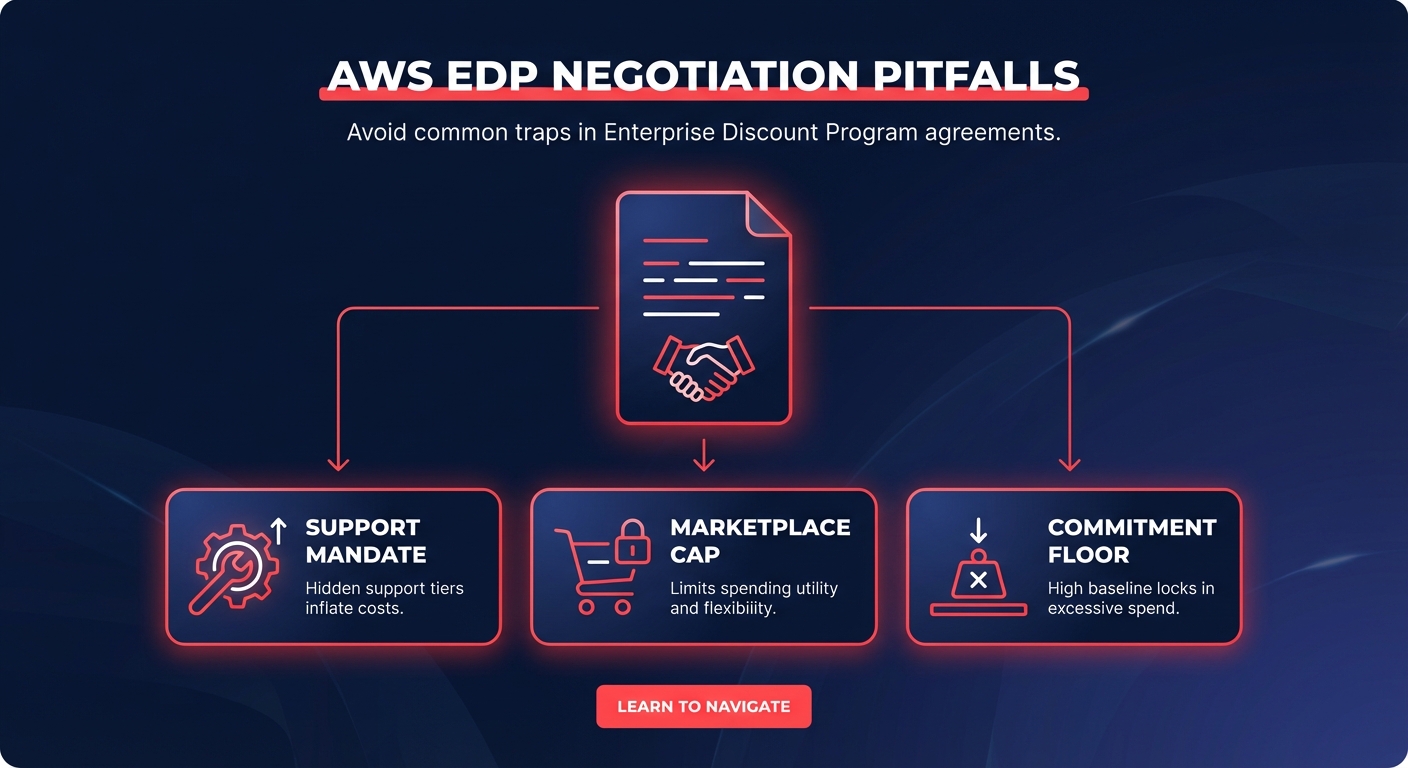
Only Standard regional or zonal RIs for EC2 are allowed; Convertible RIs and RIs for other services cannot be sold on the Marketplace. The RI must have at least one month remaining on the term and must have been active in your account for at least 30 days before listing. RIs purchased under volume discount tiers cannot be sold – and as of January 2024, Enterprise Discount Program (EDP) customers are prohibited from selling discounted RIs. You cannot list RIs in regions disabled by default in your account, and sellers must provide US bank account information for AWS to disburse payment.
There’s also a lifetime cap: you can sell a maximum of $50,000 in total value and up to 5,000 Reserved Instances across your account’s entire history – not annually. Once you hit the ceiling, you cannot list more RIs. Most teams never approach these limits, but large enterprises managing thousands of reservations need to plan for this constraint.
Step-by-step: how to sell a Reserved Instance
Verify eligibility and payment setup
Before listing, confirm your RI meets the criteria above. Navigate to EC2 → Reserved Instances in the AWS Management Console and select the RI you want to sell. If you haven’t already, set up a US bank account under Account Settings → Payment Methods for disbursements – AWS pays via ACH within three to five business days after the sale.
List your RI in the Marketplace
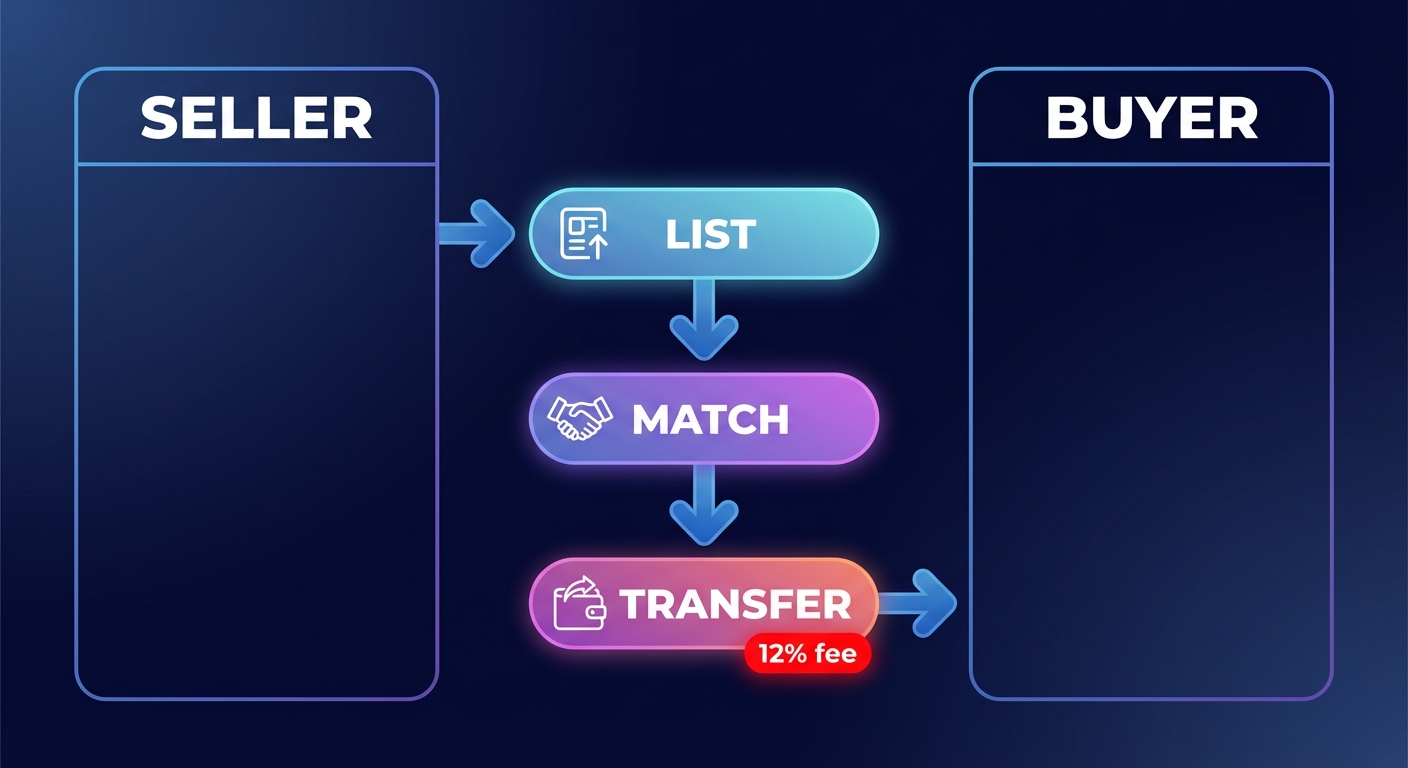
Choose Actions → Sell Reserved Instances and set your upfront price (minimum $0.00). AWS allows you to price at or below the remaining value. Review the 12% service fee AWS will deduct from your upfront proceeds – this is how AWS monetizes the Marketplace. Confirm the listing and your RI appears in the public Marketplace catalog within minutes.
Once listed, AWS processes transactions and transfers RI ownership to buyers immediately upon successful purchase. RI Marketplace transactions cannot be canceled, so once a buyer purchases your RI, the transfer is final. You’ll receive payment minus the 12% commission, and the RI no longer applies discounts to your account.

Optimize timing and pricing
Selling RIs is more art than science. Automated RI management platforms time listings to peak demand – weekday mornings for popular us-east-1 instance types – and adjust pricing in real-time based on marketplace trends. If you’re managing manually, monitor comparable listings via AWS Cost Explorer and price competitively to attract algorithm-driven buyers that dominate the Marketplace.
For less common configurations or regions like Frankfurt, selling can be challenging because automated algorithms prioritize standard instances and market demand is limited. Human buyers are scarce, so you’re competing for the attention of automated trading systems that may never match your offering.
Step-by-step: how to buy a Reserved Instance from the Marketplace
Search for matching RIs
Navigate to EC2 → Reserved Instances → Purchase Reserved Instances in the AWS Management Console. Filter by instance type, region, platform (OS), tenancy, and term length, then select “Reserved Instance Marketplace” as the source. AWS automatically applies the lowest available price in the specified grouping until your order is fulfilled, mixing third-party listings and AWS’s own RIs to give you the best aggregate deal.
Review pricing and terms
Each listing shows remaining term (for example, seven months), upfront price, hourly rate (if partial or no-upfront payment), and effective discount versus On-Demand. Buyers receive a price quote with a limit price; the purchase completes only if the final price doesn’t exceed the quoted amount. AWS bundles multiple seller RIs behind the scenes to fulfill your order at the best price, so you see one consolidated purchase even if AWS sourced your capacity from multiple sellers.
Complete the purchase
Click Purchase, confirm the details, and AWS charges your account. Ownership transfers immediately, and the RI discount begins applying to matching usage in the next billing hour. Remember that Standard RIs require exact matches on instance type, size, platform, and region to apply discounts. If you later change architectures – migrating from m5 to m6i, switching from Linux to Windows, or moving regions – those RIs become stranded commitments that continue billing but stop providing value.
Pricing mechanics: what you pay (or receive)
For sellers
You set the upfront price, but AWS takes a 12% commission on that amount. If you list a $1,000 upfront RI, you receive $880. The hourly rate (if any) continues to go to AWS, not you – you’re only selling the upfront portion and transferring the remaining commitment to the buyer.
For buyers
You pay the seller’s upfront price (via AWS as intermediary) plus any remaining hourly charges for the RI term. Because you’re buying from the secondary market, the remaining term is typically shorter – meaning lower total commitment but potentially higher effective hourly rates than a fresh one-year or three-year RI from AWS.
AWS applies the RI discount automatically to matching usage in your account. If you’re in an AWS Organization, regional RIs can be shared across accounts in the consolidated billing family, but zonal RIs reserve capacity only for the owning account and cannot be shared. This matters for organizations using multi-account strategies for isolation or cost allocation – zonal reservations lock to the purchasing account, while regional reservations provide broader coverage.
Risks and trade-offs: RIs vs. Savings Plans in 2025
The AWS RI Marketplace offers flexibility, but it’s not risk-free. Understanding the major downsides versus alternatives helps you decide when to use the Marketplace and when to avoid it entirely.

Architectural lock-in
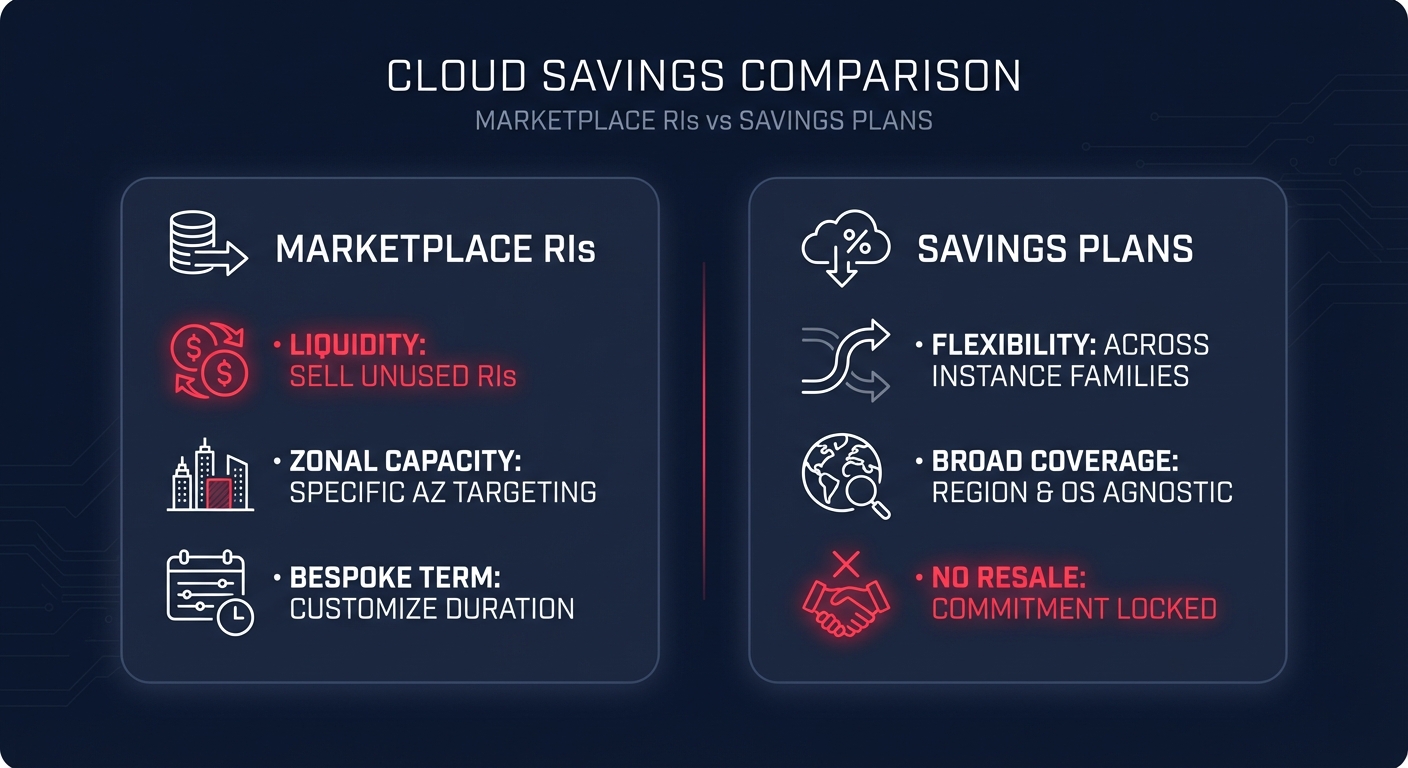
Standard RIs require exact matches on instance type, size, platform, and region. Wrong instance family, size, region, or OS means the discount doesn’t apply. Architectural shifts – like migrating from m5 to m7i instances or changing regions – strand RI commitments due to exact matching requirements. Savings Plans sidestep this by applying across families, sizes, and regions automatically. AWS automatically applies Savings Plans to the highest discount-eligible usage first across your entire portfolio, adapting as your architecture changes without manual intervention.
No resale for Savings Plans
Standard RIs can be listed on the Marketplace for resale if usage needs change, but Savings Plans cannot be resold. That makes RIs more liquid – but only if you can find a buyer. For less popular configurations or regions, selling can take weeks or may never happen. The trade-off is flexibility: Savings Plans offer better architectural flexibility, while Standard RIs offer resale as an exit strategy if you can stomach the matching constraints.
EDP restrictions
If your organization has an AWS Enterprise Discount Program agreement, you’re now prohibited from selling discounted RIs as of January 2024. That eliminates the Marketplace exit strategy for many large customers. If you rely on EDP pricing, the Marketplace becomes a one-way street – you can buy from it, but you can’t sell to it.
Limited demand for non-standard configurations
Algorithm-driven trading dominates the Marketplace, favoring common instance types like m5.large or c5.xlarge in popular regions like us-east-1. If you’re trying to sell RIs in less common configurations or regions, you may struggle to find buyers. Automated platforms like Hykell increase liquidity by timing listings to peak demand and adjusting prices in real-time, but manual sellers face an uphill battle in thin markets.
Lower discounts for Convertible RIs
Convertible RIs provide 10–15% lower discounts (typically 54–66% off On-Demand) than Standard RIs but allow adjustments for architectural changes. You can exchange Convertible RIs within certain rules, but you cannot resell them on the Marketplace. For most evolving architectures, Compute Savings Plans offer similar flexibility with better discounts than Convertible RIs and avoid the exchange complexity.
Hykell’s best practices for RI Marketplace trading
At Hykell, we’ve managed over $10 million in monthly AWS spend and helped clients recover up to 21% in immediate savings by intelligently blending RIs, Savings Plans, and Marketplace trading. Here’s our recommended approach based on real-world results.
Cover only 60–80% of baseline capacity with RIs
Optimal RI strategy covers 60–80% of baseline capacity to avoid over-commitment on unused capacity as architectures evolve. Use Savings Plans or On-Demand for the variable portion. This approach balances commitment savings with flexibility, reducing the risk that you’ll need to sell stranded RIs in the first place.
Prioritize Savings Plans for flexibility
For most workloads in 2025, Savings Plans deliver up to 72% discounts with far better flexibility than Standard RIs. Reserve RIs for specific cases: zonal capacity guarantees (for example, Black Friday traffic where you need guaranteed AZ capacity), extremely stable and unchanging workloads where exact matching isn’t a liability, or situations where you want the option to resell via the Marketplace if plans change. For everything else, Savings Plans provide similar discounts without the resale need because they adapt automatically.
Use the Marketplace as a tactical exit, not a strategy
The RI Marketplace is a useful exit valve when commitments become liabilities – not a primary savings vehicle. If you’re buying and selling RIs frequently, you’re managing complexity that Savings Plans and automation handle more efficiently. The Marketplace should be your backstop for one-off mistakes or major architectural pivots, not a routine part of your cost optimization playbook.
Automate trading with guardrails
Manual Marketplace management is time-intensive and error-prone. Hykell’s platform continuously monitors your usage, forecasts demand, and automatically buys, sells, or converts RIs and Savings Plans to maintain optimal coverage – without engineering lift. We apply guardrails like coverage caps, utilization thresholds, and manual overrides to prevent over-commitment while capturing Effective Savings Rates often exceeding 50–70%. Our algorithms consider risk tolerance, forecast accuracy, commitment term length, and cross-service trade-offs to balance savings with flexibility.
Blend RIs, Savings Plans, and Spot for maximum ROI
The best cost optimization strategy isn’t “all-in” on any single instrument. Hykell’s blended strategy layers Standard RIs or EC2 Instance Savings Plans for stable, predictable baseline workloads, Compute Savings Plans for flexible multi-family workloads that span services like EC2, Fargate, and Lambda, Spot Instances for fault-tolerant batch, CI/CD, or dev/test workloads (up to 90% off), and RI Marketplace trading to exit stranded commitments or acquire short-term discounts. This approach balances maximum savings with architectural agility, adapting as your infrastructure evolves without locking you into commitments that become liabilities.
Frequently asked questions
Can I sell Convertible Reserved Instances?
No. Only Standard RIs can be listed in the Marketplace. Convertible RIs allow you to exchange them for other instance types but cannot be resold.
What happens if I close my AWS account with active RIs?
Closing the account that purchased an RI results in the payer account being charged for the RI until expiration. Selling unused RIs via the Marketplace before account closure is the only way to exit the commitment early.
How quickly do RIs sell?
It varies widely. Popular instance types in high-demand regions like m5.large in us-east-1 often sell within hours. Less common configurations or regions can take weeks – or never sell. Automated platforms optimize timing and pricing to improve sell-through rates, but no tool can create demand where none exists.
Can I buy RIs from the Marketplace across multiple sellers?
Yes. AWS bundles multiple seller RIs to fulfill your order at the best aggregate price. You see one consolidated purchase, but AWS handles the backend transactions with multiple sellers and routes payment accordingly.
Are there tax implications for selling RIs?
AWS disburses proceeds via ACH to your registered US bank account. Consult your tax advisor regarding how to report the income or capital recovery from RI sales, as treatment varies by jurisdiction and entity structure.
Turn AWS commitments into strategic advantage
The AWS Reserved Instance Marketplace is a powerful tool – but it’s only one piece of a comprehensive AWS cost optimization strategy. For most organizations in 2025, the real opportunity lies in automated, adaptive commitment management that blends RIs, Savings Plans, Spot, and Marketplace trading dynamically as your infrastructure evolves. Manual management of these instruments wastes time and leaves savings on the table – teams spend days debating commitments while usage patterns shift and ideal windows to commit close.
Hykell’s platform does exactly that. We analyze your usage patterns, forecast demand, and continuously adjust your discount portfolio – buying, selling, and converting commitments to maximize savings without engineering effort. Our clients typically see 30–40% reductions in AWS compute costs while freeing their teams to focus on innovation instead of spreadsheet wrangling. We manage commitments across your entire AWS estate, applying guardrails to prevent over-commitment while capturing every available discount.
Ready to stop overpaying for AWS? Get a free commitment audit and see exactly where you’re leaving money on the table – whether it’s unused RIs, suboptimal Savings Plans coverage, or missed Marketplace opportunities. With Hykell, you only pay when you save.