How to negotiate an AWS EDP agreement to reduce spend and maximize value
Negotiating with AWS feels like playing poker when you can’t see your own cards – and AWS holds the full deck. Yet organizations that approach their AWS Enterprise Discount Program (EDP) negotiations strategically secure discounts 3–5 percentage points higher than peers with identical spend profiles, translating to hundreds of thousands in annual savings.
If you’re facing an upcoming renewal or considering your first EDP agreement, understanding the negotiation mechanics isn’t optional – it’s the difference between a 9% discount and a 15% discount on a $3 million commitment.
Understanding what you’re actually negotiating
The AWS Enterprise Discount Program requires a minimum $1 million annual spend commitment for eligibility and delivers 40–70% off On-Demand rates across 200+ AWS services. But here’s what most organizations miss: you’re not negotiating a simple percentage off your bill.
You’re negotiating a multi-dimensional contract that includes baseline discount rates, commitment tiers, step-up structures, penalty clauses for underrun, pricing breaks at specific thresholds, and flexibility provisions that determine how painful (or painless) your contract becomes when reality diverges from forecast.

AWS structures EDP contracts with 1–5 year terms featuring tiered discount structures that improve as usage grows. Baseline discounts for $1+ million annual commitments typically range from 6–9% on standard On-Demand pricing, while three-year agreements generally offer approximately 15% discounts compared to roughly 10% for one-year deals.
The critical insight: discount percentages scale significantly at key pricing breaks occurring at annual commitment thresholds of $1M, $1.5M, $2M, and $5M. Moving from a $1.5M to $1.6M annual commitment can increase your discount rate from 12% to 14% – a seemingly small increase that compounds to tens of thousands in savings.
Before you enter the negotiation room
Walking into EDP negotiations without preparation is like rightsizing EC2 instances by gut feel – you might get lucky, but you’ll probably overpay.
Conduct a forensic analysis of your current spend
Pull 12–24 months of detailed usage data from AWS Cost and Usage Reports. You need granular visibility into service-level consumption patterns, regional distribution, seasonal fluctuations, and growth trajectories. Organizations using AWS Cost Explorer can generate these insights systematically, but you’ll need to dig deeper than the default views.
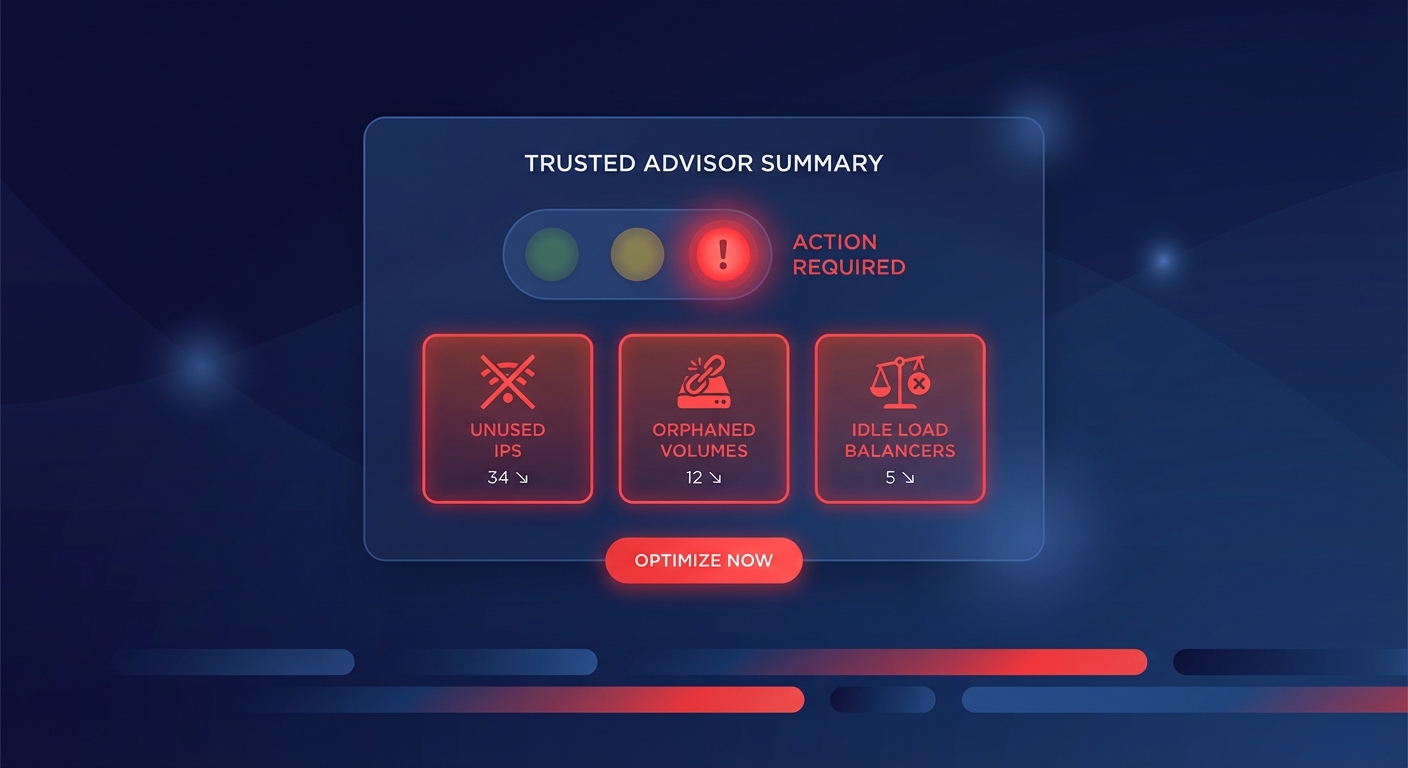
According to Gartner research, organizations can waste up to 70% of cloud spend without active optimization. Your first task is eliminating that waste before committing to multi-year spend levels. A detailed cost audit that identifies underutilized resources, orphaned EBS volumes, and inefficient architectures establishes your true baseline – the foundation for accurate commitment sizing.
Real example: a UK fintech discovered they were carrying $47,000 in monthly costs from unattached EBS volumes and oversized RDS instances running at 12% utilization. They eliminated that waste before negotiating their EDP, avoiding a commitment built on inefficient infrastructure.
Model conservative, moderate, and aggressive growth scenarios
AWS will push you toward aggressive commitments tied to optimistic growth projections. Resist. Longer-term agreements with conservative growth projections yield better negotiation outcomes than aggressive commitments you can’t meet.
Create three detailed forecast models. Your conservative scenario assumes flat growth or modest increases based on contracted customer commitments and existing product lines. Your moderate scenario projects realistic growth aligned with your three-year business plan, accounting for known product launches and market expansion. Your aggressive scenario models high-growth outcomes requiring everything to go right – new products succeeding, market expansion hitting targets, and no competitive pressure.
Your commitment should align with the conservative scenario, with step-up provisions matching your moderate forecast. Organizations cannot reduce annual commitment below the previous year’s level – if you commit to $2M in 2024, you cannot drop to $1.75M in 2025. This asymmetric risk makes conservative initial commitments essential.
Establish your walking-away threshold
You need leverage, and the only real leverage in enterprise software negotiations is credible willingness to walk away. Calculate your effective discount rate from existing Reserved Instances, Savings Plans, and Spot Instance utilization. If you’re already achieving 35% effective savings through disciplined commitment management, an EDP offering 8% baseline doesn’t move the needle.
Many enterprises stack EDP with Savings Plans – the EDP establishes baseline discounts while Savings Plans handle variable workloads. Understand this interplay before negotiations. Teams using automated optimization platforms achieve 50–70% Effective Savings Rates (ESR), which creates powerful negotiation leverage: “We’re already achieving X% ESR through active optimization – your EDP needs to deliver incremental value beyond that baseline.”
Eight negotiation tactics that actually work
1. Lead with your commitment ceiling, not your floor
Most organizations enter negotiations stating their expected annual spend and ask AWS for a discount. This anchors the discussion at the wrong point. Instead, state the maximum commitment you’re willing to make and negotiate the discount rate against that ceiling.
“We’re prepared to commit $2.8M annually over three years, and we need to understand what discount rate makes that commitment financially attractive compared to our current optimization approach delivering 42% ESR.”
This frames the conversation around discount depth rather than commitment size, shifting negotiating dynamics in your favor.
2. Use pricing thresholds as leverage points
Remember those commitment thresholds at $1M, $1.5M, $2M, and $5M? These aren’t arbitrary – they represent AWS’s internal discount tiers. Key pricing breaks occur at these thresholds, with incremental discount increases as you cross each level.
If your natural commitment level sits just below a threshold (say, $1.8M), negotiate the discount rate as if you’re committing to $2M, with provisions to reduce if usage doesn’t materialize. AWS wants to hit their own revenue targets, and getting a customer across a threshold matters to their account managers.
3. Negotiate step-up structures that align with realistic growth
Step-up commitments – for example, £1.2M year one, £1.5M year two, £1.8M year three – align with growth projections while securing better overall discounts. This approach protects you from overcommitment while giving AWS visibility into your growth trajectory.
The key is negotiating step-ups that track conservatively below your moderate-case forecast, leaving room for reality to fall short without triggering penalties.
4. Clarify how discounts count toward commitment
Many organizations don’t realize that EDP discounts don’t count toward total annual commitment. If you commit to $2M spend and receive $200K in discounts, only $1.8M counts toward commitment retirement. This creates a gotcha where you need to spend more gross dollars to meet your net commitment.
Negotiate explicit language defining whether commitment is measured pre- or post-discount, and ensure any overrun beyond committed spend is charged at your EDP rate but doesn’t automatically roll into future commitment requirements.
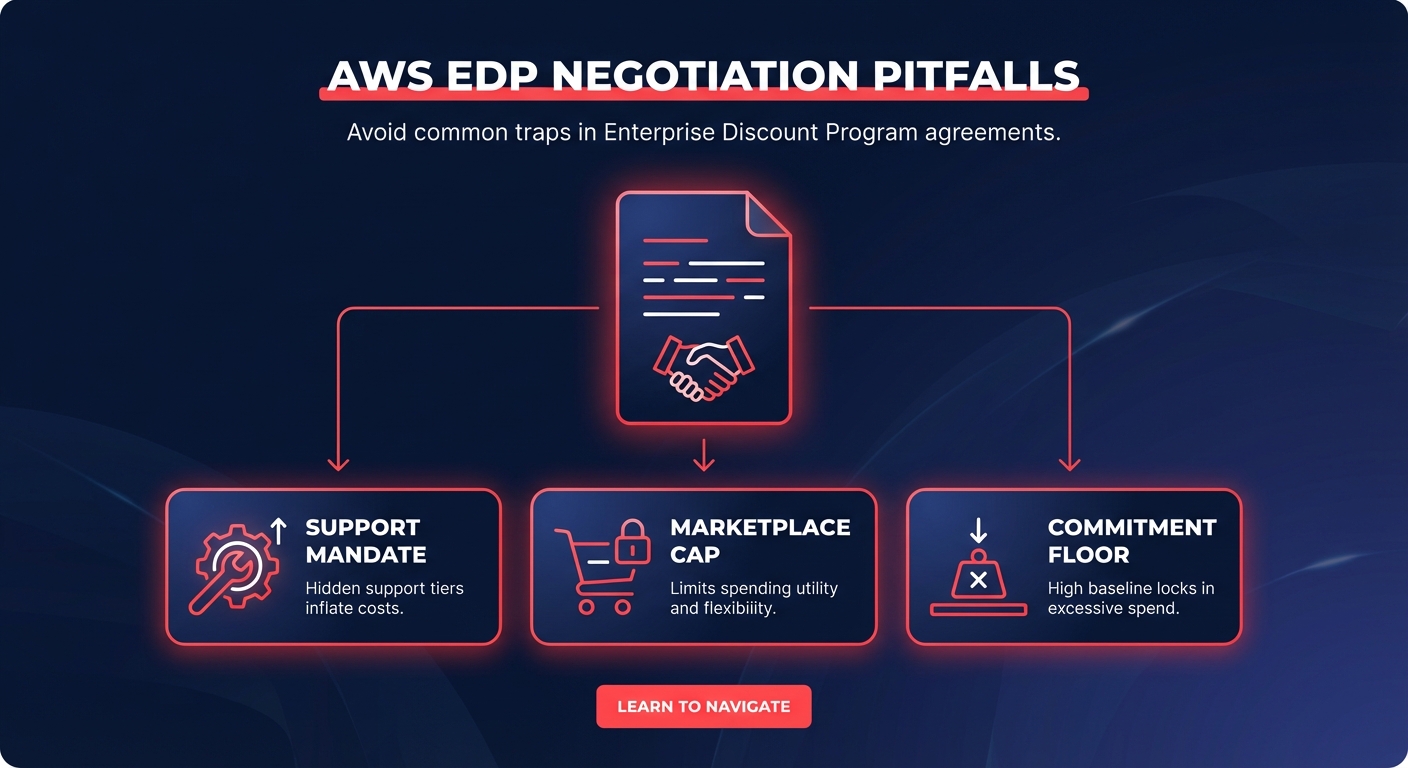
5. Maximize AWS Marketplace inclusion
Up to 25% of EDP committed spend can include AWS Marketplace purchases. If you’re using third-party software through the Marketplace (monitoring tools, security solutions, databases), negotiate to maximize this percentage. Getting to 30% or even 35% Marketplace inclusion in your EDP provides flexibility to shift between first-party AWS services and Marketplace solutions without jeopardizing commitment retirement.
6. Negotiate around Enterprise Support requirements
AWS requires EDP participants to enroll in AWS Enterprise Support, which increases your effective costs. Enterprise Support pricing varies by spend level but typically ranges from 3–10% of monthly AWS charges.
Two negotiation approaches work here: first, negotiate to have a portion of Support fees count toward your EDP commitment; second, if you’re already on Enterprise Support, use that existing relationship as leverage – “We’ve been Enterprise Support customers for 18 months, investing in this partnership before signing an EDP. That loyalty should factor into our discount rate.”
7. Build in architectural flexibility provisions
Cloud architectures evolve rapidly. Migration to Graviton instances can cut compute costs by up to 40% while improving performance, but only if your EDP doesn’t penalize architectural optimization. Negotiate provisions that allow commitment reductions if you achieve significant savings through architectural improvements like Graviton adoption, Kubernetes optimization, or serverless refactoring.
This protects you from the perverse incentive where optimizing your infrastructure actually hurts your EDP economics by creating commitment underrun.
8. Use competitive alternatives as negotiation leverage
While your workloads may be deeply AWS-native, AWS doesn’t know that with certainty. Multi-cloud strategies are common enough that credibly exploring Azure Enterprise Agreements or GCP committed use discounts creates negotiating pressure. You don’t need to actually migrate – you need to demonstrate you’ve modeled the economics of alternatives.
“We’ve run parallel POCs on Azure for our container workloads, and their Enterprise Agreement terms are competitive on a TCO basis when factoring in our migration costs. We’d prefer to consolidate on AWS, but we need the economics to justify that decision.”
The anatomy of a well-structured EDP agreement
Beyond discount rates, your EDP contract terms determine whether you’ve negotiated a strategic advantage or an expensive straitjacket.
Commitment measurement and true-up mechanics
Insist on quarterly true-up cycles rather than annual. Quarterly reviews give you visibility into commitment pacing and allow course corrections before underrun penalties bite. Overconsumption beyond committed spend is charged at your EDP rate but doesn’t count toward future commitment retirement – ensure this is explicit in your contract to avoid surprise bills.
Service scope and exclusions
Not all AWS services receive equal discounts under EDP agreements. Clarify which services receive preferential rates and which remain at standard pricing. Data transfer, support fees, and certain specialized services may be excluded from your negotiated discount – get this in writing to avoid bill shock.
Commitment portability across accounts
If you operate multiple AWS accounts under AWS Organizations, ensure your EDP commitment pools across all linked accounts. This flexibility is critical for showback and chargeback strategies that allocate costs to business units while maintaining enterprise-level discount leverage.
Modification and exit provisions
Business circumstances change – acquisitions, divestitures, product pivots, or economic downturns can make your commitment untenable. Negotiate provisions allowing commitment modification under specific triggers: material acquisition or divestiture (typically defined as >30% revenue impact), force majeure events, or AWS service quality issues documented through Enterprise Support cases.
Exit provisions are harder to negotiate but not impossible. A tiered penalty structure (50% of remaining commitment if you exit in year one, 30% in year two, 10% in year three) is more reasonable than the all-or-nothing approach AWS initially proposes.
Common EDP negotiation pitfalls to avoid
Optimizing for headline discount rate instead of effective savings
A 15% EDP discount sounds impressive until you realize it applies to already-inflated On-Demand pricing. Organizations using Reserved Instances and Savings Plans strategically often achieve deeper effective discounts than headline EDP rates suggest.
Calculate your effective savings rate by dividing actual spend by the equivalent On-Demand cost for your usage profile. A scenario with 75% coverage and 100% utilization achieved 28.1% savings versus 100% coverage with 66.7% utilization yielding only 6.3% savings. Your EDP should improve on these baseline ESR numbers, not replace them.
Committing based on gross spend including waste
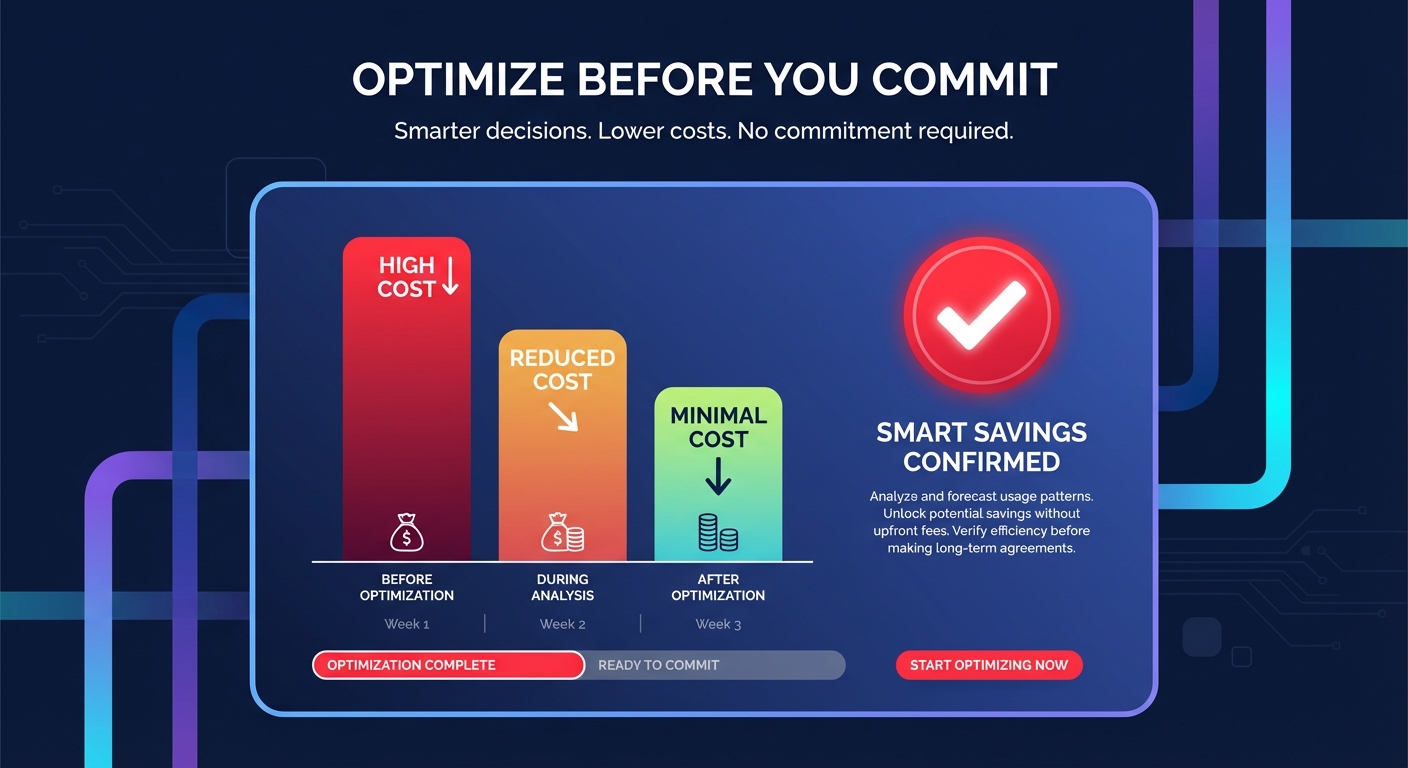
Negotiating an EDP before rightsizing and optimization is like buying life insurance before getting healthy – you’re locking in costs you shouldn’t be incurring. Businesses typically reduce AWS costs by 30–70% through rightsizing, automation, and strategic resource allocation.
Sequence your optimization: eliminate waste, establish efficient baseline, then negotiate EDP based on optimized spend. Otherwise you’re committing to pay for inefficiency.
Ignoring the relationship between EDP and Savings Plans
Many enterprises make commitment decisions in isolation – negotiating an EDP without considering how it interacts with their Savings Plans strategy. The most cost-effective approach stacks both: EDP provides baseline discounts across your full AWS footprint, while Savings Plans cover specific compute workloads with deeper discounts.
Standard Reserved Instances offer up to 72% off On-Demand with 3-year All Upfront payment, while Convertible RIs provide up to 66% off On-Demand with flexibility to change instance attributes. Your EDP baseline stacks with these instruments – ensure your negotiation preserves this stacking capability.
Accepting AWS’s first offer
AWS account managers operate under quota pressure and have flexibility to improve terms – but only if you negotiate. The first EDP proposal is never the best available deal. A mid-market SaaS company initially offered a 9% discount at $1.8M commitment pushed back, modeling alternative scenarios, and ultimately secured 13.5% at the same commitment level simply by demonstrating they’d done their homework and had alternatives.
Using optimization as negotiation leverage
Your current and demonstrated future efficiency directly impacts your negotiating position. Walking into EDP discussions with evidence of sophisticated cost management signals you’re a mature, informed buyer who understands cloud economics.
Build your efficiency portfolio before negotiations begin
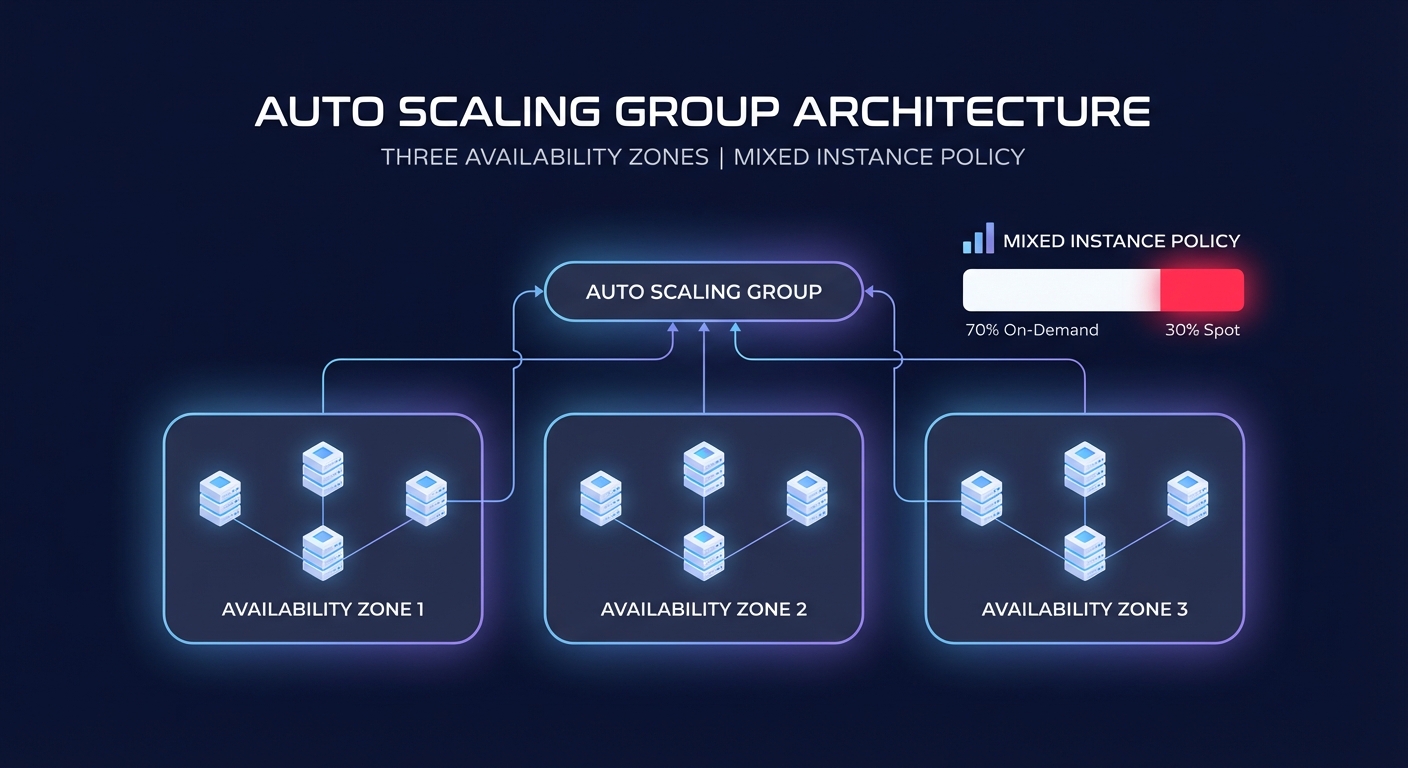
Document your optimization initiatives and achieved savings over the trailing 12 months. If you’ve eliminated $400K in annual waste through EBS optimization, migrated workloads to Spot Instances saving 85% on that compute spend, and implemented auto-scaling that reduced average instance runtime by 35%, you’ve demonstrated financial discipline that warrants favorable EDP terms.
Better yet, quantify your optimization pipeline – savings you’re confident you’ll achieve in the next 6–12 months through initiatives already in flight. Graviton migration roadmaps showing medium deployments realizing $25,000–75,000 annual savings and enterprise-scale deployments achieving $150,000+ demonstrate you’re actively reducing your commitment requirements while improving performance.
Position automated optimization as commitment flexibility
Organizations increasingly use automated rate optimization platforms that dynamically manage Reserved Instances and Savings Plans portfolios. These platforms achieve 50–70% Effective Savings Rates by algorithmically blending Convertible RIs, Savings Plans, and short-term Flexible Plans based on real-time usage patterns.
Frame this capability in negotiations: “Our automated optimization platform is already achieving 58% ESR on compute without any EDP discount. We’re evaluating whether an EDP meaningfully improves on that baseline or if we’re better served by maintaining flexibility through dynamic commitment management.”
This is powerful leverage. AWS knows sophisticated buyers optimize continuously, and they’d rather lock in your commitment with competitive terms than lose you to continued flexible optimization.
Demonstrate cross-functional cost ownership
Companies with mature FinOps practices and established showback processes negotiate better EDP terms because AWS recognizes these organizations will hold them accountable to performance commitments. If you can show engineering teams receive monthly cost reports, product owners own P&L including infrastructure costs, and you’ve implemented tagging strategies enabling granular cost allocation, you’ve signaled operational maturity that warrants partnership-level pricing.
After you sign: maximizing EDP value through active management
Signing your EDP isn’t the finish line – it’s the starting gun. The agreement only delivers projected savings if you actively manage against it.
Establish commitment tracking and pacing dashboards
Build real-time visibility into commitment consumption. You need daily metrics showing committed spend, actual consumption, projected end-of-quarter pacing, and variance trends. AWS Cost Explorer provides basic tracking, but you’ll need custom dashboards pulling from Cost and Usage Reports for the granularity required to avoid surprises.

Set alerts at 70%, 85%, and 95% of quarterly commitment thresholds, with escalation workflows that notify FinOps leadership and trigger contingency planning if you’re tracking significantly over or under pace.
Coordinate EDP with ongoing optimization initiatives
Your EDP baseline doesn’t eliminate the need for continuous optimization – it amplifies its importance. Every dollar of waste you eliminate while maintaining service quality directly improves your effective savings rate. Organizations that combine EDP agreements with automated optimization platforms typically achieve combined effective savings rates of 60–75%, far exceeding what either approach delivers independently.
Prioritize optimization initiatives that don’t reduce committed spend but improve efficiency within your commitment envelope: rightsizing within instance families, EBS performance tuning that maintains capacity while reducing IOPS provisioning, and architectural improvements like containerization with Kubernetes optimization.
Prepare for renewal negotiations 6–9 months early
EDP renewals are easier to negotiate than initial agreements because you have consumption history and relationship capital. Start renewal preparation three quarters before expiration. Quarter minus three: audit current agreement performance, document commitment accuracy, and calculate achieved effective savings rates. Quarter minus two: model future scenarios based on product roadmap, analyze service mix shifts, and identify leverage points (new services you’re adopting, competitive alternatives, optimization achievements). Quarter minus one: engage AWS account team with preliminary renewal parameters, negotiate terms, and finalize agreement before expiration to avoid coverage gaps.
Organizations that negotiate from a position of demonstrated commitment performance and continued optimization typically secure 2–4 percentage point discount improvements at renewal.
When an EDP doesn’t make sense
Despite AWS’s push toward EDP agreements, they’re not optimal for every organization. Three scenarios warrant declining or deferring EDP negotiations.
High growth uncertainty
If you’re a Series A startup projecting 3–5x growth but unsure of timing, product-market fit, or go-to-market execution, EDP commitment risk outweighs discount benefits. You’re better served by flexible Savings Plans covering proven baseline usage, with Spot Instances handling variable growth workloads at up to 90% discounts.
Active multi-cloud strategy
Organizations genuinely distributing workloads across AWS, Azure, and GCP for strategic reasons (avoiding vendor lock-in, leveraging service-specific capabilities, regulatory requirements) sacrifice EDP leverage. You’re better negotiating service-specific commitments and preserving architectural flexibility than locking spend into a single cloud provider.
Sophisticated existing optimization
If you’re already achieving 55%+ Effective Savings Rates through disciplined Savings Plans management, active Spot Instance utilization, and continuous rightsizing, the incremental benefit from EDP baseline discounts may be minimal. Organizations with less than $500K annualized compute usage typically achieve 0% median ESR – but those already optimizing effectively may find EDP adds complexity without proportional value.
Your negotiation roadmap
Successful EDP negotiations follow a structured timeline that builds leverage systematically.

T-120 days: Launch comprehensive cost audit, eliminate obvious waste, establish baseline efficiency metrics.
T-90 days: Model conservative/moderate/aggressive growth scenarios, calculate current Effective Savings Rate, document optimization pipeline.
T-60 days: Engage AWS account team, share preliminary commitment parameters, request initial EDP proposal.
T-45 days: Analyze proposal, identify gaps, prepare counterproposal with specific term modifications and discount rate expectations.
T-30 days: Negotiate actively, use competitive alternatives and optimization achievements as leverage, push for quarterly true-up provisions and architectural flexibility.
T-15 days: Finalize terms, ensure legal review captures critical provisions (commitment measurement, service scope, modification rights), prepare internal stakeholders for governance requirements.
T-0 days: Sign agreement, establish tracking dashboards, communicate terms and implications to engineering and finance teams.
This timeline assumes adequate preparation time. If AWS is pushing for faster signature (often tied to quarter-end deal pressure on their side), use that urgency as leverage: “We can expedite if you can improve the discount rate to 14% and add quarterly true-up provisions.”
The path forward
AWS Enterprise Discount Program negotiations reward preparation, strategic thinking, and demonstrated operational maturity. Organizations that approach these discussions with forensic cost analysis, clear growth modeling, and evidence of optimization discipline secure discount rates 3–5 percentage points higher than peers – a difference that compounds to hundreds of thousands or millions over multi-year commitments.
But even the best-negotiated EDP agreement is only as valuable as your ability to optimize within its structure. The most successful AWS customers combine EDP baseline discounts with continuous optimization – eliminating waste, adopting cost-efficient architectures like Graviton, leveraging automated rate optimization platforms, and embedding cost-awareness into engineering culture.
If you’re preparing for EDP negotiations or evaluating whether your current agreement delivers competitive value, start with a comprehensive cost audit that establishes your true efficiency baseline. Hykell’s automated optimization platform can reduce your AWS spend by up to 40% through detailed audits, automated EBS and EC2 optimization, and real-time monitoring – creating the leverage and efficiency metrics that drive successful EDP negotiations. The cost savings calculator shows potential savings in minutes, and because Hykell operates on a pay-for-performance model, you only pay a percentage of what you actually save.
Your EDP negotiation is too important to approach unprepared. With the right analysis, leverage, and optimization foundation, you’ll secure terms that reduce costs materially while preserving the architectural flexibility your business requires.