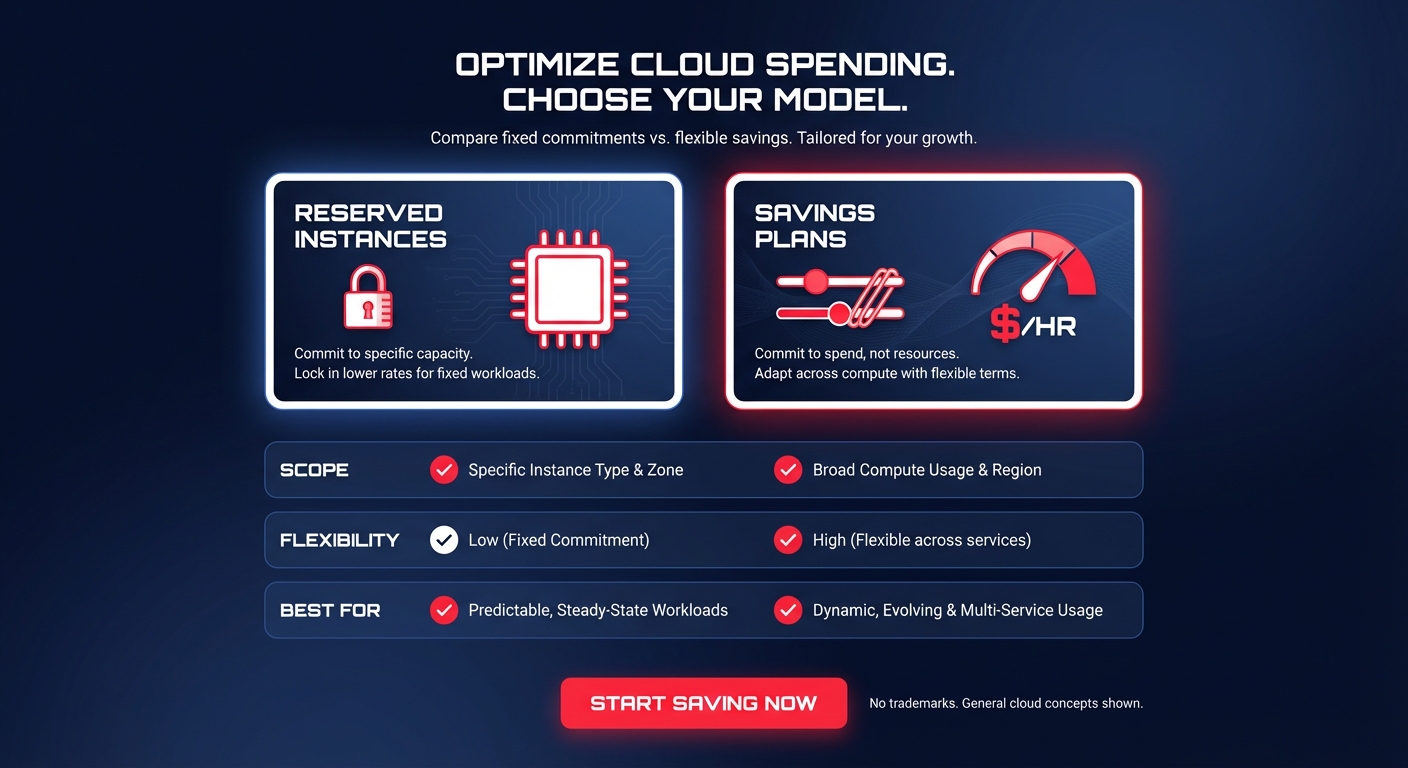
Are you overpaying for AWS capacity? Most engineering teams leave 20% of their potential savings on the table by treating commitments as “set and forget” tasks. This guide breaks down the technical trade-offs to help you reclaim your budget without sacrificing performance.
Navigating the complex landscape of commitments requires a balance of technical foresight and financial agility. While both models offer significant discounts over On-Demand rates, choosing the wrong path can lock you into inefficient architectures or leave you paying for unused capacity. Effective AWS rate optimization requires moving beyond static planning to a more dynamic approach.
The fundamental shift from RIs to savings plans
For years, Standard Reserved Instances (RIs) served as the primary lever for reducing costs. However, the introduction of Savings Plans fundamentally changed the game by shifting the commitment focus from specific instance configurations to a dollar-per-hour spend. This transition allows teams to maintain performance while gaining the flexibility needed for modern, elastic environments.
Flexibility for modern architectures
Savings Plans are generally the preferred choice for teams with evolving infrastructures. They apply automatically across EC2, Lambda, and Fargate, regardless of instance family, size, or region. This makes them highly effective for organizations that are actively modernizing their stacks or experimenting with different instance generations.
Compute Savings Plans provide the highest degree of flexibility with discounts reaching up to 66%. They are both region-agnostic and service-agnostic, ensuring your discount remains active even if you migrate from EC2 to Fargate or shift workloads between different geographical regions.
Alternatively, EC2 Instance Savings Plans offer deeper discounts of up to 72% but require you to lock into a specific instance family within a chosen region. These are ideal for stable production workloads where the instance family is unlikely to change for at least a year.
The legacy power of the marketplace
Despite the flexibility of Savings Plans, Reserved Instances still hold a unique tactical advantage through liquidity. Standard RIs offer the deepest potential discounts – up to 72% – but are much more rigid than their counterparts. The defining benefit of a Standard RI is its eligibility for the AWS Reserved Instance Marketplace. If your architectural requirements shift, you can list these instances for sale to another user to recoup your costs.
Convertible RIs provide a middle ground, offering up to 66% savings and the ability to exchange them for different instance families. However, they lack the marketplace liquidity of Standard RIs and do not benefit from the automatic application features found in Savings Plans. Managing these effectively requires diligent AWS RI management to ensure you are not paying for capacity that no longer serves your needs.
Comparing cost, flexibility, and risk
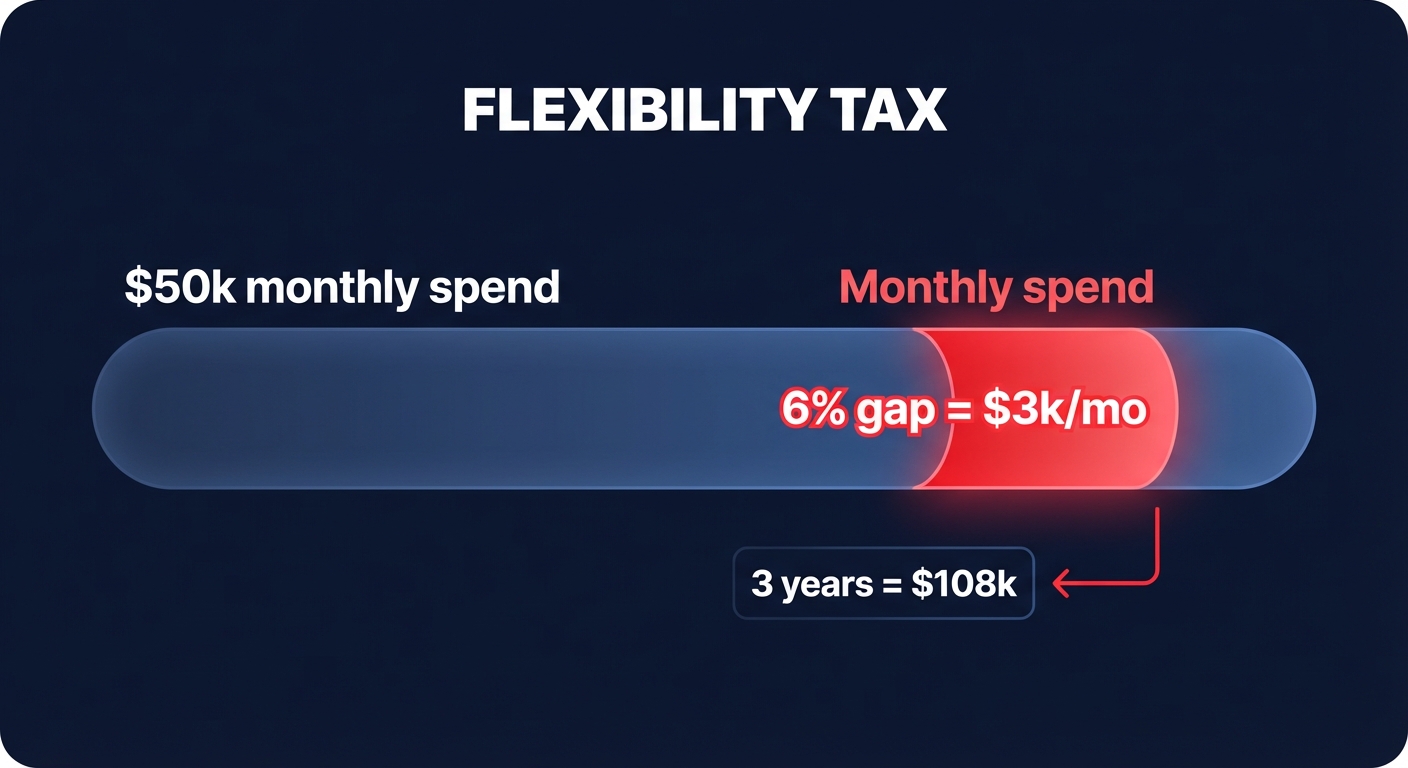
The choice between these models often comes down to what many FinOps professionals call a “flexibility tax.” For example, on a $50,000 monthly compute spend, the 6% discount gap between a Compute Savings Plan and an EC2 Instance Savings Plan represents $3,000 a month. Over a three-year term, that decision results in a $108,000 difference in total spend.
- Compute Savings Plans offer up to 66% discounts and cover EC2, Fargate, and Lambda across any region.
- EC2 Instance Savings Plans provide up to 72% discounts but are locked to a specific family and region.
- Standard RIs offer up to 72% discounts and are the only type that can be resold on the marketplace.
- Convertible RIs provide up to 66% discounts and allow family exchanges but cannot be resold.
Important policy changes and marketplace guardrails
It is critical to stay updated on the shifting rules AWS enforces regarding commitments. As of January 2024, customers under the Enterprise Discount Program (EDP) are prohibited from selling discounted RIs on the Marketplace. Furthermore, effective June 1, 2025, AWS will limit RIs and Savings Plans to a “single end customer,” which restricts the ability of some organizations to pool or redistribute commitments across disparate entities.
These changes make auditing your RI utilization an essential task. Without regular audits, you risk carrying “zombie” commitments that provide no financial value but still count against your budget.
When to choose which model
Your commitment strategy should align with your specific workload characteristics. You should prioritize Compute Savings Plans if you are currently containerizing workloads, moving toward serverless with Lambda, or frequently changing instance types to take advantage of new generations like Graviton.
EC2 Instance Savings Plans or Standard RIs are better suited for your “steady-state” baseline. This represents the 60-80% of your infrastructure that stays consistent month-over-month. Utilizing Standard RIs for this baseline allows you to keep the Marketplace as an exit strategy should a major architectural pivot occur.
Be cautious of relying solely on one-year Savings Plans, as they are often the least effective tool for long-term cost reduction. They typically offer lower discount ceilings of roughly 20-25% and lack the long-term leverage provided by a managed three-year strategy.
How Hykell automates the optimal mix
Manually managing a blend of Standard RIs, Savings Plans, and Spot Instances is a significant engineering time-sink. Most DevOps teams spend 10-15% of their time attempting to maintain high coverage ratios, yet many still miss out on significant savings due to the complexity of the secondary market and usage fluctuations.
Hykell removes this burden by operating your rate optimization on autopilot. Our platform uses AI to analyze your historical and real-time usage to create a customized “Blended Strategy.” We do not just buy and hold; we actively manage your portfolio through several advanced mechanisms.
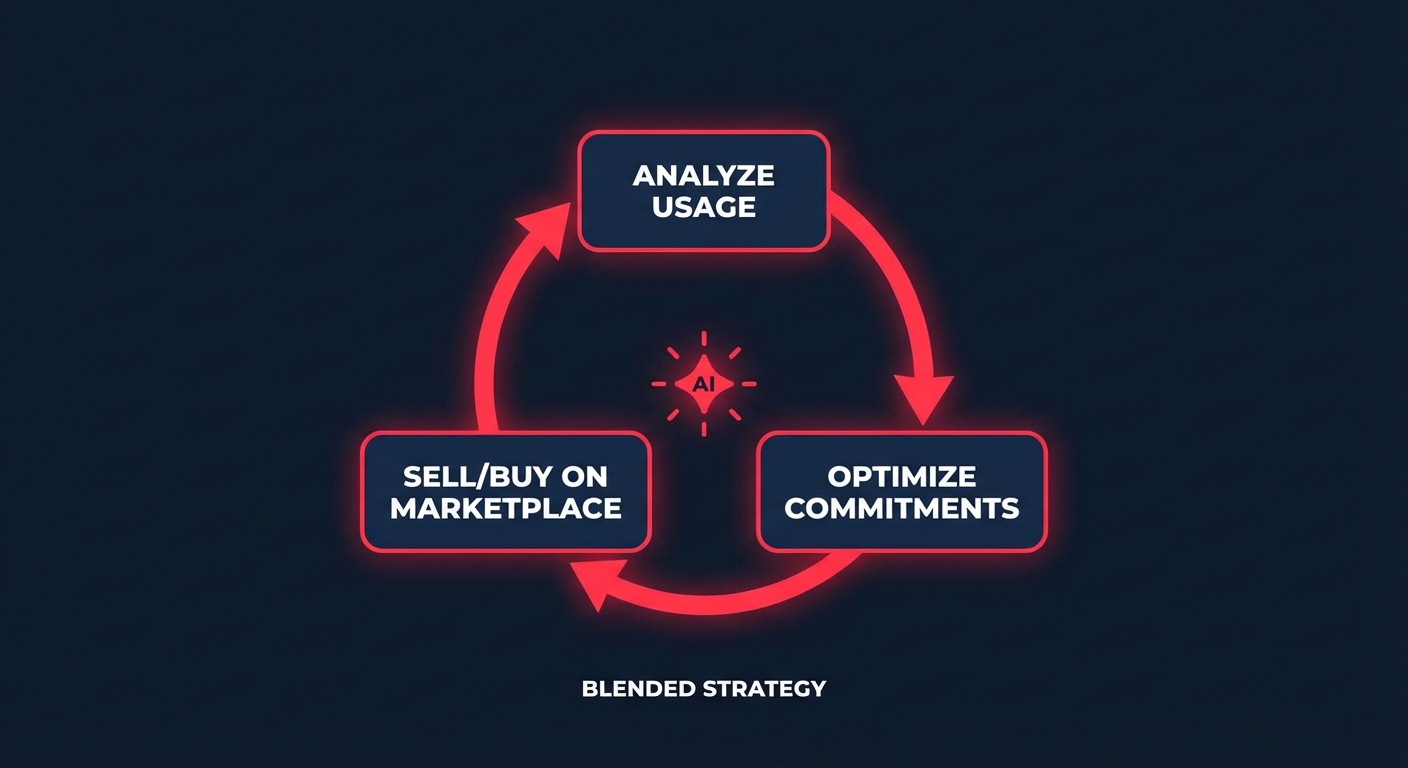
- We utilize the RI Marketplace to sell off underutilized Standard RIs and acquire short-term commitments that match your current needs.
- We layer Compute Savings Plans over a baseline of Standard RIs to maximize both flexibility and discount depth.
- Our optimizations require no code changes and zero downtime, handling the financial grunt work so your engineers can focus on product development.
Hykell customers typically achieve an Effective Savings Rate (ESR) of 50–70% on compute spend, often doubling the results of a manual DIY approach. Because we operate on a performance-based model, you only pay a slice of the actual savings we generate.
If you are ready to stop leaving money on the table, you can view our pricing and performance model today and let Hykell handle your AWS commitments with precision automation.