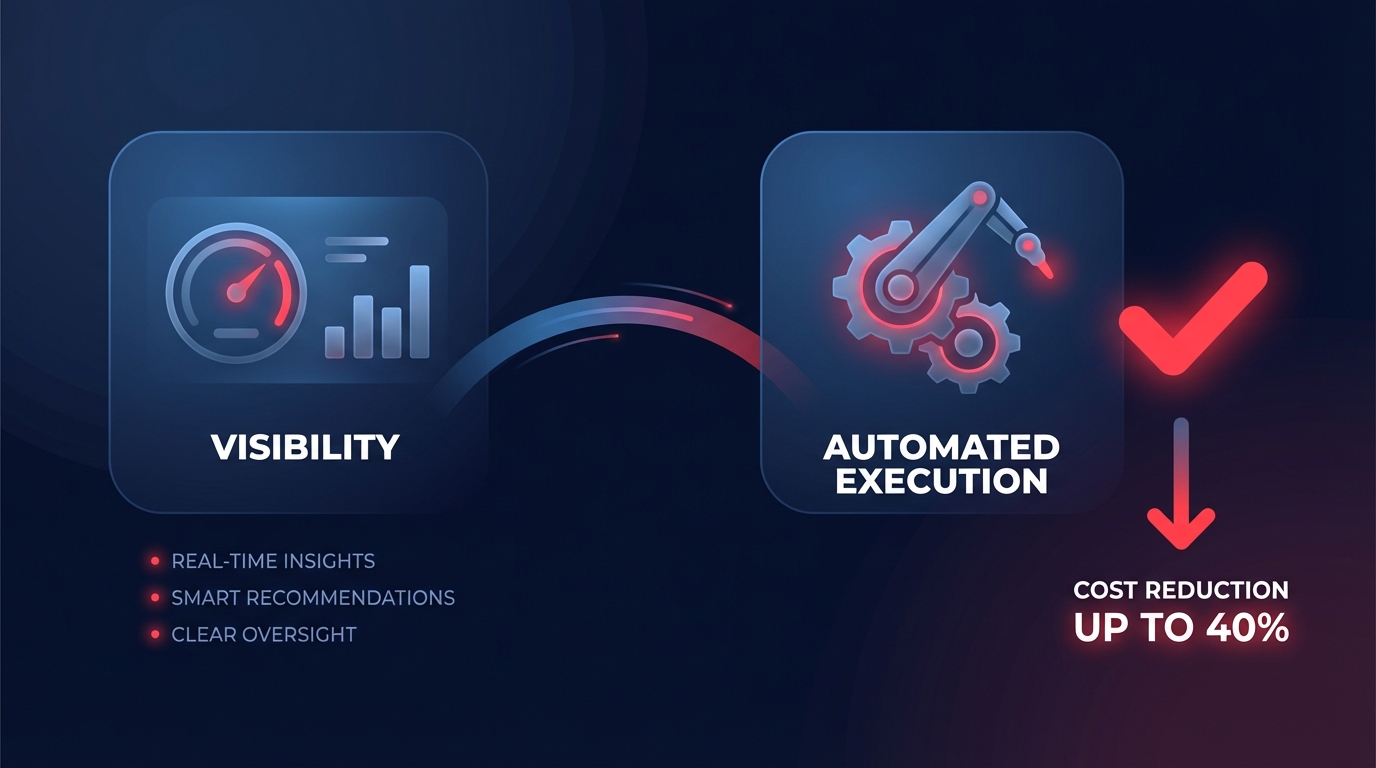
Are you tired of looking at AWS dashboards that show you where you’re wasting money but don’t actually fix the problem? For most engineering leaders, the gap between “insight” and “savings” is measured in hundreds of wasted engineering hours.
The shift from cloud visibility to automated execution
The first generation of cloud cost management tools, such as CloudHealth and Cloudability, focused heavily on visibility, cost allocation, and complex reporting. While these platforms are excellent for multi-cloud governance and creating KPI scorecards, they share a fundamental flaw: they only provide recommendations. This leaves your DevOps team to manually right-size the instances, migrate the volumes, and manage the commitments.
In contrast, modern automated cloud cost management tools move beyond “showback” to “execution.” Instead of giving you a to-do list, these tools use AI and programmatic APIs to execute changes in real-time. This shift allows your engineering team to focus on shipping features while the software handles the tedious work of infrastructure tuning.
Comparing the three main vendor approaches
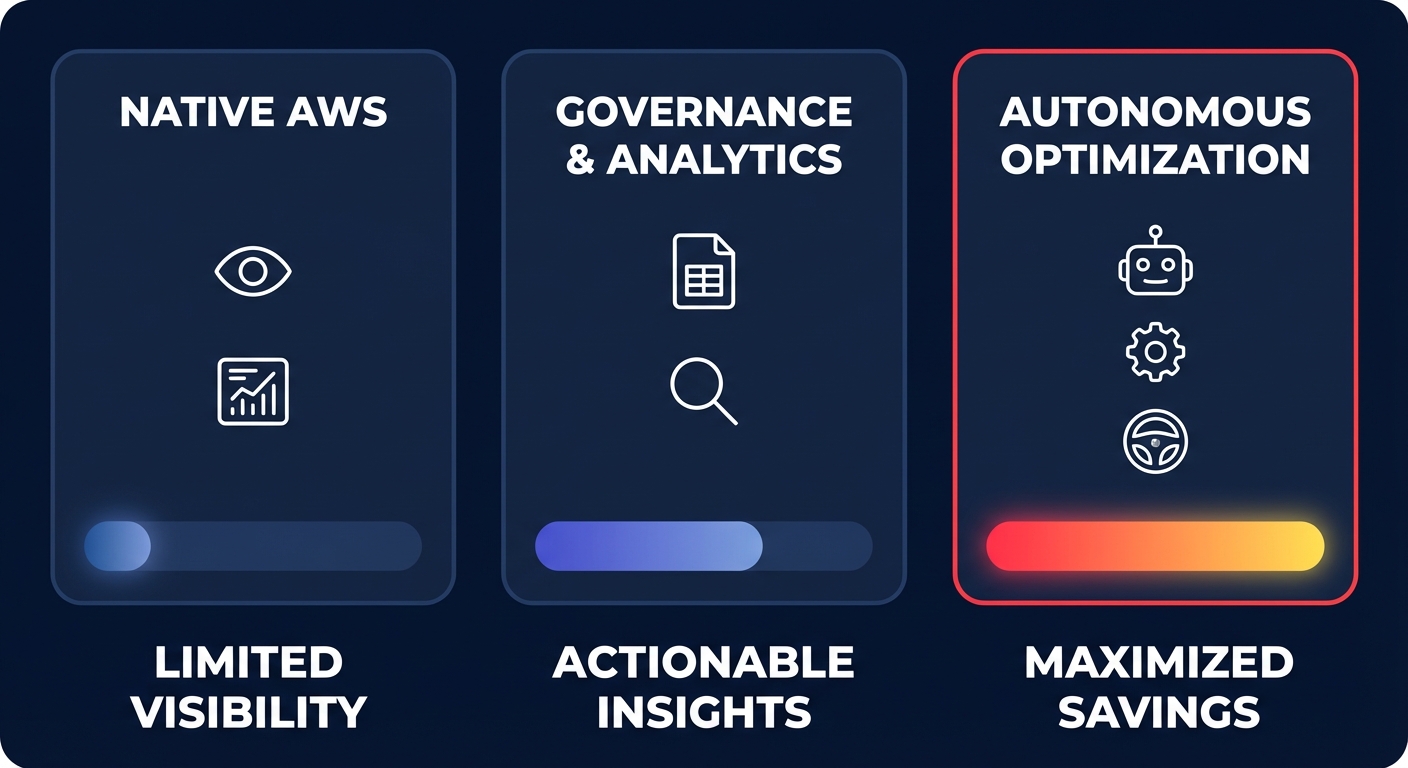
When evaluating cloud cost management tools, you will typically find three distinct philosophies in the market. Native AWS tools represent the baseline, where services like AWS Cost Explorer and AWS Budgets provide high-level visibility. While they are useful for tracking historical spend, they are largely reactive. Even the AWS Compute Optimizer, which uses machine learning to offer rightsizing suggestions, requires manual intervention to actually implement the changes.
The second category involves governance and analytics platforms. Tools like CloudHealth (VMware Aria Cost) and Cloudability (Apptio) are built for the “crawl” and “walk” phases of FinOps. These are often preferred by large enterprises that require deep observability and complex chargeback reports across AWS, Azure, and GCP. However, the complexity of these platforms often requires you to hire a dedicated FinOps team just to manage the tool itself.
Finally, autonomous optimization engines like Hykell, ProsperOps, and CloudFix represent the cutting edge of the market. These tools focus on AWS rate optimization and workload automation. They operate at the billing and cost dataset level to maximize your Effective Savings Rate (ESR) without requiring your engineers to lift a finger. This “autopilot” approach ensures that you are always running on the most cost-effective pricing models.
Pricing models: SaaS fees vs. pay-as-you-save
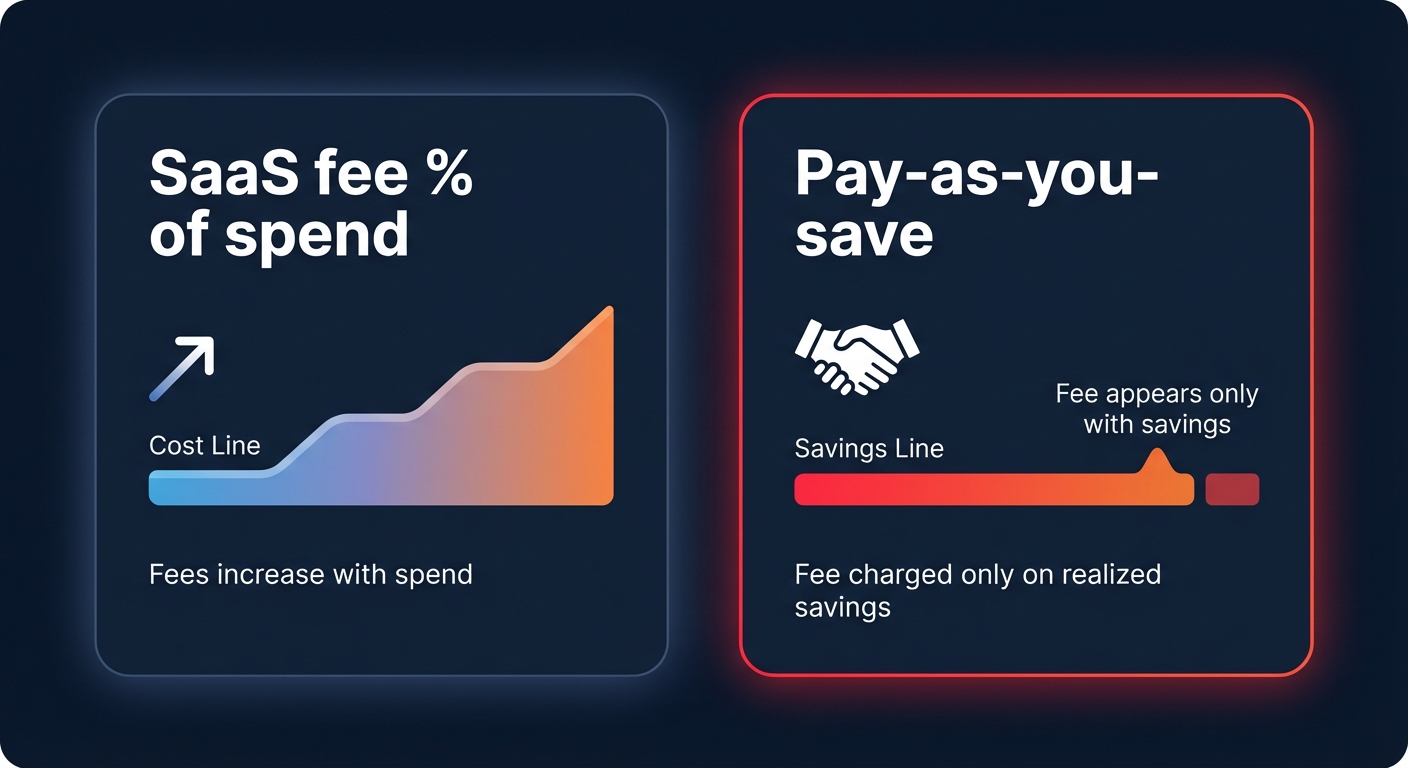
The pricing model of your chosen tool often determines its true ROI. Most traditional vendors charge a SaaS fee based on a percentage of your total cloud spend, usually ranging from 1% to 3%. This structure can be counterintuitive; as your AWS bill grows, your tool costs increase even if the software is not finding additional ways to save you money.
Hykell and other performance-based tools utilize a pay-as-you-save model. In this structure, the vendor only takes a slice of the actual, realized savings they generate for your account. This aligns the vendor’s incentives directly with yours – if they do not find savings, you do not pay. This risk-free approach is particularly attractive for mid-market and enterprise companies looking to conduct a cloud cost audit without a large upfront budget request.
Key features for engineering and FinOps leaders
To achieve a total AWS cost reduction of up to 40%, you must look for a tool that handles more than just simple Reserved Instances. A comprehensive optimizer provides automated commitment management by blending Savings Plans and Convertible RIs. This maintains high coverage, often exceeding 90%, without the risk of long-term lock-in that traditional manual planning entails.
Beyond rate optimization, your tool should handle storage and compute modernization. This includes automatically migrating gp2 volumes to gp3, which is approximately 37–40% cheaper, and identifying “zombie” unattached EBS volumes that inflate your bill. Furthermore, tools like Hykell can accelerate your Graviton gains by moving workloads to ARM-based processors for up to 40% better price-performance. For teams running containerized workloads, the tool should also provide Kubernetes efficiency features, such as fine-tuning pod requests and limits to reduce hidden waste in EKS clusters by 30% to 50%.
Why Hykell is the right choice for AWS-focused teams
While many tools try to be a generalist across multiple clouds, Hykell focuses exclusively on delivering deep, automated results for AWS users. We do not just tell you that your AWS RI management is inefficient; we actively fix it using AI-driven strategies. Our platform operates with zero code changes and zero engineering effort from your side, acting as a silent partner in your infrastructure.
By combining automated EBS and EC2 optimization with real-time portfolio management, our clients often see their Effective Savings Rate double, reaching 50% to 70% on compute. This allows you to stop paying for idle capacity and start running a leaner, more efficient infrastructure today. If you are ready to see exactly where your savings are hidden, calculate your potential AWS savings with our free analysis. We only get paid when you save, ensuring that your cloud optimization journey is entirely focused on your bottom line.