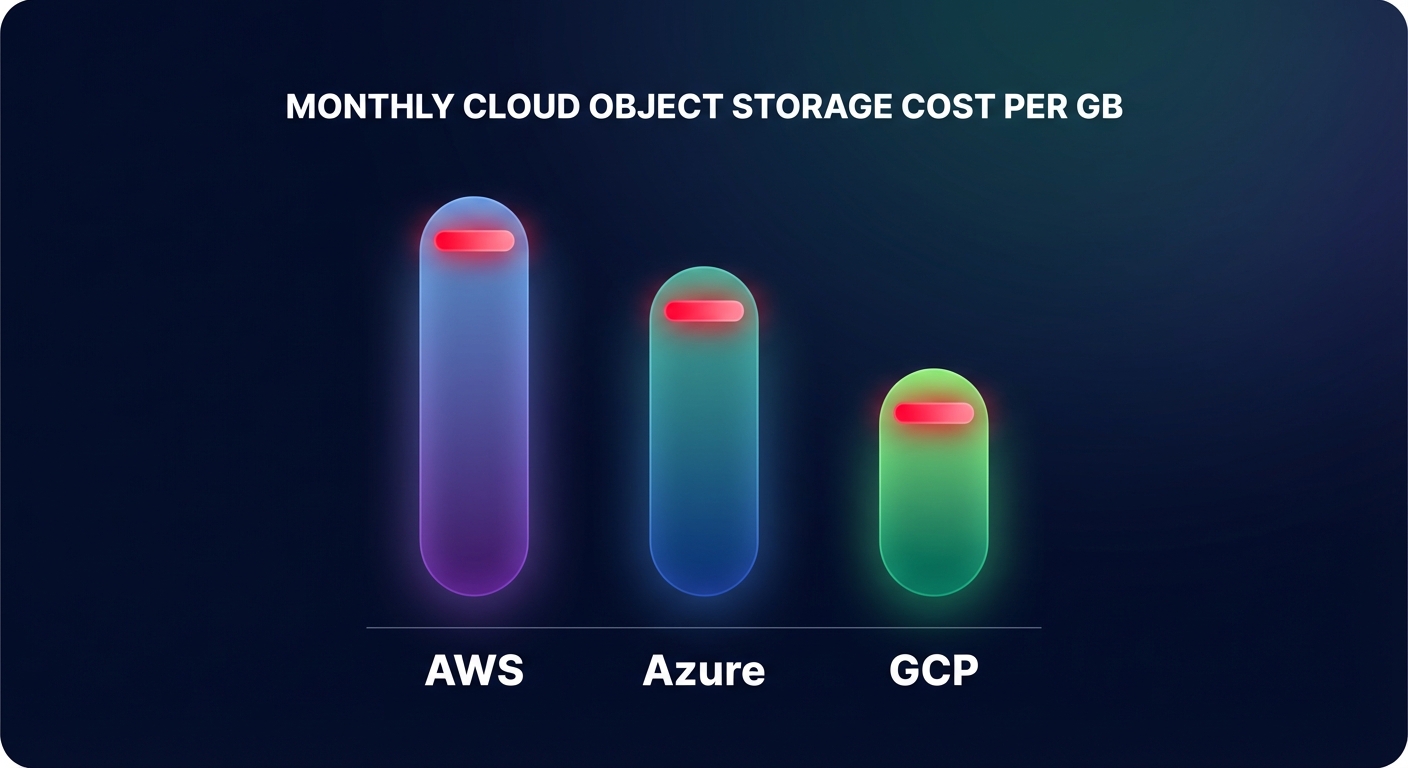
Are you paying for “hot” storage when 80% of your data has been dormant for months? Cloud storage expenses often balloon because of invisible egress fees and over-provisioned performance tiers. While base rates look similar across providers, real savings emerge through intelligent automation rather than manual vendor hopping.
The raw numbers: AWS S3 vs. Azure Blob vs. Google Cloud Storage
When comparing the “Big Three,” the baseline storage costs are deceptively similar, but the operational details dictate your actual TCO. In the US-East-1 region, Amazon S3 Standard storage costs start at $0.023 per GB for the first 50 TB. In comparison, Azure Blob Storage (Hot) sits at approximately $0.018 per GB, and Google Cloud Storage (Standard) hovers around $0.020 per GB depending on the specific region. These narrow margins often lead teams to believe that provider choice is the only lever for optimization, but that ignores the high cost of manual tier management.
The landscape shifts significantly when you move into infrequent access and archival tiers. AWS S3 Standard-IA costs $0.0125 per GB, while Azure’s Cool tier is slightly lower at $0.01 per GB. Google Cloud Storage Nearline ranges from $0.010 to $0.013 per GB depending on the region. However, a major AWS vs. GCP pricing comparison factor is the flexibility of automation. AWS offers a distinct advantage with S3 Intelligent-Tiering, which automatically moves data between tiers based on access patterns without retrieval fees. This feature often offsets slightly higher per-GB rates by eliminating the engineering hours required to manage complex lifecycle policies manually.
Managing the “hidden killers”: Egress and API requests
Storage costs are rarely just about capacity; data movement is where budgets typically spiral out of control. AWS egress costs typically start at $0.09 per GB after the first 100 GB. Azure is comparable at $0.087 per GB, while Google Cloud can reach as high as $0.12 per GB for general internet egress. These charges can silently devour your budget, sometimes representing 25–35% of your total cloud spend if you utilize multi-region architectures or frequent data exports.
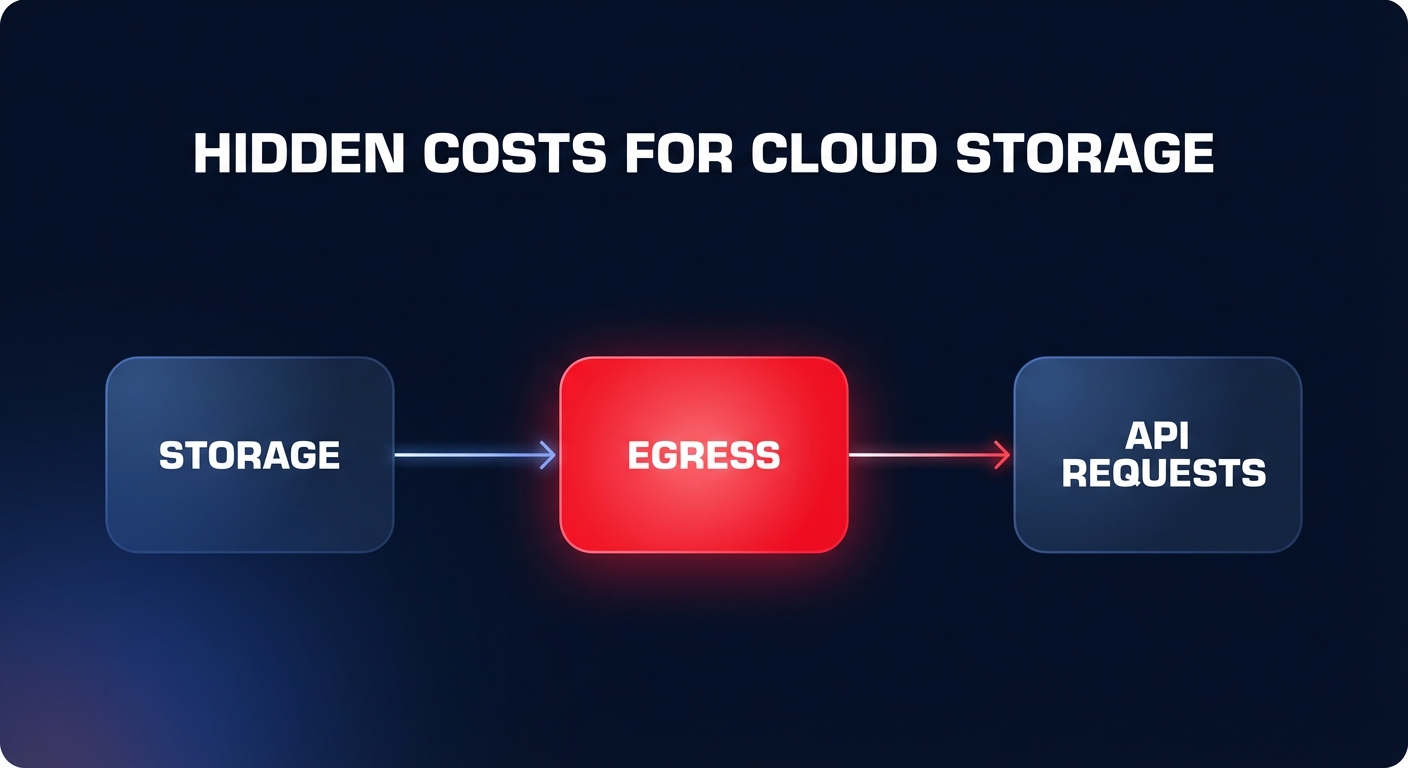
Beyond transfer fees, API request charges – the micro-costs for GET, PUT, and LIST operations – can inflate bills for high-transaction workloads. This is particularly true in archival tiers. While AWS Glacier Deep Archive offers a staggering $0.00099 per GB rate, the retrieval and request costs mean it is only cost-effective for data that is truly dormant. Failing to account for these variables often negates the savings found in lower-cost storage tiers, especially when a single microservice inadvertently triggers thousands of requests against expensive archive volumes.
Block storage optimization for engineering performance
For engineering leaders, the conversation often shifts from object storage to block storage, such as EBS on AWS, Managed Disks on Azure, or Persistent Disks on GCP. This is where performance-cost trade-offs become critical. On AWS, migrating from gp2 to gp3 volumes is one of the most immediate wins for any organization. This move typically reduces storage costs by approximately 20% per GiB while allowing you to decouple IOPS from storage size, ensuring you don’t pay for capacity you only needed for performance.
Effective AWS EBS cost optimization requires a deep understanding of provisioned IOPS and throughput. If your team is over-provisioning IOPS to handle occasional spikes, you are paying for idle performance that never hits the disk. Hykell solves this by continuously monitoring actual IOPS usage and automating the rightsizing of these volumes. This ensures your applications maintain high responsiveness without the financial waste of unused “burst” capacity or over-provisioned SSDs.
Why AWS plus Hykell delivers the strongest ROI
While Azure and GCP offer competitive entry-level pricing, the AWS ecosystem – when combined with Hykell’s automation – provides a level of cost efficiency that manual multi-cloud management cannot touch. Hykell targets the most complex areas of your bill, from AWS rate optimization that secures the best Savings Plans to automated EBS and Kubernetes cleanup.
The primary reason mid-to-large businesses choose Hykell over manual FinOps processes is the “autopilot” factor. Instead of tasking your engineers with writing scripts to identify orphaned snapshots or idle volumes, Hykell’s automated cloud cost management handles the heavy lifting without code changes or downtime. This approach frees up your engineering resources for innovation and scalability rather than administrative maintenance.
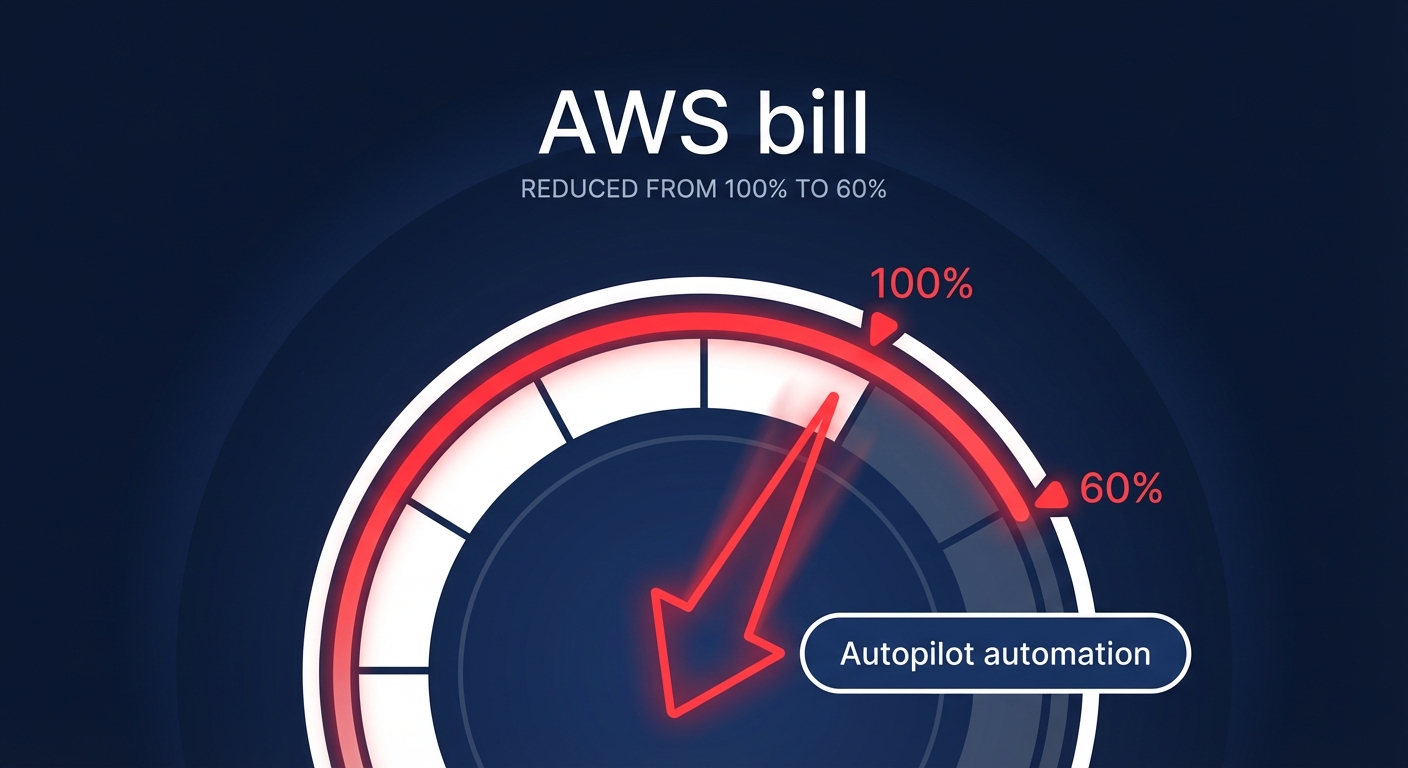
We provide comprehensive cloud observability that allows CFOs to see role-relevant KPIs while giving DevOps leads granular, resource-level data. Our pricing model is entirely success-based: we only take a slice of what you save. This means there are no upfront fees and no financial risk; if we don’t uncover significant savings, you don’t pay.
Building a sustainable storage strategy
Optimizing cloud storage is not a one-time event; it is a continuous cycle of auditing, rightsizing, and rate adjustment. Relying solely on native tools often leaves “low-hanging fruit” on the vine because they lack the automated execution required to maintain efficiency at scale. By integrating detailed cost audits with automated remediation, you can transform your cloud storage from a growing liability into a lean, high-performance asset.
If you are ready to see how much your AWS infrastructure is currently wasting, Hykell provides a read-only audit that identifies your exact savings potential within hours. Calculate your potential AWS savings now and stop overpaying for unoptimized storage infrastructure.