Most AWS environments run at a meager 30–40% utilization, meaning you are likely paying for 60% idle capacity. While conducting a cloud cost audit reveals these gaps, realizing the savings usually requires significant engineering hours – unless you automate the process.
Reclaiming 15 engineering hours per week at a high-growth SaaS
A mid-sized SaaS provider recently faced a common scaling challenge: their monthly AWS bill had ballooned to $120,000, yet their resource utilization remained stuck at a disappointing 32%. Your own DevOps team likely understands the frustration this company felt; their engineers were spending nearly two full workdays every week manually rightsizing EC2 instances and adjusting auto-scaling groups, leaving almost no time for product innovation.
By shifting to an automated FinOps approach, the company achieved a 38% reduction in total spend, resulting in $45,000 in monthly savings. Beyond the financial impact, the provider reclaimed 15 engineering hours per week. Their resource utilization jumped from 32% to 68% without a single performance degradation or “out of memory” (OOM) event. These results were driven by automated AWS rightsizing that analyzed P99 utilization data to match compute resources precisely to workload demands.
The $1 million savings roadmap at GE Vernova
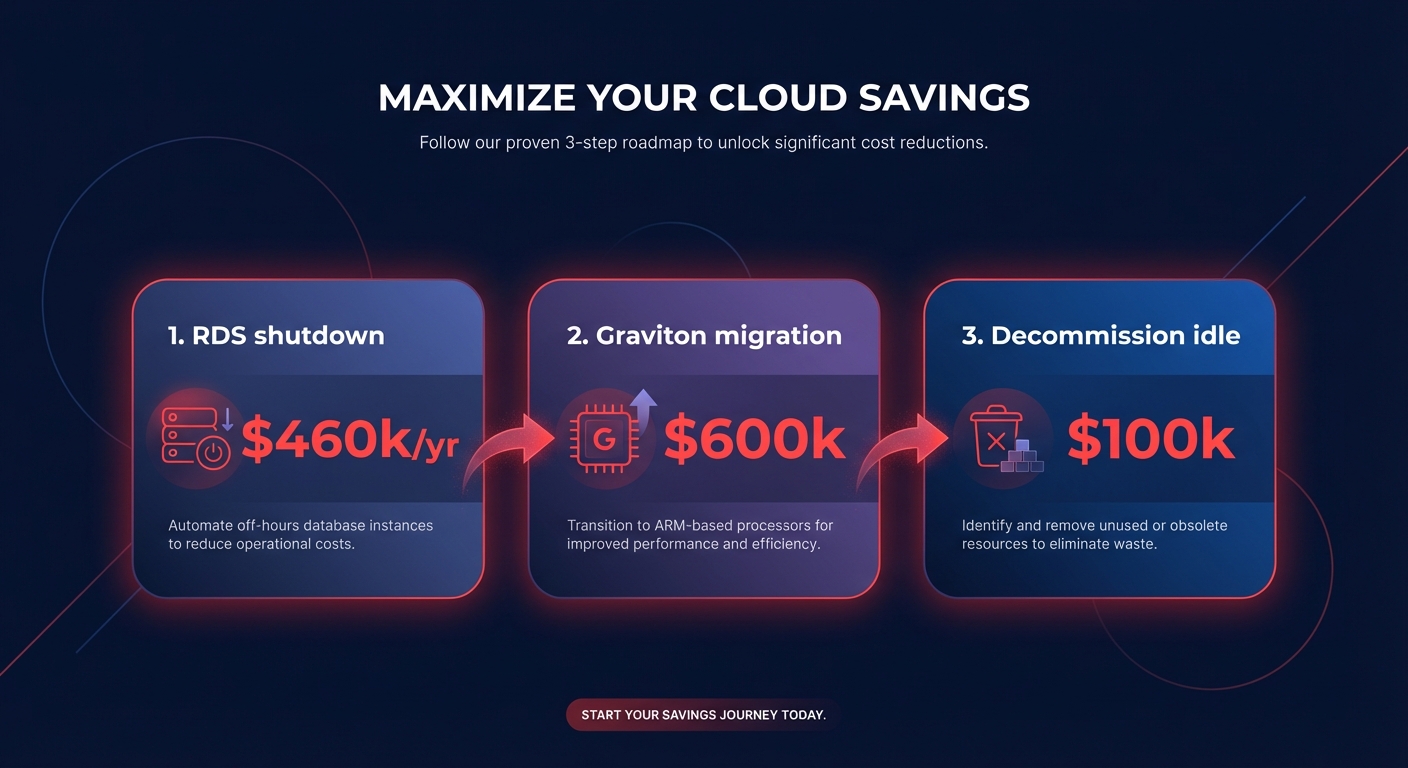
Enterprise-scale organizations often struggle with “zombie” resources and inefficient silicon that quietly inflate the bottom line. GE Vernova demonstrated the power of a multi-pronged optimization strategy by saving $1 million in less than a year. Their approach combined several high-impact tactics that you can replicate within your own infrastructure.
The company saved $460,000 annually by automating the shutdown of 80% of their non-production RDS instances during off-hours. They further optimized their compute spend by migrating to AWS Graviton processors, which offer up to 40% better price-performance than traditional x86 instances, resulting in $600,000 in savings. Additionally, by decommissioning idle instances – often identified through AWS Trusted Advisor – they recovered an additional $100,000. This case highlights that the largest enterprise savings often come from a blend of architectural modernization and simple operational automation.
E-commerce scaling with a 75% cost reduction
An e-commerce platform facing seasonal traffic spikes found that their “safety buffers” were costing them a fortune during periods of normal activity. A detailed audit revealed that 40% of their EC2 instances were running at less than 10% CPU utilization even during peak hours. By implementing a systematic optimization program, the platform successfully reduced its cloud budget by 75%.
The savings breakdown for this initiative provides a clear template for high-impact remediation:
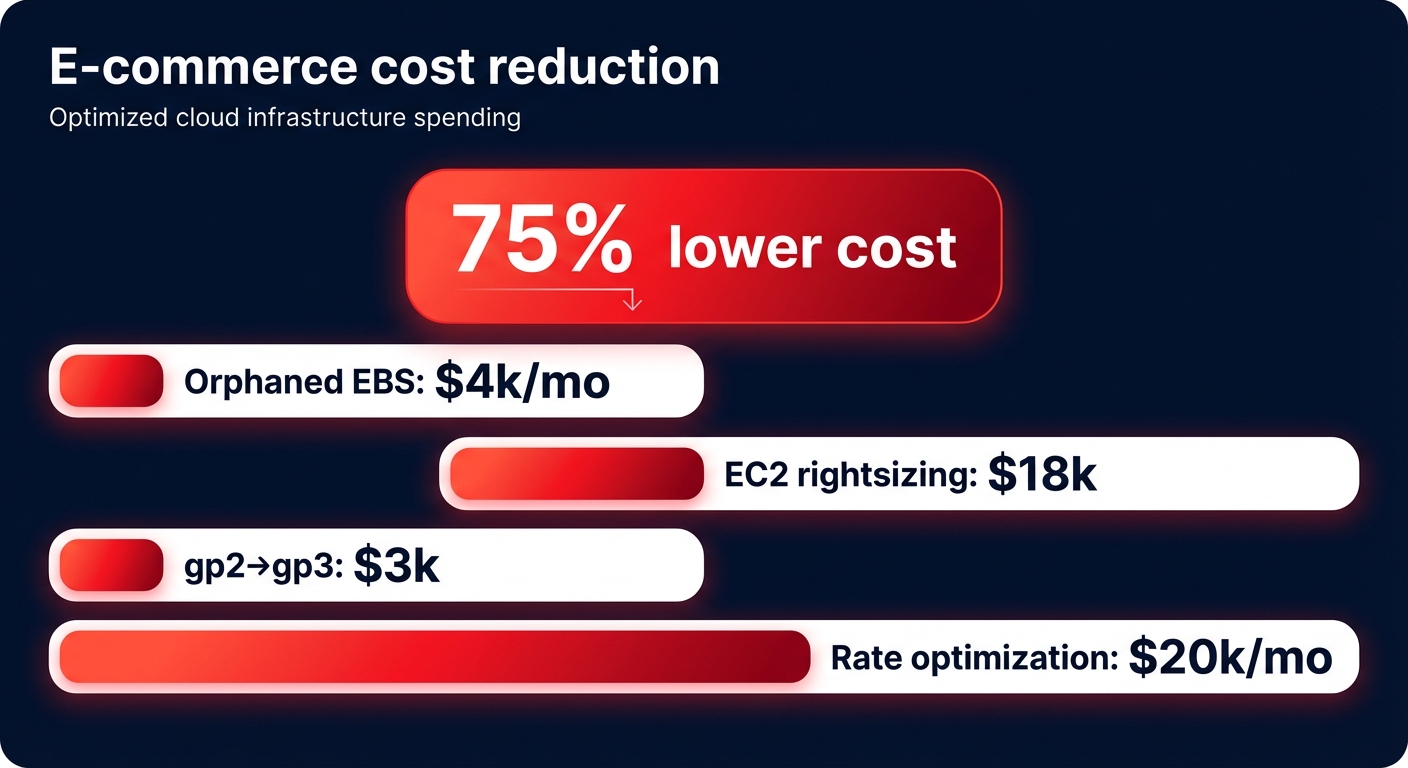
- $4,000 per month was recovered by identifying and deleting orphaned EBS volumes.
- $18,000 was saved through aggressive rightsizing of EC2 fleets to match real-time demand.
- $3,000 in savings came from migrating gp2 volumes to gp3, which is roughly 40% cheaper per GB.
- $20,000 per month was secured through strategic AWS rate optimization using Reserved Instances and Savings Plans.
This combination allowed the company to scale for Black Friday traffic while maintaining a significantly lower cost floor during the rest of the year.
Driving effective savings rates at Coupa and SmartNews
Success in FinOps is often measured by the Effective Savings Rate (ESR), a metric that tracks how much you actually save relative to on-demand pricing. Coupa improved its ESR from 41.9% to 45.9% by automating their commitment coverage, which increased their coverage from 85% to 98%. This ensures that almost every dollar spent on compute is protected by a discount.
Similarly, SmartNews reduced its main workload costs by 50% by aggressively utilizing Spot Instances for fault-tolerant tasks. They further improved efficiency by using Graviton instances to shave 15% off the cost of their machine learning workloads. These organizations prove that you do not have to choose between performance and cost; you simply need the right mix of purchasing models and modern hardware.
Achieving these results with Hykell on autopilot
The common thread in these success stories is the need for constant vigilance, but most companies cannot afford to have their best engineers acting as full-time cloud accountants. Hykell changes this equation by delivering up to 40% savings on AWS through total automation. Our platform integrates directly with AWS Cost Explorer and other native APIs to execute optimizations – like rightsizing, EBS tuning, and Graviton migrations – without any manual engineering effort from your team.
We eliminate the financial risk with a performance-based pricing model where you only pay a slice of the actual savings we generate. This approach allows you to achieve enterprise-grade cloud observability and efficiency without the traditional overhead. Stop leaving 40% of your AWS budget on the table and calculate your potential savings to see how Hykell can optimize your infrastructure today.